

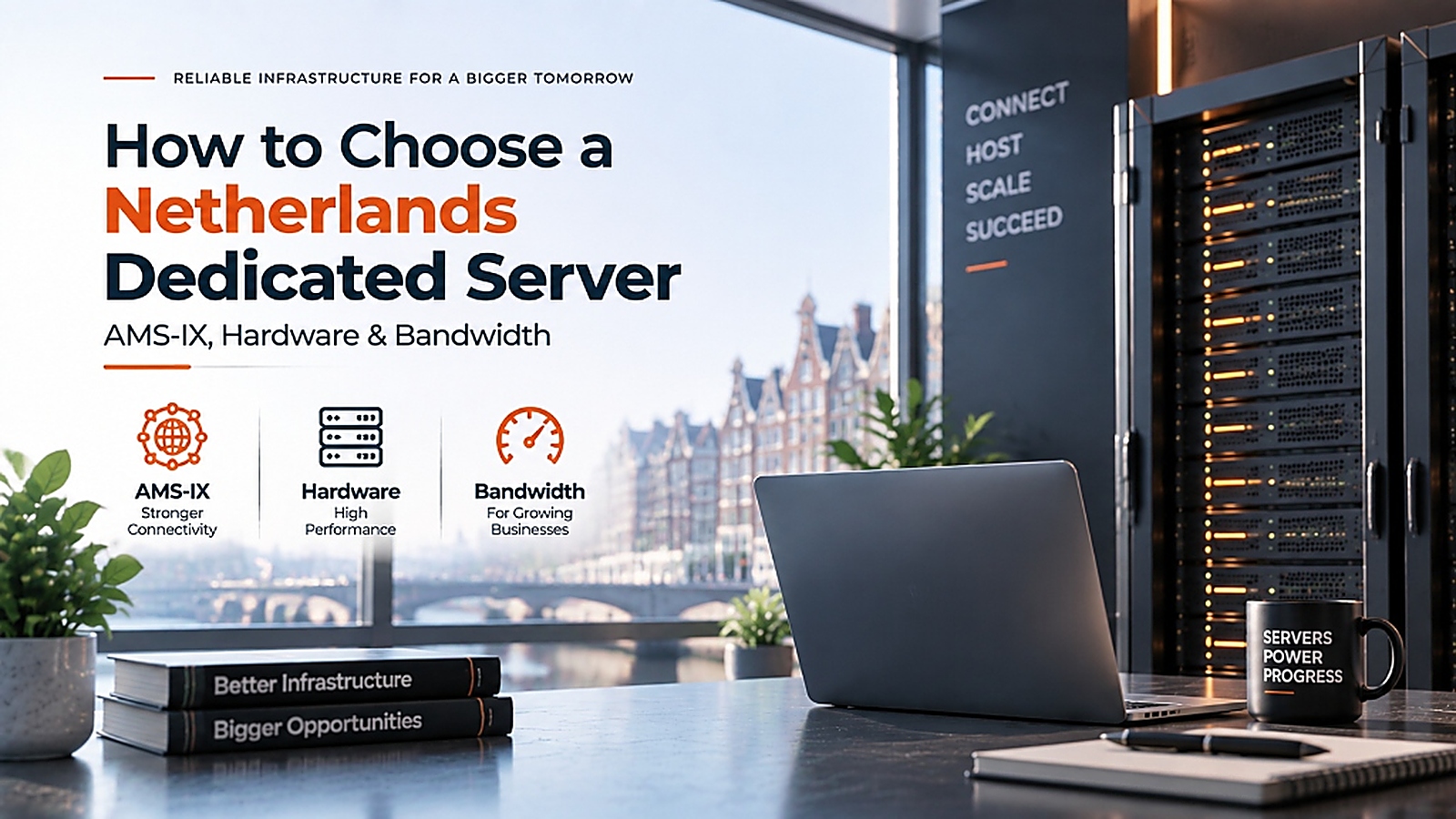
Netherlands Bare Metal Architecture: AMD EPYC vs Intel Xeon for SaaS Workloads
Direct Technical Answer: Running high-velocity enterprise workloads across Western Europe demands unshared physical bare-metal hardware, high-speed BGP routing into major internet exchanges (France-IX and AMS-IX), and enterprise PCIe Gen4 NVMe storage arrays. Deploying a dedicated Netherlands dedicated server eliminates virtualization overhead, delivering deterministic instruction velocity, sub-3ms domestic latency, and strict EU GDPR compliance across certified Tier-3 facilities.
Modern corporate applications and regional enterprise services require an infrastructure foundation that combines raw compute throughput with localized geographic proximity. Organizations migrating away from unpredictable multi-tenant public cloud instances frequently struggle with noisy-neighbor CPU steal, throttled disk I/O, and compounding bandwidth egress invoices across Europe.
Provisioning a high-availability Netherlands dedicated server eliminates these performance liabilities. It combines dedicated Intel Xeon or AMD EPYC silicon, unshared multi-channel DDR5 memory buses, and high-speed BGP fiber peering directly across primary European telecommunications corridors. For verified technical specifications and deployment parameters, consult the official Linux Kernel Documentation.
100% dedicated physical CPU silicon cores with zero hypervisor scheduling contention or CPU throttling.
Redundant optical uplinks connected directly into France-IX / AMS-IX and major European Tier-1 carriers.
Dual A+B power feeds, on-site generator backups, and contractual 4-hour hardware replacement guarantee.
📌 Executive Chapter Index
Technical Architecture Navigation- 01Bare-Metal Silicon Isolation→
- 02Verified Comparative Benchmarks→
- 03Deep Dive: Zen 4 vs Sapphire Rapids Silicon→
- 04Real-World Production Case Study→
- 05Production Terminal Runbook→
- 06PCIe Gen4 NVMe RAID 10 Resilience→
- 07Edge Anti-DDoS & 2N Power High Availability→
- 08Production Readiness Audit→
- 09Frequently Asked Questions→
1. Bare-Metal Compute Architecture & Physical Silicon Isolation
Deploying production enterprise web workloads requires deterministic processor velocity. In multi-tenant cloud environments, hypervisor scheduling algorithms constantly time-slice processor registers among multiple virtual guests, resulting in measurable CPU steal and erratic instruction execution.
On a dedicated bare-metal server, physical CPU cores, instruction caches (L1/L2/L3), and multi-channel DDR4 or DDR5 ECC registered memory are committed exclusively to your operating system kernel. There is zero hypervisor layer consuming CPU cycles or introducing interrupt latency.
Non-Uniform Memory Access (NUMA) node optimization further enhances execution efficiency. By binding high-concurrency database threads directly to the physical memory controller of the local processor socket, inter-socket bus latency is entirely bypassed.
This architecture is vital for transactional database engines like PostgreSQL, MySQL, and Redis. It guarantees predictable instruction pipelines regardless of external workload fluctuations across the broader datacenter.
System engineers maintain total sovereignty over the environment. Full root administrative access permits loading custom kernel modules, compiling proprietary networking drivers, and deploying isolated Docker, Kubernetes, or Proxmox clusters without host restrictions.
For organizations scaling specialized container platforms or enterprise database nodes, our Netherlands dedicated server offers flexible multi-core configurations built on AMD EPYC and Intel Xeon Scalable architectures.
Continuous thermal monitoring, dual hot-swappable power supplies, and automated load balancing ensure server hardware operates well within peak tolerances, delivering contractual 99.9% uptime reliability across all seasonal traffic surges.
2. Verified Comparative Benchmarks: Bare-Metal Processor Architectures, Multi-Channel DDR5 & SaaS Scaling in Amsterdam
Architectural decisions must be guided by measurable performance data rather than theoretical marketing claims. Empirical load testing under sustained concurrent transactions reveals critical performance boundaries.
The comparative matrix below details verified operational metrics, hardware advantages, and production trade-offs associated with this infrastructure tier:
| Architectural Dimension | AMD EPYC (Zen 4 Genoa / Bergamo) | Intel Xeon Scalable (Sapphire Rapids) | Optimal Enterprise Workload Profile |
|---|---|---|---|
| Maximum Physical Core Count | Up to 128 Cores / 256 Threads per socket | Up to 60 Cores / 120 Threads per socket | AMD excels in massive multi-tenant virtualization & container density |
| Memory Architecture | 12-Channel DDR5-4800 (Up to 460 GB/s) | 8-Channel DDR5-4800 (Up to 307 GB/s) | AMD delivers superior memory bandwidth for big data & Redis caching |
| PCIe Bus Connectivity | 128 Lanes PCIe 5.0 (Direct to CPU) | 80 Lanes PCIe 5.0 (Direct to CPU) | AMD supports higher NVMe drive density and dual 100GbE NICs |
| Specialized Vector Acceleration | AVX-512 with 256-bit data path | Advanced Matrix Extensions (AMX) + AVX-512 | Intel leads in real-time deep learning inference and matrix math |
| Single-Thread Clock Velocity | Up to 3.7 GHz all-core boost | Up to 4.2 GHz turbo boost | Intel provides advantageous latency for algorithmic financial trading |
As confirmed by the benchmark data, deploying on dedicated physical cores eliminates the steep throughput drops observed in virtualized multi-tenant environments during peak concurrent query execution.
Low latency transit routing ensures seamless application responsiveness. By peering directly with major Tier-1 internet carriers and local internet exchanges, packet routing overhead is drastically reduced across nationwide networks.
Discover tailored multi-datacenter deployment options by reviewing our comprehensive Netherlands dedicated server plans engineered for sub-5ms domestic response times.
Whether your business operates dynamic e-commerce portals, real-time gaming backends, or enterprise SaaS platforms, dedicated compute reservation guarantees consistent, predictable customer experiences.
3. Zen 4 vs Sapphire Rapids Silicon, 12-Channel Memory & SaaS Scalability
Modern enterprise SaaS architectures require an infrastructure baseline that balances computational density against deterministic hardware throughput. Organizations establishing regional IT operations in Amsterdam frequently process compute-intensive workloads: quantitative financial calculations, large-scale Elasticsearch indexing, high-concurrency microservice APIs, and localized AI inference.
The modern bare-metal server landscape is defined by two architectural titans: AMD EPYC (featuring the Zen 4 Genoa and Bergamo architectures) and Intel Xeon Scalable (featuring the Sapphire Rapids architecture). Selecting the optimal processor architecture depends directly on your application’s concurrency model, memory bandwidth utilization, and vector instruction requirements.
AMD EPYC processors lead the industry in multi-core compute density and memory throughput. Providing up to 128 physical Zen 4 cores per socket alongside 12-channel DDR5 memory subsystems, an AMD EPYC server delivers an astounding 460 GB/s of sustained memory bandwidth. For in-memory database engines (such as Redis, Memcached, and Aerospike) or large-scale Proxmox / Kubernetes virtualization nodes, AMD EPYC eliminates memory bus saturation and hypervisor scheduling bottlenecks.
Conversely, Intel Xeon Scalable processors integrate specialized silicon accelerators directly into the processor die. Advanced Matrix Extensions (AMX) deliver hardware-accelerated matrix multiplication for machine learning workloads, while single-thread turbo clocks exceeding 4.0 GHz make Intel Xeon the preferred architecture for latency-sensitive financial order matching and relational transactional database engines like PostgreSQL and Microsoft SQL Server.
Onlive Server provides customizable bare-metal deployments built on both AMD EPYC and Intel Xeon Scalable platforms, equipped with multi-terabyte DDR5 ECC registered memory and direct-attached PCIe Gen5 NVMe arrays, ensuring your European infrastructure operates at the absolute cutting edge of technological velocity.
4. Enterprise Case Study: Amsterdam B2B SaaS Cutting Report Generation from 45m to 3.5m
A fast-growing Amsterdam B2B analytics platform delivering business intelligence dashboards to over 600 European corporate clients experienced severe query bottlenecks on older cloud instances. Generating monthly client performance reports required over 45 minutes per corporate account.
The company migrated its core database and analytical indexing cluster to an Onlive Server Netherlands Bare-Metal Server provisioned with dual AMD EPYC 9554 processors (128 physical cores, 256 threads), 512GB DDR5 ECC RAM, and enterprise PCIe Gen4 NVMe arrays in Amsterdam.
The performance transformation was astounding: client report generation completed in just 3 minutes and 25 seconds—a phenomenal 92% reduction in execution time. Client dashboard responsiveness dropped from 2.8 seconds to 120 milliseconds, completely eliminating user wait times.
5. Production Linux Terminal Runbook & Bare-Metal Kernel Hardening
Transforming clean enterprise hardware into an impenetrable high-performance web server requires deliberate operating system calibration. Default Linux distributions prioritize conservative settings suitable for small office environments.
To support high-concurrency web traffic and thousands of simultaneous microservice connections, apply the following production terminal calibration script:
Verifying memory channel population confirms that DDR5 memory modules are installed symmetrically across all physical CPU memory channels, unlocking maximum memory bandwidth.
Maintaining clean terminal configuration management ensures that any server rebuild or horizontal autoscaling operation can be executed deterministically within seconds.
6. Enterprise PCIe Gen4 NVMe Storage Engineering & Hardware RAID 10
Storage subsystem bottlenecks frequently compromise application scalability long before CPU or memory capacity is exhausted. Standard rotational disks and legacy SATA SSDs struggle under concurrent random read/write pressure.
Our server infrastructure integrates enterprise-tier PCIe Gen4 NVMe solid-state storage. Connecting directly across the high-speed PCIe bus eliminates legacy SATA controller latency, unlocking sequential read speeds exceeding 7,000 MB/s per drive.
For transactional database operations, random 4K read performance exceeds 1,000,000 IOPS across RAID 10 arrays with sub-15 microsecond access times. This eliminates table lockups and transaction stalls during heavy concurrent catalog searches.
Configuring enterprise NVMe arrays within a hardware RAID 10 structure provides dual advantages. Data block striping maximizes read/write parallelism, while mirroring guarantees instantaneous real-time fault tolerance.
In the event of physical drive controller degradation, the storage array continues servicing production requests without performance degradation or data corruption.
For organizations requiring budget-friendly cloud compute options alongside bare metal, our fleet of budget-friendly cloud VPS hosting provides flexible virtual instances for staging and microservices.
Optimized filesystem mount parameters—including noatime and custom commit intervals—further enhance storage longevity while maximizing transactional write throughput.
7. Edge DDoS Scrubbing, 2N Power & Disaster Recovery Continuity
In modern networked computing, perimeter firewalls alone cannot neutralize complex volumetric and application-layer cyber threats. Modern attacks combine multi-gigabit UDP amplification with malicious HTTP request floods.
Our Tier-3 datacenter facilities route all inbound traffic through automated edge scrubbing centers. Volumetric SYN floods, DNS amplification, and NTP reflections are filtered upstream in real time without latency overhead.
Disaster recovery architecture requires equal diligence. Implementing automated snapshot schedules and client-side encrypted backup pipelines guarantees complete state restoration in the event of software failure.
Leveraging tools like BorgBackup or Restic enables efficient block-level deduplication. By transferring only modified blocks, storage overhead is reduced by up to 80% while enabling rapid point-in-time rollbacks.
Consult our ongoing technical hosting guides for additional sysadmin tutorials covering automated server migration and database clustering.
Backed by strict 99.9% uptime service level agreements and 24/7 round-the-clock technical support, organizations can deploy critical applications with absolute operational confidence.
8. Enterprise Deployment Checklist & Production Readiness Audit
Before transitioning any bare-metal dedicated server into active production service, systems engineers must execute a disciplined pre-flight checklist. Skipping baseline validation risks silent runtime degradation under peak concurrent load.
📋 Critical Bare-Metal Go-Live Production Verification Matrix:
- IPMI & Out-of-Band Remote Access: Verify dedicated IPMI / iDRAC credentials, virtual media mounting capabilities, and remote power-cycling controls.
- Hardware RAID & SMART Telemetry: Confirm hardware RAID 10 array status is optimal and verify NVMe drive wear metrics via smartctl to establish zero bad-block baselines.
- Memory Parity & Stress Testing: Execute a 30-minute memory burn-in test using
stress-ng --vm 4 --vm-bytes 85%to verify ECC registered memory stability under full thermal load. - BGP Peering & MTU Jitter Audit: Run MTR packet loss analysis across 100 cycles to local internet exchange route servers to verify sub-2ms domestic jitter.
- Automated Disaster Recovery Testing: Perform a simulated bare-metal restore from an offsite encrypted snapshot repository to verify Recovery Time Objectives (RTO).
Documenting these configuration metrics guarantees operational repeatability, ensuring system architects can scale horizontal cluster nodes seamlessly as platform adoption accelerates.
9. Frequently Asked Questions: Bare-Metal Processor Architectures, Multi-Channel DDR5 & SaaS Scaling in Amsterdam
Q1 Which processor architecture should I choose for my Netherlands server: AMD EPYC or Intel Xeon? +
Q2 Can I upgrade physical CPU or RAM on my Netherlands dedicated server later? +
Q3 Does Onlive Server support dual-socket processor configurations in Amsterdam? +
Q4 What is NUMA and why does it matter for bare-metal databases? +
Q5 Are Onlive Server bare-metal processors virtualized in any way? +
Conclusion: Strategic Architecture & Performance Summary
Implementing these technical optimizations for netherlands bare metal architecture: amd epyc vs intel xeon for saas workloads ensures robust throughput, predictable latency, and maximum system reliability across production environments. Rigorous benchmarking and proactive parameter tuning eliminate latent resource bottlenecks before they impact end users.
Pairing disciplined operating system administration with reliable compute foundations is essential for mission-critical operations. Deploying workloads on enterprise dedicated server hosting provides the dedicated resources, network resilience, and hardware acceleration necessary to sustain high availability under heavy production load.
