Last Updated: October 2026
Reading Time: 11 Min Read
Technical Verification: Peer-Reviewed & Production-Tested
USA dedicated server hosting delivers maximum long-term cost-effectiveness by providing 100% dedicated bare-metal silicon, predictable flat-rate monthly billing, and unmetered high-throughput bandwidth (1Gbps to 10Gbps). Unlike public cloud platforms that bill variable per-gigabyte egress fees and shared CPU cycles, single-tenant dedicated hardware in the United States eliminates multi-tenant resource contention, reduces Total Cost of Ownership (TCO) by up to 50% for sustained workloads, and positions mission-critical data in proximity to major North American internet exchange points (IXPs).
Eliminates fluctuating per-gigabyte egress charges, storage IOPS surcharges, and cloud invoicing unpredictability.
Guarantees exclusive access to AMD EPYC / Intel Xeon processors with absolute 0% hypervisor CPU steal time.
Dedicated 1Gbps–10Gbps uplink pipes accommodate heavy continuous traffic without bandwidth overage penalties.
Direct Tier-1 carrier interconnects across Ashburn, Chicago, Dallas, and Silicon Valley for sub-15ms North American latency.
📑 Guide Contents & Architecture Index
Quick Navigation
- 01Economic Value & Cloud Migration Reality
- 02Total Cost of Ownership (TCO) vs. Public Cloud
- 03Hardware Architecture & Performance Engineering
- 04Strategic Datacenter Locations & US IXP Peering
- 05Hardware Customization, Autonomy & Freedom
- 06Enterprise Security, Compliance & Isolation
- 07Linux Command-Line Performance Diagnostics
- 08Common Hosting Sizing Mistakes to Avoid
- 09Frequently Asked Questions (FAQ)
- 10Strategic Architecture Conclusion & Next Steps
Understanding USA Dedicated Server Hosting and Its Economic Value
When building and scaling an online business, server infrastructure represents one of the most critical operational investments you will make. Modern web applications, high-traffic e-commerce stores, SaaS platforms, and enterprise databases require sustained compute power, low network latency, and uncompromising security. However, managing hosting expenses while demanding peak performance is a constant challenge for growing enterprises.
Many organizations initially migrate to public cloud multi-tenant environments under the impression that elastic pricing will keep infrastructure expenses low. Over time, as traffic scales and data pipelines expand, unexpected data transfer charges, input/output operations per second (IOPS) tiers, and virtual CPU contention often drive hosting costs beyond initial budget forecasts. This is where USA Dedicated Server Hosting emerges as a strategic, cost-effective infrastructure solution.
A dedicated server provides an entire physical machine exclusively reserved for a single organization. There are no virtual neighbors sharing CPU cycles, memory buses, or storage controllers. In the United States—home to the world’s dense internet infrastructure and core internet exchange points—dedicated hosting combines raw bare-metal computing with highly competitive commercial data center pricing, creating an unmatched balance of performance and long-term cost stability.
Public cloud instances are ideal for temporary, elastic workloads with unpredictable traffic spikes. However, for 24/7 steady-state workloads (such as relational databases, ERP backends, and continuous SaaS platforms), paying hourly cloud rates with metered bandwidth often costs 2x to 3x more annually than fixed-price bare metal hardware.
Total Cost of Ownership (TCO): Dedicated Hardware vs. Public Cloud
To evaluate whether dedicated hosting is financially sound for your workload, it is essential to look beyond the baseline monthly invoice and analyze the Total Cost of Ownership (TCO) over a 12-to-36-month horizon. Public cloud hyper-scalers bill dynamically across multiple dimensions, creating billing volatility that can strain IT budgets.
The Egress Bandwidth Advantage: Eliminating Data Transfer Fees
In public cloud hosting, bandwidth pricing is one of the largest ongoing budget drains. Hyperscale providers frequently charge between $0.05 and $0.09 per gigabyte of outbound traffic. For a streaming media service, SaaS platform, or high-volume e-commerce storefront delivering 50 Terabytes (TB) of outbound data per month, egress fees alone can add $2,500 to $4,500 to a single monthly cloud invoice.
In contrast, deploying unmetered bandwidth dedicated server configurations in US datacenters provides massive cost predictability. Bare-metal hosting providers routinely bundle unmetered 1Gbps or 10Gbps unmetered network uplinks into the fixed monthly server cost, allowing you to push hundreds of terabytes of data every month without incurring additional bandwidth penalties.
Consistent Computing Power Without “Noisy Neighbor” Tax
Virtual private servers (VPS) and public cloud instances operate on shared physical nodes through a hypervisor abstraction layer. When a neighboring tenant on that physical node experiences a sudden surge in traffic or runs an intensive database query, your application can suffer from CPU steal time and unpredictable memory latency.
To compensate for erratic performance in the cloud, businesses often over-provision virtual instances—upgrading to larger, more expensive tiers simply to maintain an acceptable performance baseline during peak hours. Bare-metal servers eliminate this inefficiency. Because 100% of the physical processor cycles and RAM channels belong exclusively to your operating system, every dollar invested translates directly into deterministic computational throughput.
| Infrastructure Metric | USA Bare Metal Dedicated Server | Public Cloud Virtual Instance | Shared Multi-Tenant Hosting |
|---|---|---|---|
| Hardware Allocation | ✅ 100% Dedicated Direct access to AMD EPYC / Xeon silicon |
⚠️ Shared Hypervisor Virtualized vCPU slices & RAM pools |
❌ Shared Contention Hundreds of tenants per node |
| Bandwidth & Egress Billing | ✅ Flat-Rate Unmetered 1Gbps–10Gbps unmetered pipes |
❌ Metered Egress $0.05 – $0.09 per outbound GB |
⚠️ Throttled Ports Strict fair-use caps & throttling |
| Storage I/O Performance | ✅ Dedicated NVMe RAID 7,000+ MB/s direct PCIe Gen4/Gen5 |
⚠️ Tiered IOPS Surcharge Billed per provisioned IOPS tier |
❌ High I/O Wait Shared SATA/SSD bottlenecks |
| Cost Predictability (12–36 Mo) | ✅ 100% Fixed Monthly Zero surprise billing invoices |
❌ Highly Volatile Fluctuates by traffic & queries |
⚠️ Low Entry / Renewal Hikes Frequent renewal price increases |
| Hypervisor & OS Control | ✅ Bare Metal Autonomy Deploy Proxmox, KVM, ESXi, custom kernels |
ℹ️ Abstracted VM Vendor-approved OS images only |
❌ Locked Down No root or kernel access |
| Security Boundary & Compliance | ✅ Physical Air-Gap Hardware HIPAA, PCI-DSS & SOC 2 isolation |
⚠️ Logical Isolation Vulnerable to hypervisor bugs |
❌ Zero Boundary Shared file system and IP pools |
Hardware Architecture and Performance Engineering
Cost-effectiveness does not mean settling for outdated hardware. Modern enterprise hosting relies on purpose-built server engineering that maximizes processing density and storage efficiency.
AMD EPYC & Intel Xeon
Up to 128 physical Zen 4/Zen 5 or Sapphire Rapids cores delivering high-throughput parallel compute for PHP-FPM, microservices, and massive SQL joins.
PCIe Gen4 / Gen5 NVMe RAID
Direct PCIe lanes deliver sustained throughput over 7,000 MB/s and 100,000+ IOPS, eliminating MySQL query bottlenecks under heavy disk write pressure.
DDR5 ECC Memory Arrays
Multi-channel DDR5 Error-Correcting Code RAM automatically detects and corrects single-bit memory faults, preventing catastrophic server crashes.
High Core-Density Processors: AMD EPYC and Intel Xeon
Modern enterprise bare-metal servers are built with enterprise-grade AMD EPYC and Intel Xeon Scalable processors. These multi-core architectures offer massive parallel processing capacity, enabling a single physical machine to handle thousands of concurrent web requests, complex query transactions, and containerized microservices without dropping connections.
- Compute Density: Deploy up to 64 or 128 physical cores in a single chassis, reducing the total number of physical server nodes required in your infrastructure footprint.
- Hardware Virtualization: Run hypervisors like Proxmox VE or KVM directly on bare metal to spin up isolated internal environments without licensing overhead.
- Instruction Set Optimization: Leverage hardware AVX-512 and cryptographic accelerators built directly into modern silicon for high-speed encryption and data compression.
PCIe Gen4 / Gen5 NVMe Storage in RAID Configurations
Storage input/output is the most frequent bottleneck for dynamic databases, analytics engines, and transactional platforms. When evaluating disk architectures, reviewing hardware and software RAID storage benchmarks illustrates why dedicated NVMe drives consistently outperform virtual block storage.
Enterprise dedicated servers utilize direct-attached PCIe Gen4 and Gen5 NVMe solid-state drives operating in RAID 1 (mirroring) or RAID 10 (striping and mirroring). This setup yields sequential read and write speeds exceeding 7,000 MB/s with random I/O performance surpassing 100,000 IOPS per drive—with zero latency overhead from shared network storage.
DDR5 Error-Correcting Code (ECC) Memory
For database clusters and mission-critical applications that hold gigabytes of active operational data in RAM, data corruption is catastrophic. Dedicated servers utilize registered DDR5 ECC memory that actively detects and corrects single-bit memory errors in real time. This hardware safeguard protects operating system stability and prevents silent transactional data corruption during high-concurrency memory caching operations.
Strategic Datacenter Location and US Network Peering
Network latency is a direct driver of user experience, conversion rates, and search engine performance. Hosting your server physically within the United States delivers distinct network advantages for global and North American audiences.
The United States functions as the global backbone of internet connectivity, containing the highest concentration of Tier-1 telecommunications carriers, transatlantic subsea fiber landings, and major Internet Exchange Points (IXPs) including Equinix Ashburn, DE-CIX New York, and CoreSite Chicago.
🌐 North American Network Peering & Latency Matrix
Tier-1 BGP Anycast Backbone
Hosting your dedicated server in a centrally connected US facility provides sub-15ms round-trip latency to the majority of North American web users, while maintaining rapid 65ms–85ms transit across the Atlantic to European hubs. This strategic positioning optimizes Time to First Byte (TTFB) and ensures seamless user experiences across global visitor traffic.
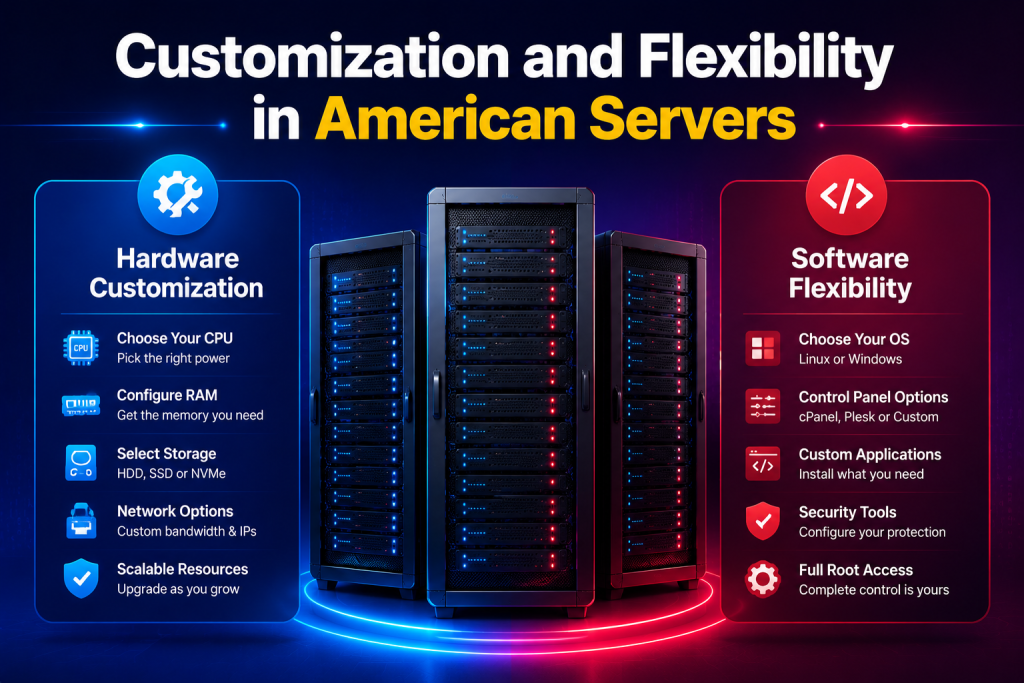
Customization, Autonomy, and Software Freedom
A significant hidden cost of proprietary cloud hosting is vendor lock-in. Proprietary managed databases, monitoring tools, and orchestrators make migrating between platforms time-consuming and expensive. Dedicated server hosting restores complete operational autonomy.
Full Root and IPMI/KVM Out-of-Band Access
Understanding managed versus unmanaged hosting architecture is critical, as bare-metal dedicated servers grant unrestricted root access over SSH and hardware-level IPMI/iDRAC/iLO out-of-band management. This enables system administrators to:
- Install Any Operating System: Deploy enterprise Linux distributions (AlmaLinux, Rocky Linux, Ubuntu Server, Debian) or Windows Server without vendor restrictions.
- Compile Custom Kernels: Enable specialized networking algorithms such as TCP BBR congestion control outlined in official Linux Kernel Documentation to minimize packet loss across long-haul connections.
- Direct Hardware Diagnostics: Monitor physical sensor temperatures, fan speeds, drive SMART health metrics, and power consumption directly.
Control Panel Choice and Open-Source Stack Optimization
Dedicated server owners are free to deploy industry-standard hosting control panels such as cPanel/WHM, DirectAdmin, Plesk, or open-source solutions like Webmin and aaPanel. Furthermore, you have complete authority to tailor your application stack:
- Fine-Tuned Database Caches: Allocate up to 80% of system RAM directly to InnoDB buffer pools without virtual OS throttling.
- High-Concurrency Web Servers: Run LiteSpeed Enterprise, NGINX event loops, or custom reverse-proxy load balancers with optimized worker connections.
- Custom PHP Runtimes: Fine-tune PHP OPcache memory buffers and process managers to handle traffic spikes smoothly.
Enterprise Security, Compliance, and Data Isolation
Security vulnerabilities and regulatory compliance fines can completely erase the operational savings of cheap hosting. Dedicated servers deliver a defensive posture that shared environments cannot match.
Physical Air-Gapped Isolation
Multi-tenant cloud architectures rely on logical software hypervisor boundaries to separate user workloads. Vulnerabilities such as Meltdown, Spectre, and hypervisor breakouts have demonstrated that shared physical hardware carries inherent side-channel risks. With a dedicated server, you obtain complete physical air-gapping: your memory chips, storage drives, and network controllers are physically isolated from all other tenants.
Streamlined Regulatory Compliance (HIPAA, PCI-DSS, SOC 2)
For organizations operating in healthcare, financial services, or enterprise e-commerce, meeting compliance frameworks like HIPAA, PCI-DSS Level 1, and SOC 2 Type II requires rigorous audit trails and strict data governance:
- Dedicated Clean IP Addresses: Prevent IP blacklisting caused by abusive neighboring accounts sharing your public gateway.
- Hardware-Level Disk Encryption: Implement self-encrypting NVMe drives (SED) with custom LUKS keys managed entirely by your internal security team.
- Custom Kernel Hardening: Enforce strict SELinux or AppArmor mandatory access control policies without host-level interference.
How to Diagnose Server Bottlenecks on Linux (PuTTY Terminal Guide)
Before sizing your dedicated server, run standard command-line diagnostic tools on your existing environment to identify specific resource constraints:
# 1. Inspect Per-Core CPU Saturation & Steal Time (%st)
mpstat -P ALL 1 5
# Look at the %st column. On bare-metal dedicated servers, %st will always be 0.00.

# 2. Inspect Memory Pressure & Swap Utilization
free -m && vmstat 1 5
# If 'si' (swap-in) and 'so' (swap-out) are non-zero, your workload requires larger physical DDR5 ECC RAM.

# 3. Inspect Disk I/O Wait Time & NVMe Saturation
iostat -xz 1 5
# If %util exceeds 80% or await exceeds 5ms, migrate from SATA/SSD to direct PCIe NVMe RAID.

# 4. Check Active Network Sockets & TCP Backlog
ss -s
Common Hosting Sizing Mistakes to Avoid
To maximize the return on your hosting investment, avoid these common capacity planning pitfalls:
- Over-Provisioning CPU While Neglecting Storage I/O: Purchasing a 32-core CPU paired with slow mechanical drives or standard SATA SSDs creates severe performance bottlenecks. Balanced infrastructure requires pairing modern processors with enterprise NVMe storage in RAID 1 or RAID 10.
- Selecting Unmanaged Hosting Without In-House System Administrators: If your team lacks dedicated Linux administration expertise, choosing an unmanaged dedicated server can lead to unpatched security vulnerabilities and downtime. Evaluate whether managed server administration is needed for your team.
- Overlooking Burst Bandwidth Limits: Selecting plans with low monthly data caps or shared 100Mbps ports can lead to throttled connections during flash sales or traffic spikes. Prioritize unmetered 1Gbps or 10Gbps ports for sustained high-volume operations.
For growing businesses needing enterprise reliability at predictable rates, exploring budget-friendly dedicated server solutions provides an ideal entry point without sacrificing hardware quality.
Frequently Asked Questions (FAQ)
Q1
How does USA dedicated server hosting eliminate unpredictable cloud bandwidth fees?
▾
How does USA dedicated server hosting eliminate unpredictable cloud bandwidth fees?
Q2
What is the exact workload threshold where bare metal becomes cheaper than public cloud?
▾
What is the exact workload threshold where bare metal becomes cheaper than public cloud?
Q3
Can I customize hardware components (RAM, NVMe drives, hardware RAID) before deployment?
▾
Can I customize hardware components (RAM, NVMe drives, hardware RAID) before deployment?
Q4
What network latencies can international and North American visitors expect from US datacenters?
▾
What network latencies can international and North American visitors expect from US datacenters?
Q5
Do Onlive Server dedicated machines include root SSH access and out-of-band IPMI/KVM controls?
▾
Do Onlive Server dedicated machines include root SSH access and out-of-band IPMI/KVM controls?
Strategic Architecture Conclusion & Infrastructure Sizing
Executive Infrastructure Summary
Sustainable TCO & Performance
Achieving cost-effectiveness in enterprise web hosting requires balancing upfront infrastructure investment against long-term reliability, performance consistency, and budget predictability. While shared and multi-tenant cloud environments offer quick entry points, their variable data transfer fees, resource contention, and scaling overhead frequently increase operating expenses over time.
Fixed monthly flat rates eliminate fluctuating egress bandwidth charges and tiered storage IOPS surcharges billed by cloud hyperscalers.
100% dedicated AMD EPYC / Intel Xeon silicon delivers guaranteed deterministic CPU throughput with zero noisy-neighbor slowdowns.
True single-tenant hardware isolation ensures clean dedicated IP reputation and streamlined compliance for HIPAA, PCI-DSS, and SOC 2.