

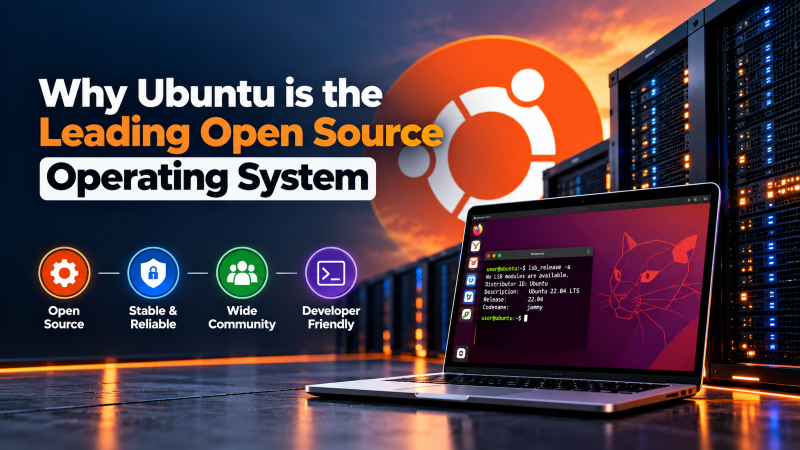
Ubuntu is an open source operating system based on the Debian Linux kernel architecture that powers over 60% of modern public cloud, VPS, and enterprise container workloads. Maintained by Canonical, Ubuntu Server delivers predictable 5-year Long Term Support (LTS) release lifecycles, an enormous APT software repository of over 60,000 packages, native Docker and Kubernetes integration, robust security via AppArmor and Canonical Livepatch (zero-downtime kernel patching), and total freedom from proprietary licensing fees.
In the landscape of modern enterprise computing, the operating system serves as the foundational bedrock for web servers, database clusters, microservices, and artificial intelligence pipelines. Since its inception in 2004, Ubuntu has evolved from a user-friendly desktop Linux distribution into the dominant operating system powering global cloud infrastructure.
Whether deploying high-performance applications on a cheap VPS or provisioning mission-critical bare-metal hardware via cheap dedicated server hosting, Ubuntu Server represents the industry standard choice for DevOps engineers and system administrators worldwide.
The Open-Source Heritage of Ubuntu: Debian Roots to Enterprise Standard
Ubuntu was founded by Mark Shuttleworth and Canonical Ltd. with a fundamental commitment to the open-source ethos: software should be freely available, customizable without restriction, and shared openly across the global community. Built upon the robust foundation of Debian GNU/Linux, Ubuntu inherited Debian’s rock-solid package management system while introducing structured release engineering and commercial-grade enterprise backing.
This open-source heritage guarantees critical advantages for production infrastructure:
- Zero Vendor Lock-In & No Licensing Fees: Unlike commercial operating systems that levy steep per-core licensing charges, Ubuntu Server is 100% free to deploy across unlimited physical and virtual cores.
- Full Source Code Transparency: System engineers can inspect, audit, and modify any kernel module or utility according to official Linux Kernel documentation.
- Vast Global Community & Knowledge Base: Ubuntu commands the web’s largest technical support ecosystem, ensuring immediate resolution for complex server administration challenges.
Ubuntu Server LTS vs. Interim Releases: Lifecycle, Kernels & Stability
A primary driver of Ubuntu’s enterprise dominance is its disciplined, predictable release cadence. Canonical publishes a new Long Term Support (LTS) release every two years in April (such as 22.04 LTS and 24.04 LTS), providing five years of standard security maintenance, expandable up to ten years via Extended Security Maintenance (ESM).
| Evaluation Parameter | Ubuntu Server LTS (e.g., 24.04 / 22.04) | Proprietary Commercial OS / Alternative Distros |
|---|---|---|
| Licensing & Core Fees | 100% Free Open-Source (Zero Per-Core Fees) | Costly Per-Core / Per-Socket Licensing Surcharges |
| Support Lifecycle | 5 Years Guaranteed Security (Up to 10+ with ESM) | Variable / Expensive Extended Support Contracts |
| Container & Cloud Support | Native First-Class Support for Docker, K8s, LXD | Often Requires Heavy Hypervisors or Emulation |
| Software Ecosystem (APT) | 60,000+ Pre-Compiled Verified Deb Packages | Fragmented Repositories or Manual Binary Compilation |
| Zero-Downtime Patching | Canonical Livepatch (Kernel Updates Without Reboot) | Mandatory Monthly Maintenance Reboots |
| Hardware Compatibility | Universal Support: AMD EPYC, Intel Xeon, ARM64 | Strict Hardware Compatibility Lists (HCL) |
The APT Package Ecosystem, Snaps, and Software Availability
The Advanced Package Tool (APT) remains the gold standard in Linux software management. Administrators can install, update, and secure complex server stacks (including Nginx, Apache, MySQL, PostgreSQL, and PHP) with single commands. Combined with Canonical’s Snap packaging format, developers can deploy self-contained, sandboxed microservices with automated background updates and instant rollback capabilities.
This dual-tiered package architecture ensures developers access both rock-solid, production-tested library foundations and bleeding-edge language runtimes (Node.js, Python, Go, Rust) without library dependency collisions.
Enterprise Security Architecture: AppArmor, UFW, and Canonical Livepatch
Security on Ubuntu Server is engineered from the ground up to defend against modern network exploits and privilege escalation attacks:
AppArmor Mandatory Access Control
Unlike complex SELinux implementations, AppArmor uses intuitive path-based security profiles to restrict application capabilities, isolating zero-day vulnerabilities inside restricted process sandboxes.
UFW & Canonical Livepatch
The Uncomplicated Firewall (UFW) streamlines iptables/nftables packet filtering, while Canonical Livepatch applies critical Linux kernel CVE patches in memory without requiring server reboots.
Cloud, Docker & Kubernetes Dominance: Why DevOps Defaults to Ubuntu
Across the cloud-native ecosystem, Ubuntu is the default reference platform. Major container runtimes, cloud-init provisioning engines, and Kubernetes orchestrators prioritize Ubuntu testing and upstream development according to the Cloud Native Computing Foundation (CNCF).
Whether deploying lightweight MicroK8s clusters on edge instances or running massive containerized microservices in multi-tier cloud architectures, Ubuntu’s standardized kernel and cgroups v2 integration deliver predictable container execution with zero virtualization tax.
Server Stack Optimization: Systemd, Netplan & Nginx Performance Tuning
Configuring Ubuntu Server for maximum production throughput involves streamlined systems administration utilities:
- Netplan YAML Network Abstraction: Configure static IP addresses, VLAN tags, and network bonding with clean, human-readable YAML configurations that compile directly into systemd-networkd.
- Systemd Resource Slices: Manage CPU, memory, and I/O quotas across individual services to prevent rogue processes from starving critical web daemons.
- High-Performance Linux Web Hosting Stacks: Optimize Nginx worker connections and PHP-FPM socket pools to serve dynamic requests with sub-millisecond Time to First Byte (TTFB).
Frequently Asked Questions: Ubuntu Open-Source Server OS
Strategic Decision: Deploying Ubuntu Server on VPS & Bare Metal Infrastructure
Deploying Ubuntu Server across Onlive Server’s high-speed cloud infrastructure delivers the optimal synthesis of open-source flexibility, raw hardware throughput, and round-the-clock reliability. Whether you require scalable virtual private servers or fully dedicated bare-metal machines, our datacenters provide the foundation for seamless deployment.
Launch Your High-Performance Ubuntu Server Infrastructure
Choose the optimal hosting architecture for your Ubuntu workloads. Pre-installed with your choice of Ubuntu 24.04 LTS or 22.04 LTS, full root access, and enterprise NVMe storage.
Ubuntu Cloud VPS Hosting
Cost-efficient virtual private servers for modern web applications, microservices, staging environments, and Docker stacks.
- Instant deployment with pre-configured Ubuntu LTS
- High-speed NVMe PCIe SSD storage arrays
- Dedicated vCPU and isolated RAM allocations
- Full root SSH access & instant resource scaling
Ubuntu Dedicated Bare Metal
100% dedicated hardware for intensive databases, high-concurrency production workloads, and enterprise Kubernetes clusters.
- Dedicated AMD EPYC / Intel Xeon multi-core silicon
- Unmetered 1 Gbps to 10 Gbps network switch ports
- Hardware RAID arrays with enterprise NVMe SSDs
- Full IPMI/KVM out-of-band management control