

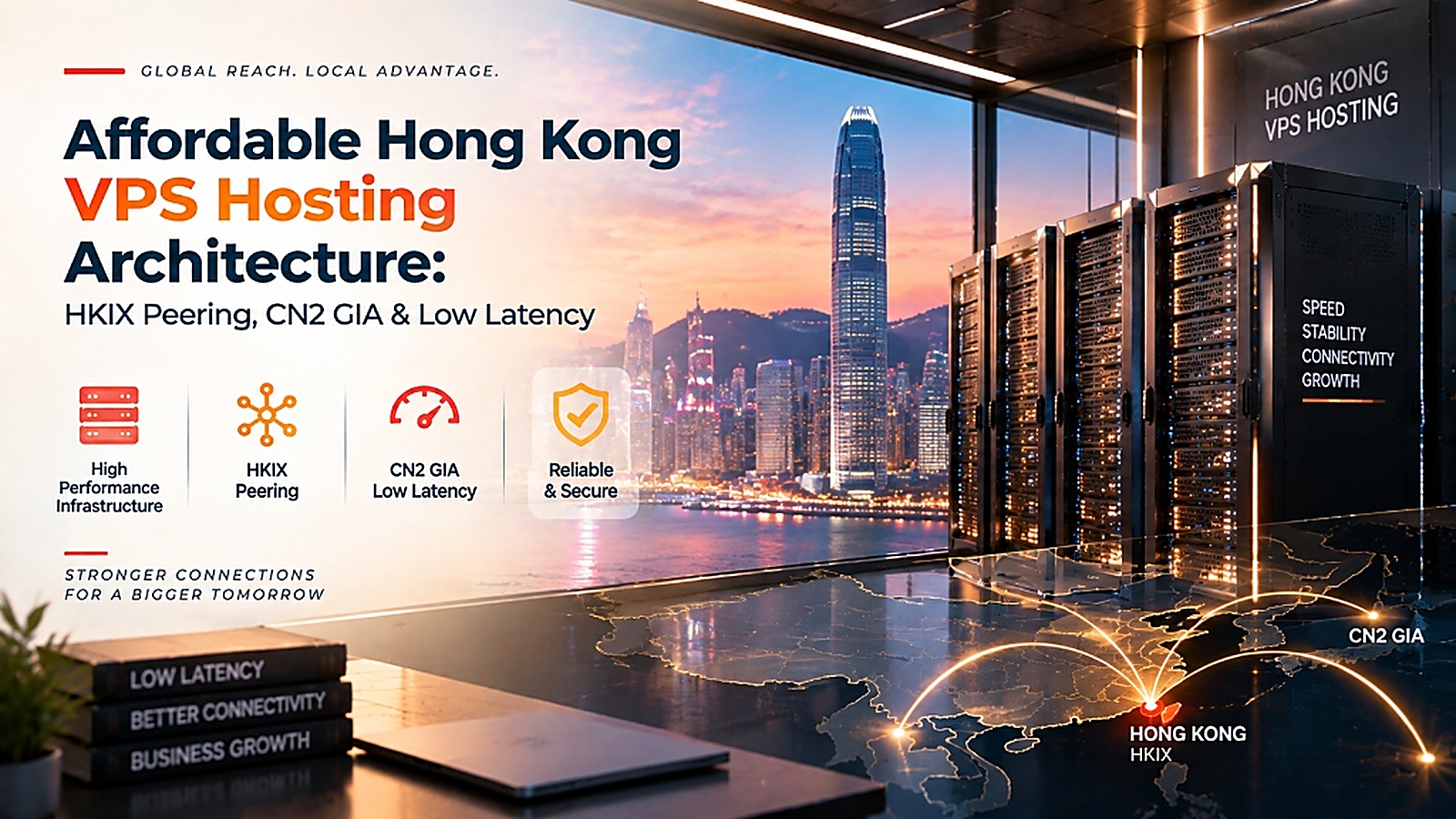
Deploying digital web infrastructure in the Asia-Pacific region requires strategic positioning at the intersection of international subsea cable systems and mainland Chinese telecommunications networks. Hong Kong stands as the primary digital gateway for enterprises targeting East Asian, Southeast Asian, and Greater China markets. Achieving sub-30ms round-trip latency across the region while maintaining cost efficiency demands hardware-isolated KVM virtualization, high-speed NVMe storage, and direct peering through the Hong Kong Internet eXchange (HKIX).
- Hong Kong Internet eXchange (HKIX) and CN2 GIA Direct Routing: Carrier-neutral Hong Kong datacenters deliver direct cross-connects to HKIX and China Telecom CN2 GIA backbones, bypassing congested public transit corridors.
- Dedicated KVM Silicon Isolation with Unthrottled NVMe Throughput: Hardware-assisted KVM hypervisors guarantee dedicated processor threads and unmetered PCIe NVMe storage lanes, eliminating noisy-neighbor resource competition.
This technical architecture guide evaluates Asia-Pacific routing mechanics, KVM hypervisor isolation, Linux kernel network tuning, and total cost of ownership for organizations deploying on cheap Hong Kong VPS server hosting solutions.
Asia-Pacific Telecommunications Crossroads: Why Hong Kong Matters
Hong Kong represents one of the densest telecommunications hubs globally, hosting landing stations for over a dozen major international submarine cable systems including APCN-2, SJC, and ASE. This submarine connectivity provides direct, high-bandwidth optical channels to Tokyo, Singapore, Seoul, Sydney, and North America.
Furthermore, Hong Kong occupies an unprecedented strategic position bordering mainland China. Businesses serving both regional Asian customers and mainland Chinese visitors benefit from direct interconnection via premium China Telecom CN2 GIA (Global Internet Access), China Unicom (CU), and China Mobile (CMI) routes.
These optimized routing backbones bypass public peering congestion at Shenzhen and Guangzhou, delivering sub-15ms latency into southern China and under 40ms into Shanghai and Beijing without requiring domestic ICP commercial licensing.
Virtualization Architecture: KVM Hypervisor vs. Shared Containers
Deploying affordable virtual private servers often involves evaluating hypervisor architectures. Legacy budget hosting providers historically utilized shared-kernel containerization platforms like OpenVZ or LXC to maximize server tenant density.
In shared-kernel container environments, every virtual instance shares the physical host’s single Linux kernel. A runaway process, memory leak, or kernel exploit triggered by an adjacent tenant can destabilize the host, crashing all hosted applications simultaneously.
Modern Hong Kong cloud infrastructure relies exclusively on Kernel-based Virtual Machine (KVM) technology. KVM operates as a true hardware-level Type-1 hypervisor integrated directly into the Linux kernel. Under KVM, each virtual instance operates with its own dedicated virtualized BIOS, private kernel space, independent virtual memory tables, and virtualized network interface cards (virtio-net).
When evaluating VPS vs dedicated server upgrade paths, KVM virtualization provides complete administrative autonomy to modify sysctl kernel parameters, compile custom kernel modules, and deploy Docker container runtimes without hypervisor restrictions.
For latency-critical SaaS and database backends, ensure your VPS utilizes Kernel-based Virtual Machine (KVM) virtualization with dedicated vCPU core affinity. This completely eliminates noisy-neighbor performance throttling.
Storage Array Performance: Direct-Attached Enterprise NVMe RAID 10
Database query performance and web application execution speeds are directly bounded by storage subsystem throughput and input/output queue depths. Legacy SATA solid-state drives communicate through storage controllers limited to a single command queue of thirty-two concurrent operations.
High-performance Hong Kong virtual private servers deploy direct-attached enterprise Non-Volatile Memory Express (NVMe) solid-state storage organized in redundant RAID 10 arrays. Operating directly across PCIe Gen 4 lanes, NVMe drives support up to 64,000 parallel queues with 64,000 commands per queue.
To maximize I/O throughput and eliminate redundant write cycles, system administrators configure file system mount options within /etc/fstab using optimized parameters:
# Optimized NVMe mount options for Hong Kong VPS
UUID=7e3d1a4c-8f2b-4e1a-9c3d-5a6b7c8d9e0f / ext4 noatime,nodiratime,commit=60,errors=remount-ro 0 1
Disabling access-time updates (noatime, nodiratime) prevents unnecessary metadata write cycles whenever cached assets or static media are accessed, preserving physical drive bandwidth for intensive MySQL or PostgreSQL transactions.
Out-of-Band Control Panels: Virtualizor Cloud Management
Managing remote cloud infrastructure across international time zones requires robust out-of-band administration tools that remain accessible even if the guest operating system fails. A firewall misconfiguration or failed network interface script can instantly sever standard SSH connectivity.
Enterprise Hong Kong virtual servers incorporate intuitive web-based control interfaces powered by the Virtualizor virtualization control panel. This management system connects directly to the underlying KVM hypervisor daemon via encrypted VNC and HTML5 serial consoles.
Through Virtualizor, administrators can perform cold hardware reboots, mount custom operating system ISO images, configure network bonding, and monitor real-time CPU, RAM, and bandwidth telemetry. Automated snapshot schedules allow administrators to capture point-in-time system backups prior to software upgrades, enabling instant one-click rollback during critical failures.
Enterprise cloud instances provisioned on pure NVMe arrays deliver over 500,000 read/write IOPS, ensuring sub-millisecond database query response times even during extreme unpredicted traffic surges.
Linux Kernel Network Optimization: Google BBR and Socket Scaling
Transmitting data packets across international submarine networks introduces variable latency and occasional packet jitter. Default Linux TCP networking stacks employ legacy loss-based congestion control algorithms like Cubic, which interpret minor packet delays as network congestion, cutting transmission throughput prematurely.
Enabling Google’s BBR (Bottleneck Bandwidth and Round-trip propagation time) algorithm on a Hong Kong VPS models physical pipe capacity directly, ensuring maximum bandwidth utilization across long-distance transit corridors:
# Enable Google BBR Congestion Control (/etc/sysctl.conf)
net.core.default_qdisc = fq
net.ipv4.tcp_congestion_control = bbr
Furthermore, expanding operating system socket buffers and connection backlog queues allows the server to accommodate thousands of concurrent client handshakes without dropping packets:
# Socket buffer and connection queue expansion
net.core.somaxconn = 65535
net.core.netdev_max_backlog = 100000
net.ipv4.tcp_max_syn_backlog = 3240000
net.ipv4.tcp_rmem = 4096 87380 16777216
net.ipv4.tcp_wmem = 4096 65536 16777216
Applying these values with sysctl -p ensures high-volume eCommerce sales or regional marketing campaigns maintain sub-second response times across the Asia-Pacific territory.
To further minimize connection handshake delays for repeat regional users, systems engineers enable TCP Fast Open (net.ipv4.tcp_fastopen = 3). This optimization allows client HTTP requests to transmit data payloads directly within the initial TCP SYN packet, shaving an entire round-trip time (RTT) from mobile and broadband connections.
Combining TCP Fast Open with modern HTTP/3 (QUIC) protocols on Hong Kong cloud servers ensures lightning-fast dynamic page rendering across mobile networks in East Asia and mainland China.
Additionally, configuring hardware interrupt request (IRQ) affinity pins high-speed network queues directly to dedicated processor cores, maximizing packet handling efficiency under heavy regional loads.
Proactive Telemetry and Multi-Tier Perimeter Defense
Hosting web services in an international hub requires proactive telemetry and multi-layered cyber defense. Edge network appliances filter volumetric Layer-3 and Layer-4 DDoS floods, such as NTP and DNS amplification attacks, before traffic enters the datacenter floor.
On the virtual instance, administrators deploy Prometheus Node Exporter to gather real-time hardware telemetry, including CPU context switching, disk I/O queue wait times, and TCP socket states. Streaming metrics to Grafana dashboards provides engineering teams with comprehensive operational visibility.
Coupling monitoring with nftables packet filtering and fail2ban intrusion prevention locks down administrative access, restricting SSH and management consoles to authorized VPN tunnels.
Carrier-Neutral Peering and Trans-Pacific Latency Reduction
High-concurrency web applications serving multinational audiences require resilient upstream connectivity. In addition to regional Asian routing, Hong Kong datacenters maintain direct trans-Pacific optical routes to the western United States.
Interconnecting with Tier-1 global carriers such as Lumen, Telia, and NTT ensures that international API traffic, software updates, and user requests travel across the lowest-latency optical paths without unnecessary transcontinental routing hops.
BGP4 multi-homing protocols dynamically adjust traffic flows in response to real-time packet loss or fiber cuts, guaranteeing uninterrupted network reachability for mission-critical SaaS platforms.
Automated Snapshot Schedules and Multi-Region Offsite Vaulting
A comprehensive enterprise disaster recovery posture mandates separating production virtual machines from offsite backup archives. While direct-attached NVMe RAID 10 arrays protect against physical drive corruption, they cannot defend against software corruption or human error.
Virtualizor management consoles enable automated snapshot scheduling, capturing point-in-time filesystem images during scheduled off-peak maintenance windows without taking web services offline.
Exporting snapshot archives across private datacenter VLANs to secondary offsite S3-compatible cloud storage vaults situated in independent geographic regions guarantees business continuity and rapid bare-metal disaster recovery.
Require High-Availability VPS Infrastructure with Guaranteed Uptime?
Deploy enterprise-grade KVM virtual servers backed by pure NVMe storage arrays, automated out-of-band management, and 24/7 technical monitoring.
