Romania Dedicated Server Hosting in Bucharest
Run websites, applications, databases, and virtualized workloads on physical servers located in Bucharest. Choose dedicated hardware, 1 Gbps connectivity, flexible operating-system and control-panel options, and managed technical support.

What Is a Romania Dedicated Server?
A Romania dedicated server is a physical machine reserved for one customer and hosted in a Romanian data centre. Unlike shared hosting or a VPS, its processor, memory, and storage are not shared with unrelated tenants. This gives you more predictable capacity, deeper configuration control, and a clear location for your workload. When you opt for a dedicated server, you’re essentially renting an entire physical machine that sits inside a data centre facility, rather than a slice of a larger shared system. This means the hardware every core, every gigabyte of RAM, every bit of disk space is allocated exclusively to your account. No other client’s website, application, or database is competing for the same underlying resources. For businesses running performance-sensitive workloads, this isolation translates directly into steadier response times and fewer unexpected slowdowns.
Romania Dedicated Servers Hosting Plans
Choose a Romania Dedicated Server for Your Workload
The live plan table ranges from a four-core entry server with 8 GB RAM to dual-processor systems with up to 256 GB RAM. Start with the workload, then compare CPU cores and clock speed, memory, storage type, and growth headroom. The categories below make the current range easier to evaluate.

Entry Servers for Focused Workloads
DSX7 pairs an Intel Xeon E3-1231v3 with 8 GB RAM and 1 TB SATA storage. It is the lowest-cost option for lighter services, test environments, small business applications, or projects that value storage capacity more than disk speed. DSX8 moves to an eight-core Intel i7-9700K, 16 GB RAM, and 1 TB SSD, making it the stronger entry choice when single-server responsiveness matters.

Balanced Servers for Growing Applications
DSX1, DSX2, and DSX4 provide 32-64 GB RAM with SSD storage. These configurations suit growing e-commerce sites, application back ends, business databases, multi-site hosting, and production services that need more memory or CPU capacity than the entry tier. Compare core count with per-core speed: more cores help parallel workloads, while higher clock speed can help applications that rely on fewer busy threads.

High-Capacity Servers for Dense Workloads
DSX3, DSX5, and DSX6 are designed for heavier consolidation. Current listings provide 128-256 GB RAM, SSD storage, and high core counts, including dual-processor options. They are better candidates for virtual machines, container clusters, large databases, CI/CD runners, and multi-tenant platforms. Confirm storage layout, RAID requirements, virtualization support, and licence needs before ordering.
Why Host a Dedicated Server in Bucharest?
Place Infrastructure Near Romanian and Regional Users
A Bucharest server places content and applications closer to users in Romania and parts of Central and South-Eastern Europe. Shorter network routes can reduce round-trip time compared with a distant hosting region, although actual latency depends on the visitor’s internet provider, peering, and route. Test from the networks that matter to your customers before migration.
Support an EU Data-Residency Strategy
Romania is an EU member state, so a Bucharest deployment can help organisations that want infrastructure located inside the European Union. Server location alone does not make a service GDPR compliant. Your contracts, access controls, logging, retention rules, backups, subprocessors, and any transfers outside the EU still need review.
Add a Distinct European Location
Romania can serve as a primary region for a local audience or as a separate location in a wider European architecture. For resilience, decide whether the server will run alone, replicate to another site, or operate behind a load balancer. A second location only improves continuity when data replication, failover, and recovery procedures are designed and tested.
What You Get With OnliveServer Romania Hosting
Exclusive hardware resources. Your selected CPU, RAM, and local disks are assigned to your server rather than divided among unrelated virtual machines.

Romania Dedicated Server Use Cases
High-Traffic Websites and E-commerce
Dedicated resources give busy websites more predictable capacity for web workers, caches, search indexes, and checkout traffic. For an online store, size RAM for the application and database, use SSD storage for active data, and keep backups outside the production disks.
SaaS Platforms, APIs, and Business Applications
A bare-metal server gives development teams control over the runtime, database, firewall, service limits, and deployment tools. It is useful when an application has sustained demand, specialised dependencies, or licensing that is easier to manage on a known physical host.
Databases, ERP, and CRM Systems
Database workloads benefit from enough memory to cache active data and storage that can handle the required input/output rate. Prioritise SSD capacity, memory headroom, RAID design, backup frequency, and recovery testing. More CPU cores will not compensate for a storage bottleneck.
Virtual Machines, Containers, and CI/CD
High-memory and multi-core configurations can consolidate virtual machines, container workloads, build runners, or development labs. Before deploying a hypervisor, confirm hardware virtualisation support, usable IP allocation, network policy, storage redundancy, and whether the chosen licence permits the planned environment.
Agency, Reseller, and Multi-Site Hosting
A dedicated server with a hosting control panel can separate accounts, domains, databases, and email services while giving the operator control over server-wide limits. Choose the panel based on operating system, account volume, automation needs, licence cost, and the experience of the team that will manage it.
Dedicated Server vs VPS: Which One Should You Choose?
Both services can provide administrative control, but they allocate infrastructure differently. Use this comparison to decide whether physical isolation is worth the additional cost and operational responsibility.
| Factor | Dedicated Server | VPS |
| Resources | Physical CPU, RAM, and disks assigned to one customer. | Virtual resources allocated on a shared physical host. |
| Performance | More predictable for sustained CPU, memory, or storage demand. | Efficient for smaller or variable workloads; host contention may vary by platform. |
| Control | Broad hardware and software configuration options. | Strong OS-level control, with limits set by the virtualisation layer. |
| Scaling | Hardware changes may require planning or downtime. | CPU, RAM, or disk can often be resized more quickly. |
| Cost | Higher because one customer rents the physical machine. | Lower entry cost because the host is shared. |
| Best fit | Busy applications, databases, virtualisation, specialised stacks, or isolation needs. | Small sites, development, bursty services, or workloads still growing into dedicated hardware. |
Choose the Right Operating System and Control Panel
Operating System
Choose Linux when your stack uses common open-source web, database, container, or automation tools. Choose Windows Server when the application depends on Microsoft technologies or Windows-specific administration. Confirm the supported versions, licence price, update policy, and whether the selected hardware meets the software vendor’s requirements.
Control Panel
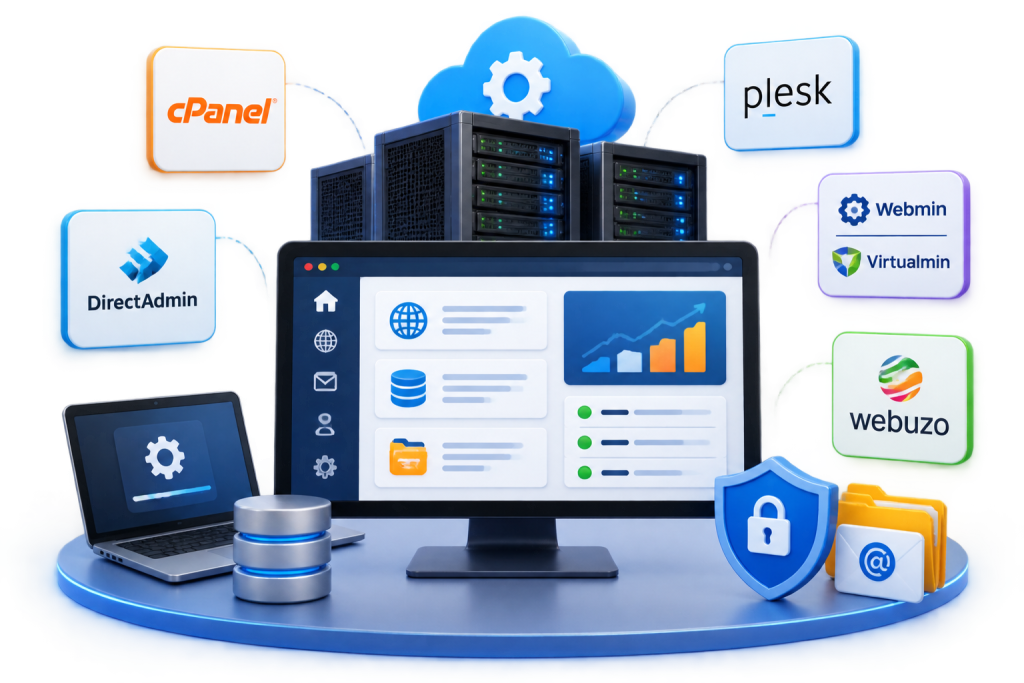
- cPanel: A familiar Linux hosting interface for domains, websites, email, databases, and hosting accounts.
- Plesk: A website and server management platform commonly used for multi-site administration and supported Linux or Windows environments.
- DirectAdmin: A lighter panel for managing websites, email, databases, and multiple accounts with a simpler resource footprint.
- Webmin and Virtualmin: Flexible tools for experienced Linux administrators; Virtualmin adds multi-domain hosting management on top of Webmin’s system controls.
- Webuzo: A web hosting control panel for managing websites, domains, databases, email, and application installations from one interface.
A control panel simplifies common tasks but does not replace system administration. It still needs secure access, updates, backups, and monitoring. Confirm panel compatibility and licence charges before the server is provisioned.
Security and Resilience for a Romania Bare-Metal Server
Dedicated hardware removes unrelated tenants from your machine, but it does not secure the operating system or application by itself. Build security in layers and test the controls that protect both access and data.

Frequently Asked Questions
Helpful Guides on Romania Dedicated Server
-
Enjoy Superior Dedicated Server Hosting Plan with Fully Managed Service
In this era where everything is interconnected through digital platforms. Having a dependable hosting infrastructure is vital for expansion and success. Obtained through direct server…
-
Why do You Need a Cheap Dedicated Server UK?
In this review, we will explore some of the best and most affordable UK-based dedicated server hosting services. These services provide excellent performance, security, and…
-
Give New Hight Your Business Website with Romania Dedicated Server
Take your business website to new heights with top-tier Romania dedicated server solutions. Our high-performance hosting offers lightning-fast speeds, enhanced security, and complete control. This…