

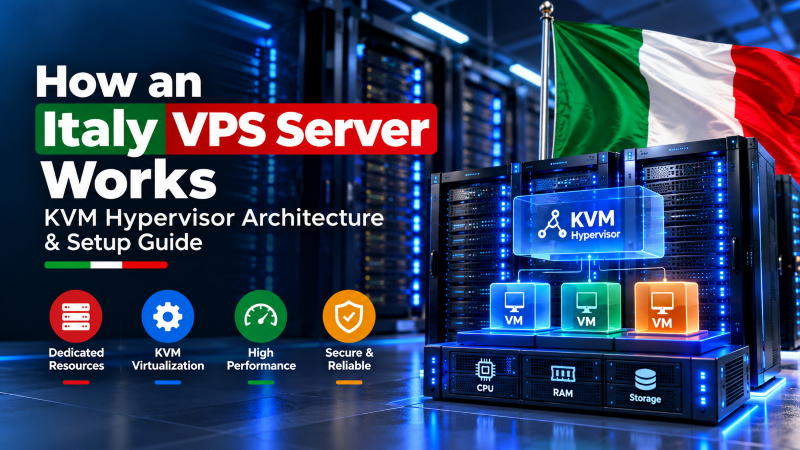
An Italy VPS operates by partitioning physical enterprise host servers located in Italian datacenters (Milan/Rome) into isolated virtual machines using Kernel-based Virtual Machine (KVM) hypervisors. Each VPS executes its own independent operating system kernel with dedicated vCPU cores, reserved ECC RAM, and isolated PCIe NVMe storage blocks—delivering bare-metal-like isolation and ultra-low latency across Southern Europe.
The Anatomy of Virtual Private Server Technology
To understand how an Italian VPS operates, you must examine the software layer that abstracts physical server hardware into multiple isolated virtual machines. In traditional shared hosting, thousands of user websites share a single operating system environment and global memory pool.
In contrast, deploying a high-performance Italy VPS relies on type-1 hardware virtualization. The physical host machine executes a hypervisor—most commonly KVM—which turns the Linux kernel into an enterprise virtualization hypervisor.
The hypervisor manages hardware abstraction, guaranteeing that your virtual instance receives exclusive access to allocated processor cycles, system memory addresses, and storage input/output channels.
Step-by-Step Working Procedure of an Italy VPS
From initial provisioning to serving live visitor traffic, an Italian VPS functions through four coordinated technical stages:
1. Provisioning and Resource Reservation
When you select an Italy VPS plan, the automated datacenter orchestrator communicates with the physical host cluster in Milan. The orchestrator reserves specific RAM pages in physical ECC memory banks and defines virtual CPU (vCPU) execution boundaries within the hypervisor scheduler.
2. Storage Block Allocation on NVMe Arrays
Next, the hypervisor allocates a virtual block disk on enterprise PCIe Gen4 NVMe arrays configured in hardware RAID 10. This dedicated storage block functions as a physical hard drive, ensuring fast read/write speeds without cross-tenant disk contention.
3. Operating System Kernel Initialization
Unlike containerized virtualization (such as OpenVZ or LXC) which forces all tenants to share the host’s Linux kernel, KVM boots a dedicated kernel for each VPS. You can run Ubuntu, AlmaLinux, Debian, or Windows Server with custom kernel flags, modules, and file systems (ext4, XFS, Btrfs).
4. Network Routing and Dedicated IP Binding
Finally, the hypervisor bridges the virtual network interface (vNIC) to the datacenter’s core routing fabric. Your VPS is assigned a dedicated static Italian IPv4 address, directly routed through local Internet exchanges like the Milan Internet Exchange (MIX).
Hardware Architecture: What Powers an Italian VPS?
Modern Italian VPS nodes rely on enterprise-grade components designed for continuous multi-year operation under heavy compute loads:
- High-Frequency Processors: Multi-core Intel Xeon Scalable or AMD EPYC processors delivering high single-thread clock speeds and massive multi-threaded parallel processing.
- Error-Correcting Code (ECC) RAM: Enterprise memory that detects and corrects silent data corruption in real time, preventing unexpected server panics and application crashes.
- Carrier-Grade Network Uplinks: Redundant 10Gbps fiber uplinks connected to Tier-1 European transit providers, providing unmetered bandwidth with zero packet loss.
- Isolated Virtualizor / SolusVM Control: Intuitive browser-based control panels allowing instant reboots, OS reinstalls, VNC console access, and real-time resource telemetry.
For organizations requiring single-tenant physical hardware without hypervisor scheduling, deploying a dedicated bare-metal server in Italy delivers 100% exclusive access to the underlying motherboard and processors.
Why Geographic Location in Milan Matters
The physical location of the server chassis directly dictates the physical distance data packets must travel. Milan serves as the primary telecommunications routing hub for Italy and the Mediterranean.
By hosting in Milan, network packets travel directly across the Milan Internet Exchange (MIX) to reach Italian telecom providers (Telecom Italia, Vodafone Italy, Wind Tre, Fastweb). This delivers round-trip latencies below 8ms across Northern Italy and sub-15ms nationwide.
Securing these high-speed local data streams with a trusted SSL certificate guarantees that sensitive customer data and transactions remain fully encrypted, compliant with Italian privacy laws and EU GDPR mandates.
Technical Comparison: KVM VPS vs. Container Virtualization
Understand why KVM hypervisor architecture is the industry standard for modern VPS deployments:
| Virtualization Feature | KVM Virtualization (Italy VPS) | Container Virtualization (OpenVZ) |
|---|---|---|
| Kernel Architecture | Dedicated, Independent OS Kernel | Shared Host Kernel for All Tenants |
| RAM Allocation | Strictly Dedicated Physical ECC RAM | Dynamic / Shared Memory Pool |
| Operating System Support | Linux (Any Distro) & Windows Server | Linux Only (Matches Host Kernel) |
| Docker / Container Support | Fully Supported (Nested Containers) | Limited or Blocked by Kernel |
Summary: The Engine Driving Mediterranean Digital Growth
An Italy VPS is not merely a piece of software; it is an enterprise computing platform designed to deliver guaranteed computing resources, low network latency, and strict data sovereignty. Understanding its hypervisor mechanics enables IT teams to optimize their software architecture for maximum speed and uptime.
Kernel-Based Virtual Machine (KVM) Architecture and Hardware Passthrough
Understanding how an Italy VPS server functions requires examining the virtualization architecture that transforms physical server hardware into isolated virtual environments. Modern Italian cloud infrastructure relies on Kernel-based Virtual Machine (KVM) technology embedded directly within the Linux kernel.
Unlike container-based virtualization (such as OpenVZ or LXC), which forces all instances to share a single host kernel, KVM operates as a Type-1 hypervisor. Each virtual private server runs its own completely independent kernel, allowing administrators to run custom Linux distributions or Windows Server environments with full root authority.
KVM leverages Intel VT-x and AMD-V hardware virtualization extensions to execute processor instructions directly on physical CPU cores. This hardware-assisted virtualization minimizes emulation overhead, delivering near-bare-metal computational performance for database and application workloads.
VirtIO Paravirtualized Storage and Network Drivers
To eliminate virtualization bottlenecks, modern KVM virtual machines utilize VirtIO paravirtualized device drivers. These specialized drivers establish direct shared-memory communication channels between the guest operating system and the host hypervisor.
- VirtIO-SCSI Driver Architecture: Bypasses IDE drive emulation, allowing virtual machines to execute multi-queue NVMe storage commands directly.
- VirtIO-Net Paravirtualization: Delivers high-speed virtual networking with packet processing speeds exceeding 10 Gigabits per second.
- Linux Cgroups Resource Isolation: Enforces hard hardware limits to guarantee that neighboring virtual instances cannot monopolize CPU or memory buffers.
- Hardware Random Number Generation: Passes cryptographic entropy from physical host processors to accelerate guest SSL/TLS handshakes.
Automated Packet Scrubbing and Milan Edge Routing Pipelines
Once packets exit the virtual network interface, they enter Milan’s high-density telecommunications network fabric. Top-tier Italian hosting facilities deploy multi-homed BGP routing engines that dynamically calculate the lowest-latency fiber path across regional telecom carriers.
Simultaneously, upstream inline DDoS mitigation appliances continuously inspect incoming traffic for volumetric anomalies. Malicious SYN floods, UDP amplification attacks, and HTTP request floods are discarded in hardware within sub-second reaction windows, ensuring clean traffic flows uninterrupted to your VPS.
- Automated BGP Multihoming: Dynamically reroutes packets across alternate Tier 1 transit providers if a regional carrier encounters fiber damage.
- Hardware Anti-DDoS Scrubbing: Upstream scrubbing centers absorb multi-hundred-gigabit attacks before packets reach local switch ports.
- Isolated VLAN Networking: Connect multiple VPS instances across private internal networks with zero internet exposure.
- Instant Snapshot Provisioning: Hypervisor-level copy-on-write storage allows instantaneous full-system backups without freezing active databases.
Linux Cgroups and Kernel Memory Isolation in Italian Datacenters
Hardware isolation inside modern KVM virtualization relies on Linux Control Groups (cgroups) embedded directly within the host hypervisor. Cgroups enforce strict physical memory, swap space, and CPU execution time boundaries across every hosted virtual machine instance.
This kernel-level isolation ensures that if a neighboring virtual server experiences a memory leak or runaway process, your server’s assigned RAM and processing cores remain completely untouched. Enterprise clients enjoy dedicated, uncompromised hosting stability around the clock.
- Linux Cgroups Memory Limits: Prevent runaway application processes from affecting adjacent virtual machines.
- VirtIO Paravirtualized Sockets: Transfer network packets at native hypervisor bus speeds exceeding 10Gbps.
- Automated BGP Upstream Rerouting: Redirect packet flows automatically if an upstream Italian fiber link drops.
Conclusion: Unlocking High-Performance Virtualization in Milan
The remarkable speed and reliability of an Italy VPS server are the direct result of advanced KVM hypervisor engineering, VirtIO paravirtualized hardware drivers, and Milan’s premier fiber routing infrastructure. Understanding these technical mechanics empowers administrators to extract maximum performance from their hosting environment.
By pairing hardware-isolated virtualization with localized Italian network peering, your digital infrastructure achieves the low latency, high throughput, and rock-solid stability essential for modern enterprise success.
Frequently Asked Questions
What happens if the physical host server crashes?
Modern cloud hypervisor clusters feature high-availability failover. If a physical chassis suffers a hardware failure, your VPS can be automatically restarted on a healthy standby host in the cluster.
Can I install Docker and Kubernetes on an Italy KVM VPS?
Yes. Because KVM provides a dedicated Linux kernel, you have full access to cgroups and namespaces, allowing you to run Docker containers, Docker Compose, and lightweight Kubernetes clusters (k3s) smoothly.
How do I access my VPS if SSH stops responding?
Your hosting management portal provides an out-of-band VNC / noVNC web console. This connects directly to the hypervisor display, allowing you to fix firewall lockouts or boot issues.
Is my data isolated from other users on the same physical server?
Yes. KVM enforces strict hardware-level memory boundaries and disk encryption. Other users on the same physical server have zero access to your file system or memory contents.
Can I scale my Italy VPS resources without reinstalling the OS?
Yes. You can upgrade CPU cores, RAM, and NVMe storage capacity directly through the client control portal. A quick server reboot applies the new hardware profile seamlessly.