

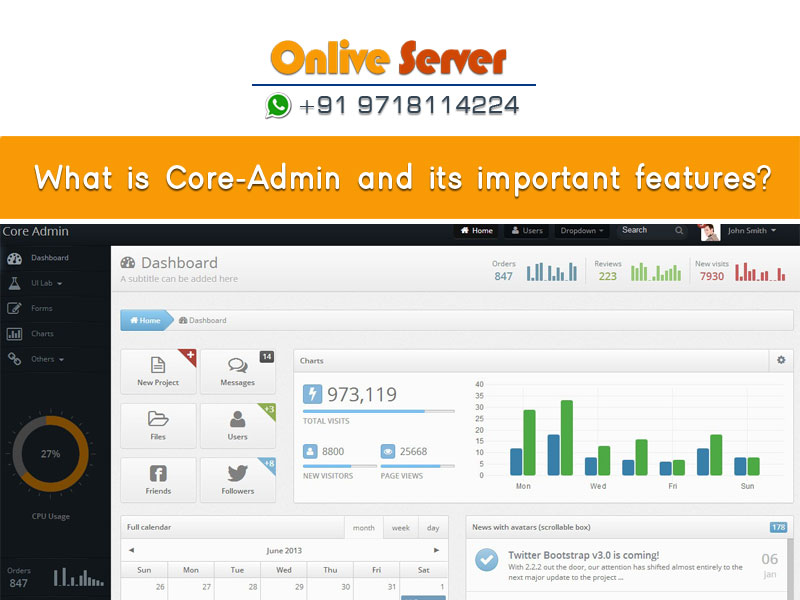
Quick Answer: What Is Core-Admin?
Core-Admin is an advanced, centralized multi-server administration and real-time monitoring platform for Linux operating systems. Unlike traditional single-server control panels like cPanel or Plesk, Core-Admin uses a client-agent architecture where lightweight node daemons (core-admin-agent) connect outward via encrypted TLS tunnels to a central management server. This enables systems administrators to oversee system health, block malicious IP addresses, track file-system alterations, and configure core Linux services across dozens of remote VPS and dedicated servers through one unified dashboard.
Managing multiple Linux servers across distributed hosting environments often forces system administrators into a difficult compromise: deploying resource-heavy control panels on every individual instance or relying solely on manual SSH terminal sessions. Understanding what is Core-Admin reveals a modern, centralized alternative designed specifically to solve this dilemma. Built with a distributed architecture, Core-Admin allows technical teams to monitor, manage, and secure fleets of virtual private servers and dedicated hardware from a single centralized web console without exposing vulnerable management ports to the public internet.
What Is Core-Admin? (Definition & System Overview)
Core-Admin was engineered by Advanced Software Production Line (ASPL) to tackle the structural challenges of multi-server Linux administration. In conventional server management workflows, installing a standalone web-based control panel on every server creates significant operational overhead. Each installation consumes memory, requires distinct administrative credentials, and opens individual HTTP/HTTPS listening ports that increase the network attack surface.
Core-Admin replaces this fragmented model with a distributed systems management framework. The platform separates the administrative user interface from the managed servers. Instead of running a full administrative web server on every endpoint, managed machines run a lightweight background daemon that reports back to a central Core-Admin management node.
Through this design, administrators gain real-time visibility across all physical and virtual machines under their supervision. Whether handling routine log maintenance, user account provisioning, or emergency service restarts, the administrator interacts with a single pane of glass that coordinates actions across the entire server cluster.
Single-Server Control Panels vs. Centralized Cluster Management
To appreciate the role of Core-Admin, it is helpful to examine how traditional hosting control panels operate. Standard web hosting control panels are built with single-server sovereignty in mind:
- Isolated Operations: If you manage fifteen virtual machines, managing them with conventional tools requires fifteen separate logins, fifteen distinct configuration backups, and fifteen individual update schedules.
- Resource Overhead: Running full web control panel software stacks (including internal web servers, MySQL databases for panel state, and management runtimes) frequently consumes between 500MB and 1.5GB of RAM per server before hosting actual production workloads.
- Network Exposure: Conventional panels listen on dedicated external ports (such as port 2087 for WHM, 8443 for Plesk, or 10000 for Webmin), requiring strict firewall whitelisting or exposing potential attack vectors to global internet scanners.
Core-Admin flips this paradigm. By decoupling the presentation layer from the execution agents, managed nodes remain lean, consuming negligible system memory while maintaining instantaneous communication with the central management console.
Core Architecture: How Core-Admin Operates Behind the Scenes
The operational efficiency of Core-Admin stems directly from its architectural blueprint. The system consists of two primary components: the Central Management Server and the Core-Admin Client Agent.
1. The Central Management Server
The Central Management Server serves as the brain of the Core-Admin ecosystem. It hosts the administrative web application, user authentication services, historical performance databases, and permission management engines. When a systems engineer or support technician logs in to manage the cluster, all authentication and session handling occur exclusively on this central server.
2. The Core-Admin Client Agent (core-admin-agent)
Every managed server—whether an entry-level virtual private server or a high-capacity bare-metal physical machine—runs the lightweight core-admin-agent. This agent operates locally as a background daemon, interfacing directly with the Linux kernel, systemd units, log facilities, and local Netfilter/iptables rules:
- Zero Inbound Port Exposure: The agent initiates outbound TLS connections to the central console, keeping all incoming management ports closed to external scanners.
- Ultra-Low Resource Footprint: Consumes less than 45MB of RAM, making it suitable for compact edge nodes and resource-constrained VPS instances.
- Autonomous Local Remediation: Continues enforcing firewall rules, service auto-restarts, and file integrity scans locally even if network connectivity to the central server is temporarily lost.
# Download the automated Core-Admin client agent installer
wget http://www.core-admin.com/c-ad-installer.py -O c-ad-installer.py

# Install client agent and link to central management server
sudo python3 c-ad-installer.py --install-agent --server-url=https://central.yourdomain.com:443

# Verify agent connection status and watcher daemons
sudo systemctl status core-admin-agent
3. Outbound Encrypted Reverse-Socket Protocol
One of the most consequential security advantages of Core-Admin is its communication protocol. Conventional remote management tools require servers to open an inbound listening port so that the management server can reach in. This means every managed server must open ports to the world, creating constant targets for port scanning and brute-force attempts.
Core-Admin solves this by using outbound reverse-socket TLS connections. When the core-admin-agent starts on a managed server, it initiates an outbound encrypted connection to the Central Management Server. Once established, this authenticated tunnel allows the central console to send instructions and receive real-time telemetry. The managed node requires zero inbound listening ports for administration, allowing network administrators to keep inbound firewall rules completely locked down.
Key Features of Core-Admin for Linux Infrastructure
Core-Admin is built around modular administrative applications designed to address core systems management tasks. Below are the primary technical capabilities built into the platform:
Real-Time Internal System Monitoring & Watcher Daemon
Standard monitoring tools often rely on external pinging or periodic polling (e.g., polling every 5 minutes). While external polling indicates whether a web port responds, it fails to explain why an internal process hung, memory leaked, or disk I/O saturated.
Core-Admin incorporates an internal Watcher Daemon that operates directly on the server. It continuously monitors:
- Real-time CPU load averages and per-core processor saturation.
- Memory allocation, swap usage trends, and out-of-memory (OOM) killer invocations.
- Storage volume utilization, inode consumption, and disk I/O bottlenecks.
- Critical daemon states (e.g., Nginx, Apache HTTP, MySQL/MariaDB, Postfix, OpenSSH).
If a monitored service crashes or becomes unresponsive, the Watcher Daemon can automatically execute predefined remediation routines—such as restarting the failed service or clearing temporary locks—while immediately transmitting structured event notifications to the administrator.
Automated Dynamic IP Blocking & Log Inspection
Brute-force attacks against SSH, FTP, web login portals, and mail daemons represent an ongoing operational threat for publicly accessible servers. Core-Admin features an integrated real-time log analysis and IP blocking system that functions similarly to an automated Intrusion Prevention System (IPS).
The agent monitors authentication logs (`auth.log`, `secure`, mail logs, and web server error logs) in real time. When an anomalous pattern or repeated authentication failure threshold is detected, the agent communicates directly with the local firewall (iptables or nftables) to ban the offending IP address immediately. Furthermore, because Core-Admin operates centrally, threat intelligence can be coordinated across nodes: an IP address attacking one server can be preemptively blacklisted across the entire cluster.
File System Integrity & Anti-Defacement Monitoring
Web application vulnerabilities frequently lead to unauthorized file modifications, such as the injection of malicious PHP web shells or altered configuration files. Core-Admin includes file-system integrity checkers that establish baseline checksum hashes for critical directories (including `/etc/`, `/bin/`, `/usr/bin/`, and web document roots).
Whenever unauthorized modifications, unexpected file creations, or permission anomalies occur, Core-Admin flags the exact file path and alerts the system administrator before attackers can expand their foothold across the system.
Centralized Service and Process Management
System administrators can inspect running processes, view thread hierarchies, and evaluate per-process memory consumption across any managed server directly through the web UI. If a runaway worker thread consumes abnormal resources, administrators can terminate, restart, or adjust process priorities with minimal clicks, avoiding the need to establish manual SSH terminal sessions during operational incidents.
Role-Based Access Control (RBAC) and Multi-Tenancy
Core-Admin provides a fine-grained permission delegation model. Organizations can define roles tailored to junior support technicians, external developers, or specific project managers. Permissions can be restricted to individual applications or specific servers—such as granting access to view logs and restart web services without allowing root-level configuration modifications or access to sensitive cryptographic keys.
Comparative Analysis: Core-Admin vs. Webmin vs. cPanel vs. Cockpit
Selecting the right management tool requires understanding where Core-Admin fits within the broader hosting software ecosystem. The comparison table below highlights key architectural distinctions:
| Feature / Metric | Core-Admin | Webmin | cPanel / WHM | Cockpit |
|---|---|---|---|---|
| Target Scope | Multi-server fleet admin | Single server sysadmin | Shared web hosting accounts | Single server Linux GUI |
| Management Architecture | Central console + Node agents | Standalone web server per box | Standalone stack per box | systemd socket + Web server |
| Memory Footprint on Node | Very Low (< 50MB RAM) | Low (~100MB – 150MB) | Heavy (1GB – 2GB RAM) | Low (~50MB – 100MB) |
| Inbound Ports Required | None (Outbound reverse TLS) | Port 10000 (Inbound) | Ports 2083, 2087 (Inbound) | Port 9090 (Inbound) |
| Built-in Cross-Server Ban | Yes (Coordinated IP defense) | No (Node-isolated) | Requires cPHulk / ConfigServer | No (Node-isolated) |
When deploying Core-Admin across mission-critical infrastructure, dedicate an isolated cloud VPS instance for the Central Management Server with hardened firewall ACLs. Route all agent communication over dedicated private internal networks or encrypted WireGuard tunnels. For production workloads demanding zero packet drop, deploying client agents on high-frequency NVMe dedicated servers ensures line-rate telemetry inspection without taxing hosted user processes.
For administrators seeking an open-source tool for managing single Linux machines with granular configuration module support, our complete overview of the Webmin server management panel provides a detailed examination of modular single-server workflows.
- Centralized Fleet Management: Control dozens of remote Linux VPS and bare-metal nodes from a single master dashboard.
- Reverse-Socket Protocol: Client agents initiate outward encrypted TLS connections, eliminating open inbound management ports.
- Autonomous Remediation: Built-in watchers automatically reboot hung daemons, clear stale locks, and mitigate bruteforce attacks.
- Infrastructure Compatibility: Seamlessly operates on enterprise CentOS, AlmaLinux, Debian, and Ubuntu environments.
Supported Operating Systems and Minimum Hardware Footprint
Because Core-Admin was designed with production scalability in mind, the node agent avoids unnecessary third-party runtime dependencies. The software operates natively across modern enterprise Linux environments:
- Debian: Debian 10, 11, and 12 (Stable releases).
- Ubuntu LTS: Ubuntu 20.04, 22.04, and 24.04 LTS.
- RHEL Ecosystem: AlmaLinux 8/9, Rocky Linux 8/9, and CentOS Stream.
Hardware requirements for the managed node agent are remarkably modest:
- CPU: Less than 1% CPU utilization during standard monitoring intervals.
- Memory: 35MB to 50MB of resident RAM, leaving remaining compute capacity completely free for customer workloads and databases.
- Disk Space: Under 150MB of local storage for binaries, local log caches, and operational state files.
Practical Use Cases: When Should You Deploy Core-Admin?
Core-Admin is particularly well-suited for infrastructure scenarios where conventional single-server control panels create technical or budgetary friction:
1. Managing Multi-Node Linux VPS Clusters
Organizations running distributed microservices, application worker nodes, or multi-location edge nodes across high-speed Linux VPS hosting environments require centralized observability. Instead of paying licensing fees for control panels on every virtual machine, Core-Admin centralizes management under a single console, simplifying maintenance while preserving compute resources.
2. Securing Enterprise Bare-Metal Fleets
For enterprises running mission-critical database backends and computing clusters on bare metal dedicated server infrastructure, security is paramount. Exposing management interfaces on public IP addresses introduces unnecessary risk. By leveraging Core-Admin’s reverse-connection architecture, dedicated servers remain isolated from public management sweeps while providing network engineers with full administrative access.
3. Managed Service Providers and Technical Agencies
Agencies maintaining web applications across dozens of client servers can leverage Core-Admin’s RBAC capabilities. Support technicians can be granted permissions to restart web servers or monitor application logs without exposing root passwords, ensuring compliance and operational control.
Frequently Asked Questions (FAQ)
What is the primary difference between Core-Admin and cPanel?
cPanel is built primarily as a standalone single-server web hosting control panel for managing web domains, emails, and end-user accounts. Core-Admin is a centralized multi-server systems administration tool designed to monitor, secure, and manage fleets of multiple Linux servers simultaneously from a single administrative console.
Does Core-Admin require opening inbound firewall ports on managed servers?
No. Core-Admin utilizes an outbound reverse-connection architecture. The local node agent initiates an outbound encrypted TLS connection to the Central Management Server, eliminating the need to expose inbound management ports to the public internet.
Which Linux operating systems support Core-Admin?
Core-Admin natively supports major enterprise Linux distributions including Debian, Ubuntu LTS releases, AlmaLinux, Rocky Linux, and CentOS/RHEL operating environments.
Can Core-Admin automatically block malicious IP addresses?
Yes. Core-Admin includes built-in real-time log inspection and automated IP blocking. When repeated authentication failures or malicious exploit patterns are detected, the local agent immediately updates firewall tables to block the offending IP address.
How much memory does the Core-Admin agent consume?
The Core-Admin node agent is extremely lightweight, typically consuming between 35MB and 50MB of RAM, making it suitable for compact cloud instances as well as large enterprise dedicated hardware.
