

Quick Answer: What Is BlueOnyx?
BlueOnyx is an open-source Linux server distribution and turnkey hosting control panel platform built on top of AlmaLinux and Rocky Linux (historically CentOS). It provides a complete turnkey hosting appliance with built-in multi-site virtual hosting, automated email services with spam filtering, DNS management, and MariaDB databases, all managed through a centralized web-based GUI powered by the Cobalt Configuration Engine (CCE).
Turnkey server appliances that bundle an enterprise Linux operating system with a pre-configured hosting control panel provide an efficient foundation for multi-tenant web hosting. Understanding what is BlueOnyx takes us back to the heritage of the Sun Cobalt RaQ server appliances. Engineered as a complete open-source Internet hosting distribution, BlueOnyx delivers an integrated web, email, DNS, and database management platform managed via an elegant, responsive web interface built on the robust Sausalito architecture.
What Is BlueOnyx? (History & Heritage)
BlueOnyx originated from the open-source code base of the legendary Sun Cobalt RaQ550 server appliances released in the early 2000s. When Sun Microsystems discontinued the Cobalt hardware line, independent developer Michael Stauber and the open-source community created the BlueQuartz project, which later evolved into BlueOnyx.
Today, modern BlueOnyx releases (such as BlueOnyx 5210R and 5211R) run natively on enterprise-grade Red Hat Enterprise Linux clones including AlmaLinux 8/9 and Rocky Linux. Unlike panels that you install on top of an existing OS as an afterthought, BlueOnyx acts as an integrated appliance where the OS and control plane are optimized to operate as a single, hardened hosting unit.
Under the Hood: The Sausalito & CCE Architecture
What sets BlueOnyx apart from conventional control panels is its transactional configuration backend called Sausalito and the Cobalt Configuration Engine (CCE):
- Object-Oriented Configuration Database: Instead of writing directly to configuration files (`httpd.conf`, `named.conf`, `postfix.cf`), all server entities (virtual sites, users, IP addresses, DNS records) are stored as structured objects within the CCE object database.
- Transactional Event Handlers: When an administrator updates a setting in the GUI, CCE triggers event handlers that validate inputs, check dependencies, and safely compile the corresponding service configuration files in an atomic transaction. If an error occurs, changes are rolled back automatically, preventing corrupted configuration states.
- Chrooted User Isolation: BlueOnyx isolates virtual sites using strict Linux filesystem permissions and chrooted shell jails, preventing cross-account data leakage across multi-tenant servers.
Core Features of BlueOnyx Server Appliances
BlueOnyx provides a comprehensive suite of pre-configured hosting services ready for production workloads immediately upon installation:
1. Multi-Site Virtual Hosting Management
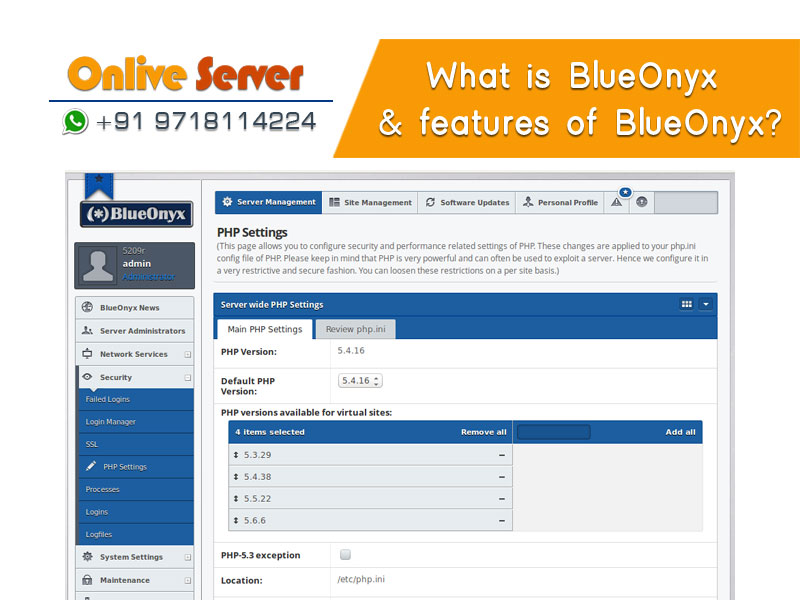
Administrators can host hundreds of individual websites (“Virtual Sites” or “V-Sites”) on a single physical or virtual machine. Each V-Site receives dedicated disk quotas, bandwidth limits, email accounts, independent SSL certificates, and custom PHP versions (including PHP-FPM integration for high performance).
2. Multi-PHP & Modern Web Stack Support
Modern BlueOnyx releases include native support for multiple concurrent PHP versions (from legacy PHP 7.4 through PHP 8.1, 8.2, and 8.3). Administrators can assign distinct PHP versions per website with individual memory limits, execution time thresholds, and OPcache configurations.
3. Built-In Security & Automated Defense
Security is integrated directly into the core operating stack:
- ModSecurity & OWASP Rules: Active Web Application Firewall (WAF) integration protecting web apps from SQL injection and XSS exploits.
- Fail2ban & CCE Security: Automated IP blocking for brute-force SSH, FTP, web login, and mail authentication attempts.
- Let’s Encrypt Integration: Point-and-click automated issuance and auto-renewal of free SSL certificates for all hosted domains.
- Mail Hardening: Postfix/Sendmail configured with SpamAssassin, ClamAV antivirus, and automated SPF/DKIM signing.
BlueOnyx vs. cPanel vs. Webmin: How Do They Compare?
Understanding the trade-offs between a turnkey appliance like BlueOnyx and standard control panels helps you choose the right hosting foundation:
| Feature / Capability | BlueOnyx | cPanel | Webmin |
|---|---|---|---|
| Architecture Model | Turnkey OS appliance + CCE DB | Standalone panel on Linux | Modular Perl Web GUI |
| Cost / Licensing | 100% Free & Open Source | Commercial (Recurring fee) | Free & Open Source |
| Multi-Site Virtual Hosting | Native built-in V-Sites | Native multi-account | Requires Virtualmin module |
| Hardware Footprint | Moderate (~500MB RAM) | Heavy (1GB – 2GB RAM) | Very Low (< 150MB RAM) |
Deploying BlueOnyx on enterprise KVM cloud servers provides the perfect balance of isolated hardware resources and snapshot flexibility. Configuring private VLAN networks between BlueOnyx web appliances and backend database nodes ensures strict data security. With automated nightly snapshots, administrators can roll back system changes instantly in case of configuration errors.
For enterprise hosting deployments where security, high concurrency, and complete hardware control are critical, deploying BlueOnyx on bare metal dedicated server infrastructure delivers maximum raw throughput with zero hypervisor overhead.
- CCEd Configuration Engine: Object-oriented transactional database eliminating configuration file corruption.
- Vsite Multi-Tenant Isolation: Dedicated Unix UID/GID boundaries with chrooted shell jail environments.
- Automated SSL Daemons: Continuous Let’s Encrypt certificates with automated ACME challenge verification.
- Active Monitor (swatch): Built-in system watchdog resolving service stalls before outages manifest.
Deploying BlueOnyx on Modern Infrastructure
BlueOnyx can be deployed in two primary configurations:
- Dedicated Bare Metal Appliance: Best for hosting providers seeking a complete replacement for expensive proprietary shared hosting platforms without recurring licensing costs.
- Virtual Private Server (VPS): Best for developers and agencies seeking a self-contained staging or production environment. Running BlueOnyx on high-speed Linux VPS hosting provides fast provisioning, dedicated CPU cores, and scalable NVMe storage.
If you are evaluating open-source server administration interfaces that work on existing Linux distributions without an appliance wrapper, check out our guide on the Webmin server management panel.
BlueOnyx Vsite Virtualization & CCEd Architecture in Production
Underneath the intuitive graphical interface of BlueOnyx lies a sophisticated, modular systems administration core centered on the Cobalt Configuration Engine daemon (cced). Unlike conventional control panels that directly edit text configuration files synchronously from web scripts, BlueOnyx routes all management directives through CCEd. This object-oriented database architecture treats each server resource—ranging from virtual sites (Vsites) to network interfaces and DNS records—as schema-enforced database entities. When an administrator or API client modifies a domain property, CCEd executes validated event handlers in a deterministic transaction sequence, eliminating race conditions and syntax corruption across Apache, Sendmail, and Postfix configurations.
Multi-tenant virtual site isolation within BlueOnyx is implemented using Unix user-group encapsulation paired with filesystem quota enforcement. Each provisioned Vsite receives dedicated Linux UID/GID boundaries, preventing shared-hosting tenants from reading cross-directory payloads. Furthermore, BlueOnyx natively implements Chrooted Shell jails and sftp-only access restrictions, locking untrusted users within their respective document roots. The integration of Automated Let’s Encrypt certificate renewal daemons ensures that every provisioned virtual site maintains perpetual TLS/SSL encryption with automated ACME challenge verification.
To ensure resilient system health across remote enterprise deployments, BlueOnyx features an autonomous system monitoring subsystem known as Active Monitor (swatch). Running as a scheduled cron service, Active Monitor interrogates vital Linux subsystems—including disk I/O wait times, memory saturation, swap exhaustion, and service responsiveness across Apache, MariaDB, and SSH. If an essential daemon becomes unresponsive, Active Monitor automatically attempts graceful service remediation, logs diagnostic telemetry, and dispatches administrative alerts before end-user outages occur.
Frequently Asked Questions (FAQ)
Is BlueOnyx free and open source?
Yes. BlueOnyx is 100% free and open-source software licensed under the Sun modified BSD license. There are no per-user, per-domain, or monthly licensing fees.
What operating systems support BlueOnyx?
Modern BlueOnyx versions run on enterprise Linux distributions including AlmaLinux 8 and 9, Rocky Linux 8 and 9, and historically CentOS 7/8.
Does BlueOnyx support multiple PHP versions?
Yes. BlueOnyx natively supports running multiple concurrent PHP versions via PHP-FPM, allowing administrators to assign different PHP versions to individual virtual sites.
What is the Cobalt Configuration Engine (CCE)?
CCE is the transactional object-oriented configuration engine at the heart of BlueOnyx. It stores server configuration data in an internal object database and compiles system configuration files through atomic event handlers.
Can BlueOnyx issue automated SSL certificates?
Yes. BlueOnyx features automated Let’s Encrypt integration for provisioning, installing, and auto-renewing SSL certificates across all hosted virtual sites.
Conclusion: A Proven Appliance for Open-Source Hosting
BlueOnyx proves that open-source hosting software can match the stability and multi-tenant capabilities of commercial control panels. By leveraging the proven Sausalito CCE engine and pairing it with modern enterprise Linux releases, BlueOnyx provides sysadmins with a robust, turnkey hosting platform free from recurring licensing overhead.
