

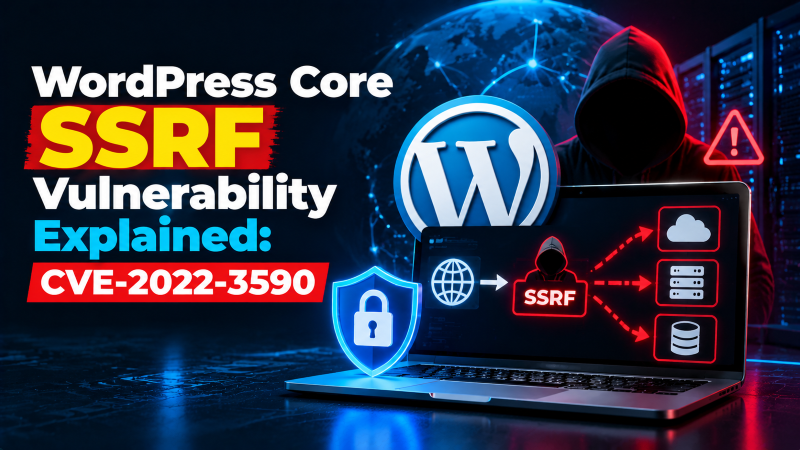
CVE-2022-3590 is a Server-Side Request Forgery (SSRF) vulnerability affecting WordPress Core prior to version 6.1.1. Rooted within the legacy `pingback.ping` XML-RPC mechanism, the vulnerability allows unauthenticated remote attackers to force the WordPress host server into issuing unauthorized HTTP requests to internal localhost addresses (`127.0.0.1`), private LAN IP subnets, and cloud instance metadata endpoints (`169.254.169.254`). Complete remediation requires upgrading to the latest WordPress release and completely disabling `xmlrpc.php` via web server configuration directives.
Server-Side Request Forgery represents one of the most perilous vulnerability classes in modern web hosting. By exploiting SSRF flaws, attackers convert public-facing web servers into internal network proxies. For verified technical specifications and deployment parameters, consult the official NIST National Vulnerability Database.
In cloud-hosted architectures, SSRF allows unauthorized actors to bypass edge firewalls, map private database subnets, and query internal instance metadata to steal secret API keys and IAM credentials.
Deploying hardened WordPress installations on an isolated hardened WordPress VPS ensures that administrative endpoints, internal network interfaces, and database credentials remain strictly segmented.
Technical Root Cause: Flawed URL Validation in `pingback.ping`
WordPress includes a legacy XML-RPC pingback mechanism designed in the early 2000s to notify blog authors when another website links to their content. The server verifies this link by making an outbound HTTP request to the target URL.
While WordPress implemented URL filtering logic to block private IP ranges, security researchers identified bypasses in `wp_http_validate_url()` that allowed crafted domain names or DNS rebinding techniques to circumvent the filter.
Consequently, an attacker could submit a pingback XML payload specifying `http://169.254.169.254/latest/meta-data/` or internal database ports, forcing the server to query internal services and report connection statuses.
For organizations operating mission-critical portals across unshared dedicated server infrastructure, isolating private management networks prevents compromised web daemons from reaching internal hardware nodes.
Why Legacy XML-RPC Must Be Disabled Completely
In modern web development, XML-RPC is almost entirely obsolete. Modern mobile applications, the WordPress block editor, and third-party integrations communicate via the authenticated WordPress REST API.
Leaving `xmlrpc.php` accessible on your server provides zero operational benefit while continuously exposing your site to SSRF attacks, brute-force password amplification, and DDoS reflection exploits.
Blocking all access to `xmlrpc.php` at the Nginx or Apache web server level neutralizes CVE-2022-3590 permanently, regardless of whether future URL filter bypasses are discovered.
Configuring proper Nginx block directives, iptables egress filtering, and web application firewalls is streamlined with technical guidance from a certified systems engineer.
Step-by-Step Server Hardening Configurations
Hardening your server against SSRF requires blocking external access to the vulnerable file and preventing your web server from reaching sensitive internal network subnets.
For Nginx web servers, add a location block inside your virtual host configuration: `location = /xmlrpc.php { deny all; return 403; }`. Save the file and execute `nginx -s reload` to apply the block instantly.
For Apache web servers, insert the following directive into your root `.htaccess` file: `
| Hardening Technique | Configuration Method | Security Impact |
|---|---|---|
| Block `xmlrpc.php` | Nginx / Apache HTTP 403 Rule | Completely eliminates pingback SSRF vector |
| WordPress Core Update | WP-CLI / Dashboard Auto-Update | Patches underlying URL validation logic |
| Block Cloud Metadata IP | Iptables: drop 169.254.169.254 egress | Prevents credential harvesting from cloud metadata |
| Disable Pingback via Filter | `add_filter(‘xmlrpc_methods’)` in theme | Disables pingback functions while leaving Jetpack active |
| WAF Request Filtering | Cloudflare / ModSecurity Rules | Inspects XML payloads for private IP addresses |
Blocking Outbound Cloud Metadata Requests via Iptables
A crucial defense-in-depth practice for cloud virtual machines is configuring host-level firewall rules to block the web server user (`www-data` or `nginx`) from contacting the link-local metadata address `169.254.169.254`.
Executing `iptables -A OUTPUT -m owner –uid-owner www-data -d 169.254.169.254 -j DROP` ensures that even if an application suffers from an undiscovered SSRF vulnerability, the kernel halts any request targeting cloud metadata.
This single firewall directive halts automated token theft scripts, protecting your cloud hosting account from full administrative takeover.
Network Segmentation for Internal Databases: Placing database servers on isolated private subnets inaccessible from the web server’s outbound interface prevents SSRF-based port reconnaissance.
Automated Core Updates: Enabling background security updates in `wp-config.php` ensures critical WordPress vulnerability patches apply automatically within hours of release.
Audit Logging for XML-RPC Traffic: Monitoring web server access logs for repeated POST requests to `xmlrpc.php` identifies malicious reconnaissance before exploitation occurs.
Defense-in-Depth via Subnet Egress Filtering: Configuring kernel-level iptables rules to drop outbound packets targeting private RFC 1918 subnets (`10.0.0.0/8`, `172.16.0.0/12`, `192.168.0.0/16`) stops SSRF probes from mapping internal infrastructure.
DNS Rebinding Attack Prevention: Deploying DNS resolver validation blocks domains that resolve to public IPs initially but rebind to internal localhost addresses during subsequent request execution, neutralizing advanced SSRF bypasses.
Automated Endpoint Monitoring: Scheduled security auditing tools verify that `/xmlrpc.php` remains blocked with HTTP 403 responses across all active virtual host configurations.
Cloud Metadata Exfiltration and Internal Network Pivoting Mechanics
Server-Side Request Forgery vulnerabilities represent severe security threats because they allow remote adversaries to abuse the server as an internal proxy. In cloud-hosted infrastructure (such as AWS, Google Cloud, or Azure), servers have access to internal metadata services via fixed non-routable IP addresses.
When an unauthenticated or low-privileged attacker tricks WordPress into dispatching an HTTP request to http://169.254.169.254/latest/meta-data/, the cloud provider responds with temporary IAM credentials, security keys, and instance identity tokens. With these stolen cloud credentials in hand, attackers can pivot from a simple web application exploit to taking over entire corporate cloud networks.
Beyond cloud metadata exfiltration, internal SSRF requests can probe sensitive private ports inside local Docker bridges or private subnets. Attackers can interact with unauthenticated Redis caches, internal Elasticsearch clusters, or microservice APIs that were never designed for direct public exposure.
DNS Rebinding and IP Validation Bypass Techniques
Naive SSRF filters often attempt to validate user-supplied URLs by performing a single DNS lookup and checking whether the resolved address falls within a private IP range. Sophisticated attackers easily bypass these superficial checks using DNS rebinding techniques.
By establishing a custom nameserver with an ultra-low TTL (Time-To-Live), the attacker causes the first DNS query to resolve to a legitimate public IP address during application validation. When the server subsequently initiates the actual data connection, the nameserver responds with 127.0.0.1 or an internal private subnet address.
- Time-of-Check vs. Time-of-Use (TOCTOU): Resolving domain names separately from connection sockets creates exploitable timing gaps.
- Decimal and Octal IP Encodings: Bypassing regex filters by encoding target loopback IPs into alternate numeric formats like
0x7f000001. - IPv6 Dual-Stack Loopholes: Utilizing IPv6 representations such as
[::1]to connect to local services when IPv4 filters are enforced. - HTTP Redirect Chains: Providing a public URL that issues a 302 redirect toward internal localhost or metadata services.
Hardening Server Egress and Network Perimeter Security
Eliminating SSRF exposure requires enforcing strict egress traffic filtering at the operating system and cloud hypervisor levels. By default, production web servers should be explicitly prohibited from initiating outbound connections to local loopback addresses or internal cloud metadata endpoints.
Configuring Linux kernel packet filters via iptables or nftables blocks unauthorized outbound communication before sockets are established. Furthermore, deploying modern cloud IMDSv2 metadata services enforces session-token headers that completely neutralize unauthenticated SSRF exfiltration attempts.
- Strict IMDSv2 Enforcement: Disable legacy IMDSv1 across cloud virtual instances to mandate session token headers for metadata access.
- Kernel Egress Filtering: Use iptables to reject all outbound packets destined for
169.254.169.254originating from the web server user. - Isolated VPC Subnets: Place database and backend cache clusters inside private subnets that reject incoming connections from web frontends except on authorized ports.
- Safe HTTP Client Wrappers: Utilize robust HTTP client libraries that pin DNS resolutions and validate socket IP destinations before sending data.
Validating Egress Traffic Filtering with Iptables Drop Rules
Testing server egress firewall configurations ensures that application-level SSRF vulnerabilities cannot successfully establish socket connections to cloud metadata endpoints. Administrators can verify protection by attempting outbound curl calls to link-local IP addresses directly from web application user accounts.
Configuring iptables to drop outbound packets targeting 169.254.169.254 terminates malicious SSRF requests instantly at the Linux kernel boundary. Combining network-level egress blocks with application security headers delivers comprehensive protection against zero-day request forgery exploits.
Conclusion: Building Resilient Web Architectures Against SSRF Exploits
Vulnerabilities like CVE-2022-21664 serve as crucial reminders that server trust boundaries must be rigorously defended both from inbound traffic and outbound data requests. Relying solely on internal application code validation leaves infrastructure dangerously exposed to complex rebinding and parsing exploits.
By implementing defense-in-depth measures, enforcing modern cloud metadata tokens, and restricting kernel network egress, enterprise administrators can permanently protect their internal networks from server-side request forgery risks.
Frequently Asked Questions
What is a Server-Side Request Forgery (SSRF) attack?
An SSRF attack tricks a web server into making unauthorized network requests to internal services or external third-party systems that are not accessible directly from the public internet.
Will disabling `xmlrpc.php` break my WordPress website?
No. Standard website functions, themes, plugins, and modern mobile app connections use the WordPress REST API and operate completely normally without XML-RPC.
Does Jetpack require XML-RPC to function?
Jetpack historically utilized XML-RPC. If your site relies on Jetpack, you can whitelist Automattic’s official IP ranges while blocking all public traffic to `xmlrpc.php`.
Which WordPress versions are vulnerable to CVE-2022-3590?
All WordPress Core versions prior to 6.1.1 are vulnerable to this flaw. Updating to WordPress 6.1.1 or any newer release includes the official security patch.
How can I test if `xmlrpc.php` is blocked on my server?
You can execute `curl -I https://yourdomain.com/xmlrpc.php` from your terminal. If properly blocked, the web server will return an HTTP 403 Forbidden response code.