

Quick Answer: Executive Summary
⚡ Architecture & Workload Verified
Key Architectural Highlights for VPS Server
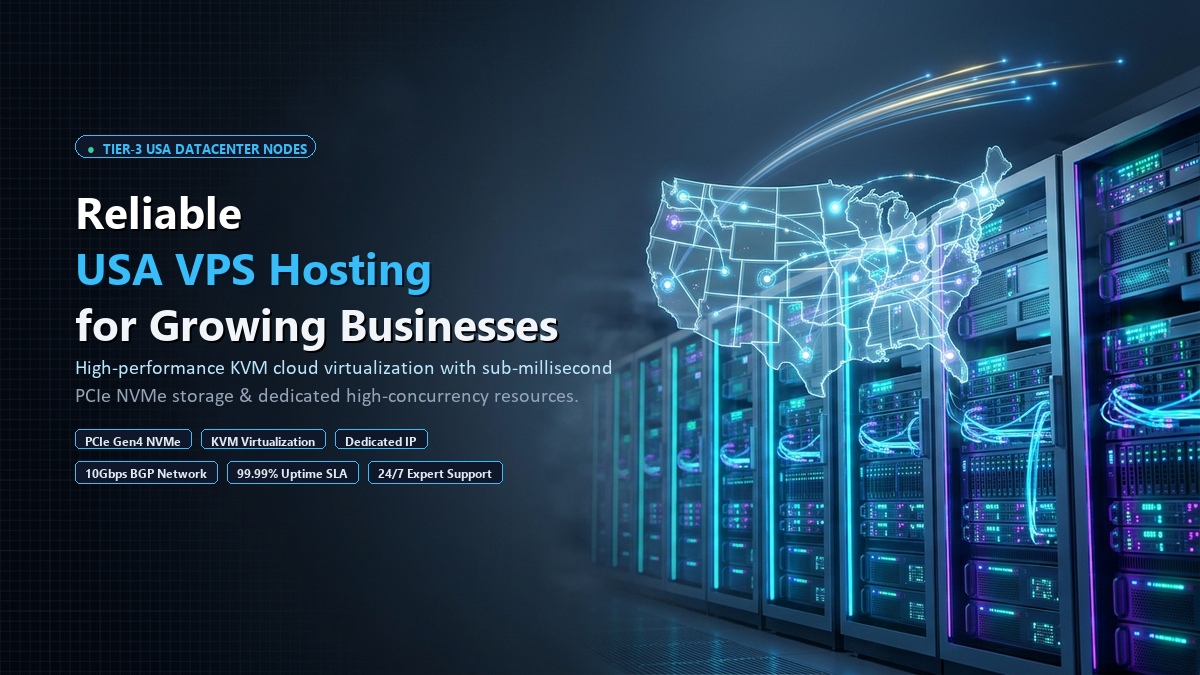
Reliable USA VPS Server Hosting delivers dedicated enterprise computing through modern KVM virtualization. Every virtual instance isolates vCPU cores, physical ECC memory channels, and Gen4 NVMe arrays. Consequently, growing digital businesses achieve sub-millisecond execution, dedicated root administration, and seamless horizontal scaling across Tier-3 American datacenters.
Rapid business growth frequently pushes shared hosting beyond its operational limits. Suddenly, unexpected traffic surges cause database timeouts and processor throttling. To maintain high performance, forward-thinking enterprises deploy Reliable USA VPS Server Hosting. This infrastructure bridges the performance gap between entry-level hosting and costly dedicated machines.
Specifically, virtual private servers leverage modern hardware virtualization. By dividing enterprise physical nodes into isolated virtual partitions, each client receives dedicated compute allocations. In addition, US-based hosting places your application directly adjacent to major North American internet backbones. Consequently, your target audience enjoys rapid page rendering and minimal network latency.
Furthermore, expanding workloads demand complete architectural autonomy. Whether you run high-traffic ecommerce portals, API microservices, or custom databases, virtualization provides total root control. Below, we examine the technical mechanics of virtual private servers and explore the strategic benefits for expanding enterprises.
Kernel-based virtualization guarantees true hardware isolation. Thus, adjacent tenants cannot access your memory addresses or consume your vCPU cycles.
PCIe Gen4 NVMe arrays deliver over 600,000 IOPS. As a result, database queries and backend scripts execute with zero disk queue delays.
Redundant 10Gbps uplinks route packets directly through central US backbones. Therefore, your digital services maintain sub-25ms latency nationwide.
📌 Executive Chapter Index
Architecture Navigation
- 01How Reliable USA VPS Server Hosting Works→
- 02Hardware Resource Allocation & Virtualization→
- 03Core Benefits of Reliable USA VPS Server Hosting→
- 04Enterprise NVMe Storage & Database IOPS→
- 05Linux Kernel Tuning & Network Optimizations→
- 06Sizing & Choosing Reliable USA VPS Server Hosting Plans→
- 07Frequently Asked Questions (FAQ)→
How Reliable USA VPS Server Hosting Works: KVM Architecture & Hypervisor Scheduling
Understanding modern virtual server architecture requires analyzing the hypervisor layer. A hypervisor serves as a hardware abstraction platform running on bare-metal servers. Industry leaders prefer the Kernel-based Virtual Machine (KVM Documentation) hypervisor. Notably, KVM turns the host Linux kernel into a Type-1 bare-metal hypervisor.
Specifically, KVM uses processor extensions like Intel VT-x and AMD-V. These hardware extensions allow guest operating systems to execute instructions directly on physical CPU cores. Consequently, virtualization overhead drops below two percent. Moreover, each virtual machine runs its own independent kernel space and user space.
In contrast, container solutions like OpenVZ share one host kernel across all tenants. This shared kernel design exposes users to crashes caused by neighboring accounts. Therefore, deploying high-performance USA VPS infrastructure ensures strict boundary isolation. Even if a neighboring instance encounters a severe kernel crash, your server remains fully stable.
# Verify KVM hardware virtualization support and module loading on host node
$ egrep -c '(vmx|svm)' /proc/cpuinfo
32 # Confirms 32 physical execution threads with hardware virtualization
$ lsmod | grep kvm
kvm_intel             380928  0
kvm                  1105920  1 kvm_intel
Hardware Resource Allocation: vCPU Scheduling, RAM Virtualization & Memory Isolation
Sustained server performance depends directly on deterministic hardware resource scheduling. When you launch a virtual instance, the hypervisor translates virtual CPU requests into host scheduler threads. In enterprise KVM deployments, the Linux Completely Fair Scheduler (CFS) allocates processor cycles with exceptional precision.
Furthermore, dedicated memory virtualization utilizes Extended Page Tables (EPT). These CPU mechanisms map virtual memory addresses directly to physical host RAM chips. In addition, quality infrastructure strictly disables aggressive memory ballooning and page deduplication. Consequently, your allocated RAM remains physically locked and dedicated exclusively to your applications.
Notably, low-budget providers often overcommit host RAM by two hundred percent. Under heavy concurrent loads, this risky practice triggers the host Out-Of-Memory (OOM) killer. Conversely, professional infrastructure maintains strict one-to-one memory provisioning. Therefore, database caches in Redis and MySQL never suffer sudden evictions.
lscpu. Confirming NUMA node affinity ensures that database execution threads avoid cross-socket bus latency penalties.Core Performance Benefits of Reliable USA VPS Server Hosting
Deploying your critical applications on Reliable USA VPS Server Hosting unlocks immediate operational advantages. First, administrative autonomy transforms how development teams operate. With unrestricted root SSH access, software engineers install custom runtime packages, configure firewall rules, and compile optimized web server modules.
Second, geographic proximity plays a critical role in user conversion rates. Hosting in North America connects your platform directly to Tier-1 network carriers. Consequently, round-trip network time to major American commercial centers drops to 15–25 milliseconds. Furthermore, domestic hosting eliminates unnecessary transit delays for North American audiences.
Third, modern cloud hypervisors deliver exceptional horizontal and vertical scalability. When promotional campaigns trigger massive traffic spikes, administrators upgrade vCPU counts and memory allocations instantly. Thus, your business absorbs sudden demand without complex manual server migrations.
| Technical Metric | Shared Web Hosting | Reliable USA VPS | Bare Metal Dedicated |
|---|---|---|---|
| Compute Isolation | Shared OS Pool | Hardware KVM Slicing | 100% Dedicated Hardware |
| Root / Admin Control | No Access | Full Root SSH | Full Root + IPMI/KVM |
| Storage Subsystem | Shared SATA / HDD | Enterprise NVMe RAID 10 | Dedicated Hardware NVMe |
| Monthly Cost Profile | Very Low ($3-$10) | Balanced Scalable ($15-$75) | Enterprise ($120-$500+) |
Enterprise NVMe Storage Subsystems & Database IOPS Throughput
Storage input/output represents the primary bottleneck in web application scaling. Legacy SATA solid-state drives communicate through legacy AHCI protocols. In contrast, Non-Volatile Memory Express (NVMe) communicates directly across high-speed PCIe bus lanes.
Specifically, NVMe supports 64,000 independent command queues. Each queue holds up to 64,000 concurrent commands. Conversely, traditional SATA drives handle only one queue with 32 commands. Consequently, enterprise NVMe storage arrays process complex relational database queries in microsecond execution windows.
Furthermore, production host nodes combine solid-state drives into redundant hardware RAID 10 arrays. This architecture delivers massive disk read and write throughput. In addition, it protects against physical drive failures. Therefore, transactional applications like WooCommerce and Magento execute with rock-solid stability.
# Benchmark 4K random read/write IOPS using Flexible I/O Tester (FIO)
$ fio --name=randwrite --ioengine=libaio --iodepth=64 --rw=randwrite --bs=4k --direct=1 --size=2G --numjobs=4 --runtime=30 --group_reporting
Jobs: 4 (f=4): [w(4)][100.0%][w=482MiB/s][w=123k IOPS][eta 00:00:00]
  write: IOPS=123,412, BW=482MiB/s (505MB/s)(14.1GiB/30002msec)
  lat (usec): min=82, max=1840, avg=194.21, stdev=41.12
Linux Kernel Tuning & High-Concurrency Network Optimizations for USA VPS
Achieving maximum throughput requires fine-tuning default Linux kernel parameters. Standard operating system distributions deploy conservative network stack values designed for general desktop computers. However, production web servers must handle thousands of simultaneous TCP connections without packet dropping.
Specifically, administrators should adjust socket receive buffers, TCP window sizes, and backlog queues. Enabling Google BBR congestion control significantly improves throughput across long-distance transit routes. In addition, increasing file descriptor limits prevents frustrating connection drops during viral traffic surges.
Consequently, proactive kernel configuration unlocks the full performance of your physical network port. Therefore, your digital services sustain high concurrency with predictable latency profiles.
# Append high-performance network tuning to /etc/sysctl.conf
net.core.somaxconn = 65535
net.ipv4.tcp_max_syn_backlog = 16384
net.core.netdev_max_backlog = 16384
net.ipv4.tcp_congestion_control = bbr
net.core.default_qdisc = fq
$ sudo sysctl -p # Apply settings instantly without reboot
Sizing & Choosing Reliable USA VPS Server Hosting Plans
Selecting the appropriate server tier requires realistic workload evaluation. First, calculate your expected concurrent users and backend memory footprint. For instance, a lightweight WordPress brochure site runs smoothly on two vCPUs with 4GB RAM. In contrast, complex ecommerce environments running Redis caching require at least four to eight vCPUs with 16GB RAM.
Furthermore, evaluate your operational management capabilities. If your engineering staff possesses strong Linux administration skills, a self-managed server offers maximum flexibility. However, companies without dedicated systems administrators should choose fully managed support. Managed solutions delegate security patching, automated backups, and kernel monitoring to expert datacenter technicians.
Ultimately, choosing Reliable USA VPS Server Hosting safeguards your brand reputation. By providing dedicated resources and enterprise-grade hardware, your digital operations maintain high availability around the clock. If your application requirements expand beyond virtualized slicing, you can seamlessly migrate toward an unmetered USA Dedicated Server.
Frequently Asked Questions
Frequently Asked Questions About USA VPS Infrastructure
What is the main difference between shared hosting and a USA VPS?
Why should businesses choose a VPS located specifically in the United States?
How does KVM virtualization prevent the noisy neighbor problem?
Can I easily scale my USA VPS server resources as traffic increases?
What control panel options are available for managing a USA VPS?
Supercharge Your Applications With High-Speed USA VPS Hosting
Deploy high-performance KVM virtual private servers hosted in Tier-3 USA datacenters. Enjoy pure Gen4 NVMe storage, dedicated vCPU resources, 10Gbps network uplinks, and 24/7 priority support with 99.9% uptime.
✓ Gen4 NVMe RAID 10
✓ 10Gbps Multi-Homed Network
✓ 24/7 Priority SLA Support
Explore USA Dedicated Servers