

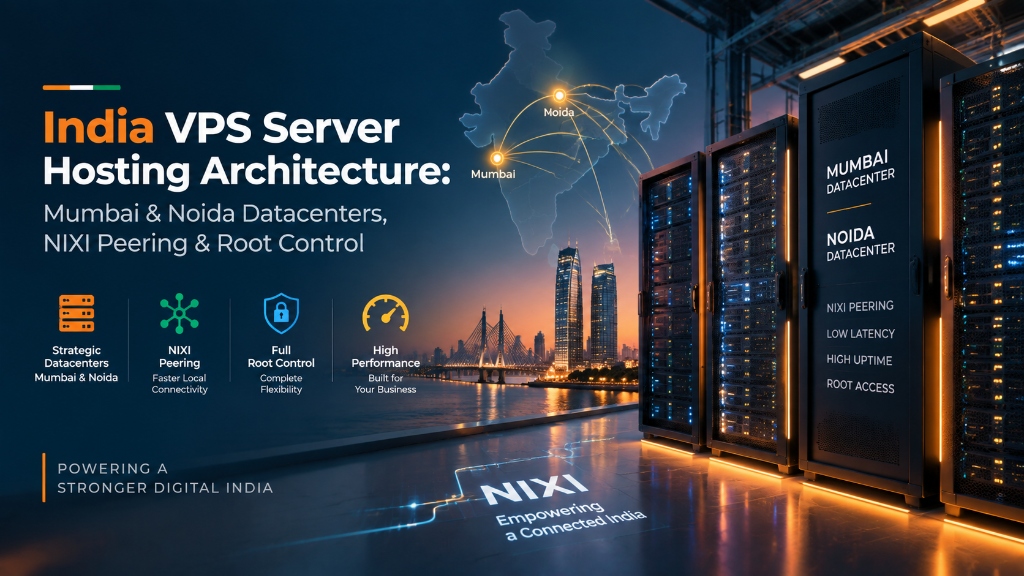
Operating high-throughput digital services, fintech applications, and e-commerce portals across the Indian subcontinent requires a hosting infrastructure engineered for low domestic latency, strict regulatory compliance, and reliable computational determinism. Deploying workloads on overseas cloud instances introduces latency penalties exceeding 150 milliseconds that degrade user experience and reduce transaction conversion rates. An enterprise virtual private server provisioned within Indian Tier-3 data centers delivers root administrative control, local data sovereignty, and unthrottled domestic transit.
- Direct domestic peering via the National Internet Exchange of India (NIXI) routes national traffic across high-capacity fiber rings without international transit hops.
- Hardware-isolated KVM hypervisors pair with enterprise NVMe storage arrays to guarantee dedicated virtual CPU execution and unthrottled memory throughput.
To eliminate network latency bottlenecks across the Indian subcontinent and ensure uninterrupted service availability, growing businesses deploy high-performance vps india infrastructure backed by redundant enterprise hardware and carrier-neutral connectivity.
Indian Telecommunications Topography: Mumbai and Noida Datacenter Hubs
India’s digital economy is anchored by strategic telecommunications corridors centered in Mumbai and Noida. Mumbai functions as the primary subsea fiber gateway for the nation, housing landings for major undersea cables connecting India to Europe, the Middle East, and Southeast Asia.
Hosting infrastructure within Mumbai and Noida data centers delivers sub-10ms latency across major metropolitan zones, including Delhi NCR, Bengaluru, Hyderabad, Chennai, and Pune. This geographic proximity ensures that database-driven web platforms, corporate APIs, and payment gateways execute with instantaneous responsiveness.
Furthermore, hosting locally inside India ensures full compliance with the Digital Personal Data Protection Act (DPDPA 2023) and Reserve Bank of India (RBI) data localization mandates. Storing consumer records, payment card tokens, and transactional archives within Indian borders eliminates the legal complexities associated with foreign data hosting jurisdictions.
Hypervisor Management and Simplified VPS Control with Virtualizor
Efficient infrastructure administration requires robust hypervisor management panels that enable rapid server provisioning, real-time resource telemetry, and automated snapshot backups. System administrators need complete autonomy over virtual instances without submitting manual support tickets.
To understand the operational capabilities of modern virtualization control systems, read our comprehensive overview on what is virtualizor simple guide to vps management.
Virtualizor allows administrators to manage KVM virtual machines through an intuitive web interface. From one centralized dashboard, engineers can perform live reboots, execute one-click operating system provisioning, configure custom reverse DNS (rDNS) records, and monitor real-time CPU, RAM, and disk IOPS metrics.
For latency-critical SaaS and database backends, ensure your VPS utilizes Kernel-based Virtual Machine (KVM) virtualization with dedicated vCPU core affinity. This completely eliminates noisy-neighbor performance throttling.
Multi-Layered Security Architecture: Firewalls, SSL, and Threat Defense
Public-facing web servers in India face constant automated threat scanning, including brute-force SSH credential attacks, distributed denial-of-service (DDoS) flood campaigns, and SQL injection attempts. Safeguarding enterprise digital assets requires multi-layered perimeter and host defenses.
For an exhaustive breakdown of enterprise cybersecurity baselines, review our technical guide on the ultimate guide to website security ssl ddos malware phishing protection.
Indian VPS hosting incorporates hardware-level Anti-DDoS mitigation appliances at the datacenter border, filtering volumetric SYN, UDP, and ICMP floods before packets reach the virtual server network adapter. At the operating system layer, administrators configure hardened UFW firewalls, deploy Fail2ban intrusion prevention daemons, and automate TLS certificate lifecycles via Let’s Encrypt.
KVM Virtualization Architecture and Dedicated Resource Allocations
The hypervisor technology underlying a VPS platform determines application runtime predictability and security. Legacy container virtualization platforms like OpenVZ share a single monolithic Linux kernel across all tenant instances on the physical host node, permitting hypervisor resource oversubscription.
In contrast, Kernel-based Virtual Machine (KVM) virtualization creates a true hardware-emulated virtual machine with private virtual BIOS, virtual network adapters, and dedicated memory spaces. KVM hypervisors enforce strict resource boundaries, preventing adjacent virtual tenants from consuming your allocated CPU execution cycles.
System administrators enjoy complete operating system autonomy under KVM, with the ability to install custom Linux distributions, compile specialized kernel security patches, configure custom swap files, and tune network stack parameters via sysctl.
Enterprise cloud instances provisioned on pure NVMe arrays deliver over 500,000 read/write IOPS, ensuring sub-millisecond database query response times even during extreme unpredicted traffic surges.
Storage Performance: NVMe SSD Arrays with Distributed Redundancy
Disk I/O latency represents a critical performance metric for dynamic database engines like MySQL, PostgreSQL, and Redis. Traditional spinning hard drives and SATA solid-state drives create severe I/O bottlenecks when processing concurrent transactional queries.
Modern Indian VPS nodes utilize enterprise NVMe solid-state storage connected directly to host CPU PCIe lanes. NVMe technology delivers throughput speeds exceeding 3,000 MB/s and tens of thousands of concurrent IOPS with sub-millisecond response latency.
Storage arrays operate in fault-tolerant RAID 10 configurations, combining data striping for peak throughput with mirroring for hardware redundancy. If a physical drive degrades, the RAID array continues operating seamlessly without data corruption or service downtime.
Indian Internet Exchanges: Peering Dynamics via NIXI and Extreme IX
Domestic network efficiency across India is driven by direct participation in carrier-neutral internet exchanges. Our Indian server deployments connect directly to the National Internet Exchange of India (NIXI) and Extreme IX.
Direct exchange peering allows domestic internet service providers such as Airtel, Reliance Jio, Tata Communications, and Vodafone Idea to exchange data traffic locally. By keeping domestic data packets within Indian national borders, organizations minimize transit hops and eliminate packet transit jitter.
High-capacity BGP4 routing engines continuously monitor transit paths dynamically, automatically rerouting outbound packets around damaged optical links to guarantee uninterrupted national availability.
Operating System Selection and Development Stack Compatibility
A high-performance VPS must seamlessly support modern web development frameworks and containerized microservices stacks. Administrators can choose from a broad range of operating systems:
| Operating System | Target Workload | Kernel Version | Package Ecosystem | Recommended Tooling |
|---|---|---|---|---|
| Ubuntu 22.04 / 24.04 LTS | Cloud Native & Microservices | Linux 5.15 / 6.8+ | APT / Canonical Snap | Docker, Kubernetes, Nginx |
| Debian 11 / 12 | Rock-Solid Production Servers | Linux 5.10 / 6.1 LTS | APT / Upstream Stable | LEMP Stack, PostgreSQL, Redis |
| AlmaLinux 8 / 9 | Enterprise RHEL Replacement | Linux 4.18 / 5.14 RHEL | DNF / RPM / EPEL | cPanel, DirectAdmin, MariaDB |
| Rocky Linux 9 | Enterprise Systems & FinTech | Linux 5.14 RHEL | DNF / RPM Modules | SELinux Hardening, Node.js |
Automated Backup Strategies and Disaster Recovery Planning
Maintaining high service availability requires reliable data protection frameworks. Indian VPS infrastructure features automated block-level snapshot creation executed on customized schedules.
Snapshots are replicated across physically isolated storage clusters, providing immutable recovery points resistant to accidental deletion or ransomware encryption. Automated integrity verification routines confirm backups can be restored cleanly within minutes.
Administrators should also establish automated off-site synchronization routines using rsync or S3 storage APIs to safeguard application state against facility-wide disaster scenarios.
Conclusion and Deployment Summary
India VPS server hosting delivers the ideal combination of low-latency national connectivity, robust KVM virtualization isolation, and stringent compliance with domestic data regulations. Leveraging enterprise NVMe solid-state storage arrays and direct peering through NIXI ensures outstanding application responsiveness.
Whether deploying enterprise e-commerce portals, fintech processing systems, or high-traffic corporate portals, Indian VPS infrastructure provides the speed, security, and scalability necessary to capture digital opportunities across the subcontinent.
Kernel Hardening and TCP BBR Congestion Control Tuning
Maximizing network throughput across diverse Indian telecommunications networks requires fine-tuning Linux kernel parameters via sysctl configurations. Implementing Google BBR congestion control optimizes data packet flow across mobile 4G and 5G connections, preventing packet queue buildup at intermediate regional routers.
Administrators should also expand the socket listen backlog queue and lower TCP keepalive timeout thresholds. These kernel-level optimizations ensure the virtual server handles sudden traffic surges during regional festival shopping events without dropping active socket connections.
Automated Security Scanning and Proactive System Integrity
Protecting commercial platforms against unauthorized intrusions requires deploying automated host security auditing tools. Integrating Fail2ban daemons with local packet filters automatically blocks IP addresses executing repetitive failed authentication attempts against SSH and administrative web ports.
Automated package update schedules apply critical upstream security patches without service interruption, keeping the server environment shielded against emerging threat vectors while maintaining continuous compliance with corporate security governance.
Proactive hardware telemetry tracks physical host component health, detecting subtle voltage irregularities and memory parity alerts before hardware degradation causes unplanned hosting interruptions for Indian enterprise applications.
Require High-Availability VPS Infrastructure with Guaranteed Uptime?
Deploy enterprise-grade KVM virtual servers backed by pure NVMe storage arrays, automated out-of-band management, and 24/7 technical monitoring.
