
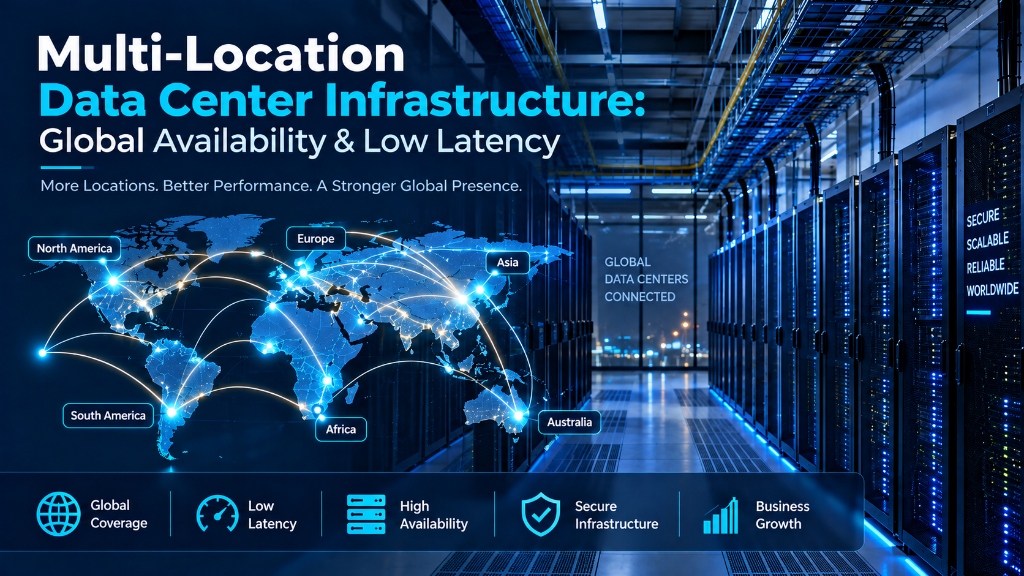
A multi-location data center infrastructure is a geographically distributed deployment of compute, storage, and networking resources across multiple sovereign regions, metropolitan hubs, or countries. By interconnecting independent hosting facilities through high-speed transit and orchestrating traffic via Anycast BGP routing or latency-based GeoDNS, this architecture terminates end-user requests at the topologically closest location. Operating across multiple facilities eliminates single points of failure, reduces physical network distance to lower latency, and enables localized data residency to satisfy jurisdictional privacy frameworks (such as GDPR, HIPAA, or DPDPA). However, achieving true high availability requires active data replication, robust health monitoring, and intelligent automated failover mechanisms.
The Physics of Latency: Why Single-Location Hosting Fails Global Applications
Modern web applications, SaaS platforms, API microservices, and database clusters cannot overcome the fundamental laws of physics when constrained to a single geographical facility. Data packets traveling through terrestrial and submarine fiber-optic cables propagate at roughly two-thirds the speed of light in a vacuum—approximately 200,000 kilometers per second. This fundamental constraint introduces roughly 1 millisecond of round-trip time (RTT) for every 100 kilometers of physical distance, excluding router hops, queueing delays, and packet serialization overhead.
When an enterprise hosts an application exclusively within a single regional facility—such as in North America (e.g., Dallas or New York)—end users located in Western Europe, Tokyo, or Singapore face unavoidable physical latencies ranging from 120ms to over 280ms per round trip. Because modern secure web transactions require multiple sequential packet round trips for DNS resolution, TLS 1.3 handshakes, and TCP connection establishment, a single origin server can induce several seconds of delay before transmitting the first byte of payload data (Time to First Byte, TTFB). This latency penalty degrades search engine rankings, inflates bounce rates, and directly damages conversion rates.
Deploying infrastructure across multiple data center locations resolves this physical barrier by situating computing power within immediate proximity to target user populations. For mission-critical web platforms, pairing high-performance bare metal hardware with multi-region enterprise dedicated server hosting ensures dedicated hardware execution, enterprise SLA guarantees, and carrier-neutral low-latency routing.
What Is a Multi-Location Data Center? Core Architectural Components
At its technical foundation, a multi-location data center infrastructure federates sovereign compute, storage, and networking layers across physically separated, tier-certified facilities. Rather than operating isolated server silos, a mature multi-region topology links locations via high-speed global backbones and intelligent traffic orchestration layers.
Anycast BGP & GeoDNS Ingress
Border Gateway Protocol (BGP) Anycast announces identical IP addresses from multiple edge locations, allowing Internet routers to automatically direct visitor packets along the topologically shortest autonomous system path.
Global Private Network (GPN)
Dedicated fiber interconnects and secure multi-region MPLS/VLAN tunnels bypass the public Internet to synchronize databases and manage inter-cluster RPC traffic with deterministic sub-millisecond jitter.
Active-Active & Active-Passive Nodes
Workloads operate either in active-active topologies (serving write and read queries concurrently across all facilities) or active-passive standby configurations for automated failover during regional incidents.
Distributed Edge DDoS Mitigation
Multi-terabit volumetric DDoS attacks (UDP/NTP amplification, SYN floods) are absorbed and filtered at edge scrubbing nodes across continents before reaching origin application backends.
Geofenced Data Sovereignty
Local compute zones allow organizations to partition user databases to comply with data residency legislation, guaranteeing that sensitive citizen records never cross national borders.
Stateful Compute & Edge Separation
Decoupling dynamic stateless application containers at regional edge facilities from primary transactional database clusters maximizes response speed while protecting relational consistency.
Server Redundancy vs. Facility Redundancy vs. Geographic Redundancy
To design an effective disaster recovery and high-availability strategy, engineering teams must clearly differentiate between three distinct layers of redundancy:
- Server Redundancy (Rack-Level Protection): Involves duplicate components within a single physical server chassis or rack—such as redundant hot-swappable power supplies (PSUs), hardware RAID arrays, dual bonded network interface cards (NICs), and clustered virtual hypervisors. If an individual drive or power supply fails, the server continues operating without interruption. However, it cannot protect against a facility-wide power or network outage.
- Facility Redundancy (Datacenter-Level Protection): Involves independent backup infrastructure within a single physical building—such as N+1 or 2N uninterruptible power supply (UPS) battery systems, on-site diesel backup generators, multi-loop chilled water HVAC systems, and diverse physical fiber entrances. This shields workloads against local grid flickers, but leaves the business vulnerable to localized regional natural disasters, catastrophic flood events, or city-wide fiber severance.
- Geographic Redundancy (Region-Level Protection): Distributes computing clusters across completely independent geographical territories, power grids, and regional transit corridors (e.g., deploying synchronized nodes in Frankfurt, Dallas, and Singapore). If an entire metropolitan grid or undersea cable corridor experiences an outage, traffic is automatically rerouted to distant geographic facilities, ensuring continuous operational survival.
Architectural Comparison: Single-Facility vs. Multi-Location Infrastructure
| Evaluation Metric / Capability | Single Regional Data Center | Multi-Location Distributed Infrastructure |
|---|---|---|
| Global Round-Trip Latency (RTT) | 120ms–350ms for cross-continental visitors; high packet jitter | Sub-20ms to 40ms within regional metropolitan corridors; requests terminate at nearest regional node |
| Disaster Recovery & Redundancy | Single Point of Failure (SPOF); facility outages cause total downtime | Automated failover across independent power grids and transit paths when paired with health monitoring |
| Data Sovereignty Compliance | Severe legal risk; foreign users’ data is processed outside their jurisdiction | Satisfies physical residency requirements; databases geofenced to specific national jurisdictions |
| Volumetric DDoS Mitigation | Vulnerable to uplink saturation when attacks exceed local pipe capacity | Attacks dispersed across global scrubbing centers using Anycast routing |
| Maintenance & Upgrades | Requires scheduled maintenance windows and customer service disruptions | Rolling zero-downtime upgrades by shifting live traffic away from nodes during patching |
| Operational Complexity & Cost | Low complexity; centralized configuration and single management console | Higher architectural complexity; requires distributed consensus, data synchronization, and inter-region transit |
Network Routing Mechanics: How Traffic Directs Across Multi-Location Hubs
Directing global users to the most efficient server location requires intelligent routing at the network and application layers. Infrastructure architects utilize two primary routing strategies depending on application architecture and statefulness:
1. BGP Anycast Routing (Network Layer Routing)
Under an Anycast routing architecture, multiple physical data centers advertise identical IP addresses and BGP prefixes through their Autonomous System Numbers (ASN) to upstream Tier-1 transit carriers. When a user transmits an HTTP request, intermediate Internet routers evaluate Border Gateway Protocol metrics—primarily AS-Path length and network topology—to route packets to the topologically closest data center. Anycast provides seamless automated failover: if a facility’s uplink fails, its BGP route withdrawal instantly redirects global packets to the next nearest operational facility without DNS cache invalidation delays.
2. Latency-Based GeoDNS Routing (Application Layer Routing)
GeoDNS routing evaluates the geographical origin and recursive resolver IP of incoming DNS lookups. The authoritative name server dynamically responds with the A/AAAA record of the data center situated nearest to that specific resolver. GeoDNS is especially effective when pairing dynamic stateless edge nodes with persistent storage layers, allowing enterprises to enforce strict national data residency boundaries and configure customized split-horizon traffic policies.
Real-World Latency Considerations: Centralized vs. Distributed Node Deployment
While multi-location hosting significantly reduces physical transmission distance, actual network latency is governed by routing paths, ISP peering agreements, and transit congestion. The following benchmark table illustrates typical round-trip time (RTT) improvements when terminating traffic at local regional nodes compared to a single centralized US facility:
| End-User Region | Centralized Server (US Central) | Multi-Location Local Node | Typical RTT Improvement |
|---|---|---|---|
| Western Europe (Frankfurt / London) | 115ms–135ms | 12ms–18ms (EU Node) | ~85%–88% Reduction |
| East Asia (Tokyo / Seoul) | 160ms–185ms | 14ms–22ms (APAC Node) | ~85%–89% Reduction |
| Southeast Asia (Singapore) | 220ms–250ms | 10ms–15ms (SG Node) | ~90%–94% Reduction |
| Latin America (São Paulo) | 140ms–175ms | 15ms–25ms (BR Node) | ~80%–86% Reduction |
| North America West Coast (San Jose) | 45ms–65ms | 6ms–12ms (West Coast Node) | ~75%–80% Reduction |
Strategic Decision Framework: Selecting Optimal Server Locations
Deploying a cost-effective and resilient multi-location hosting topology requires a structured engineering evaluation. Sysadmins and IT leaders should follow this five-step decision matrix:
- Analyze Visitor Geolocation Telemetry: Audit application access logs and Real User Monitoring (RUM) metrics to map user clusters. Position primary compute clusters within 500 kilometers of the top 80% of your audience.
- Verify Carrier Density and Internet Exchange (IXP) Peering: Prioritize data center facilities with dense carrier-neutral meet-me rooms connected directly to major exchange points (such as DE-CIX in Frankfurt, AMS-IX in Amsterdam, LINX in London, or NIXI in Mumbai) to avoid suboptimal third-party transit paths.
- Evaluate Data Residency and Regulatory Mandates: Identify whether customer data falls under statutory privacy protections. Segregate relational databases into compliant physical regions while deploying stateless caching proxies globally.
- Determine Database Synchronization Topologies: For write-intensive workloads, deploy asynchronous multi-master replication or active-passive setups with read-replicas situated at edge locations to prevent distributed locking stalls.
- Calculate Geographic Disaster Recovery Separation: Ensure secondary backup facilities are situated on separate power grids and seismic zones—typically at least 250 to 500 miles away from primary sites—to prevent concurrent regional outages.
Strategic Infrastructure Takeaway
A multi-location data center infrastructure is the bedrock of modern high-availability architecture. By distributing computing nodes across primary global hubs and routing traffic via Anycast BGP and GeoDNS, enterprises eliminate single points of failure, slash latency by up to 90%, and fulfill statutory data residency mandates. Combining bare metal dedicated hardware with geographically dispersed edge nodes guarantees the uptime and deterministic speed demanded by mission-critical digital platforms.
Recommended Next Steps & Related Infrastructure Resources
Enterprise Dedicated Servers
Deploy dedicated bare-metal hardware across North America, Europe, and Asia-Pacific facilities.
Cloud VPS Infrastructure
Review scalable KVM virtual instances deployed across distributed international server nodes.
📌 Frequently Asked Questions (FAQ)
Q1
What is a multi-location data center infrastructure?
What is a multi-location data center infrastructure?
Q2
What is the difference between server, facility, and geographic redundancy?
What is the difference between server, facility, and geographic redundancy?
Q3
Does hosting in multiple data centers automatically guarantee zero downtime?
Does hosting in multiple data centers automatically guarantee zero downtime?
Q4
How does multi-location hosting reduce website and application latency?
How does multi-location hosting reduce website and application latency?
Q5
What is the difference between Anycast BGP routing and Latency-Based GeoDNS?
What is the difference between Anycast BGP routing and Latency-Based GeoDNS?
Q6
Does hosting data in regional facilities ensure automatic regulatory compliance?
Does hosting data in regional facilities ensure automatic regulatory compliance?
Q7
What are the main trade-offs and challenges of multi-location infrastructure?
What are the main trade-offs and challenges of multi-location infrastructure?
Ready to Deploy High-Availability Global Infrastructure?
Ensure ultra-low latency, multi-region redundancy, and rock-solid uptime for your mission-critical applications with Onlive Server. Deploy your custom multi-location dedicated server cluster today.

Kartik Singh is an SEO professional with experience in SEO, content strategy, and website optimization. At Onlive Server, he writes and manages content related to web hosting, VPS, dedicated servers, and hosting technologies.