

CVE-2026-56216 is a privilege escalation vulnerability in the Capgo live-update plugin for mobile applications that allows attackers to manipulate application updates and execute unauthorized code. Developers must update the Capgo SDK to the latest patched version and enforce end-to-end cryptographic checksum verification for all live updates.
📑 Table of Contents
Quick NavigationTo ensure round-the-clock infrastructure availability, proactive security hardening, and rapid vulnerability patching, partnering with proactive server management and security support safeguards servers against unauthorized access and operational downtime.
Introduction to CVE-2026-56216
CVE-2026-56216 is a high-severity security flaw found in Capgo, a platform used for application update management and deployment. Attackers can exploit this flaw to perform privilege escalation through improper handling of API keys. The vulnerability carries a CVSS v3.1 score of 8.7 (High), and all Capgo users running affected versions should apply the available patch without delay.
What is Capgo?
Capgo is an update deployment platform that allows software developers to efficiently manage application updates and allocate resources. It is widely used for managing application deployment, API management, and resource allocation within organisations.
Understanding Privilege Escalation Vulnerabilities
A privilege escalation vulnerability occurs when a user or attacker gains access to permissions beyond their authorised level. This is particularly risky because it may enable the attacker to access restricted resources, perform administrative functions, or expose sensitive data. Privilege escalation flaws are frequently exploited to gain greater control over an application or system.
What is CVE-2026-56216?
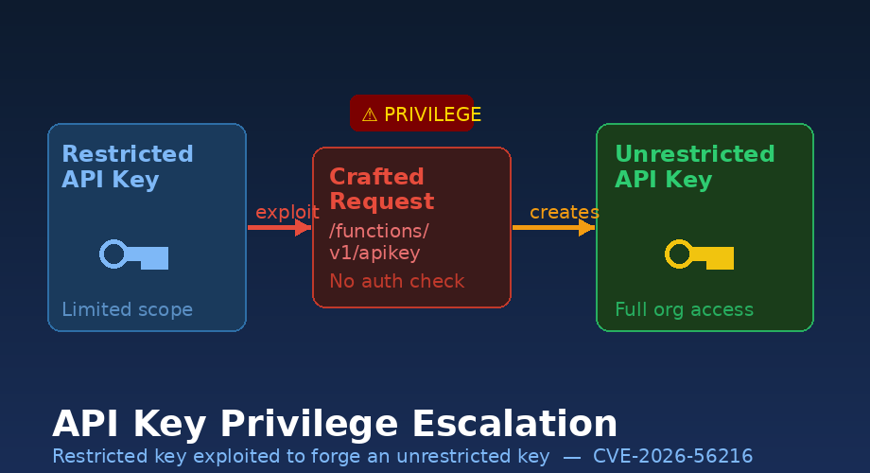
CVE-2026-56216 is a privilege escalation flaw in Capgo affecting all versions prior to v4.8.4. The vulnerability exists in the /functions/v1/apikey endpoint, where an attacker can exploit a restricted API key to create a new key with higher privileges, gaining unauthorised access to protected resources.
How CVE-2026-56216 Works
This vulnerability can be exploited when an attacker obtains an app-limited API key. By sending carefully crafted requests to the /functions/v1/apikey endpoint, the attacker can bypass the authorisation mechanism and create a new unrestricted API key. This new key grants full organisational access to resources including application listings, endpoints, and administrative functions.
Affected Versions
CVE-2026-56216 affects the following versions of Capgo:
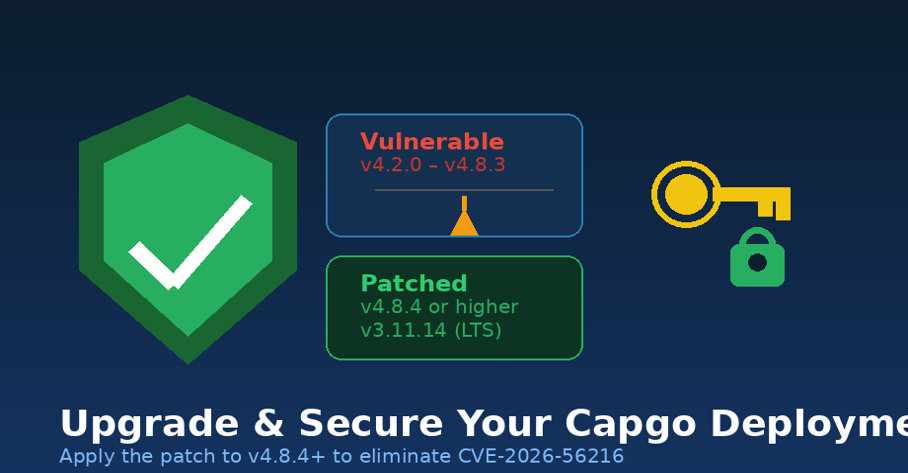
- Vulnerable Versions: All versions from v4.2.0 up to v4.8.3.
- Legacy Branches: Long-Term Support (LTS) versions v3.11.x prior to patch v3.11.14.
- Unaffected Versions: Any installations running v4.8.4 or higher, and the newly patched v5.0.0 release candidate.
Note: If your organization utilizes third-party integrations or custom plugins built on top of these affected versions, your attack surface may be significantly wider.
Potential Security Risks and Impact
CVE-2026-56216 is classified as a High-severity vulnerability with a CVSS v3.1 score of 8.7. The flaw stems from missing authorisation checks on the API key creation endpoint, allowing a low-privileged attacker to escalate their access to full organisational level.
Key Risks:
- Privilege Abuse: An attacker holding a restricted API key can create a new key with elevated permissions, gaining unauthorised access to all organisational resources, application listings, and administrative endpoints without additional credentials.
- Data Exposure: With full organisational API access, an attacker can read, modify, or exfiltrate sensitive application data, configuration files, and deployment settings belonging to the organisation.
- Lateral Movement: Once inside the environment, attackers can leverage the compromised server as a beachhead to pivot into deeper, more sensitive segments of the corporate network.
How to Mitigate and Fix CVE-2026-56216
Immediate action is highly recommended to protect your infrastructure. Follow these steps to secure your environment:
The Definitive Fix: Upgrade Immediately
The most effective resolution is to upgrade your system to the latest patched version.
- Deploy Version 4.8.4 or higher.
- If you are on an LTS track, apply the v3.11.14 patch immediately.
Temporary Mitigations (If You Cannot Patch Today)
If an immediate upgrade is not feasible due to change management restrictions, apply the following temporary workarounds:
- Implement WAF Rules: Configure your Web Application Firewall (WAF) to restrict and monitor requests to the /functions/v1/apikey endpoint, blocking any attempts to create API keys from unauthorised or unexpected sources.
- Network Segmentation: Restrict access to the affected service’s port using firewalls, ensuring only trusted, internal IP addresses can communicate with it.
- Disable Unused Services: If the vulnerable module or API is not business-critical, disable it temporarily through the configuration console.
Conclusion: Proactive Mitigation for Capgo Privilege Escalation Security
CVE-2026-56216 represents a critical security issue that enables attackers to elevate their privileges within the Capgo ecosystem. Immediate upgrading to the latest patched version is essential. Until you can upgrade, applying the recommended mitigations will help reduce the attack surface. For additional security updates and mitigation guides, monitor the official Capgo security channels and deploy mission-critical applications on hardened infrastructure.
Frequently Asked Questions (FAQ)
Has CVE-2026-56216 been exploited in the wild?
Yes. Security researchers have noted active, targeted exploitation attempts by sophisticated threat actors. Organizations should check their application logs for unusual POST requests to the API directory.
Does a standard server reboot mitigate this vulnerability?
No. A reboot does not fix the underlying code flaw. The system will remain completely vulnerable until the patch is applied or explicit configuration workarounds are implemented.
Will upgrading cause any breaking changes or downtime?
Upgrading to the patched release maintains backward compatibility and resolves the API authorization flaw without introducing breaking changes. Any service restart or rolling update can be completed with near-zero downtime.
How can server administrators monitor and detect exploitation attempts targeting CVE-2026-56216?
Administrators should inspect web server access logs for anomalous payload patterns, enable intrusion detection systems (IDS/IPS), and set up automated alert triggers on unexpected process executions.
What server-level security configurations minimize the impact of CVE-2026-56216?
Enforcing strict least-privilege service accounts, isolating application tiers in separate containers, and configuring a robust Web Application Firewall (WAF) significantly mitigates exploitation risks.