

Enterprise Cyber Resilience Guide
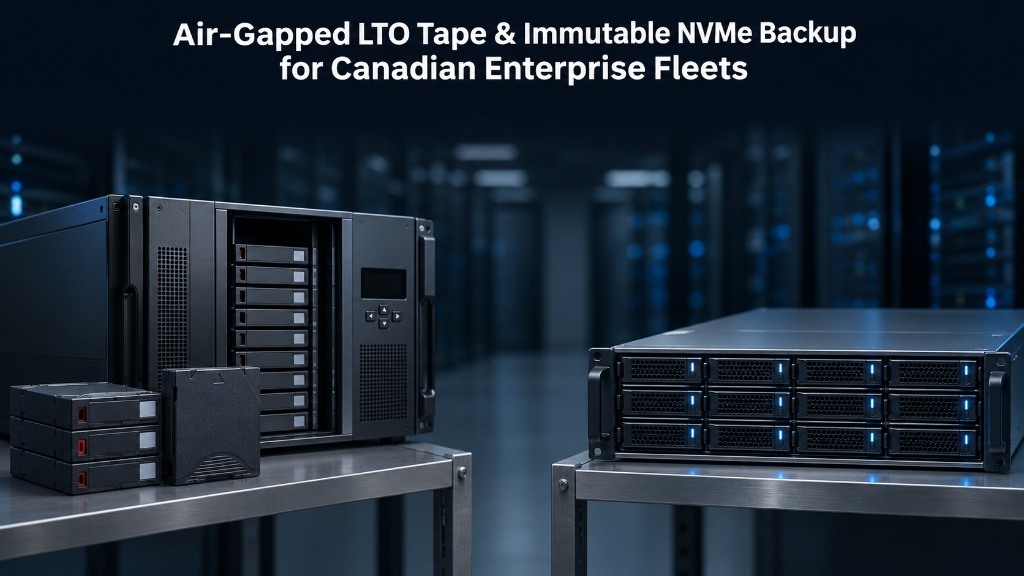
Air-Gapped LTO Tape & Immutable NVMe Backup Architecture (Canada): Safeguarding enterprise infrastructure against modern cyber warfare, catastrophic double-extortion ransomware, and credential compromise requires an uncompromising tiered defense strategy. By deploying single-tenant bare-metal storage servers in Montreal and Toronto, Canada, enterprises combine sub-millisecond local Recovery Time Objectives (RTO) via immutable NVMe Write-Once-Read-Many (WORM) S3 Object Lock with true, offline air-gapped LTO-8 and LTO-9 tape automation. Because air-gapped tape cartridges are physically detached from IP networks, they remain 100% immune to remote lateral encryption attacks. Crucially, keeping all primary and archival copies physically hosted on Canadian soil ensures complete compliance with PIPEDA, Quebec Law 25, and OSFI B-13 guidelines while shielding corporate assets from foreign legal exposure such as the US CLOUD Act.
To achieve total ransomware immunity and regulatory compliance in Canada, enterprises implement a modernized 3-2-1-1-0 backup topology on dedicated bare-metal infrastructure. The hot operational tier leverages PCIe Gen4 NVMe arrays configured with MinIO or Ceph object storage enforcing immutable S3 Object Lock (Compliance Mode) for instant database and VM rollbacks. Concurrently, scheduled backup streams spool to automated LTO-8 or LTO-9 robotic tape libraries. Once written, magnetic tape cartridges are mechanically moved into offline slots or fireproof vault storage—creating an unbreakable physical air-gap that cannot be traversed by malware, corrupted by root account compromise, or destroyed by compromised cloud IAM credentials.
Enterprise ransomware attacks have evolved from simple disk encryption scripts into sophisticated, multi-stage cyber warfare operations. Threat actors such as LockBit, BlackCat (ALPHV), and Akira spend an average of 14 to 28 days silently mapping enterprise networks, escalating privileges, and locating backup repositories. Their primary objective before detonating payloads is the deliberate deletion of online snapshots, shadow copies, and cloud backup buckets. When cybercriminals hold administrative domain credentials or root cloud access, standard online backups offer zero protection against catastrophic corporate paralysis.
For Canadian enterprises across financial services, healthcare, Crown corporations, legal, and critical infrastructure, data protection is both an operational necessity and a stringent statutory mandate. Storing enterprise archives in foreign multi-tenant clouds creates severe compliance vulnerabilities under the Personal Information Protection and Electronic Documents Act (PIPEDA) and Quebec’s Law 25, while exposing sensitive records to foreign extraterritorial subpoenas. Deploying dedicated bare-metal infrastructure via Onlive Server Dedicated Server Canada provides sovereign Montreal and Toronto physical hosting, unmetered multi-gigabit private interconnects, and dedicated hardware control for uncompromising enterprise survivability.
1. Ransomware Threat Model: Why Cloud Snapshots Fail
Public cloud marketing frequently equates virtual machine snapshots with enterprise disaster recovery. In practice, modern adversaries treat online cloud snapshots as their primary reconnaissance targets. When threat actors compromise cloud identity and access management (IAM) credentials, API keys, or hypervisor console accounts, online snapshots are extinguished in seconds.
Unlike legacy malware that encrypted production files blindly, sophisticated extortion syndicates establish persistent footholds inside enterprise networks. They leverage PowerShell, WMI, and API automation to locate Veeam backup repositories, Commvault storage nodes, and cloud buckets. Attackers silently disable immutability timers where permission models permit, wipe backup catalogs, and purge volume shadow copies (VSS) before encrypting production databases. If your secondary and tertiary backup tiers remain connected to an IP address accessible by an administrative credential, your enterprise remains vulnerable to total extortion.
2. The Modern 3-2-1-1-0 Enterprise Backup Topology
The classical 3-2-1 rule is no longer adequate to counter targeted ransomware campaigns. Enterprise security frameworks, including CIS Controls v8 and NIST SP 800-209, mandate the 3-2-1-1-0 architecture, integrating immutable object storage and true offline physical air-gapping:
3. Physical Air-Gapped LTO-8 & LTO-9 Tape Automation
Linear Tape-Open (LTO) Ultrium technology remains the world’s premier offline archival medium. While disk arrays and cloud object storage offer rapid retrieval, tape delivers the ultimate defense: an electronic circuit that can be physically broken. Once a backup job finishes and an automated robotic library parks the tape cartridge, no packet, exploit, or zero-day vulnerability can alter its magnetic state.
Deploying LTO automation within Canadian enterprise infrastructure on Dedicated Server Canada hardware delivers formidable technical performance:
| LTO Generation | Cartridge Native Capacity | Compressed (2.5:1) | Native Transfer Speed | Archival Shelf Life |
|---|---|---|---|---|
| LTO-8 Ultrium | 12.0 TB | 30.0 TB | 360 MB/s (1.30 TB/hr) | 30+ Years |
| LTO-9 Ultrium | 18.0 TB | 45.0 TB | 400 MB/s (1.44 TB/hr) | 30+ Years |
| Dual LTO-9 Library (Parallel) | 36.0 TB concurrent | 90.0 TB concurrent | 800 MB/s (2.88 TB/hr) | 30+ Years |
4. High-Speed Immutable NVMe S3 WORM Object Storage
While tape provides the ultimate offline fortress, restoring petabytes of data from tape during a minor operational incident or database corruption would incur excessive Recovery Time Objectives (RTO). To bridge the gap between instant recovery and tamper-proof protection, the operational tier deploys immutable NVMe object storage with S3 Object Lock.
Enforcing S3 Object Lock in Compliance Mode prevents an object from being overwritten or deleted by any user—including the root account—until the retention period expires. Mathematical immutability prevents ransomware from truncating or altering backup blocks.
Enterprise U.2/U.3 NVMe SSDs configured in ZFS RAID-Z2 or Ceph BlueStore provide sequential read throughput exceeding 25 GB/s. When disaster strikes, production SQL clusters and virtual machine images restore at wire speed across dedicated 25Gbps private interfaces.
5. Canadian Data Sovereignty: PIPEDA & Law 25 Compliance
Data sovereignty is the legal principle that digital information is governed by the laws and judicial frameworks of the country in which it is physically stored. For Canadian public institutions, healthcare authorities, pension funds, and commercial enterprises, transferring backup datasets across international borders—or hosting them with US-headquartered hyperscalers subject to the US CLOUD Act—introduces severe regulatory liability.
Mandates strict cross-border privacy impact assessments (PIAs) before transmitting personal data outside Quebec or Canada. Fines reach up to $25,000,000 CAD or 4% of worldwide turnover. Hosting backups locally in Montreal satisfies all statutory residency criteria.
Ensures enterprise records, financial transactions, and citizen personal information remain exclusively subject to Canadian courts and the Office of the Privacy Commissioner of Canada (OPC), eliminating extraterritorial surveillance exposure.
Requires federally regulated financial institutions (banks, insurers, trust companies) to maintain verified, resilient, offline disaster recovery systems capable of surviving systemic cyber incidents without third-party platform dependency.
6. Automated Backup Verification & Bare-Metal Runbook
An unverified backup is an assumption, not a recovery plan. Operating enterprise-grade backup infrastructure requires automated tape library diagnostic routines, immutable lock expiration inspections, and SHA-256 block hash validation:
7. Comparison Matrix: Public Cloud vs Canadian Bare-Metal
| Security & Operational Dimension | Public Cloud (AWS Glacier / Azure Vault) | Onlive Server Canadian Bare-Metal LTO & NVMe |
|---|---|---|
| Air-Gap Immunity | Logical only (vulnerable to root IAM exploit) | True Physical Isolation (Offline Magnetic Tape) |
| 100TB Disaster Recovery Time (RTO) | 12 to 48 hours (Glacier tier retrieval delay) | < 75 minutes (Dedicated 25Gbps NVMe Pool) |
| Data Retrieval & Egress Penalties | $0.02–$0.05/GB retrieval + $0.09/GB egress fee | $0 Egress Fees (100% Unmetered Private Port) |
| Sovereign Data Jurisdiction | Subject to US CLOUD Act extraterritoriality | 100% Sovereign Canadian Law (PIPEDA / Law 25) |
| Long-Term Archival Media Longevity | Vendor locked (recurring monthly cloud billing) | 30+ Year Certified Tape Shelf Life (LTFS) |
| Out-of-Band Hardware Control | None (restricted to cloud provider web dashboard) | Full Hardware IPMI / KVM with Virtual Media |
Frequently Asked Questions (Technical FAQ)
Why is a physical air-gap superior to logical cloud immutability against ransomware?
How does this backup architecture fulfill Quebec Law 25 compliance requirements?
What is the difference between LTO-8 and LTO-9 tape for enterprise archival fleets?
Can our backup software (Veeam, Commvault, Bacula) interface directly with this solution?
What hardware out-of-band management and security controls are included?
Deploy Canada Dedicated Servers for Immutable Enterprise Backup
Protect critical corporate datasets with physical LTO tape air-gapping, immutable NVMe object locking, and 100% sovereign Canadian data residency in Montreal and Toronto. Eliminate ransomware risk with zero egress fees and 24/7 hardware SLA support.
Cloud snapshots alone remain exposed when compromised admin credentials can delete retention policies. Combine fast immutable NVMe S3 WORM recovery tiers with offline LTO-8/LTO-9 tape vaults inside Canada to satisfy 3-2-1-1-0 ransomware resilience, PIPEDA, and Law 25 rules.
