

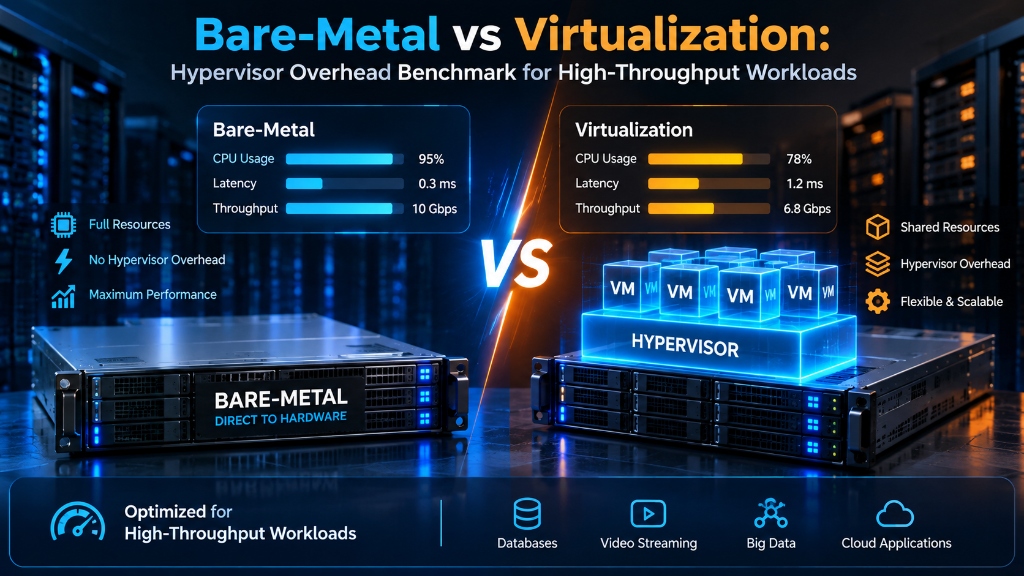
Virtualization Overhead: KVM VPS vs Bare Metal Performance
Virtualization adds a software layer between an operating system and physical hardware, but modern KVM environments can keep that overhead relatively small for many production workloads. The actual impact depends on CPU scheduling, memory translation, storage I/O, networking, and host configuration.
Bare-metal dedicated servers eliminate the 5-12% hypervisor virtualization overhead found in multi-tenant cloud environments. Direct hardware access delivers consistent CPU clock cycles, deterministic NVMe IOPS, and zero noisy-neighbor resource contention.
Does virtualization slow down a VPS?
Yes, virtualization can introduce some CPU, memory, storage, and networking overhead. However, KVM uses hardware-assisted virtualization so most ordinary guest instructions can execute directly on the physical processor. For many web, application, and database workloads, the practical difference depends more on resource allocation and host configuration than on virtualization alone.
What Is Virtualization Overhead?
Virtualization overhead is the additional processing, memory, I/O, or scheduling work introduced when a virtual machine accesses resources through a hypervisor instead of running directly on physical hardware.
Modern processors include virtualization extensions such as Intel VT-x and AMD-V. KVM uses these capabilities to allow guest operating systems to execute CPU instructions with hardware assistance rather than relying on traditional software emulation.
The remaining overhead usually appears around operations that require hypervisor involvement, including certain privileged instructions, virtual device access, memory translation, interrupt handling, and resource scheduling.
Virtualization overhead is not a fixed percentage. It changes according to the processor, hypervisor, workload, storage stack, network configuration, and resource contention on the host.
How KVM Virtualization Works
KVM is integrated into the Linux kernel and uses hardware virtualization extensions provided by modern CPUs. A virtual machine runs as a Linux process while KVM provides the kernel-level virtualization interface required for guest execution.
CPU Execution and VM-Exit Overhead
Most ordinary guest CPU instructions can run directly on the physical processor when hardware-assisted virtualization is enabled. The hypervisor becomes involved when the guest performs operations that require privileged handling.
One important mechanism is the VM-Exit. When a guest operation requires intervention from the hypervisor, CPU execution switches from the guest to the host virtualization layer. After the operation is handled, execution returns to the guest.
A small number of VM-Exits may have little practical impact. A latency-sensitive workload generating a very high number of exits, however, can make the overhead more visible.
# Monitor KVM VM exits
sudo perf top -e kvm:kvm_exit

# Check KVM statistics
sudo kvm_stat -1Memory Virtualization: EPT, NPT and TLB Behaviour
A bare-metal operating system maps virtual memory addresses directly toward physical RAM through the processor’s memory-management hardware. A virtual machine introduces another translation layer.
Single Translation Path
Two-Level Translation
Intel processors use Extended Page Tables (EPT), while AMD systems use Nested Page Tables (NPT). These hardware features reduce the amount of software intervention required during memory translation.
Large memory pages can also reduce translation overhead in workloads that benefit from fewer page-table entries. The appropriate HugePages configuration depends on the workload and operating-system setup.
# Example: inspect HugePages configuration
grep -i huge /proc/meminfo

# Example sysctl configuration
vm.nr_hugepages = 8192Storage I/O: VirtIO vs Direct NVMe Access
Storage is one of the areas where virtualization configuration can have a noticeable effect on performance. Database workloads often generate frequent random reads and writes, making latency and queue behaviour more important than sequential throughput alone.
In a virtual machine, storage requests may pass through virtual storage devices and host-side I/O layers before reaching physical media. VirtIO is designed to reduce this overhead by providing an efficient paravirtualized device interface.
Engineers can use FIO to measure random I/O behaviour instead of assuming that a storage configuration will perform identically across different environments.
fio --name=iops_benchmark \
--rw=randrw \
--rwmixread=70 \
--bs=4k \
--ioengine=libaio \
--iodepth=64 \
--numjobs=4 \
--size=20G \
--direct=1 \
--runtime=60 \
--group_reportingNetwork Performance: VirtIO-Net vs SR-IOV
Network virtualization adds another processing layer between the guest operating system and the physical network adapter. For normal websites and applications, VirtIO networking is usually sufficient.
Workloads that process very large packet volumes or require tightly controlled latency can use technologies such as SR-IOV. SR-IOV allows a physical network adapter to expose virtual functions that can be assigned to individual virtual machines.
NUMA Awareness and CPU Pinning
Multi-socket servers divide CPU cores and memory into NUMA (Non-Uniform Memory Access) nodes. Accessing memory attached to the same NUMA node is generally preferable to repeatedly accessing memory attached to another node.
Poor vCPU and memory placement can increase memory-access latency. For latency-sensitive workloads, administrators can use CPU pinning and NUMA-aware VM configuration to keep compute resources closer to the memory they use.
<numatune>
  <memory mode='strict' nodeset='0'/>
</numatune>

<cputune>
  <vcpupin vcpu='0' cpuset='0'/>
  <vcpupin vcpu='1' cpuset='2'/>
  <vcpupin vcpu='2' cpuset='4'/>
  <vcpupin vcpu='3' cpuset='6'/>
</cputune>Why Tail Latency Matters More Than Average Speed
Average performance does not always describe how a production system feels under load. For transactional applications, engineers often examine p95, p99, and p99.9 latency to identify occasional delays hidden by an average measurement.
On a busy virtualization host, scheduling delays or I/O contention can affect tail latency even when average CPU utilisation appears acceptable. This is why production testing should measure the distribution of response times rather than relying on a single average number.
How to Benchmark KVM vs Bare Metal
There is no single benchmark that describes virtualization overhead. A useful comparison should test the resources that matter to the production workload.
| Workload | What to Measure | Useful Tool |
|---|---|---|
| CPU | Execution throughput and latency | Sysbench / stress-ng |
| Memory | Latency and bandwidth | Sysbench / STREAM |
| Storage | IOPS, throughput and latency | FIO |
| Network | Bandwidth and packet latency | iperf3 |
| Database | Transactions and query latency | pgbench / sysbench |
Benchmark results are environment-specific. CPU generation, RAM configuration, storage device, kernel, hypervisor settings, workload profile and host contention can all change the result. Do not treat one test result as a universal virtualization overhead percentage.
When Should You Use KVM VPS or Bare Metal?
KVM VPS
A KVM VPS can be suitable when you need isolated virtual resources, operating-system control, easier provisioning, snapshots, and the flexibility to resize or move workloads.
- Web applications
- SaaS platforms
- Development environments
- APIs and application servers
- Many database workloads
Bare Metal
Bare metal becomes more relevant when an application requires direct hardware access, tightly controlled latency, sustained hardware utilisation, or specialised PCIe devices.
- Latency-sensitive systems
- Heavy storage workloads
- Specialised hardware
- Large database environments
- Dedicated compute requirements
How to Reduce Virtualization Overhead
Use hardware-assisted virtualization. Ensure Intel VT-x or AMD-V is available and correctly enabled.
Choose appropriate virtual devices. VirtIO devices are designed for efficient guest-to-host I/O.
Review CPU allocation. Avoid excessive vCPU overcommitment for latency-sensitive workloads.
Consider NUMA locality. Keep vCPU and memory placement aligned on multi-socket systems.
Measure storage performance. Test actual database I/O patterns instead of relying only on advertised sequential disk speeds.
Monitor tail latency. p95 and p99 measurements can reveal contention that averages hide.
Virtualization overhead depends on the workload, not just the hypervisor.
KVM virtualization adds an abstraction layer, but hardware-assisted CPU execution, efficient virtual I/O, appropriate memory management, NUMA awareness, and careful resource allocation can keep the impact low for many workloads.
Bare metal remains useful when an application needs direct hardware access or highly predictable performance. For other production environments, a properly configured KVM VPS can provide a practical balance between performance, isolation, and infrastructure flexibility.
Frequently Asked Questions
Does KVM virtualization reduce VPS performance? +
KVM can introduce some virtualization overhead, but hardware virtualization allows many guest CPU instructions to execute directly on the physical processor. The practical impact depends on CPU scheduling, storage, memory, networking and host configuration.
What causes virtualization overhead? +
Common sources include VM exits, memory address translation, virtual device processing, I/O handling, interrupt processing, scheduling and resource contention on the physical host.
Is KVM suitable for database servers? +
KVM can support database workloads when CPU, memory, storage and I/O resources are correctly sized. Database performance should be evaluated using workload-specific tests, particularly for storage-intensive or latency-sensitive applications.
Does CPU pinning improve KVM performance? +
CPU pinning can improve predictability for selected workloads by controlling where virtual CPUs run. It is most useful when consistent latency or NUMA locality matters; it is not automatically beneficial for every VPS.
When should I choose bare metal instead of KVM VPS? +
Bare metal may be appropriate when an application requires direct hardware access, specialised PCIe devices, sustained hardware utilisation or tightly controlled latency. The decision should be based on measured workload requirements.
How should virtualization performance be tested? +
Test CPU, memory, storage and network performance separately, then run a realistic application or database workload. Compare throughput, latency and tail-latency measurements under similar resource and load conditions.
Conclusion: Strategic Architecture & Performance Summary
Implementing these technical optimizations for bare-metal vs virtualization: hypervisor overhead benchmark for high-throughput workloads ensures robust throughput, predictable latency, and maximum system reliability across production environments. Rigorous benchmarking and proactive parameter tuning eliminate latent resource bottlenecks before they impact end users.
Pairing disciplined operating system administration with reliable compute foundations is essential for mission-critical operations. Deploying workloads on enterprise dedicated server hosting provides the dedicated resources, network resilience, and hardware acceleration necessary to sustain high availability under heavy production load.
Match your infrastructure to the workload.
Choose the server architecture according to your application’s CPU, memory, storage, network and latency requirements.
