

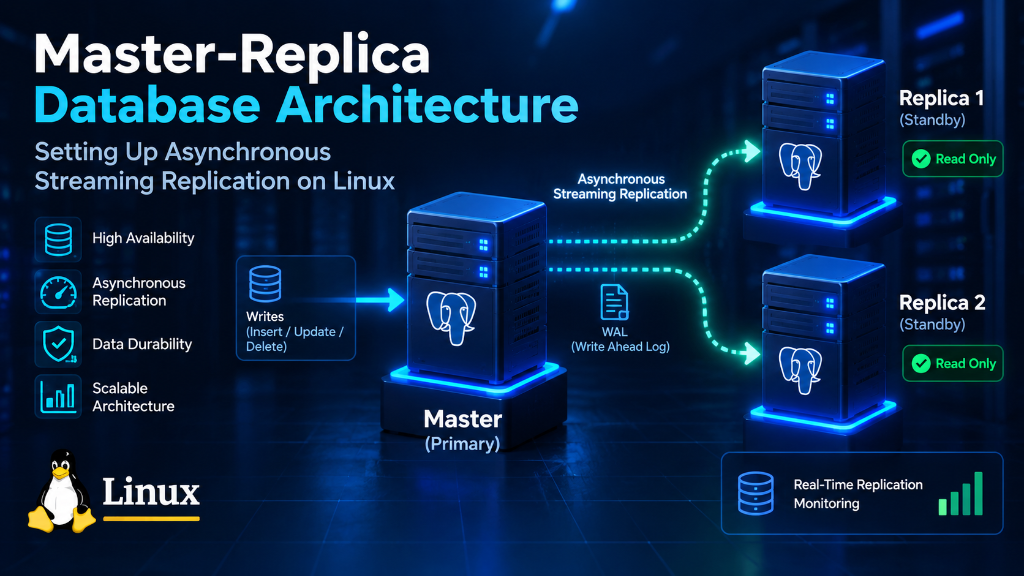
Setting up master-replica asynchronous database replication on Linux requires configuring the primary node with binary logging enabled (log_bin), a unique server_id, and GTID mode, while the replica reads and applies transaction logs via a dedicated replication user over TLS. Asynchronous streaming offloads read-heavy queries to secondary nodes without blocking primary writes, though high-throughput architectures should continuously monitor replication lag (Seconds_Behind_Source).
- The Mechanics of Relational Streaming Replication: Binlogs & Appliers
- Enabling GTID on the Primary Node
- Configuring and Provisioning the Read Replica Node
- Baseline Backup & Initializing Replication
- Monitoring and Mitigating Replication Lag
- Lossless Semisynchronous Replication
- Automated Topology Failover with Orchestrator
- Point-in-Time Recovery (PITR) with Percona XtraBackup
- Automated Health Checks with Prometheus & Grafana
- Database Architecture Scalability Comparison
- Frequently Asked Questions (FAQ)
The Mechanics of Relational Streaming Replication: Binlogs and Appliers
pAsynchronous replication decouples write execution from replica confirmation. When a client application executes a write transaction on the primary database, the primary commits the transaction to its local InnoDB storage engine, writes the serialized event into its binary log (binlog), and immediately returns success to the client without waiting for secondary replicas to acknowledge receipt. pThe replication pipeline operates across three distinct asynchronous threads:- Primary Binlog Dump Thread: When a replica connects, the primary spawns a dump thread that reads binary log events from disk and streams them across the network to the secondary node.
- Replica I/O Receiver Thread: Connects to the primary node, ingests incoming binlog events, and writes them sequentially into the replica’s local Relay Log storage.
- Replica SQL Applier Thread: Reads events from the relay log and executes them against the replica’s local database engine to synchronize records.
Enabling Global Transaction Identifiers (GTID) on the Primary Node
pLegacy replication relied on physical binary log file names and byte offset positions (e.g.,mysql-bin.000142, position 10745). Positional replication is fragile; if a position is miscalculated during failover, replica data becomes corrupt.
pMySQL Global Transaction Identifiers (GTID) revolutionize replication by assigning a unique 128-bit UUID and monotonically increasing sequence number to every committed transaction across the cluster.
pConfigure the Primary node in /etc/mysql/mysql.conf.d/50-primary.cnf:
[mysqld]
server-id    = 101
bind-address = 10.50.10.20

# ── Binary Logging & GTID Configuration ──────────────────────
log_bin                    = /var/log/mysql/mysql-bin.log
binlog_format              = ROW
gtid_mode                  = ON
enforce_gtid_consistency   = ON

# ── Crash-Safe Replication Settings ──────────────────────────
sync_binlog                = 1
innodb_flush_log_at_trx_commit = 1
binlog_expire_logs_seconds = 604800     # Retain 7 days of binlogs
max_binlog_size = 512MCREATE USER 'repl_user'@'10.50.10.%'
IDENTIFIED WITH caching_sha2_password BY 'Str0ngReplPassw0rd!';
GRANT REPLICATION SLAVE, REPLICATION CLIENT
ON *.* TO 'repl_user'@'10.50.10.%' REQUIRE SSL;
FLUSH PRIVILEGES;Configuring and Provisioning the Read Replica Node
pOn the secondary replica server, configure a uniqueserver-id, enable GTID matching, and make the replica strictly read-only to prevent unauthorized manual writes from desynchronizing data:
[mysqld]
server-id    = 102
bind-address = 10.50.10.21

# ── GTID & Relay Log Configuration ───────────────────────────
gtid_mode                  = ON
enforce_gtid_consistency   = ON
relay_log                  = /var/log/mysql/mysql-relay-bin.log
read_only                  = ON
super_read_only            = ON

# ── Multi-Threaded Applier (Parallel Replication) ─────────────
replica_parallel_workers         = 8
replica_parallel_type            = LOGICAL_CLOCK
replica_preserve_commit_order = ONreplica_parallel_workers = 8 allows the SQL applier thread to execute independent transactions concurrently across multiple CPU cores, preventing replica lag during write bursts. For high-volume transaction clusters, see our recommendations on budget dedicated server ecommerce hosting.
Baseline Backup & Initializing Replication
pTo establish replication without shutting down the primary node, generate a consistent point-in-time snapshot usingmysqldump with the --single-transaction flag:
# On Primary Node: Dump all databases with GTID metadata
mysqldump -u root -p \
    --all-databases \
    --single-transaction \
    --quick \
    --master-data=2 \
    --set-gtid-purged=ON \
    | gzip > /mnt/backups/primary_baseline.sql.gz

# Transfer snapshot to Replica node over private network
scp /mnt/backups/primary_baseline.sql.gz \
sysadmin@10.50.10.21:/tmp/-- Step 1: Import baseline via CLI shell (run before entering MySQL):
-- zcat /tmp/primary_baseline.sql.gz | mysql -u root -p
-- Step 2: Point Replica to Primary using GTID auto-positioning
CHANGE REPLICATION SOURCE TO
SOURCE_HOST = '10.50.10.20',
SOURCE_PORT = 3306,
SOURCE_USER = 'repl_user',
SOURCE_PASSWORD = 'Str0ngReplPassw0rd!',
SOURCE_AUTO_POSITION = 1,
SOURCE_SSL = 1;
-- Step 3: Start all replication threads
START REPLICA;
-- Step 4: Verify both IO and SQL threads are running
SHOW REPLICA STATUS\GReplica_IO_Running: Yes and Replica_SQL_Running: Yes are active, confirming that binary log streaming and local transaction execution are operating properly.
Monitoring and Mitigating Replication Lag in Production
pThe inherent trade-off of asynchronous replication is replication lag: the brief temporal delta between when a write commits on the primary and when it is replayed on replicas. In the output ofSHOW REPLICA STATUS, this delay is reported as Seconds_Behind_Source.
pUnder heavy load, replication lag can grow if:
- Large bulk updates (e.g., altering 500,000 rows in a single query) lock tables on the replica.
- Disk I/O bandwidth on the replica is inferior to the primary node.
- Single-threaded SQL appliers become saturated on complex joins.
pt-heartbeat from Percona Toolkit). This tool continuously inserts microsecond timestamps into a dedicated heartbeat table on the primary and calculates exact fractional second replication latency on all connected read replicas.
Lossless Semisynchronous Replication: Eliminating Primary Crash Data Loss
pWhile pure asynchronous replication yields maximum write throughput, it introduces a vulnerability window where transactions committed on the primary may not have reached replicas when sudden hardware failure strikes. pTo achieve zero data loss without sacrificing database concurrency, configure MySQL Lossless Semisynchronous Replication. Under semisync replication, the primary engine halts the final client commit confirmation until at least one secondary replica acknowledges that it has written the transaction event to its local relay log. pConfigure semisynchronous replication in/etc/mysql/mysql.conf.d/60-semisync.cnf:
[mysqld]
# ── Enable Primary Semisync Plugin ──────────────────────────
plugin-load-add                         = semisync_master.so
rpl_semi_sync_master_enabled            = 1
rpl_semi_sync_master_timeout            = 2000   # Fall back to async if replica unreachable for 2s
rpl_semi_sync_master_wait_point         = AFTER_SYNC
rpl_semi_sync_master_wait_no_slave = ONrpl_semi_sync_master_wait_point = AFTER_SYNC ensures that even if the primary crashes after writing to the storage engine, unacknowledged transactions are never made visible to concurrent sessions until the replica confirms relay log durability. This is the “lossless” guarantee.
Automated Topology Management and Failover with Orchestrator
pManual primary failover during a 3:00 AM production outage is prone to operator panic, mismatched GTID subsets, and inadvertent split-brain scenarios. Enterprise environments utilize Orchestrator — an open-source MySQL HA and replication management tool — to continuously audit topology health. pOrchestrator discovers cluster topologies automatically, maps GTID transaction offsets across all nodes, and executes deterministic automated failover when primary nodes become unreachable:{
"DetectClusterAliasHeuristicFlag": true,
"RecoveryPeriodBlockSeconds": 3600,
"ProcessesShellCommand": "bash",
"ApplyMySQLTopologyCredentials": true,
"MasterFailoverProcesses": [
"echo 'Orchestrator detected Primary Failure at {failedHost}!' >> /var/log/orchestrator-failover.log",
"/usr/local/bin/vip-reassign.sh {failedHost} {successorHost}"
]
}Point-in-Time Recovery (PITR) with Binary Logs and Percona XtraBackup
pWhile streaming replication protects against hardware failure on individual nodes, it does not protect against logical corruption or human error. If an administrator inadvertently executes a destructiveDROP TABLE or an unconstrained DELETE statement on the primary, that statement is replayed across all read replicas within milliseconds.
pEnterprise database architectures implement Point-in-Time Recovery (PITR) to rewind database state to the exact second prior to an erroneous transaction, combining physical hot backups from Percona XtraBackup with sequential binary logs:
# 1. Take non-blocking physical hot backup
xtrabackup --backup \
    --target-dir=/mnt/backups/base_backup \
    --user=backup_user \
    --password=SecretBackup

# 2. Extract transaction log position from xtrabackup_binlog_info
cat /mnt/backups/base_backup/xtrabackup_binlog_info
# Example output: mysql-bin.000215  458291  4a3b2c1d-1111-...:1-58290

# 3. Extract exact binary log events up to the incident timestamp
mysqlbinlog --read-from-remote-server \
    --host=10.50.10.20 \
    --user=root -p \
    --start-position=458291 \
    --stop-datetime="2026-09-25 14:32:15" \
mysql-bin.000215 > /tmp/pitr_recovery.sqlAutomated Replication Health Checks with Prometheus and Grafana
pMaintaining cluster visibility requires real-time telemetry collection. Deploy the Prometheusmysqld_exporter on both the primary and replica instances to scrape replication metrics every 15 seconds:
# Expose MySQL Prometheus exporter on private VLAN interface
./mysqld_exporter \
    --mysqld.address="10.50.10.21:3306" \
    --collect.slave_status \
    --collect.info_schema.innodb_metrics \
--web.listen-address="10.50.10.21:9104"mysql_slave_status_seconds_behind_master and mysql_slave_status_slave_io_running. If replication lag exceeds 5 seconds or the I/O receiver thread terminates due to network dropouts, automated PagerDuty or Slack webhooks notify on-call database engineers immediately, preventing read queries from serving stale application data.
Database Architecture Scalability Comparison
| Architecture Topology | Read Concurrency | Write Performance | Failover Recovery Time |
|---|---|---|---|
| Standalone Primary | Severely bottlenecked under traffic surges | Limited by local disk IOPS | Hours (Restore from cold backup) |
| Master-Replica (Positional) | Horizontally scalable across read nodes | Dedicated to Primary node | 20–45 mins (Manual log reconciliation) |
| GTID Master-Replica with Multi-Threading | Near-infinite scale across replica pool | Maximized via zero read locks | Sub-60 seconds (Automated GTID failover) |
Implementing a master-replica database architecture unlocks horizontal read scalability, insulates primary transactional engines from expensive business intelligence reporting queries, and establishes resilient disaster recovery mechanisms. By leveraging MySQL GTID consistency, parallel replica applier threads, and automated health monitoring, engineering teams can support millions of daily database queries with sub-second failover and zero data divergence. For verified technical specifications and deployment parameters, consult the official Linux Kernel Documentation.
Q What is asynchronous replication in MySQL & MariaDB?
Asynchronous database replication is a high-availability architecture where a primary (master) database writes transactions to a binary log (binlog) and completes client queries immediately without waiting for confirmation from secondary (replica) nodes. The replica servers read the binary log asynchronously in background threads and replay the transactions locally.
Q How do read replicas improve dynamic site performance?
A read replica improves website performance by offloading heavy SELECT queries, reporting tasks, and analytical workloads away from the primary database instance. Directing write operations (INSERT, UPDATE, DELETE) to the master server and spreading read traffic across replicas prevents database CPU saturation and eliminates table locks.
Q What is replication lag and how is it monitored on Linux?
Replication lag is the time delay between a transaction committing on the master database and its execution on the replica node. On MySQL 8.0+, administrators monitor replication lag by executing SHOW REPLICA STATUS\G and checking the Seconds_Behind_Source metric. Lag occurs when replica applier execution cannot keep pace with primary write volume.
Q What are the benefits of GTID in MySQL replication?
Global Transaction Identifiers (GTID) assign a unique, sequential identifier to every committed transaction across the database cluster. GTID eliminates the complex manual tracking of binary log filenames and byte offsets, simplifying automated replica failover and preventing duplicate transaction execution during disaster recovery.
Q Can a replica automatically take over if the master server fails?
While native MySQL asynchronous replication does not fail over automatically, pairing replication with orchestration tools like Orchestrator, ProxySQL, or HAProxy enables automated health monitoring and seamless promotion of a healthy replica to primary master status with minimal service interruption — typically under 60 seconds with GTID auto-positioning.
Conclusion: Your Enterprise MySQL Replication Cluster is Production-Ready
Implementing a master-replica database architecture unlocks horizontal read scalability, insulates primary transactional engines from expensive analytical queries, and establishes resilient disaster recovery mechanisms.
By leveraging MySQL GTID consistency, multi-threaded parallel applier workers, lossless semisync, and automated Prometheus lag monitoring, engineering teams can sustain high-throughput database workloads with sub-second failover and zero data divergence. Combining scheduled Percona XtraBackup physical snapshots with verified Point-in-Time recovery runbooks guarantees comprehensive enterprise business continuity.
