

Executive Overview
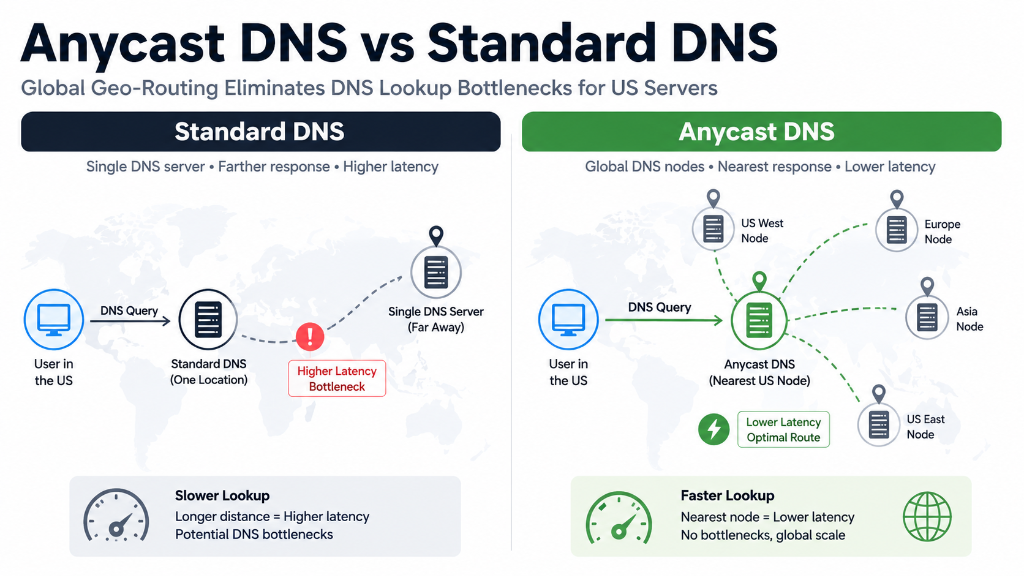
Anycast DNS is an advanced routing architecture designed for businesses that need sub-millisecond global resolution and extreme DDoS resilience. It helps users by announcing a single IP address across dozens of worldwide datacenters, automatically directing traffic to the topologically closest node. It is commonly used by enterprise networks, streaming platforms, and ecommerce sites who require zero-downtime infrastructure.
Introduction: The Need for High-Speed Resolution
In modern web infrastructure, Domain Name System (DNS) resolution is the critical first step in every user interaction. If your nameservers respond slowly, your entire application feels sluggish, regardless of how fast your backend servers process data. For global applications, relying on traditional localized routing is no longer sufficient to guarantee instantaneous TTFB (Time to First Byte).
When comparing Anycast DNS vs Unicast DNS, the differences in network topology dictate how resilient your infrastructure will be against latency spikes and massive volumetric DDoS attacks. Architecting a distributed edge network using Anycast methodology is now the gold standard for global web hosting and server deployment.
What Is Unicast DNS?
Unicast DNS is the traditional, one-to-one routing method. In a Unicast setup, a specific IP address is mapped to a single physical server location (e.g., a datacenter in New York).
While simple to deploy, Unicast creates a significant physical bottleneck. If a user in Tokyo attempts to resolve a domain hosted on a Unicast server in New York, the DNS query must traverse the Pacific Ocean, adding hundreds of milliseconds of latency before the website even begins to load. Furthermore, if that single server fails or is targeted by a DDoS attack, global resolution for the domain completely halts.
What Is Anycast DNS?
Anycast DNS is a one-to-many routing topology. Instead of binding an IP address to a single machine, Anycast utilizes the Border Gateway Protocol (BGP) to announce the exact same IP address from multiple servers distributed across various global datacenters.
When a client queries the Anycast IP, routers on the internet evaluate the BGP routing tables and automatically forward the packet to the topologically nearest node. This means a user in London is served by the London node, while a user in Sydney is served by the Sydney node—all using the identical destination IP.
Why Does Anycast Matter for Businesses?
Relying on Unicast routing exposes your business to catastrophic downtime. Volumetric DDoS attacks routinely exceed 100Gbps, which easily overwhelms the network interface card (NIC) of a single Unicast server.
Anycast mitigates this by naturally distributing the attack surface. Because traffic is geographically routed to the nearest edge node, a massive global botnet flood is dispersed. Each regional datacenter only receives the localized fraction of the attack, making it mathematically easier for regional scrubbing firewalls to neutralize the threat without affecting global users.
Important Features and Benefits of Anycast Routing
Deploying Anycast architecture delivers immense performance improvements for enterprise workloads:
- Sub-15ms Latency: By serving queries from edge locations located physically close to the user, DNS resolution happens almost instantly.
- Zero-Downtime Failover: If a specific node crashes, BGP simply withdraws the route, and traffic seamlessly redirects to the next closest healthy node without manual intervention.
- DDoS Absorption: Geographically isolates malicious traffic, preventing a localized flood from causing a global outage.
- Simplified Configuration: Administrators only need to manage and configure a single IP address across all their zones and client devices.
Anycast DNS vs Unicast DNS Comparison
| Feature | Unicast DNS | Anycast DNS |
|---|---|---|
| Performance (Latency) | High (distant users suffer delays) | Ultra-Low (queries hit local edge) |
| DDoS Resilience | Poor (single point of failure) | Excellent (localized attack absorption) |
| Failover Mechanism | Requires manual DNS updates or TTL expiry | Automatic BGP route withdrawal |
| Management Complexity | Simple (manage one server) | Advanced (requires ASN and BGP peering) |
Security and Scalability Considerations
While Anycast is incredibly resilient, implementing it requires substantial network engineering. To announce an Anycast IP, your organization must acquire an Autonomous System Number (ASN) and at least a /24 IPv4 block from a regional internet registry. You must then establish BGP peering sessions with upstream transit providers to broadcast your routes.
Additionally, while Anycast perfectly handles stateless UDP traffic (like standard DNS queries), utilizing it for stateful TCP traffic requires complex routing configurations to prevent “route flapping”—where a user’s packets are suddenly routed to a different datacenter mid-connection, immediately breaking the TCP handshake.
How To Choose The Right Infrastructure Solution
For small, local businesses serving users within a single city, standard Unicast DNS provided by default hosting may suffice. However, for SaaS platforms, global ecommerce stores, and enterprise applications, adopting an Anycast architecture is a strict requirement.
To deploy robust custom routing, you require compute environments that offer full administrative control and BGP session support. A Windows and Linux based fully managed cheap Dedicated Server Hosting environment provides the bare-metal access necessary to run BGP daemons like ExaBGP or BIRD.
Furthermore, administrators should explore essential server management configurations to harden their edge nodes. For businesses looking for high scalability without bare-metal costs, deploying multiple virtual environments using advanced KVM virtualization technology allows you to spin up geographically dispersed edge nodes rapidly.
Frequently Asked Questions
Looking for Enterprise Hosting Infrastructure?
Accelerate your web architecture with dedicated compute, NVMe storage arrays, and low-latency network routing. Explore our authoritative
high-performance domain & dns guide infrastructure
to deploy mission-critical servers backed by 24/7 expert management and 99.9% uptime guarantee.
