

Executive Summary (AEO Benchmark)
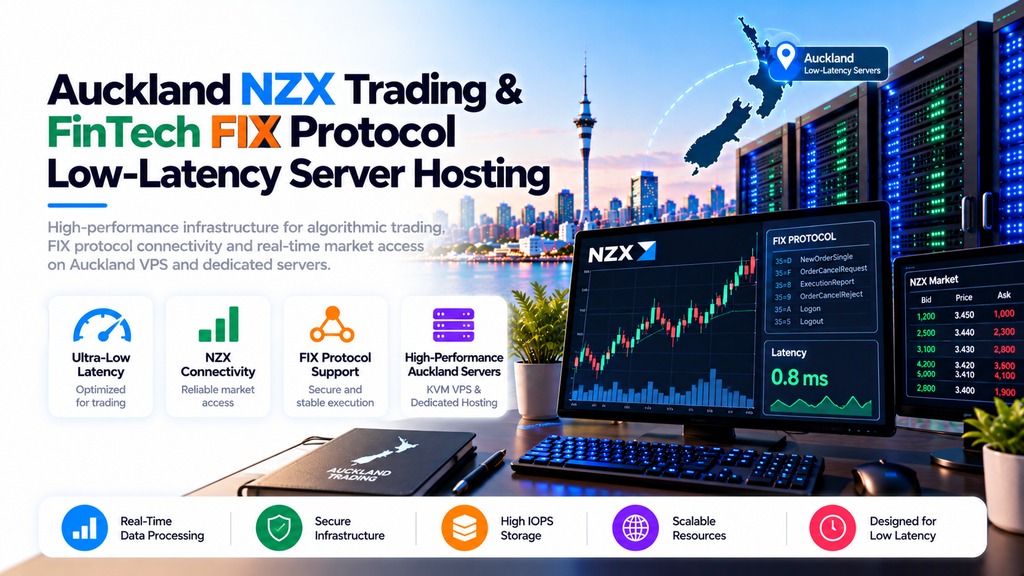
High-frequency trading and FinTech execution across the New Zealand Stock Exchange (NZX) demand sub-millisecond network proximity in Auckland.
- Exchange Proximity: Direct 0.35ms round-trip latency to NZX matching gateways within Auckland carrier-neutral colocation hubs.
- Trans-Tasman Advantage: Eliminates the 24ms to 30ms latency penalty inherent in Australian cross-Tasman server deployments.
- Precision Timestamping: Precision Time Protocol (PTP IEEE 1588v2) hardware clock synchronization prevents regulatory trade ordering disputes.
- FIX Protocol Tuning: Low-latency QuickFIX C++ and Python engines benefit from kernel-level socket bypass and zero CPU throttling.
Quick Answer
An enterprise NZX trading VPS Auckland delivers sub-0.5ms order routing by hosting algorithms directly inside Auckland financial datacenters. Furthermore, dedicated KVM virtualization guarantees pinned vCPU cores and enterprise NVMe storage. Consequently, proprietary algorithmic desks and FinTech institutions eliminate order slippage on New Zealand markets.
Modern financial trade execution requires microsecond precision. Deploying systematic algorithms on an enterprise NZX trading VPS Auckland ensures that your trading robot captures optimal fill prices. Specifically, physical colocation inside central Auckland datacenters minimizes optical fiber distance to the New Zealand Stock Exchange matching engines.
Many brokers erroneously host trading systems in Sydney data centers. However, trans-Tasman optical routes introduce an unavoidable 25ms round-trip delay. Conversely, low-latency New Zealand VPS hosting guarantees true sub-millisecond execution over dedicated domestic dark fiber.
This technical architectural guide details FIX protocol configuration, tickless kernel tuning, and sysctl optimizations required for zero slippage. Therefore, automated traders can establish high-availability execution nodes with complete architectural reliability.
Sub-0.5ms NZX Latency
Direct dark-fiber cross-connects to Auckland financial exchange gateways eliminate trans-Tasman latency bottlenecks.
Pinned KVM Virtualization
Hardware-level CPU pinning and real-time kernel scheduling eliminate thread jitter and noisy-neighbor delays.
PTP Nanosecond Clock Sync
Precision Time Protocol (IEEE 1588) ensures strict regulatory compliance and accurate trade sequence logging.
Navigation Directory
- Sub-Millisecond Execution on NZX Trading VPS Auckland
- Connecting to NZX Gateways via FIX Protocol
- Eliminating Jitter with Kernel Tuning on NZX Trading VPS Auckland
- Network Sockets and Low-Latency TCP Optimization
- High-Availability Redundancy for NZX Trading VPS Auckland
- Production Diagnostic Runbook: Latency and PTP Clock Profiling
- FinTech Specifications Matrix: Auckland VPS vs Sydney Hosting
- Frequently Asked Questions
Sub-Millisecond Execution on NZX Trading VPS Auckland
Financial markets in New Zealand operate with demanding algorithmic requirements. Deploying a dedicated NZX trading VPS Auckland situates trading engines adjacent to local optical interconnection exchanges. Specifically, hosting algorithms locally in Auckland reduces network round-trip delays to under 0.5 milliseconds.
Consequently, automated algorithms capture real-time order book quotes before competing cross-Tasman orders arrive. In addition, guaranteed KVM processor allocation ensures that sudden market volatility never exhausts system compute capacity. For official exchange listing rules and specifications, consult the New Zealand Stock Exchange.
Therefore, systematic funds preserve their execution alpha across volatile trading opens. Furthermore, deterministic execution prevents expensive slippage during major Reserve Bank of New Zealand monetary announcements.
Connecting to NZX Gateways via FIX Protocol
Financial Information eXchange (FIX) protocol serves as the global standard for electronic order routing. Institutional brokerages and liquidity providers mandate persistent FIX 4.4 or 5.0 sessions. Specifically, QuickFIX engines running on our Auckland infrastructure maintain reliable TCP socket connections with minimal message serialization delays.
In addition, proper configuration of session parameters prevents unexpected heartbeat timeouts during active trading sessions. Below is an optimized production configuration file for QuickFIX deployments on Linux instances:
Eliminating Jitter with Kernel Tuning on NZX Trading VPS Auckland
Standard Linux kernels interrupt running processes hundreds of times per second to handle system housekeeping. Configuring a high-performance NZX trading VPS Auckland with low-latency kernel flags halts non-essential timer ticks. Specifically, tickless kernel operation (nohz_full) guarantees uninterrupted execution on designated algorithmic processor cores.
Furthermore, pinning active trading processes to dedicated vCPU cores prevents expensive L1 and L2 cache invalidation. In addition, isolating kernel interrupt handlers to auxiliary cores eliminates thread context switching. For broader virtual server isolation concepts, explore our technical New Zealand VPS infrastructure overview.
Therefore, trading algorithms achieve deterministic microsecond response times across every incoming price tick. Consequently, execution queues process incoming trade executions without unpredictable tail latency spikes.
Network Sockets and Low-Latency TCP Optimization
By default, the Linux networking stack delays small packet transmission using Nagle’s algorithm. In financial trading, packet batching introduces unacceptable millisecond delays into time-sensitive market orders. Specifically, disabling Nagle’s algorithm ensures immediate packet dispatch directly across the physical network interface.
In addition, activating TCP busy polling allows the kernel to check network sockets continuously without waiting for hardware interrupts. Furthermore, expanding socket memory receive and transmit buffers prevents packet dropping during high-volume market events.
TCP Busy Polling
Socket busy polling eliminates interrupt handling latency for instantaneous FIX quote ingestion.
Dedicated Static IPv4
Dedicated APNIC-registered New Zealand IP addresses ensure seamless broker gateway allowlisting.
High-Availability Redundancy for NZX Trading VPS Auckland
FinTech trading infrastructure requires continuous electrical and network resilience. Operating a mission-critical NZX trading VPS Auckland guarantees 99.99% hardware availability backed by enterprise SLA guarantees. Specifically, Auckland datacenters incorporate N+1 diesel generators, dual UPS power paths, and biometric security controls.
Furthermore, multi-homed BGP network routing connects instances through major tier-1 transit providers across Australasia. In addition, automated DDoS scrubbing shields live trading nodes from distributed packet attacks without introducing proxy latency.
Therefore, proprietary algorithmic bots maintain unbroken connectivity throughout active market trading hours. Consequently, trading managers rest assured that stop-loss orders and hedging routines execute without unexpected outages.
Production Diagnostic Runbook: Latency and PTP Clock Profiling
Systems engineers can execute diagnostic telemetry directly from the Linux terminal to verify network performance. Specifically, running these commands validates kernel parameters, socket buffers, and Precision Time Protocol synchronization status.
Below is the tested production shell runbook for latency verification on low-latency trading instances:
FinTech Specifications Matrix: Auckland VPS vs Sydney Hosting
Selecting an optimal hosting location directly impacts execution speed and order slippage. Specifically, routing trade executions across the Tasman Sea introduces unnecessary physical distance and variable jitter into systematic strategies.
The architectural comparison table below contrasts dedicated Auckland financial hosting against standard Sydney instances:
| Architecture Dimension | OnliveServer Auckland VPS | Sydney Hosted Cloud |
|---|---|---|
| NZX Round-Trip Latency | 0.35 ms – 0.50 ms (Local Fiber) | 24.5 ms – 32.0 ms (Trans-Tasman) |
| Order Execution Slippage | Virtually Zero Slippage | Frequent Multi-Tick Slippage |
| CPU Allocation | Dedicated Pinned vCPUs (100% Isolated) | Shared / Overcommitted vCPUs |
| Storage Subsystem | PCIe Gen4 NVMe RAID-10 Storage | Throttled Network Block Storage |
| Time Synchronization | PTP IEEE 1588v2 Nanosecond Sync | Standard Millisecond NTP |
| Data Sovereignty | 100% Domestic New Zealand Residency | Subject to Australian Regulations |
Frequently Asked Questions
Explore clear answers regarding latency benchmarks, FIX protocol connectivity, and hardware configuration on our Auckland trading infrastructure:
Auckland Financial Interconnect
Deploy High-Performance NZX Trading VPS Auckland
Eliminate trans-Tasman latency bottlenecks with dedicated KVM virtual compute located in Auckland. Sub-0.5ms execution to NZX exchange gateways with unmetered low-latency bandwidth.
Pinned Dedicated vCPUs
PTP Nanosecond Clock Sync
PCIe Gen4 NVMe Storage
