

How Do You Select a Reliable Bangkok Cloud VPS?
To select a reliable cloud VPS in Bangkok, verify four non-negotiable infrastructure factors. First, confirm native Tier-III datacenter certification. Second, check direct Layer 2 peering with the Thailand Internet Exchange (BKNIX). Third, ensure enterprise PCIe NVMe storage arrays in RAID-10. Finally, look for a legally binding 99.9% network uptime SLA backed by 24/7 on-site technical support.
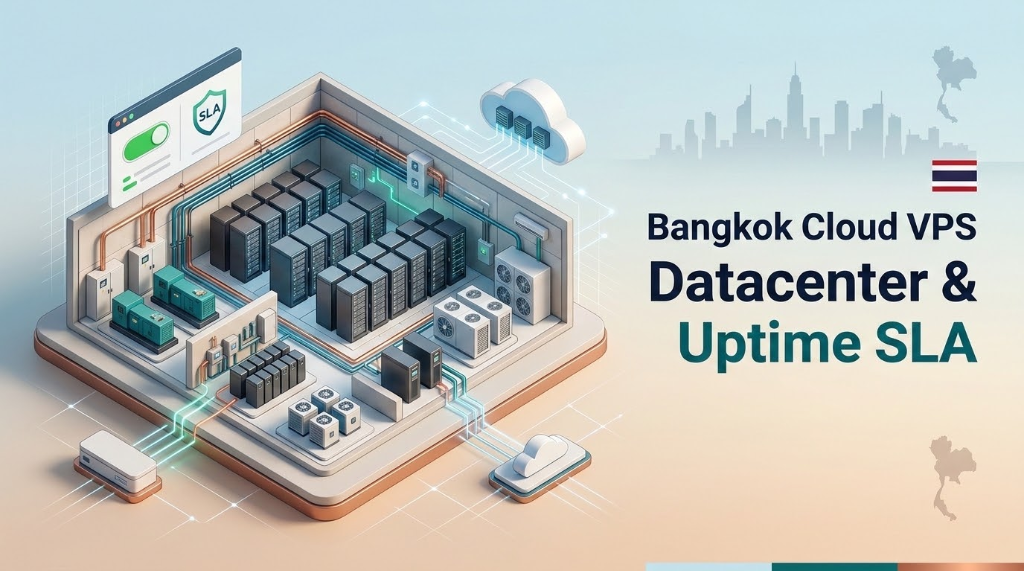
In the tropical cloud infrastructure landscape of Southeast Asia, physical datacenter engineering is just as critical as software virtualization. International enterprises, fintech institutions, and regional e-commerce operators frequently overlook local environmental challenges unique to central Thailand. Specifically, these include monsoonal flash floods, high ambient humidity, and electrical grid fluctuations. Therefore, evaluating enterprise Bangkok Cloud VPS infrastructure requires a rigorous engineering audit of power distribution redundancy, precision cooling systems, and contractually verifiable uptime commitments.
✔ Key Datacenter Audit Takeaways
- Concurrently Maintainable Power: Certified Tier-III Bangkok telehouses deploy 2N or N+1 electrical distribution, allowing power path maintenance without taking cloud servers offline.
- MEA Grid Redundancy: Premier facilities receive independent medium-voltage feeds from separate Metropolitan Electricity Authority (MEA) substations backed by on-site diesel generators.
- Tropical Thermal Management: Datacenters in Bangkok must operate closed-loop chilled water systems and hot-aisle containment to combat extreme ambient wet-bulb temperatures.
- Flood Defense Architecture: Critical electrical switchgear, UPS batteries, and server halls must be situated above municipal flood levels (elevated above street grade).
- Auditable Uptime SLAs: Legitimate 99.9%–99.95% SLAs define precise downtime exclusion clauses, packet loss thresholds, and contractually binding billing credit formulas.
Table of Contents
- The Anatomy of Bangkok’s Enterprise Cloud Infrastructure
- Decoding Datacenter Tiers: Why Tier-III Standards Matter in Thailand
- Power Resilience: Dual MEA Grid Feeds and Backup Generator Protocols
- Battling Tropical Humidity: Precision Cooling and Thermal Management in Bangkok
- Physical Security and Access Control in Central Bangkok Telehouses
- Reading the Fine Print: How to Audit a 99.9% Network Uptime SLA
- Checklist: Evaluating Your Bangkok Cloud VPS Provider
- Frequently Asked Questions (FAQ)
1The Anatomy of Bangkok’s Enterprise Cloud Infrastructure
Bangkok has evolved into a strategic telecommunications gateway for Southeast Asia. It bridges the Greater Mekong Subregion with maritime Southeast Asia and global internet backbones. Consequently, major carrier telehouses—such as the CAT Tower in Bangrak, True IDC Pattanakarn, and NTT Bangkok 2—host hundreds of thousands of bare-metal servers and cloud virtualization clusters.
Why Physical Infrastructure Matters in a Tropical Climate
However, the operational reliability of a cloud VPS in Bangkok is deeply tethered to the physical integrity of its host facility. Unlike data centers in temperate climates such as Frankfurt or London, Bangkok data centers cannot leverage natural outside-air economizers. Instead, they operate in a continuous tropical climate where ambient outdoor temperatures routinely exceed 36°C with relative humidity averaging over 75% year-round. As a result, these extreme baselines place severe operational stress on power delivery transformers, uninterrupted power supplies (UPS), and precision computer room air handling (CRAH) infrastructure.
Therefore, when selecting a Bangkok cloud VPS, technical procurement teams must look past user-friendly dashboards. Specifically, they must interrogate the mechanical, electrical, and plumbing (MEP) engineering that keeps physical compute nodes online during power disruptions, monsoonal flash storms, and telecommunications grid maintenance.
2Decoding Datacenter Tiers: Why Tier-III Standards Matter in Thailand
The Uptime Institute’s Tier Standard defines four distinct levels of data center availability and architectural resilience. In the Thai hosting marketplace, low-cost operators frequently claim “Tier-III equivalent” specifications. However, they often lack the underlying engineering topology to withstand concurrent maintenance or equipment failures.
Tier-I and Tier-II Limitations in Bangkok
Tier-I facilities provide a single non-redundant distribution path for power and cooling with no built-in backup components. Consequently, a failure in a transformer, UPS module, or chiller unit causes immediate total service disruption. Tier-II data centers add redundant components (N+1 power and cooling units), but still rely on a single distribution path. Therefore, if a main electrical panel requires scheduled servicing, the entire facility must be powered down.
The Tier-III Concurrently Maintainable Standard
For mission-critical production systems, Tier-III Concurrently Maintainable architecture is the non-negotiable benchmark in Bangkok. A certified Tier-III facility features multiple independent distribution paths for power and cooling. While one path actively powers the server racks, the alternate redundant path remains energized on standby. As a result, any active component—including circuit breakers, UPS capacitor banks, static transfer switches (STS), or chilled water pumps—can be removed, serviced, or replaced without interrupting power to customer cloud hypervisors.
| Datacenter Standard | Redundancy Model | Annual Downtime Allowance | Maintenance Disruption |
|---|---|---|---|
| Tier-I Standard | N (Zero Redundancy) | 28.8 hours / year | Requires full facility shutdown |
| Tier-II Standard | N+1 (Redundant Components) | 22.0 hours / year | Shutdown required for path maintenance |
| Tier-III Standard | N+1 or 2N (Concurrently Maintainable) | 1.6 hours / year (99.982%) | Zero downtime during scheduled maintenance |
| Tier-IV Fault Tolerant | 2(N+1) Fully Segmented Paths | 0.4 hours / year (99.995%) | Withstands unplanned catastrophic failure |
OnliveServer’s Bangkok cloud clusters are hosted strictly in Tier-III certified enterprise facilities. Therefore, electrical bus upgrades, transformer maintenance, and battery health inspections happen seamlessly in the background. As a result, your live production workloads are never disrupted by maintenance windows.
3Power Resilience: Dual MEA Grid Feeds and Backup Generator Protocols
Electricity supply in metropolitan Bangkok is administered by the Metropolitan Electricity Authority (MEA). While Bangkok’s central power grid is robust compared to regional provinces, severe electrical storms during the annual monsoon season can trigger high-voltage utility sags and frequency fluctuations. Therefore, when evaluating local data centers, verify BKNIX peering and Bangkok data center routing to guarantee single-digit millisecond latency across all major domestic Thai telecom networks. For more details on transmission window buffers, review the IETF RFC 793 Transmission Control Protocol specification.
A resilient Bangkok cloud hosting facility mitigates utility power instability through a multi-stage defense architecture. Specifically, it employs the following three layers of protection:
1. Diverse Utility Substation Ingress
Rather than relying on a single overhead power line, Tier-III Bangkok telehouses receive dual underground medium-voltage (24kV) electrical feeds. These feeds are routed from two geographically independent MEA substations. Consequently, if a construction accident or storm severs one underground conduit, an automatic transfer switch transfers the utility load to the secondary feed in sub-cycle milliseconds.
2. Double-Conversion Online UPS Architecture
Between raw grid electricity and physical server power supplies stands a massive bank of enterprise true online double-conversion UPS systems. These systems convert incoming AC power to DC to float battery arrays, then invert it back into pristine, harmonic-filtered AC sine waves. As a result, this continuous double conversion completely isolates cloud hypervisors from voltage sags, power surges, and frequency spikes.
3. N+1 Diesel Generator Plants with On-Site Fuel Reserves
In the event of a total municipal power blackout across central Bangkok, automated control systems signal industrial diesel generator banks to start. Generators achieve synchronization and assume the full facility electrical load within 12 seconds. Furthermore, Tier-III standards mandate on-site bulk diesel fuel storage. This reserves enough fuel to power the data center at full capacity for a minimum of 48 to 72 continuous hours, backed by priority refuel contracts with local fuel distributors.
4Battling Tropical Humidity: Precision Cooling and Thermal Management in Bangkok
Cooling is the operational Achilles’ heel of data centers operating in Southeast Asia. When high-density cloud servers equipped with high-wattage AMD EPYC and Intel Xeon processors run intensive workloads, they generate tremendous thermal energy. This energy must be rapidly extracted from server chassis to maintain stable operating temperatures.
In Bangkok, cooling systems must battle dual atmospheric hazards: extreme sensible heat (temperatures reaching 38°C–40°C in April and May) and latent heat from high humidity. Specifically, if relative humidity drops below 40%, server rooms face dangerous electrostatic discharge (ESD) risks. Conversely, if humidity rises above 60% in a cold room, moisture condenses on motherboard circuits, causing short-circuits and permanent hardware corrosion.
Enterprise data centers solve this through closed-loop precision computer room air handling (CRAH) and hot-aisle/cold-aisle containment. Consequently, the following three systems are deployed in all certified Bangkok facilities:
- Closed Hot-Aisle Containment (HAC): Server racks are sealed within airtight containment pods. Cold air (conditioned to 22°C–24°C) is delivered through perforated raised flooring into the front of the racks. Hot exhaust air (35°C–38°C) is then captured within the contained hot aisle and ducted straight into cooling chillers, preventing dangerous thermal mixing.
- Dual Chilled Water Loops: Chilled water distribution operates on an N+1 loop topology. If a primary centrifugal chiller or water pump fails, redundant backup chillers engage immediately to maintain the thermal envelope defined by ASHRAE TC 9.9 standards.
- Continuous Ultrasonic Dehumidification: Precision industrial humidifiers and dehumidifiers monitor dew point metrics constantly, maintaining exact atmospheric equilibrium inside the white space.
5Physical Security and Access Control in Central Bangkok Telehouses
Digital cybersecurity is meaningless if physical access to server hardware is compromised. Thailand’s Personal Data Protection Act (PDPA) explicitly penalizes data controllers who fail to maintain physical custody and access controls over servers containing customer personal records. Moreover, modern businesses expanding across Southeast Asia rely on high-performance cloud VPS solutions to deliver scalable compute resources with local network peering.
Our Bangkok hosting infrastructure enforces defense-in-depth physical security protocols. Specifically, the following layers protect the server environment:
Perimeter Defense and Biometric Authentication
Accessing the server floor requires navigating five sequential security perimeters. These include 24/7 guarded vehicle barriers, anti-tailgating mantrap entry portals, biometric fingerprint and iris scanners, RFID smart card verification, and individual lockable steel server cages. Furthermore, all access attempts are recorded in tamper-evident electronic audit logs retained for compliance reviews.
Continuous High-Definition CCTV & Environmental Telemetry
Every server rack aisle, electrical room, and facility ingress point is monitored by high-definition infrared security cameras. Additionally, video archives are retained for a minimum of 90 days. Laser-based VESDA (Very Early Smoke Detection Apparatus) air sampling systems detect microscopic combustion particles hours before visible smoke appears. Consequently, this triggers inert gas fire suppression (such as FM-200 or Novec 1230) that extinguishes fire without damaging electronic circuitry.
6Reading the Fine Print: How to Audit a 99.9% Network Uptime SLA
Every cloud provider’s marketing website proudly displays a “99.9% Uptime Guarantee” badge. However, in the hosting industry, an SLA is only as trustworthy as the legal definitions and financial penalties embedded in the Master Service Agreement (MSA). Therefore, when auditing a cloud VPS provider’s SLA in Thailand, procurement teams must analyze five critical clauses:
1. The Mathematical Reality of Uptime Figures
Understanding the allowable downtime for specific SLA tiers over a 30-day billing cycle is essential. Specifically, the key thresholds are as follows:
- 99.0% Uptime: Allows up to 7 hours, 12 minutes of downtime per month. (Unacceptable for business workloads).
- 99.9% Uptime: Allows up to 43 minutes, 12 seconds of downtime per month. (Industry baseline standard).
- 99.95% Uptime: Allows up to 21 minutes, 36 seconds of downtime per month. (High availability benchmark).
- 99.99% Uptime: Allows up to 4 minutes, 19 seconds of downtime per month. (Enterprise mission-critical).
2. Scheduled Maintenance Exclusion Clauses
Scrutinize how the provider defines “scheduled maintenance.” Disreputable providers exclude scheduled maintenance from uptime calculations. Furthermore, they reserve the right to declare scheduled maintenance with as little as two hours’ notice. In contrast, a legitimate enterprise SLA requires at least 5 business days’ advance notification for planned work and strictly restricts maintenance windows to off-peak hours (01:00 to 05:00 Bangkok time).
3. Network Outage Definition & Packet Loss Thresholds
Does the SLA define downtime solely as a 100% complete link severed state? Or does it also account for severe packet degradation? If upstream peering drops 40% of packets across True or AIS networks, your website is effectively down for Thai visitors. Therefore, a quality SLA defines network unavailability when packet loss exceeds 5% or latency increases by more than 50ms over a sustained 15-minute window.
4. Financial Credit Remedies vs. Fee Caps
Review the exact credit remedy formula carefully. A robust SLA provides graduated service credits. For example, a 10% credit for downtime between 30 and 60 minutes, scaling up to a 50% or 100% monthly service credit for severe outages exceeding 4 hours. Consequently, providers offering only token discounts or requiring onerous certified mail claim submissions are demonstrating an unwillingness to financially back their uptime claims.
7Checklist: Evaluating Your Bangkok Cloud VPS Provider
Before executing a long-term infrastructure contract in Thailand, use this engineering audit checklist to evaluate your prospective cloud VPS provider:
Bangkok Cloud VPS Infrastructure Audit Checklist
- Physical Location: Confirm the exact datacenter facility in Bangkok (e.g., CAT Bangrak, True IDC Pattanakarn) rather than an unverified white-label reseller address.
- Datacenter Tier Rating: Verify certified Tier-III concurrently maintainable electrical and cooling topology.
- Power Redundancy: Confirm dual diverse MEA utility feeds, true online double-conversion UPS arrays, and on-site diesel fuel reserves for at least 48 hours.
- Cooling Controls: Ensure precision CRAH units, hot-aisle containment pods, and active humidity regulation compliant with ASHRAE standards.
- Carrier Connectivity: Check direct BGP peering with the Bangkok Neutral Internet Exchange (BKNIX) and major domestic telcos (AIS, True, NT/CAT).
- Local Data Sovereignty: Ensure strict compliance with the Thailand Personal Data Protection Act (PDPA B.E. 2562) regarding data residency and physical access controls.
- Transparent SLA Terms: Verify clear financial credit remedies, realistic packet loss definitions, and advance maintenance notification commitments.
By conducting a rigorous facility evaluation, enterprise procurement teams can guarantee that their Bangkok cloud instances rest upon an unshakable physical and network foundation. As a result, uninterrupted uptime is delivered for users across Thailand and Southeast Asia.
To audit network route hops and confirm that incoming traffic terminates directly within Bangkok’s BKNIX or CAT Tower exchange, execute this PuTTY diagnostic runbook:
