

Verified Answer
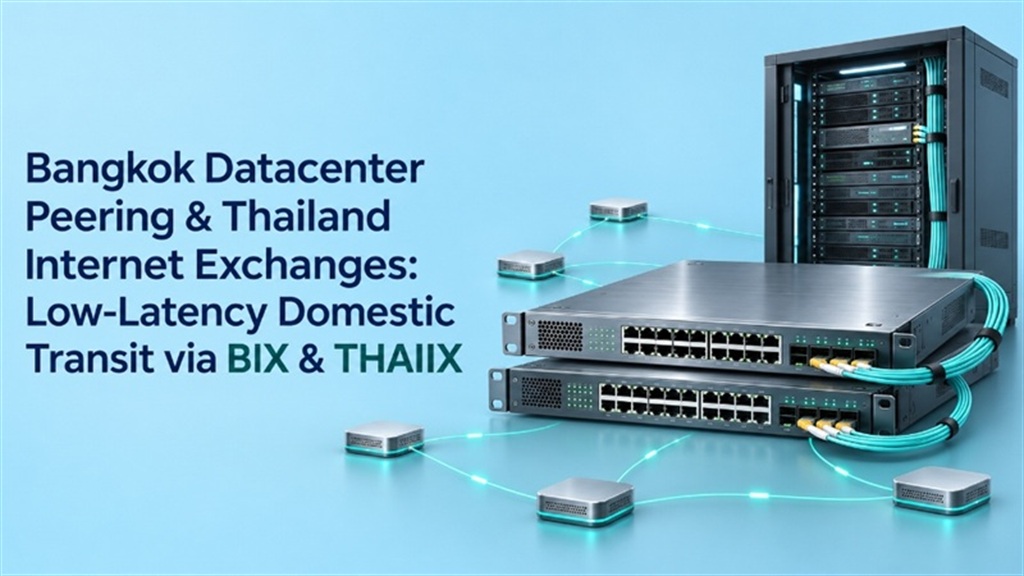
Domestic traffic in Thailand achieves lowest latencies (1–5 ms) when routed directly through the Bangkok Neutral Internet Exchange (BKNIX AS1025) peering fabric and Thai Internet Exchange (THIX AS4652). To optimize performance across AIS, True-Dtac, and NT networks, audit your hosting provider’s upstream transit blend to prevent domestic data packets from tromboning through Singapore or Hong Kong.
Bangkok functions as the optical gateway of Mainland Southeast Asia, anchoring terrestrial fiber routes connecting Thailand with Cambodia, Laos, Myanmar, and Malaysia. Inside Bangkok’s carrier-neutral facilities, domestic internet exchanges like BKNIX (AS1025) and THIX (AS4652) interconnect with carriers including AIS, True-Dtac, and National Telecom. Deploying dedicated bare metal within this peering ecosystem keeps Thai user requests within domestic fiber rings, bypassing high-latency international transits. Selecting the right transit blend ensures sub-10ms domestic response times and robust PDPA compliance.
Reality: BKNIX (AS1025) and THIX (AS4652) operate carrier-neutral Layer 2 exchange fabrics in central Bangkok datacenters.
Takeaway: Keeps domestic Thai traffic local, avoiding international tromboning through Singapore or Hong Kong.
Reality: Dominated by AIS (AS17552), True-Dtac (AS23969/AS45430), and National Telecom (AS9848/AS4652) backbone networks.
Takeaway: Upstream bilateral peering delivers 1–3 ms latency across Greater Bangkok and sub-15 ms nationwide.
Reality: Modern Bangkok plans feature 1 Gbps unmetered uplinks operating under local Thai legal and physical jurisdiction.
Takeaway: In-country packet processing avoids Section 28/29 cross-border transfer liabilities and sudden port throttling.
Why Bangkok Serves as Mainland Southeast Asia’s Fiber Crossroads
Bangkok’s geography establishes it as the natural aggregation hub for telecommunications across Indochina. Terrestrial fiber corridors cross northern Thailand into Laos and Myanmar, extend east toward Cambodia, and follow southern coastal routes directly into Malaysia. Subsea cable systems landing along the eastern seaboard—including AAG, APG, and SJC2—meet terrestrial rights-of-way terminating in central Bangkok facilities.
For digital platforms serving Southeast Asia, this physical fiber architecture establishes Bangkok as an ideal deployment hub. Handling requests from Bangkok, Chiang Mai, or neighboring ASEAN regions within a domestic facility eliminates the 25ms to 35ms propagation penalty incurred when routing through Singapore or Hong Kong.
However, physical fiber proximity alone does not guarantee optimal packet delivery. The Internet is governed by commercial BGP relationships between autonomous systems (ASNs). Packets follow routing policies advertised by upstream carriers rather than the shortest physical path. If a hoster lacks local domestic peering, requests from an AIS subscriber in Nonthaburi destined for a central Bangkok server may route offshore across submarine fiber to Singapore, exchange hands at an external carrier switch, and return northward across that same cable corridor.
This pathological routing—known as “tromboning” or “hairpinning”—inflates domestic latency from 2ms to over 60ms, introduces jitter, and degrades interactive applications. Preventing tromboning requires bare-metal infrastructure connected to transit blends that actively peer at local Internet Exchange Points (IXPs). When evaluating Thailand versus Singapore dedicated server placement, domestic Thai latency hinges on whether the provider peers directly with local exchanges.
How BKNIX & THIX Peering Differs from Paid International IP Transit
To architect high-performance infrastructure in Thailand, engineers must differentiate between Layer 2 exchange peering and Layer 3 paid IP transit. These two mechanisms serve distinct technical and economic purposes.
The Role of Internet Exchange Points (IXPs) in Thailand
An Internet Exchange Point is a shared physical Layer 2 Ethernet fabric through which autonomous systems exchange traffic settlement-free without intermediary transit charges. Two primary public exchange platforms anchor domestic peering in Thailand:
- BKNIX (Bangkok Neutral Internet Exchange – AS1025): Operated by the THNIC Foundation, BKNIX is Thailand’s carrier-neutral internet exchange. With multiple points of presence across Bangkok, BKNIX enables bilateral and multilateral peering across BGP route servers, keeping Thai content on local high-speed switching fabrics.
- THIX (Thailand Internet Exchange – AS4652): Operated by National Telecom (NT), THIX interconnects governmental, enterprise, and educational networks nationwide.
When your server transmits data through an upstream carrier peering at BKNIX or THIX, packets destined for participating networks flow directly across Bangkok metropolitan switches. Traffic avoids international transit pipes, sustaining 1ms to 5ms domestic latency.
Paid IP Transit: The Global Gateway
In contrast, commercial IP transit provides global reachability via Tier-1 and Tier-2 transit carriers (such as NTT, Lumen, Arelion, and Singtel). Transit providers advertise global routing tables exceeding 950,000 IPv4 prefixes.
While IP transit is necessary for international users, relying on it for domestic Thai traffic introduces unnecessary latency. Transit providers route traffic according to internal BGP metrics, frequently routing domestic packets through Singapore or Hong Kong switching hubs if local carrier cross-connects are omitted.
| Feature / Metric | Domestic Internet Exchange (BKNIX / THIX) | Commercial International IP Transit |
|---|---|---|
| Network Layer | Layer 2 shared Ethernet switching fabric with BGP route servers | Layer 3 routed service with full or partial routing tables |
| Routing Scope | Domestic Thai ASNs and participating regional peers | Global reachability covering all active autonomous systems |
| Average Bangkok Latency | 1ms to 5ms round-trip time | 25ms to 65ms (if routed via regional transit hubs) |
| Cost Model | Port speed subscription fee; zero per-gigabyte egress fees | Metered transit bandwidth or committed data rate ($/Mbps) |
| Regulatory Risk | Minimal; packets remain within Thai sovereign optical fiber | Higher; cross-border routing can trigger PDPA transfer audits |
Understanding this structural separation prevents costly provisioning mistakes. When selecting high-bandwidth infrastructure, such as dedicated servers provisioned for 1 Gbps unmetered port capacity and bandwidth sizing, verifying that high-volume domestic asset delivery utilizes direct local peering paths is critical to maintaining both throughput and cost stability.
Distinguishing Facility-Level Neutrality from Your Server’s Actual Upstream Path
A pervasive misconception in the dedicated hosting industry is the belief that placing a server inside a “carrier-neutral” datacenter facility automatically guarantees that the server has direct, low-latency peering with every domestic ISP. In practice, datacenter facility specifications and dedicated server network routing operate on distinct physical and contractual layers.
Facility Neutrality vs. Server Upstream Blend
A datacenter facility is classified as carrier-neutral when its Meet-Me Rooms (MMRs) permit any licensed telecommunications operator to pull dark fiber into the building and terminate optical distribution frames (ODFs). Facilities like True IDC North Muang Thong, NTT Bangkok 2, Telehouse Bangkok, or AIMS Bangkok host dozens of carrier points of presence.
However, when you rent a standard bare-metal dedicated server, your server’s physical network interface card (NIC) is not patched into all of those carriers simultaneously. Instead, your server connects to an access switch port owned by the hosting provider. Your routing path is dictated strictly by the hosting provider’s own upstream autonomous system (ASN), its multi-homed BGP configuration, and its active transit contracts.
The Three Upstream Architectures
When ordering dedicated hardware in Bangkok, your server will typically fall into one of three network models:
- Single-Homed Upstream: The hosting provider connects to a single regional ISP. If that ISP experiences upstream congestion or subsea fiber cuts, your server has no alternate path.
- Multi-Homed Blended Transit (Standard Dedicated Server Model): The provider operates its own Autonomous System Number (or utilizes a carrier partner’s multi-homed ASN), maintaining BGP sessions with multiple domestic carriers (such as AIS, True, and NT) and international transit providers. Outbound traffic follows BGP routing policies managed at the provider’s border routers.
- Bring-Your-Own-IP & Direct Cross-Connect BGP (Enterprise Model): The client provides their own APNIC-allocated IP space and ASN, and contracts dedicated physical cross-connects directly to specific carriers or BKNIX ports inside the datacenter MMR. This advanced model is explored in our guide to multi-homed BGP and Anycast routing architectures.
For most web, e-commerce, and SaaS workloads, a well-engineered multi-homed domestic blend (Model 2) provides the optimal balance of performance and operational simplicity. However, infrastructure leads must actively audit that blend rather than assuming that the facility’s carrier logo list automatically applies to their server instance.
Auditing Live Routes to AIS, True-Dtac, NT, 3BB & Regional ASEAN Peers
To verify that your Bangkok dedicated server benefits from true domestic peering rather than circuitous international hops, you must conduct empirical network path audits. Static ping times provide insufficient data; you must inspect the autonomous system numbers (ASNs) and hop-by-hop latency across all major Thai telecommunications networks.
Major Domestic Autonomous Systems in Thailand
When analyzing route telemetry from within a Bangkok server, the primary domestic networks you will encounter include:
- AIS (Advanced Info Service): AS17552 (AIS Domestic Backbone), AS24378 (AWN / AIS 4G/5G Wireless).
- True-Dtac (True Corporation / Telenor): AS23969 (True Internet Backbone), AS45430 (Dtac / Total Access Communication).
- National Telecom (NT): AS9848 (NT / formerly TOT Public Co.), AS4652 (NT / formerly CAT Telecom & THIX).
- 3BB (Triple T Broadband – now integrated under AIS): AS45758.
Network Audit Runbook: Testing from the Server Shell
Execute the following diagnostic commands from an administrative SSH session on your dedicated server to inspect outbound routing decisions.
[!TIP] Always install mtr and bind-utils (or dnsutils) to perform continuous, multi-cycle path tracing that captures micro-burst packet loss and route flapping.
Interpreting MTR Output: Peered Path vs. Trombone Path
Reviewing MTR traces reveals whether packets take a direct domestic route or trombone offshore:
1. Verified Low-Latency Peered Path: Packets flow directly through local exchanges, reaching domestic destinations within 1–3ms with zero packet loss:
- Hop 1: Local Datacenter Gateway (<1ms)
- Hop 2: Bangkok Internet Exchange / BKNIX Hop (1–2ms)
- Hop 3: AIS Domestic Core (AS17552) (2.1ms)
- Hop 4: Destination Host (2.4ms)
2. Pathological Unpeered Trombone Path: Packets leave Bangkok, cross submarine cables to Singapore, and return to Thailand, inflating latency to 55ms+:
- Hop 1: Local Datacenter Gateway (<1ms)
- Hop 2: International Transit Uplink (1.5ms)
- Hop 3: Subsea Cable Hop to Singapore (16ms)
- Hop 4: Equinix Singapore Carrier Exchange (28ms)
- Hop 5: Return Transit to Thailand (54ms)
- Hop 6: Destination Host (56ms)
This trace reveals severe routing inefficiency. Instead of a direct 2ms cross-connect in Bangkok, packets travel southward through submarine fiber to Singapore, exchange at a regional switch, and return northward back into Thailand. This path quadruples latency and exposes local application data to transit outages outside of Thailand.
Network & Peering Questions to Confirm Prior to Ordering
Before committing capital to a dedicated server contract in Thailand, network administrators must perform vendor technical due diligence. Generic hosting sales teams often advertise “Tier 3 Datacenter” and “1 Gbps Port Speed” without understanding the underlying routing architecture.
Submit the following six technical inquiries to your prospective infrastructure provider’s engineering team:
- Which specific Autonomous System Number (ASN) announces the dedicated server IP allocation?
Why it matters: Obtaining the ASN allows you to verify the provider’s upstream transit providers, peering presence at BKNIX or THIX, and public peering relationships using public tools like BGP.tools or PeeringDB.
- Does the hosting provider maintain direct bilateral peering with AIS (AS17552) and True-Dtac (AS23969)?
Why it matters: Together, AIS and True-Dtac control over 80% of Thailand’s mobile subscriber base and consumer broadband market. Direct peering ensures the lowest possible latency for end users.
- What is the dedicated physical port speed and upstream commit on the server?
Why it matters: Onlive Server offers transparent hardware segmentation: entry-level and legacy Xeon configurations (Thailand Dedicated – DSX1 through DSX9) feature dedicated 100 Mbps ports ($116 to $406/mo), which are ideal for internal backends, VPNs, and staging workloads. For production e-commerce, media delivery, and high-concurrency public APIs, modern Core, Ryzen, and Xeon configurations (DSX10 through DSX25, starting at $99/mo for the Ryzen 9 7900 DSX16 and $119/mo for the Core i5-12600 DSX10) provide full 1 Gbps unmetered network ports.
- Is the unmetered bandwidth subject to an aggressive Fair-Use Policy (FUP) or 95th-percentile throttling?
Why it matters: Transparent providers guarantee continuous port throughput without sudden speed caps or unexpected per-terabyte egress bills at the end of the billing cycle.
- How does the provider ensure compliance with the Thailand Personal Data Protection Act (PDPA B.E. 2562)?
Why it matters: Under PDPA Sections 28 and 29, transferring personal data of Thai data subjects across international borders requires rigorous contractual and technical safeguards. Housing your databases and application servers inside Bangkok ensures data localization, eliminating complex cross-border transfer compliance hurdles.
- Can the server accommodate hardware RAID or software storage mirroring?
Why it matters: In high-availability production environments, storage redundancy is mandatory. Entry-level bare-metal plans (such as DSX1-DSX3 and DSX10-DSX21) ship with a single high-performance SATA, SSD, or NVMe drive. For mission-critical deployments, administrators should always add a second matched drive to configure RAID 1 or software ZFS mirroring.
Frequently Asked Questions
Seeking Direct Indochina Peering Exchange Uplinks?
Routing traffic through international transit hubs adds unnecessary latency for local users. Direct interconnections with BKNIX and THIX ensure single-digit millisecond latency across major Thai internet service providers and regional ASEAN networks.

Naveen Rajput
Founder, CEO & Technical Director, Onlive Server
Naveen Rajput oversees enterprise infrastructure architecture, bare-metal server provisioning, and international peering networks across Onlive Server Tier III datacenters in Bangkok and worldwide.
