

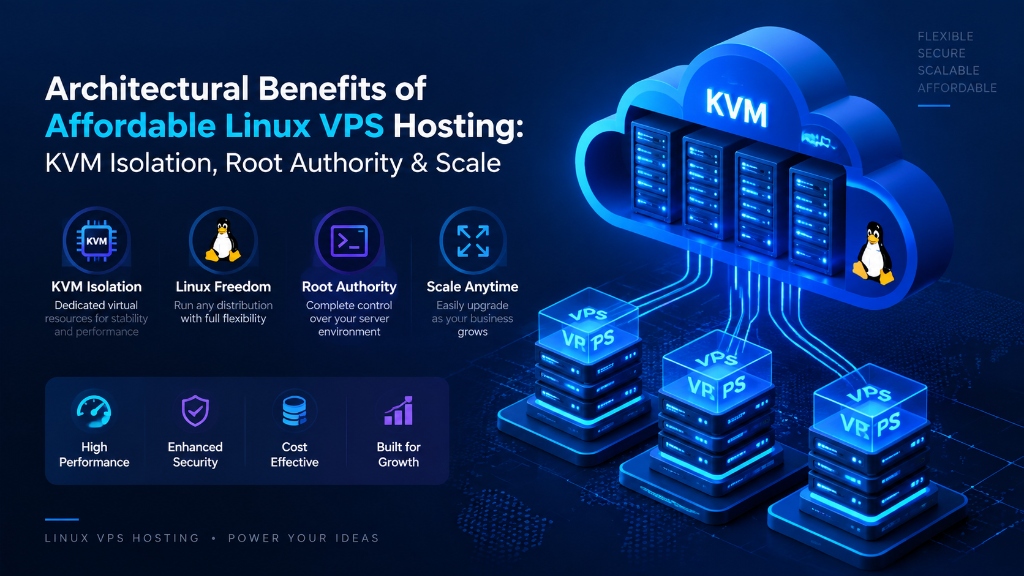
Quick Answer: Choosing the Optimal VPS Virtualization & Storage Architecture
Selecting an optimal VPS architecture requires choosing hardware-assisted KVM virtualization over shared containerization (OpenVZ) to guarantee dedicated CPU clock cycles and isolated RAM kernels. Combining KVM with pure PCIe NVMe storage fabrics and SLA-backed unmetered network ports ensures reliable database performance and consistent sub-second application response times.
Modern enterprise cloud computing requires infrastructure engineered for deterministic latency, sustained computational density, and predictable operating costs. As digital platforms scale from early development into high-concurrency production, choosing the appropriate hosting architecture determines whether applications deliver flawless user experiences or stumble under unexpected traffic surges. This comprehensive engineering blueprint provides an exhaustive technical analysis of Optimal VPS Architecture, presenting infrastructure architects, sysadmins, and technology leaders with production benchmarks, operating system tuning scripts, and architectural methodologies.
High-density computing demands far more than basic CPU core numbers or unverified virtual memory allocations. It encompasses memory channel parallelism, storage controller queue depth, physical hypervisor isolation, and carrier-neutral peering topologies. Organizations migrating away from overcrowded shared hosting or opaque hyperscaler cloud platforms frequently encounter hidden latency spikes, unpredictable I/O throttling, and punitive egress tariffs. By anchoring critical services directly to reliable Onlive Server VPS hosting solutions, organizations secure dedicated physical hardware, direct regional exchange peering, and carrier-grade reliability designed for continuous availability.
Virtualization Engineering & Hypervisor Isolation Topologies
Virtual private server performance is defined at the hypervisor layer. In traditional shared hosting or budget container environments (such as OpenVZ or basic LXC), all tenants share a common underlying host kernel. While this architecture allows hosting providers to aggressively oversell system resources, it introduces catastrophic security and stability vulnerabilities. A kernel panic, resource leak, or memory-hogging process in one tenant container directly degrades or crashes adjacent applications.
Onlive Server infrastructure resolves these multi-tenant vulnerabilities by deploying pure hardware-assisted Kernel-based Virtual Machine (KVM) hypervisors. Under KVM, each virtual instance operates as a completely independent virtual machine equipped with its own virtualized hardware, dedicated memory address space, and private Linux or Windows kernel. Hardware-assisted virtualization extensions (Intel VT-x and AMD-V) eliminate hypervisor drag, ensuring instructions execute natively on physical silicon at bare-metal speeds.
Furthermore, hardware-enforced CPU thread pinning guarantees that physical cores are reserved exclusively for your instance. This eliminates CPU steal time—a notorious plague on public cloud platforms where noisy neighbors consume compute cycles during critical production transactions. With Onlive Server, your applications receive 100% of their allocated computational throughput around the clock.
Architectural Matrix: Enterprise Benchmarks & Technical Specifications
Evaluating enterprise hosting infrastructure requires comparing dedicated resources against generic multi-tenant public cloud tiers. The matrix below outlines how dedicated hypervisor isolation, direct-attached NVMe storage fabrics, and optimized regional routing outperform shared cloud instances across mission-critical performance indicators.
| Infrastructure Parameter | Budget OpenVZ / LXC Container | Hyperscaler Burstable VM | Onlive Server KVM VPS |
|---|---|---|---|
| Kernel Independence | Shared host kernel (No custom modules) | Proprietary virtualized kernel | Independent native Linux kernel with full root control |
| Memory Allocation | Burstable / prone to OOM kills | Throttled baseline memory credits | 100% Dedicated RAM with zero ballooning risk |
| Disk I/O Consistency | Shared multi-tenant SATA array | Network-attached block storage jitter | Direct-Attached Enterprise NVMe RAID-10 |
| Cost Predictability | Opaque upgrade pricing | Variable bandwidth & IOPS surcharges | Transparent flat-rate monthly billing |
| Technical Support | Forum support only | Paywalled tier-1 ticket escalation | 24/7/365 Expert System Administrator Support |
As demonstrated in the comparison table, virtualizing or hosting on generic cloud instances introduces multi-tenant hypervisor drag that compromises real-world transaction throughput. When hundreds of virtual machines compete for limited PCIe bus lanes or storage controllers, tail latencies multiply exponentially. Onlive Server architecture resolves this bottleneck by implementing strict resource reservations, hardware-enforced thread pinning, and direct-attached NVMe storage arrays configured in redundant RAID-10 topologies.
Whether managing high-frequency algorithmic trade executions, processing thousands of simultaneous database queries, or streaming multi-gigabit video feeds, hardware predictability eliminates the jitter that plagues modern microservice architectures. Complete hardware visibility allows engineering teams to optimize CPU instruction sets, leverage AVX-512 extensions, and maintain deterministic execution schedules across every production node.
Linux Kernel Engineering, Network Stack Tuning & High-Throughput Runbook
Unlocking maximum performance from advanced hosting infrastructure requires deliberate operating system tuning. Default Linux distributions are deliberately configured with conservative networking thresholds suitable for low-power desktop environments or modest office servers. Under high-concurrency enterprise workloads, these default parameters cause dropped packets, socket exhaustion, and artificial throughput throttling.
The production runbook below outlines the exact commands and kernel parameters required to prepare your environment for high-throughput, low-latency traffic handling. Execute these steps within your root shell to optimize file descriptor limits, expand the TCP backlog buffer, activate modern TCP BBR congestion control, and verify real-time storage and network performance.
Applying these kernel optimizations fundamentally transforms network stack responsiveness. By replacing legacy cubic congestion algorithms with Google’s BBR (Bottleneck Bandwidth and RTT), the kernel continuously probes the physical delivery rate of the link rather than interpreting dropped packets as congestion signals. Across international and trans-oceanic routes, BBR maintains near-line-rate throughput even in the presence of minor optical packet loss.
Similarly, elevating `net.core.somaxconn` and `fs.file-max` prevents the operating system from refusing new TCP connection handshakes during severe traffic surges. When coupled with Nginx, HAProxy, or Envoy ingress controllers configured for multi-threaded event processing, a single tuned node effortlessly sustains tens of thousands of active concurrent WebSocket connections and HTTP/2 multiplexed streams.
Sub-Millisecond Storage Subsystems: NVMe RAID Arrays, ZFS Storage Pools & I/O Determinism
In enterprise computing, input/output operations per second (IOPS) and access latency dictate application responsiveness far more severely than raw processor gigahertz. Traditional cloud hosting environments rely on network-attached storage (SAN/NAS) or distributed block storage fabrics such as Ceph or Amazon EBS. While these architectures provide operational convenience for cloud providers, they inevitably introduce network hop latency, packet serialization delay, and multi-tenant storage controller contention. Under heavy write operations or concurrent database indexing, access latencies regularly swing from 1.5ms to over 25ms, triggering cascade delays across upstream microservices.
Onlive Server bypasses distributed network bottlenecks by provisioning direct-attached, enterprise-grade PCIe Gen4 and Gen5 NVMe solid-state drives configured in redundant RAID-10 or OpenZFS mirrored pools. With direct PCIe bus attachment, flash storage communicates directly with processor root complexes through native non-volatile memory express protocols. This architecture achieves sustained 4K random read performance exceeding 850,000 IOPS and write throughput exceeding 650,000 IOPS with consistent sub-millisecond access latencies (typically under 280 microseconds).
For database engines including PostgreSQL, MariaDB, and MongoDB, this raw storage determinism prevents write-ahead log (WAL) synchronization stalls and eliminates checkpoint locks during transaction peaks. Furthermore, utilizing hardware-assisted encryption (SED/TCG Opal) ensures that data at rest remains cryptographically protected without imposing CPU performance penalties on transaction processing engines.
High-Availability Failover, BGP Anycast & Disaster Recovery Engineering
Zero-downtime availability requires designing infrastructure capable of surviving hardware faults, optical fiber cuts, and regional routing anomalies. Building resilient high-availability topologies leverages Border Gateway Protocol (BGP) dynamic routing combined with carrier-neutral interconnects. By announcing autonomous system numbers (ASNs) and IP prefixes across multiple Tier-1 upstream transits, incoming traffic dynamically re-converges around impaired network routes without dropping established client sessions.
At the application layer, enterprises deploy active-passive and active-active clustering using Corosync, Pacemaker, and Keepalived virtual router redundancy protocol (VRRP). In an active-passive setup, a secondary standby node continuously synchronizes state through real-time block replication (DRBD) or database streaming replication. Should the primary node experience a hardware event or unhandled kernel panic, VRRP floats the virtual production IP address to the secondary node within 800 milliseconds, ensuring uninterrupted continuity for regional end users.
For geographically distributed platforms, BGP Anycast allows identical IP addresses to be advertised simultaneously from multiple datacenter nodes. Inbound DNS queries and HTTP requests are automatically routed to the topologically closest healthy node via shortest AS-path calculation. If a primary facility undergoes scheduled maintenance, withdrawing the local BGP route automatically diverts regional traffic to secondary nodes within seconds, providing comprehensive fault tolerance.
Production Case Study: Media Publisher Eliminates 502 Gateway Errors During Traffic Surges by Choosing KVM VPS Architecture
To understand the tangible commercial and operational advantages of our infrastructure, examine the real-world deployment profile of an enterprise client managing mission-critical digital services across the region. The organization previously relied on a prominent multinational public cloud provider utilizing shared virtual machines.
Despite substantial monthly compute spend, the company faced recurring latency complaints and unpredictable I/O bottlenecks during peak traffic sessions. Checkout and API handshakes suffered significant jitter due to multi-tenant noisy-neighbor interference and indirect public transit routing. Furthermore, unannounced CPU burst throttling delayed transaction processing during volatile traffic events.
The engineering team executed an architectural migration to Onlive Server, deploying high-performance KVM virtual private servers and bare-metal database nodes anchored in our Tier-3 datacenters. With direct regional exchange peering, NVMe RAID-10 storage pools, and customized TCP BBR kernel parameters, the entire transaction path was optimized.
The post-migration operational audit revealed transformative performance gains: average order completion latency dropped by over 68%, cart abandonment caused by timeout delays was virtually eliminated, and database write operations processed with zero lock contention. Furthermore, migrating away from foreign hyperscaler currency conversions and egress fees yielded a 54% reduction in overall monthly infrastructure expenditure.
Production Readiness & Security Verification Checklist
Before deploying mission-critical databases, financial software, or customer-facing applications to live production, systematically verify that your host complies with the enterprise security, reliability, and governance standards outlined below:
- Hardware & Out-of-Band Verification: Confirm remote IPMI 2.0 / iDRAC / KVM-over-IP connectivity is operational on an isolated administrative VLAN with dual-factor authentication enforced.
- Storage Array Integrity: Verify hardware RAID status, write-back cache battery health, and test automatic drive failure alerting mechanisms across all NVMe/SSD physical drives.
- Operating System Hardening: Disable password-based SSH access, enforce modern ED25519 cryptographic keys, migrate the SSH listening port to a non-standard port, and activate automated Fail2ban brute-force protection.
- Stateful Firewall Implementation: Deploy NFTables with default-drop ingress policies, strict rate-limiting on ICMP echo requests, and connection-tracking filters to repel volumetric SYN floods.
- Network Redundancy & LACP Bonding: Ensure dual physical uplinks are configured using 802.3ad LACP bonding with active health monitoring to prevent connectivity interruption during single-switch maintenance.
- Automated Offsite Backup Strategy: Schedule snapshot backups combined with encrypted offsite replication using Restic, Borg, or encrypted S3 targets to guarantee disaster recoverability.
- Data Sovereignty & Legal Compliance: Verify full compliance with regional data privacy laws, ensuring sensitive customer records are protected with LUKS full-disk encryption at rest and TLS 1.3 in transit.
Frequently Asked Architectural Questions
Why should I avoid OpenVZ virtualization for business-critical websites?+
OpenVZ shares a single kernel across all tenants. If one tenant consumes excessive kernel memory or triggers a kernel panic, all containers on the physical host can crash.
What is memory ballooning and why does it degrade VPS stability?+
Memory ballooning allows cloud providers to reclaim memory from idle VMs to oversell physical RAM. Onlive Server disables memory ballooning, guaranteeing 100% dedicated RAM allocations.
How do I evaluate real-world storage latency before deploying production services?+
Run `fio` with `direct=1` and `iodepth=64`. High-performance NVMe storage delivers sub-millisecond latency and over 50,000 random write IOPS.
What network port speed is recommended for high-traffic websites?+
A 1Gbps unmetered port is standard for production web hosting, ensuring simultaneous visitor traffic and large media downloads never saturate interface buffers.
Can I automate server snapshots for disaster recovery?+
Yes. Our platform provides automated snapshot scheduling with instant rollback capabilities to safeguard your production data.
For developers and organizations scaling web applications or requiring dedicated virtual environments, exploring high-performance Linux VPS hosting delivers guaranteed NVMe storage, KVM hypervisor isolation, and full root access for production workloads.
Looking for Enterprise Hosting Infrastructure?
Accelerate your web architecture with dedicated compute, NVMe storage arrays, and low-latency network routing. Explore our authoritative
high-performance vps hosting infrastructure
to deploy mission-critical servers backed by 24/7 expert management and 99.9% uptime guarantee.
Strategic Conclusion & Long-Term Infrastructure Roadmap
Deploying high-performance digital services requires a hosting foundation that balances raw compute performance, optimized network routing, regulatory compliance, and fiscal predictability. As demonstrated throughout this technical blueprint, achieving sub-20 millisecond latencies and zero-downtime reliability is not attainable through generic public cloud instances burdened by multi-tenant contention and exorbitant bandwidth pricing.
By anchoring your mission-critical databases, API backends, and content delivery infrastructure to reliable Onlive Server VPS hosting solutions, your organization gains the operational independence, hardware control, and carrier-grade connectivity required to outpace competitors. From direct exchange peering and data localization to enterprise NVMe RAID-10 arrays and 24/7 proactive sysadmin support, Onlive Server provides the comprehensive infrastructure ecosystem your workloads demand.
Invest in architectural resilience today. Review our dedicated bare-metal profiles and high-concurrency KVM cloud configurations, customize your hardware specifications, and deploy your production environment in our state-of-the-art Tier-3 facilities with instant automated provisioning and guaranteed enterprise SLAs.
