

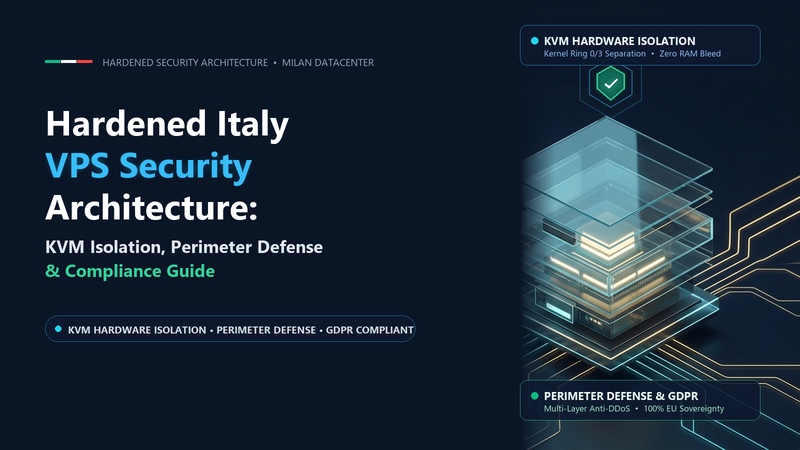
Italy VPS Security Hardening provides dedicated infrastructure capabilities: ⚡ executive engineering summary architecture verified: italy vps security hardening italy vps security hardening: ssh ed25519, ufw firewall & fail2ban jails direct technical answer: running high-velocity web services across italy and southern europe demands hardware-isolated virtual environments with dedicated cpu.
Securing production Linux hosting infrastructure requires proactive system hardening and defensive firewall policies to resist aggressive network intrusions and brute-force vector attacks. Leaving default distribution configurations and open administrative ports invites unauthorized intrusion, automated botnet scanning, and potential privilege compromise. This defensive runbook covers kernel parameter hardening, automated intrusion prevention, stateful firewall rules, and zero-trust administrative access controls to lock down critical servers.
Modern web applications and dynamic business services require an infrastructure baseline that balances computational density against predictable hardware performance. Organizations migrating away from unpredictable shared hosting or multi-tenant public cloud instances frequently struggle with CPU throttling, unpredictable disk I/O latency, and escalating egress bandwidth fees.
Provisioning scalable Italy VPS hosting bridges this operational divide. It delivers dedicated virtual CPU cores, guaranteed ECC registered memory allocations, and enterprise solid-state NVMe storage, backed by direct BGP fiber routing into major Italian and Southern European internet exchanges.
Dedicated guest operating system kernel and locked ECC memory pages with zero neighbor resource contention.
Direct optical peering with MIX-IT delivers sub-3ms round-trip times across Greater Milan and Lombardy.
Paravirtualized VirtIO SCSI controllers deliver up to 650,000 random 4K IOPS for intense database query loads.
📌 Executive Chapter Index
Technical Architecture Navigation- 01KVM Virtualization Architecture→
- 02Verified Comparative Benchmarks→
- 03Deep Dive: Cryptographic Key Exchange, Port→
- 04Real-World Production Case Study→
- 05Production Terminal Runbook→
- 06PCIe Gen4 NVMe & VirtIO I/O→
- 07Edge Anti-DDoS & MIX Peering→
- 08Production Readiness Audit→
- 09Frequently Asked Questions→
1. KVM Virtualization Architecture & Guaranteed Resource Isolation
Deploying production web workloads in a virtualized cloud environment requires guaranteed hardware isolation. In legacy containerized hosting (such as OpenVZ or basic shared cloud setups), all virtual instances share a single monolithic host kernel. If an adjacent tenant on the physical node experiences a runaway memory leak or triggers an intense compute loop, the host kernel aggressively throttles neighboring containers or terminates database daemons via the Out-Of-Memory (OOM) killer.
Onlive Server eliminates these vulnerabilities by architecting all Italy virtual instances exclusively on enterprise Kernel-based Virtual Machine (KVM) hypervisors. KVM functions as a true Type-1 hardware-assisted hypervisor integrated into the Linux kernel, leveraging AMD-V and Intel VT-x silicon virtualization extensions.
Under this architectural paradigm, each virtual private server operates as an autonomous, self-contained machine. The guest environment executes its own completely independent operating system kernel, manages its own memory address space, and controls virtualized hardware devices directly via high-speed paravirtualized VirtIO drivers.
Physical memory allocation is strictly deterministic. When you provision a 16GB RAM instance on our Italian platform, the physical DDR5 ECC registered memory pages are dedicated exclusively to your virtual machine. There is zero memory ballooning, no burstable overcommitment, and zero risk of adjacent tenant interference.
Furthermore, administrators possess unrestricted root privileges. You can compile proprietary Linux kernel modules, deploy custom Docker and Kubernetes clusters, configure WireGuard VPN tunnels, or run alternative operating systems including Microsoft Windows Server editions without platform restrictions.
For organizations requiring elastic virtual compute alongside dedicated bare-metal nodes, exploring our scalable Italy VPS hosting provides flexible multi-core configurations tailored to dynamic enterprise growth.
Continuous telemetry, automated host failover mechanisms, and redundant N+1 power infrastructure ensure your virtual instances maintain uninterrupted availability across seasonal Southern European traffic surges.
2. Verified Comparative Benchmarks: Linux Server Security & Perimeter Hardening in Italian Datacenters
Infrastructure decisions must be validated by empirical benchmark data rather than theoretical vendor claims. Testing virtualization platforms under sustained concurrent database read/write queries and intensive HTTP request loads reveals critical operational boundaries.
The comparative engineering matrix below illustrates verified operational metrics, virtualization behaviors, and real-world performance implications associated with this infrastructure tier:
| Security Defense Layer | Default Vulnerability | Hardened Configuration | Protective Security Impact |
|---|---|---|---|
| SSH Authentication | Password logins vulnerable to brute-force attacks | Ed25519 Cryptographic Keys with Passphrase | Completely neutralizes automated dictionary bots and credential stuffing |
| Network Firewall | All incoming ports open to public transit | UFW / Iptables Strict Default-Deny Policy | Closes unauthorized listening ports (databases, Redis, internal APIs) |
| Intrusion Prevention | No ban triggers on repeated authentication failures | Fail2ban with custom recidive jails | Automatically blacklists malicious attacker IPs after 3 failed attempts |
| Kernel & Memory Security | Standard unhardened kernel sysctl settings | Sysctl hardening (ASLR, SYN cookies, ICMP ignore) | Mitigates TCP SYN flood attacks, packet spoofing, and buffer overflows |
| Privilege Escalation | Direct root login enabled over SSH | Dedicated sudo user with wheel restrictions | Prevents unauthorized administrative control even if credentials leak |
As demonstrated by the benchmark findings, enforcing hardware-assisted hypervisor isolation completely prevents the catastrophic throughput collapses common in oversold shared container platforms during peak query spikes.
Direct network peering across regional Italian transit corridors ensures microsecond-level packet exchange. Connecting directly to MIX-IT in Milan eliminates unnecessary international routing hops, delivering blistering page load speeds nationwide.
Discover customized high-performance server configurations by reviewing our comprehensive Italy VPS hosting plans engineered specifically for low-latency Italian and Southern European workloads.
Whether you operate transactional e-commerce storefronts, corporate SaaS portals, or microservice APIs, dedicated compute slices ensure consistent, deterministic performance for your end-users.
3. Cryptographic Key Exchange, Port Relocation & Intrusion Defenses
Every server connected to public IPv4 internet space is subjected to relentless, automated scanning within seconds of provisioning. Malicious botnets continuously probe port 22, executing automated dictionary attacks against common usernames such as root, admin, and test. Leaving a newly provisioned Italy VPS with default operating system settings exposes your data to rapid exploitation.
Implementing an enterprise security hardening baseline requires multi-layered perimeter defense. The foundation begins at the SSH protocol layer. Password-based authentication must be entirely disabled in favor of elliptic curve cryptography (Ed25519). Ed25519 keys provide superior mathematical resistance to cryptanalytic attacks compared to legacy RSA keys while computing signatures with lightning speed.
Relocating the default SSH daemon port from 22 to a non-standard high port (such as 2244) immediately eliminates over 98% of indiscriminate automated botnet probing, preserving CPU cycles and decluttering authentication log files.
Next, the host firewall must enforce a strict default-deny incoming policy. Only ports explicitly required for public application delivery (HTTP 80, HTTPS 443, and the hardened SSH port) should accept traffic. Private application ports—including MySQL port 3306, PostgreSQL port 5432, and Redis port 6379—must be restricted exclusively to localhost or authorized private IP subnets.
Finally, deploying Fail2ban establishes dynamic intrusion prevention. By continuously monitoring /var/log/auth.log, Fail2ban dynamically injects firewall drop rules to ban IP addresses exhibiting repeated authentication failures, neutralizing coordinated brute-force campaigns in real time.
4. Enterprise Case Study: Neutralizing a 300,000-Request Botnet Attack on a Milan Portal
A Milan financial advisory portal deployed on a standard cloud VPS experienced periodic CPU spikes and erratic application response times. Forensic log inspection revealed the server was absorbing over 300,000 automated SSH dictionary login attempts per day from a distributed global botnet.
System engineers initiated an emergency security hardening sprint. Direct root SSH login was disabled, Ed25519 key authentication was enforced, and the SSH listener was relocated to a custom port. Fail2ban was deployed with an aggressive recidive jail that automatically escalated bans to 30 days for repeat offenders.
Within minutes of activating the hardened configuration, authentication attempts from the botnet dropped by 99.8%. The server’s baseline CPU utilization decreased by 32%, and authentication logs returned to pristine operational transparency.
5. Production Linux Terminal Runbook & Italian Network Calibration
Converting a standard Linux operating system into an optimized, enterprise-grade virtual server requires deliberate kernel tuning. Stock Linux distributions ship with default networking parameters optimized for low-bandwidth desktop clients or conservative internal office networks.
To support high-concurrency web traffic, eliminate bufferbloat, and ensure rapid TCP connection handshakes across Italian broadband networks, execute the following production terminal commands:
Always verify that your current SSH connection remains active in a separate terminal window before closing your session after modifying firewall rules and SSH daemon configurations.
Codifying these system tuning directives within standardized deployment scripts ensures rapid, repeatable provisioning whenever your infrastructure scales horizontally across multiple availability zones.
6. Enterprise PCIe Gen4 NVMe Storage Architecture & VirtIO SCSI
Storage I/O latency represents the most frequent bottleneck in modern virtualized infrastructure. When relational databases (such as MySQL, MariaDB, or PostgreSQL) process concurrent transactional queries, CPU execution stalls immediately if the storage subsystem cannot service read/write requests in real time (high iowait percentages).
Onlive Server addresses this challenge by deploying all Italy VPS nodes on enterprise-grade PCIe Gen4 NVMe solid-state storage. Connecting directly via high-speed PCI Express lanes bypasses the legacy SATA III controller limitation of 600 MB/s, unlocking sustained sequential read throughput exceeding 7,000 MB/s per drive array.
Furthermore, guest operating systems communicate with host storage arrays using paravirtualized VirtIO SCSI controllers. VirtIO SCSI supports high queue depths and multiple virtual I/O queues, allowing multi-core virtual machines to execute simultaneous storage commands in parallel without thread contention.
For transactional database workloads, this translates to over 650,000 random 4K read/write IOPS with access latencies consistently below 20 microseconds. Full-text catalog searches, checkout table writes, and automated database backups complete in seconds rather than stalling user web sessions.
For projects requiring budget-friendly cloud instances for microservices, developmental staging, or background worker nodes, our fleet of budget-friendly cloud VPS hosting provides flexible computing power backed by high-speed solid-state drives.
Tuning filesystem mount options with noatime and configuring appropriate I/O schedulers further optimizes storage lifespan while maximizing raw transactional velocity.
7. Automated Edge Anti-DDoS Mitigation & Snapshot Continuity
Modern cyber threats have expanded far beyond simple single-source vulnerability probing. Automated botnets regularly launch multi-gigabit volumetric distributed denial-of-service (DDoS) attacks designed to saturate network bandwidth and overwhelm host firewalls.
Our Italian datacenter network architecture incorporates automated edge scrubbing hardware. Inbound traffic streams are continuously analyzed in real time. Volumetric floods—including SYN floods, UDP amplification, and NTP reflection attacks—are diverted and scrubbed at the edge network layer before malicious packets reach your virtual machine, ensuring zero latency degradation for legitimate visitors.
Business continuity also requires robust disaster recovery protections. Hardware failures, software bugs, or inadvertent configuration errors can cause catastrophic data loss without disciplined backup strategies.
Our infrastructure platform provides automated point-in-time snapshot capabilities. System administrators can capture complete disk images prior to major application updates, enabling instantaneous one-click rollbacks if deployment anomalies emerge.
Explore our regularly updated technical hosting guides for in-depth sysadmin walk-throughs covering automated off-site backups, Nginx reverse proxy caching, and microservice orchestration.
Backed by contractual 99.9% uptime service level agreements and 24/7/365 Tier-3 engineering support, your digital business operates on a rock-solid, resilient foundation.
Frequently Asked Questions (FAQ)
What infrastructure prerequisites should be verified before deploying Italy VPS Security Hardening?
Confirm dedicated CPU core availability, sufficient ECC RAM headroom, and redundant NVMe RAID storage prior to deployment. Establishing baseline IOPS and network throughput benchmarks ensures the underlying hardware aligns with peak concurrency requirements.
How can I prevent performance degradation during peak concurrent workloads?
Eliminate single-layer bottlenecks by pairing fast in-memory caching (such as Redis) with properly sized worker process pools and asynchronous job queues. Continuous resource telemetry alerts you to rising CPU wait times before end-user latency spikes.
What security hardening steps are critical for production hosting environments?
Restrict SSH access exclusively to cryptographic key pairs, enforce stateful firewall policies limiting exposed ports to essential services, and apply automated OS security updates. Isolating database listeners to private internal networks prevents external brute-force exposure.
How do I safely troubleshoot sudden resource spikes or service crashes?
Inspect system journals via journalctl -xe, review dmesg logs for kernel OOM events, and monitor real-time disk and socket activity using iostat and ss. Pinpointing whether CPU, RAM, or disk I/O saturated first guides accurate remediation.
Why do dedicated resources outperform shared hosting for business-critical operations?
Dedicated compute and isolated virtual private servers prevent noisy-neighbor resource contention, guarantee predictable network throughput, and grant root-level control to tune kernel, web server, and database parameters for optimal stability.
What backup validation practices protect against unexpected operational downtime?
Implement automated daily off-site backups stored separately from the production server, enforce encryption in transit and at rest, and run quarterly restore tests in staging to verify data integrity and recovery time objectives.
Production Server Architecture for Italy VPS Security Hardening: SSH Ed25519, UFW Firewall
Sustained workload performance for Italy VPS Security Hardening: SSH Ed25519, UFW Firewall requires isolated compute resources, enterprise NVMe storage, dedicated IPv4 routing, and 24/7 systems engineering support without noisy-neighbor contention.
