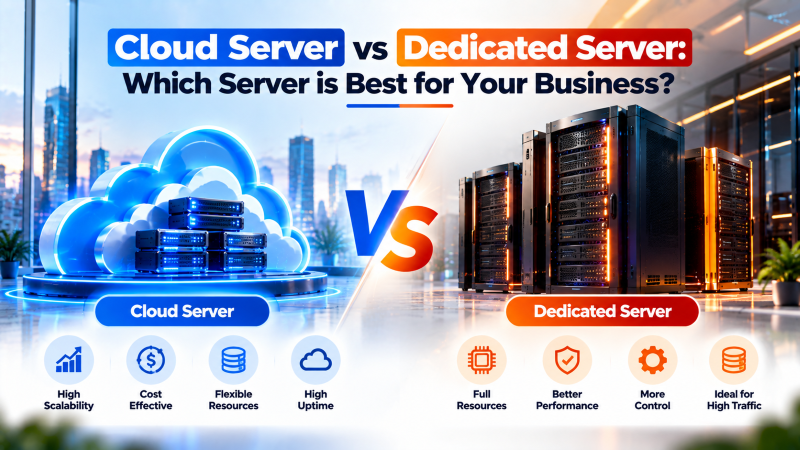
The fundamental distinction between a Cloud Server and a Dedicated Server is virtualization architecture and hardware ownership. Cloud servers operate as virtualized instances on distributed SAN storage clusters, offering instantaneous resource elasticity and automated failover. Dedicated servers provide 100% single-tenant bare-metal physical hardware, delivering maximum raw compute power, zero virtualization overhead, and predictable fixed pricing for heavy database and high-throughput workloads.
The Core Architectural Dilemma: Virtual Elasticity vs. Physical Power
Selecting the optimal hosting infrastructure represents one of the most critical technology decisions an organization can make. Your infrastructure choice directly governs application performance, operational agility, security compliance, and long-term hosting expenses. For verified technical specifications and deployment parameters, consult the official Linux Kernel Documentation.
Modern enterprises frequently face the decision between an elastic cloud VPS and physical bare-metal hardware. While cloud virtualization provides unparalleled flexibility for fluctuating traffic, bare-metal hardware delivers pure computing muscle without shared hypervisor overhead.
Understanding the specific architectural strengths and cost trade-offs of each hosting model ensures your infrastructure aligns perfectly with your technical and financial objectives.
What is a Cloud Server? (Architecture & Strengths)
A cloud server is an isolated virtual machine running on top of a hypervisor (such as KVM) within a pooled cluster of physical servers. Storage is typically decoupled from compute nodes, utilizing centralized Ceph or SAN NVMe storage arrays connected via high-speed fiber networks.
This distributed architecture provides remarkable resilience. If a physical host machine experiences hardware failure, the hypervisor management plane automatically migrates running cloud instances to a healthy node in the cluster with zero data loss.
Primary Advantages of Cloud Servers:
- Instant Elastic Scalability: Add vCPU cores, expand RAM, or increase storage volume sizes in seconds without downtime.
- High Availability & Redundancy: Distributed storage and automated failover protect against unexpected hardware outages.
- Agile Development Workflows: Quickly spin up staging instances, clone production environments, and destroy temporary workloads on demand.
What is a Dedicated Server? (Architecture & Strengths)
A dedicated server is a standalone physical computer housed in an enterprise datacenter rack. When you lease an enterprise bare-metal dedicated server, the entire physical chassis—including processors (Intel Xeon or AMD EPYC), motherboard PCIe lanes, ECC DDR5 RAM, and NVMe drives—is reserved exclusively for your workload.
Because there is no hypervisor layer translating CPU instructions or scheduling disk I/O, your software interacts directly with raw silicon. This direct access unlocks maximum possible throughput and deterministic, microsecond-level latency.
Primary Advantages of Dedicated Servers:
- Unmatched Raw Performance: Zero hypervisor CPU overhead and dedicated memory buses deliver unmatched computational speed.
- Maximum Disk I/O Throughput: Direct PCIe NVMe hardware access unlocks millions of read/write IOPS for massive database operations.
- Predictable Long-Term Economics: Fixed monthly billing eliminates surprise bandwidth overage bills and burst compute surcharges.
- Hardware-Level Compliance: Single-tenant isolation satisfies stringent HIPAA, PCI-DSS Level 1, and GDPR compliance mandates.
Comprehensive Feature Comparison Matrix
Compare the operational characteristics of both hosting paradigms across essential enterprise criteria:
| Architectural Parameter | Enterprise Cloud Server | Bare Metal Dedicated Server |
|---|---|---|
| Tenancy Model | Multi-Tenant (Hypervisor Isolated) | Single-Tenant (100% Bare Metal) |
| Compute Overhead | 2% – 5% Hypervisor Virtualization Layer | 0% (Direct physical execution) |
| Hardware Scalability | Instant (Dynamic vertical scaling) | Manual (Physical component upgrades) |
| Hardware Failure Impact | Automated failover to spare node | Requires technician component swap |
| Cost Predictability | Variable or tier-based monthly | Fixed, unmetered monthly cost |
Total Cost of Ownership (TCO) and ROI Evaluation
When calculating total infrastructure costs over a three-to-five-year horizon, dedicated servers consistently offer superior return on investment for steady-state workloads. Hyperscale public clouds charge premium rates for outbound bandwidth egress, IOPS provisioning, and continuous CPU usage.
Conversely, dedicated hosting bundles generous or unmetered multi-gigabit bandwidth allocations and unrestricted NVMe read/write access into a single flat monthly fee, eliminating billing surprises as your data footprints expand.
This predictable cost structure proves highly advantageous for data-intensive organizations, allowing finance teams to forecast operational infrastructure budgets accurately over multi-year business cycles.
Data Security and Transport Layer Encryption
Regardless of whether you choose virtualized cloud infrastructure or dedicated hardware, securing customer data in transit remains mandatory. Securing application endpoints with a validated SSL certificate guarantees that browser communications, API payloads, and payment transactions remain fully encrypted against interception.
How to Choose the Right Server for Your Business
Choose an Enterprise Cloud Server if your business operates early-stage SaaS platforms, dynamic e-commerce stores with unpredictable seasonal spikes, staging environments, or microservice fleets that demand rapid vertical scaling.
Choose a Bare Metal Dedicated Server if your organization manages enterprise ERP systems, relational databases with hundreds of gigabytes of active data (MySQL, PostgreSQL, Oracle), high-frequency financial trading applications, or multi-tenant virtualization clusters where raw throughput and predictable hardware pricing drive positive ROI.
Architectural Deep Dive: Bare Metal Computing vs. Hypervisor Abstraction
Choosing between cloud servers and dedicated bare-metal servers is one of the most consequential architectural decisions an enterprise can make. The fundamental distinction lies in how each platform interacts with underlying physical hardware components.
Dedicated servers provide exclusive, unshared access to physical CPU cores, direct memory channels, and PCIe storage buses. Without a hypervisor virtualization layer intercepting hardware calls, bare-metal hardware delivers zero virtualization overhead, deterministic memory latencies, and maximum computing efficiency.
In contrast, cloud servers operate as virtual machine instances carved from massive multi-tenant hardware clusters. While hypervisors introduce a 2-5% computational tax, they provide instantaneous provisioning, live vertical scaling, and automated hardware failover that dedicated hardware cannot match natively.
Direct Comparison of Core Enterprise Metrics
Evaluating cloud and dedicated servers across performance, cost, and security parameters clarifies which architecture best aligns with your organizational workload requirements.
- Computational Throughput: Dedicated servers provide 100% of physical CPU cycles, making them ideal for high-performance computing and massive databases.
- Scalability and Provisioning: Cloud servers scale compute resources vertically and horizontally within minutes to absorb sudden viral traffic surges.
- Storage I/O Predictability: Dedicated NVMe drives eliminate noisy-neighbor I/O contention, guaranteeing millions of IOPS without throttling.
- Disaster Recovery Automation: Cloud instances leverage automated cross-datacenter snapshot replication for rapid disaster recovery.
Total Cost of Ownership (TCO) and Regulatory Compliance Realities
At low to moderate traffic volumes, cloud servers provide an economical and flexible entry point because organizations pay solely for allocated virtual resources. However, as enterprise workloads expand to consume hundreds of gigabytes of RAM and petabytes of bandwidth, public cloud costs escalate dramatically.
Dedicated servers feature fixed, transparent monthly billing with unmetered 1Gbps or 10Gbps bandwidth uplinks. For organizations with predictable high-volume workloads, bare-metal hosting routinely slashes annual infrastructure expenditures by 40% to 65% compared to public cloud providers.
- Predictable Monthly Invoicing: Eliminate surprise egress bandwidth charges and per-operation API invocation billing.
- Single-Tenant Compliance Isolation: Bare metal satisfies strict HIPAA, PCI-DSS, and GDPR requirements by eliminating multi-tenant hardware sharing.
- Hardware Customization: Tailor physical RAID arrays, configure custom GPU accelerators, and select exact CPU core clock profiles.
- Hybrid Infrastructure Deployments: Combine dedicated bare-metal database backends with elastic cloud web frontends for the ultimate hybrid architecture.
Hardware Customization Flexibility and Bare Metal Autonomy
Dedicated bare-metal hosting provides organizations with complete physical hardware autonomy that multi-tenant public clouds cannot match. Enterprises can specify exact CPU clock speeds, configure custom hardware RAID controllers, and deploy dedicated GPU processing units.
This architectural freedom is vital for machine learning model training, video rendering, and financial modeling where specialized hardware accelerators are required. Operating on dedicated silicon maximizes computing efficiency while keeping infrastructure costs completely predictable.
- Hardware Direct Memory Access: Run high-performance databases directly on physical L3 processor caches.
- Dedicated PCIe Gen4 Storage: Eliminate shared cloud storage contention with single-tenant NVMe controllers.
- Predictable Enterprise Cost Models: Eliminate surprise egress data fees with unmetered network uplinks.
Conclusion: Aligning Infrastructure Architecture with Strategic Vision
Neither cloud servers nor dedicated servers represent a universally superior choice; rather, each platform excels across specific operational demands. Cloud servers provide unmatched agility and rapid scalability for dynamic, unpredictable workloads, while dedicated servers offer raw power, security isolation, and unbeatable economic predictability for sustained enterprise scale.
By evaluating your platform’s computational requirements, compliance obligations, and budget realities, you can architect an infrastructure model that maximizes speed, reliability, and long-term business profitability.
⚖️ Workload Decision Matrix: When to Use vs. When NOT to Use
✓ When Should You Use This?
- High-traffic enterprise platforms and database clusters processing over 1,000,000+ monthly requests without noisy-neighbor contention.
- Regulatory compliance demanding 100% single-tenant physical hardware isolation (HIPAA, PCI-DSS Level 1, GDPR financial tiers).
- Long-term compute workloads where sustained physical hardware usage eliminates variable public cloud egress bills.
✕ When Should You NOT Use This?
- Early-stage MVPs or short-lived dev/test environments requiring hourly spin-up and teardown (Deploy Cloud VPS instances instead).
- Budget-constrained projects with under $50/month operational infrastructure budget.
Target Audience / Persona: Enterprise IT directors, systems architects, high-volume fintech operators, and SaaS engineering teams requiring dedicated multi-core Xeon/EPYC silicon.
Common Failure Mode & Quick Fix: RAID controller synchronization degradation: Monitor physical disk health via MegaCLI or smartctl -a /dev/nvme0n1 and configure automated email alerts for degraded hardware RAID array rebuilds.
Frequently Asked Questions
Is a dedicated server always faster than a cloud server?
For raw CPU computation, memory bandwidth, and sustained disk I/O, a dedicated server is consistently faster due to the absence of hypervisor scheduling overhead.
Can I build my own private cloud on a dedicated server?
Yes. You can install hypervisors such as Proxmox VE, VMware ESXi, or OpenStack on a bare-metal dedicated server to create your own isolated private cloud environment.
Which hosting model is more cost-effective for 24/7 sustained workloads?
Dedicated servers are significantly more cost-effective for continuous, high-utilization workloads because they offer fixed monthly pricing with unmetered bandwidth, avoiding variable cloud usage fees.
How long does it take to deploy a cloud server vs. a dedicated server?
Cloud servers deploy almost instantly (within 60 seconds) through automated provisioning. Dedicated servers typically deploy within a few hours to allow for physical hardware racking and testing.
Can I use a hybrid infrastructure combining cloud and dedicated servers?
Yes. Many organizations employ a hybrid architecture: hosting public-facing web servers on elastic cloud instances while anchoring core database engines on a high-speed dedicated server via private network links.