

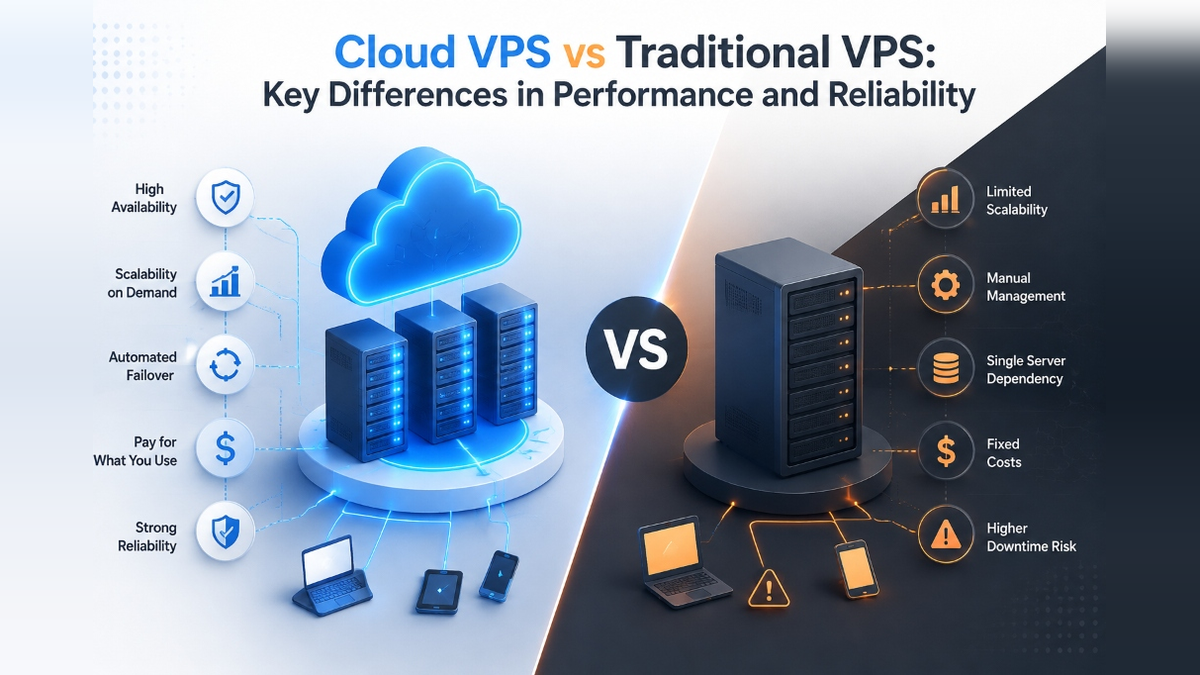
The fundamental difference between Cloud VPS and Traditional VPS is infrastructure redundancy. A Traditional VPS resides on a single physical host server; if a motherboard, power supply, or RAID array fails, all virtual machines on that node go offline. A Cloud VPS operates on a distributed cluster with decoupled SAN/Ceph storage; if a physical hypervisor fails, virtual instances automatically migrate and reboot on healthy cluster nodes in seconds with zero data loss.
When selecting virtual hosting for web applications, SaaS platforms, or business portals, infrastructure architects frequently weigh Cloud VPS against Traditional (standard) VPS solutions.
While both hosting models present isolated virtual environments running Linux or Windows operating systems, their underlying engineering designs differ fundamentally in resilience, scalability, and disaster recovery mechanics.
Deploying business workloads on a resilient high-availability cloud VPS hosting cluster protects mission-critical platforms from physical hardware single-point-of-failure events.
Traditional VPS Architecture: The Single Server Paradigm
A Traditional VPS relies on a single high-capacity bare-metal server divided into multiple virtual instances using a hypervisor such as KVM or VMware. Storage drives, memory modules, and network cards are all contained within that single chassis.
Because storage is physically direct-attached, Traditional VPS instances often deliver exceptional raw disk throughput at budget-friendly price points. However, this architecture creates a single point of failure.
If the physical host server suffers a power supply failure, memory parity fault, or motherboards damage, every virtual server hosted on that machine suffers downtime until datacenter technicians physically repair the server hardware.
For applications requiring dedicated physical resources without any hypervisor layer, upgrading to bare-metal dedicated servers provides absolute control and unshared compute capacity.
Architectural Comparison: Cloud VPS vs. Traditional VPS
| Feature | Traditional VPS | Cloud VPS |
|---|---|---|
| Infrastructure Design | Single physical server node | Distributed multi-node cloud cluster |
| Hardware Failover | None (Manual technician repair required) | Automatic instance migration & reboot |
| Storage Redundancy | Local hardware RAID controller | Triple-replicated Ceph / SAN storage |
| Resource Scalability | Bounded by physical host limits | Instant on-demand scale without reboots |
| Cost vs. Reliability | Maximum compute per dollar | Enterprise 99.99% uptime guarantee |
Cloud VPS Architecture: Distributed Clustering and High Availability
Cloud VPS hosting decouples compute resources from physical storage. Virtual CPU and RAM run on clustered hypervisor nodes, while data blocks reside on an independent, network-distributed storage fabric.
Technologies like Ceph maintain triple-replication across independent storage nodes. Every write operation is written synchronously across three distinct physical drives in the datacenter.
Distributed Block Storage Mechanisms: In a Cloud VPS environment, virtual hard disks are divided into small 4MB binary objects distributed across dozens of physical storage nodes. This architecture ensures that even multiple simultaneous drive failures in the datacenter cause zero data loss or application downtime.
Instant Vertical Resource Scaling: Cloud VPS platforms allow administrators to dynamically allocate additional CPU cores and RAM during seasonal marketing campaigns without migrating files or rebuilding server configurations.
Private Cloud Networking Overlays: Cloud VPS instances communicate across isolated virtual private networks (VPCs), enabling secure multi-tier architectures where public web servers interface with private database clusters over encrypted internal backbones.
For organizations managing multi-terabyte data stores and media assets, pairing cloud instances with distributed storage server infrastructure delivers massive archiving capacity alongside low operational expense.
Storage Architecture: Distributed SAN/Ceph vs. Local RAID Arrays
The primary architectural distinction between cloud VPS and traditional VPS environments lies within their underlying disk storage topologies. Understanding how storage fabrics operate clarifies why performance characteristics diverge under intense production workloads.
Traditional VPS instances rely on direct-attached storage configured across local hardware RAID arrays inside a single chassis. In contrast, cloud VPS platforms utilize distributed software-defined storage fabrics such as Ceph or NVMe-over-Fabrics across clustered nodes.
Analyzing Latency and IOPS Trade-Offs
Local RAID setups provide ultra-low access latencies because read and write operations avoid traversing internal data center network switches. However, distributed cloud storage replicates data blocks across three discrete physical hosts simultaneously, providing unmatched fault tolerance.
- Single Point of Failure: If a traditional host node suffers a backplane or motherboard failure, the local VPS remains offline until technicians repair hardware.
- Automated Cloud Failover: Clustered cloud hypervisors detect failed compute nodes instantly, rebooting your virtual server on healthy compute nodes within seconds.
- Snapshot Elasticity: Distributed cloud storage allows instantaneous point-in-time snapshots without consuming local disk performance or exhausting array capacity.
- I/O Contention Behavior: Modern cloud fabrics enforce strict Quality of Service (QoS) ceilings, preventing neighbor instances from monopolizing underlying storage channels.
Elastic Scaling and Business Continuity Planning
Scaling resources on a traditional VPS generally requires server reboots and tedious manual partition resizing when crossing physical hardware limits. Expanding memory, CPU cores, or storage capacity requires verifying that the physical host machine has available headroom.
Cloud VPS environments decouple compute processing from physical hardware boundaries, enabling vertical and horizontal scaling with negligible interruption. Businesses running marketing campaigns or seasonal sales can expand compute capacity dynamically to absorb temporary traffic spikes seamlessly.
Evaluating Total Cost of Ownership
While traditional VPS solutions often deliver higher raw single-core compute performance per dollar, cloud VPS environments reduce overhead associated with downtime and manual disaster recovery. Comparing long-term operational resilience reveals substantial financial protection for revenue-critical applications.
- Predictable Budgeting: Traditional VPS packages feature fixed monthly subscription pricing regardless of fluctuating storage access patterns.
- Dynamic Resource Adaptation: Cloud VPS billing accommodates real-time resource adjustments, allowing lean scaling during off-peak seasonal cycles.
- Disaster Recovery RPO/RTO: Distributed cloud backups reduce Recovery Point Objectives and Recovery Time Objectives to mere minutes during major infrastructure incidents.
- High-Availability SLAs: Cloud clusters typically offer 99.99% uptime guarantees backed by redundant power supplies, multi-homed uplinks, and automated node failovers.
Security Isolation and Hypervisor Multi-Tenancy Defense
Virtualization security demands strict physical isolation mechanisms to prevent malicious guest instances from accessing neighboring hypervisor memory spaces. Both cloud and traditional VPS hosting implement kernel-based virtualization safeguards, but their defense-in-depth topologies differ significantly.
Traditional VPS servers house multiple client instances on a single shared physical machine, meaning a severe zero-day hypervisor breakout could potentially expose local disk partitions. Cloud architectures isolate compute nodes behind virtual private clouds (VPCs), micro-segmented software firewalls, and hardware-accelerated network encryption layers.
Security Architecture Safeguards
Evaluating multi-tenant defenses ensures your sensitive business databases and customer records remain strictly compartmentalized across all infrastructure layers.
- Hardware-Enforced Memory Encryption: Modern cloud hypervisors leverage AMD SEV and Intel SGX to encrypt virtual machine RAM against host-level inspection.
- Network Micro-Segmentation: Cloud VPS networks isolate internal traffic via VXLAN overlays, blocking rogue ARP requests and local network packet sniffing.
- Hypervisor Kernel Hardening: Regular live-patching protocols protect virtual hosts against Meltdown, Spectre, and speculative execution vulnerabilities without downtime.
- Granular Role-Based Access Control: Cloud management dashboards provide multi-user IAM permissions, audit logging, and hardware token authentication.
Bandwidth Allocation and Egress Traffic Optimization
Network transfer architectures differ fundamentally between traditional single-node VPS hosting and distributed cloud platforms. Understanding how network bandwidth is allocated and billed prevents budget overruns as your web audience grows globally.
Traditional VPS packages usually bundle fixed monthly data transfer allowances on unmetered or semi-metered 1Gbps ports. In contrast, cloud VPS environments often leverage complex multi-cloud transit networks with granular egress pricing that requires vigilant traffic monitoring.
- Predictable Monthly Bandwidth: Traditional VPS hosts include generous bandwidth quotas without penalty fees for sudden viral spikes.
- Cloud Global Anycast Routing: Cloud environments distribute ingress requests across multiple global POPs to deliver lowest latency routing.
- Egress Traffic Auditing: Implement NetFlow analytics to identify data-heavy API endpoints and prevent unbudgeted cloud egress costs.
- Internal Network Backplanes: Cloud instances communicate over private 10Gbps virtual local area networks (VLANs) with zero external bandwidth consumption.
Conclusion: Matching Infrastructure to Workload Profiles
Choosing between cloud VPS and traditional VPS hosting depends entirely on your application’s uptime tolerance, architectural requirements, and growth projections. Traditional VPS instances excel at running predictable workloads where maximum local disk I/O and budget efficiency dominate operational priorities.
Conversely, cloud VPS solutions represent the definitive choice for mission-critical web applications, enterprise databases, and fast-scaling digital platforms where hardware failures cannot compromise business continuity. Aligning your workload needs with the right virtualization model ensures superior long-term performance and reliability.
⚖️ Workload Decision Matrix: When to Use vs. When NOT to Use
✓ When Should You Use This?
- Deploying production web applications with 25,000 to 500,000+ monthly visits requiring guaranteed RAM & CPU.
- Hosting high-concurrency databases (MySQL, PostgreSQL) demanding low-latency NVMe PCIe read/write IOPS.
- Environments requiring dedicated IP addresses, custom kernel modules (WireGuard, Docker), and root access.
✕ When Should You NOT Use This?
- Massive Big Data analytics clusters or real-time 8K video transcoding requiring raw physical GPU/PCIe lanes (Deploy Dedicated Bare Metal instead).
- Simple hobby blogs or static brochure websites with under 1,000 visits/month (Shared hosting or static CDN hosting is more cost-effective).
Target Audience / Persona: SaaS startups, full-stack developers, e-commerce store operators, and digital marketing agencies running multi-site client hosting.
Common Failure Mode & Quick Fix: Linux Out-Of-Memory (OOM) Killer terminating processes: Prevent sudden MySQL terminations by creating a 2GB–4GB NVMe swap file (sudo fallocate -l 4G /swapfile && sudo mkswap /swapfile && sudo swapon /swapfile) and setting vm.swappiness=10.
Frequently Asked Questions
Is Cloud VPS faster than Traditional VPS?
In terms of raw CPU and single-disk write latency, a Traditional VPS with direct NVMe storage can be slightly faster. However, Cloud VPS provides vastly superior reliability, zero-downtime scaling, and cluster resilience.
What is high-availability (HA) in Cloud VPS hosting?
High-availability monitors cluster hypervisors in real time. If a physical node crashes, the cluster hypervisor automatically restarts your virtual server on an operational node within 30 to 60 seconds.
Can a Traditional VPS scale resources without downtime?
Scaling a Traditional VPS typically requires a system reboot to reconfigure assigned RAM and CPU core quotas, and scaling is capped by the remaining physical capacity of the host server.
How does storage replication work in a Cloud VPS environment?
Cloud storage systems (like Ceph) replicate block data across multiple physical storage servers over a high-speed 40Gbps/100Gbps network fabric, ensuring that drive failures cause zero data loss or downtime.
Which VPS hosting model is best for eCommerce stores?
Cloud VPS is strongly recommended for eCommerce stores. A hardware failure on a Traditional VPS can take your checkout offline for hours, directly causing revenue loss and customer dissatisfaction.
Conclusion: Driving Business Growth with Enterprise VPS Hosting
Deploying mission-critical applications on high-performance Enterprise VPS Hosting infrastructure provides the dedicated processing power, network speed, and reliability demanded by modern web users.
Whether managing high-traffic e-commerce portals, streaming media, or corporate databases, Onlive Server delivers enterprise-grade hardware, 24/7 technical support, and competitive pricing for global success.

