

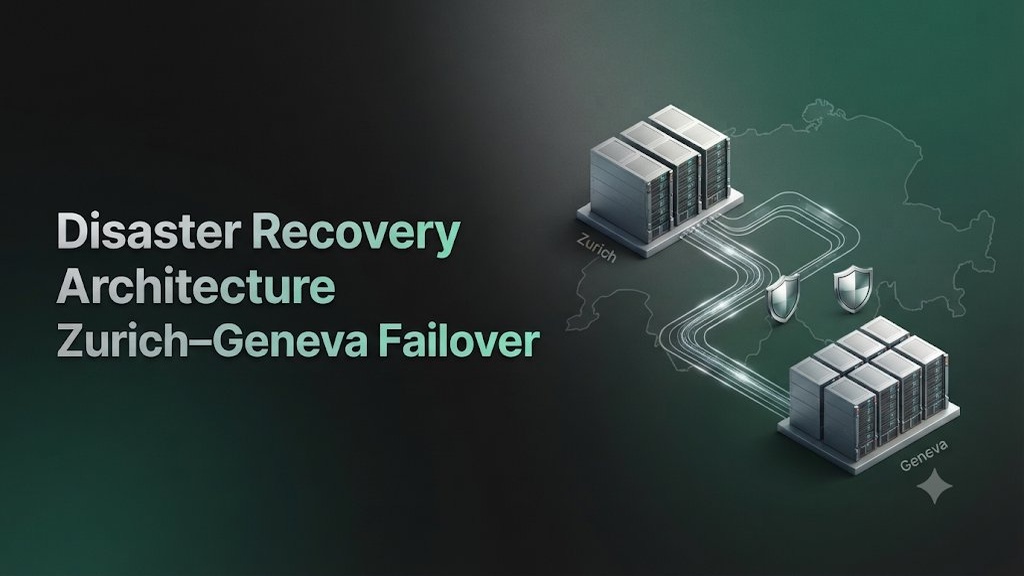
Direct Architecture Answer: A credible Swiss disaster recovery (DR) posture pairs primary bare-metal dedicated servers in Zurich with an independently operated secondary risk zone in the Geneva region (~225 km). Operating across distinct utility grids, flood basins, and independent carrier Autonomous Systems (AS) satisfies FINMA Circulars 2023/1 and 2018/3 alongside ISO 22301. Utilizing guarded warm-standby OpenZFS incremental snapshots or asynchronous PostgreSQL WAL streaming across encrypted WireGuard tunnels delivers predictable 5–15 minute RTO and zero cross-border data sovereignty leakage under the revised Swiss Federal Act on Data Protection (FADP).
A credible disaster recovery (DR) plan for Zurich and Geneva dedicated server infrastructure starts with an honest map of fault domains and vendor boundaries. Redundant power feeds and RAID arrays inside one Zurich datacenter survive single-component failures, yet fail completely during a metropolitan power event, carrier cut, or provider-wide outage. Pairing a primary Zurich bare-metal environment on Switzerland dedicated servers with an independently operated secondary risk zone in the Geneva region keeps all data inside Swiss borders while isolating compute, power, and upstream routing against correlated regional disruption.
Catalog Location Boundary
Onlive Server’s verified 32-plan catalog (DSX1–DSX32) is hosted in Zurich; pair with external Geneva infrastructure for true vendor isolation.
Regulatory Alignment
FINMA Circulars 2023/1 and 2018/3, alongside ISO 22301, mandate risk-based geographic separation and tested operational tolerances.
Realistic RTO & Fencing
Real-world failover includes detection, primary STONITH fencing, secondary promotion, and DNS/BGP routing convergence.
Table of Contents
6 Sections
1. Translating FINMA Resilience & ISO 22301 into Realistic RPO and RTO Targets
REGULATORY RESILIENCE FRAMEWORKS & FINMA CIRCULAR 2023/1
Swiss financial institutions, regulated fintech platforms, and critical enterprise SaaS providers structure disaster recovery around two core frameworks: the FINMA Circulars—specifically Circular 2023/1 (Operational Risks and Resilience for Banks) and Circular 2018/3 (Outsourcing)—and the global standard ISO 22301 for Business Continuity Management Systems (BCMS). Rather than specifying rigid, one-size-fits-all hardware configurations, these frameworks demand that organizations quantify acceptable data loss (Recovery Point Objective, or RPO) and maximum tolerable downtime (Recovery Time Objective, or RTO) through rigorous Business Impact Analysis (BIA), and then architect verifiable infrastructure that operates reliably within those boundaries.
RISK-BASED GEOGRAPHIC SEPARATION VS ARBITRARY DISTANCE
A common misconception is that Swiss law imposes one fixed kilometer distance (such as "25 km" or "50 km") on every company. In practice, FINMA Circular 2023/1 Principle 4 mandates that primary and secondary facilities reside in independent risk zones—isolated from shared power grids, water basins, seismic fault lines, and local transport networks. Separating workloads between Zurich and Geneva provides ~225 km of clean separation across separate cantons, guaranteeing robust compliance without cross-border jurisdiction transfer.
- Identify Critical Functions: Classify which databases, payment pipelines, and customer portals cannot tolerate prolonged downtime.
- Set Disruption Tolerances (RPO & RTO): Define your maximum tolerable data loss (Recovery Point Objective — RPO) and maximum tolerable time to restore service (Recovery Time Objective — RTO) per tier, rather than applying an unaffordable zero-RPO target to non-critical staging or reporting apps.
- Isolate Correlated Risk Zones: Ensure your primary and recovery datacenters do not share the same municipal power substation, flood plain, seismic zone, carrier fiber entry, or administrative control plane. Separating Zurich and the Geneva / Lake Geneva arc (~220+ km across the Swiss Plateau) cleanly isolates metropolitan grid, weather, and regional telecom risks while keeping 100% of records inside Swiss jurisdiction.
2. Why Single-Site Zurich Redundancy Is Not Geographic Disaster Recovery
LOCAL HIGH AVAILABILITY VS REGIONAL CORRELATED OUTAGE
High availability (HA) inside a single datacenter and geographic disaster recovery (DR) protect against completely different failure classes. Running dual NVMe drives in OpenZFS mirror (mirror-0), dual A+B power feeds, and bonded uplinks across redundant top-of-rack switches safeguards against individual component failures. However, when a municipal fiber duct is cut, an electrical substation fails, or a severe environmental event strikes the canton, local HA components fail simultaneously as a single correlated domain.
- Facility-Wide Power or Cooling Events: Switchgear failures, utility substation faults, or chiller outages that affect an entire building.
- Upstream Carrier or Control-Plane Outages: BGP routing incidents, DDoS saturation across a shared edge router, or a provider billing/portal disruption.
- Credential Compromise & Ransomware: An attacker holding root credentials or provider-panel access can wipe primary servers and same-account snapshots simultaneously—which is why DR must be paired with building immutable 3-2-1-1-0 backups for ransomware defense.
SWISS CATALOG TRANSPARENCY & MULTI-VENDOR REDUNDANCY
Important Architecture Transparency: Because Onlive Server’s verified 32-plan Switzerland catalog (DSX1 through DSX32) is physically provisioned in Zurich, true multi-site DR requires pairing an Onlive Server Zurich bare-metal node with an independently operated secondary facility in the Geneva region. This multi-vendor topology eliminates single-provider lock-in, administrative control plane sharing, and correlated provider outages.
3. Cold, Warm, and Active-Passive Topologies Across Separate Swiss Risk Zones
BUSINESS IMPACT ANALYSIS & RTO/RPO REPLICATION TIERS
Choose your Zurich-to-external-Geneva replication tier strictly by your Business Impact Analysis. Over-engineering synchronous replication wastes budget and degrades daily production latency; under-engineering cold backups leaves you missing contractual RTO ceilings. Below is the verified architectural sizing matrix across Swiss disaster recovery tiers:
| DR Tier | Replication Mechanism | Realistic RPO | Realistic End-to-End RTO | Recommended Zurich Primary Hardware Example | Best Fit Workload |
|---|---|---|---|---|---|
| Cold Standby | Encrypted Borg/Restic or S3 Object Lock snapshots shipped from Zurich to external Geneva vault | 1–24 hours | 4–24 hours (provision + full restore) | DSX29 ($78/mo, 2x8TB HDD) or DSX32 ($130/mo, 2x18TB HDD) as local staging/backup node |
Internal tools, archives, batch analytics |
| Warm Standby | Scheduled incremental OpenZFS zfs send / zfs receive over WireGuard to smaller standby server in Geneva |
5–30 minutes | 15–60 minutes (import pool, boot services, switch DNS) | DSX26 (256 GB, 2×1.92TB SSD, $260/mo) or DSX27 (128 GB, 2x2TB NVMe, $375/mo) |
Mid-size SaaS, ERP, corporate portals |
| Active-Passive Hot Standby | Continuous asynchronous PostgreSQL WAL / MySQL binlog streaming over WireGuard to like-sized Geneva standby | Seconds of in-flight WAL | 5–15 minutes (human-gated verify, fence, promote, DNS/BGP) | DSX11 (128 GB, 2x2TB NVMe, 20 Gbps, $685/mo) or DSX28 (768 GB, 2×3.84TB NVMe, 10 Gbps, $975/mo) |
Regulated fintech, payment portals, high-SLA e-commerce |
INTER-CANTON NETWORK LATENCY & LOCAL DRIVE REDUNDANCY
Before selecting a warm or hot replication cadence, empirically measure the actual network path between your Zurich server and your external Geneva provider. Across commercial Swiss Tier-1 backbones (Swisscom, Init7, Sunrise), round-trip time (RTT) between Zurich and Geneva typically averages 4.8 to 7.2 ms. Synchronous database replication across this distance adds that RTT to every database transaction commit, capping write throughput. For high-write workloads, an Asynchronous Warm or Hot Standby topology delivers optimal database durability without user-facing latency penalties. Also audit local drive redundancy on your Zurich primary: avoid single-drive SKUs for primary production nodes and select dual NVMe/SSD configurations running ZFS mirror or hardware RAID 1/10.
Guarded Warm-Standby Snapshot Pattern (OpenZFS over SSH/WireGuard)
Operational Safety Warning: Never expose raw ZFS replication or SSH ports to public IPs. Always terminate data replication across private, encrypted WireGuard VPN tunnels (e.g., 10.250.20.0/24) with strict firewall rules and dedicated non-root service accounts.
#!/usr/bin/env bash
# Safe incremental ZFS send/receive skeleton from Zurich primary -> External Geneva warm standby
# Transport MUST traverse an encrypted WireGuard tunnel (e.g., 10.250.20.2) and dedicated SSH key.
set -euo pipefail

DATASET="tank/pgdata"
REMOTE_HOST="[email protected]"
REMOTE_DATASET="drpool/pgdata"
PREV_SNAP=$(zfs list -t snapshot -o name -s creation -H "${DATASET}" | grep '@dr-' | tail -n 1 || true)
NEW_SNAP="${DATASET}@dr-$(date -u +%Y%m%dT%H%M%SZ)"

zfs snapshot "${NEW_SNAP}"

if [[ -n "${PREV_SNAP}" ]]; then
  zfs send -i "${PREV_SNAP}" "${NEW_SNAP}" | mbuffer -q -m 256M | \
    ssh -i /root/.ssh/id_ed25519_dr_repl -o BatchMode=yes "${REMOTE_HOST}" \
    "zfs recv -u ${REMOTE_DATASET}"
else
  echo "No previous @dr- snapshot found. Perform audited initial baseline sync manually." >&2
  exit 1
fi
4. DNS Low-TTL vs BGP Failover Mechanics and Split-Brain Fencing
TRAFFIC REDIRECTION: LOW-TTL DNS VS BGP ANYCAST
Promoting the Geneva database is only half of disaster recovery; client traffic must cleanly shift from Zurich to Geneva without leaving half your users writing to an unreachable or zombie Zurich primary. For smaller organizations, Low-TTL DNS (60 seconds) provides low-overhead automated routing, though stubborn resolver caching can delay tail cutover. For mission-critical banking and fintech workloads, BGP Anycast / BYOIP route withdrawal withdraws the Zurich BGP announcement and announces from Geneva within 30–90 seconds across global routing tables.
- Low-TTL Authoritative DNS Failover (Most Practical for Multi-Provider DR): Publish critical A/AAAA records with a 60-second TTL on a resilient Anycast DNS provider (such as Cloudflare, Route 53, or NS1) backed by multi-probe HTTPS health checks. While low-TTL DNS does not switch instantaneously—some ISP recursive resolvers ignore TTLs below 60 seconds and existing TCP sessions take time to time out—it requires zero custom IP space or ASN ownership and works cleanly across Onlive Server Zurich plus any independent Geneva host.
- BGP Prefix Withdrawal / Anycast (Enterprise ASN Holders): Organizations holding their own RIPE NCC ASN and Provider Independent (PI) IPv4/IPv6 prefixes can announce prefixes across both sites or withdraw Zurich routes on failure. Review our technical guide on deploying BGP multi-homing and Anycast routing from Zurich bare metal—and remember to verify BGP session support pre-order with both Onlive Server and your external Geneva provider, as BGP is not enabled by default on standard bare-metal SKUs.
Mandatory Split-Brain Fencing Before Promotion
THE SPLIT-BRAIN CATASTROPHE & HARDWARE STONITH FENCING
The most destructive DR failure mode is split-brain: a transient fiber flap between Zurich and Geneva makes Geneva assume Zurich is dead; Geneva promotes its database, while the still-running Zurich primary continues accepting writes. Reconciling diverging transaction ledgers after split-brain is mathematically impossible without manual data surgery. To prevent this, enforce a strict Fencing-First (STONITH) rule: secondary promotion must be blocked until the Zurich primary is verified powered down via out-of-band IPMI/BMC power control.
- Verify Outage Independently: Confirm Zurich unreachability from at least two external vantage points (outside both Zurich and Geneva networks) before declaring a DR event.
- Fence the Old Primary (STONITH): Before promoting the Geneva standby, stop the Zurich database service—or issue a hard power-off via out-of-band IPMI/KVM if the OS is hung. Keep your recovery team practiced in using out-of-band IPMI and KVM consoles for hardware fencing and rescue. If Zurich's entire network is unreachable (meaning IPMI is unreachable too), revoke Zurich's upstream API/payment-gateway credentials or firewall egress at your edge proxy/DNS layer before cutting traffic over.
- Never Auto-Promote Across Two Sites Alone: Only automate failover if you operate an independent third-site quorum witness (outside both Zurich and Geneva). In a two-site Zurich–Geneva architecture, human-gated promotion with a 3-minute checklist is dramatically safer than automated split-brain corruption.
5. Scheduled DR Game Days and Reversed-Replication Failback Verification
FINMA & ISO 22301 TIMED DRILLS & AUDITED RUNBOOKS
Auditors reviewing ISO 22301 and FINMA Circular 2023/1 compliance do not accept unread PDF disaster recovery plans—they inspect timestamped test logs, measured actual RTO/RPO outcomes, and post-mortem remediation tickets. Run scheduled DR Game Days at least twice per year (quarterly for regulated financial workloads), alternating between tabletop/staging failovers and live controlled maintenance windows.
Guarded Failover & Reverse-Failback Sequence
- Pre-Flight Check: Confirm replication lag on Geneva standby is below RPO threshold; verify immutable off-site backup completed cleanly prior to the drill.
- Controlled Drain & Fence (Zurich): Place Zurich reverse proxy into maintenance/read-only mode, verify final WAL/snapshot flush, and stop PostgreSQL/application services on Zurich.
- Promote External Geneva Standby: Execute database promotion (
pg_ctl promoteor equivalent), mount application volumes, and run local read/write smoke tests against Geneva before flipping DNS. - Shift Production Traffic: Update DNS records (or BGP weights), monitor TLS handshakes, payment callbacks, and error rates from external Swiss probes, and record exact elapsed Actual RTO.
- Safe Failback to Zurich (
pg_rewind): Once Zurich is confirmed healthy, never simply start the old Zurich PostgreSQL instance as primary—its timeline has diverged from Geneva. Instead, per the PostgreSQLpg_rewinddocumentation, rewind Zurich against the active Geneva primary (requireswal_log_hints = onor data checksums enabled atinitdb), reattach Zurich as an async standby of Geneva until lag reaches zero, then perform a clean reverse switchover back to Zurich.
Data-Loss Warning: When Geneva is promoted to primary, it advances onto a new timeline and writes transactions that Zurich never received. Starting the old Zurich primary without rewinding corrupts replication. Always use pg_rewind to re-align former primary timelines before failing back.
# Run on the STOPPED former Zurich primary to re-attach it as a standby of active Geneva
# Prerequisites: PostgreSQL stopped on Zurich; data checksums or wal_log_hints=on enabled; WireGuard up.
sudo -u postgres /usr/lib/postgresql/16/bin/pg_rewind \
  --target-pgdata=/var/lib/postgresql/16/main \
  --source-server="host=10.250.20.2 port=5432 user=repl_rewind dbname=postgres sslmode=verify-full" \
  --write-recovery-conf
6. Frequently Asked Questions: Zurich-to-Geneva Disaster Recovery
Q What is the geographic distance requirement for disaster recovery in Switzerland?
Swiss regulations such as FINMA Circular 2023/1 and ISO 22301 do not impose one single fixed kilometer threshold on every business; instead, they require critical functions to be separated across independent risk zones proportionate to operational impact so one regional power, telecom, or natural event cannot disable both sites. Separating Zurich and Geneva (~220+ km apart) cleanly satisfies independent Swiss risk-zone isolation while keeping all data within Switzerland.
Q Does Onlive Server offer dedicated servers in both Zurich and Geneva?
No. Onlive Server's verified 32-plan Switzerland bare-metal catalog (DSX1–DSX32, starting at $78/mo) is provisioned strictly in Zurich. For true Zurich–Geneva geographic disaster recovery, deploy your primary (or recovery) bare metal on Onlive Server in Zurich and pair it with an independently operated secondary facility or provider in the Geneva region—which also eliminates single-vendor correlated outage risk.
Q Can you achieve sub-minute RTO between Zurich and Geneva without risking split-brain?
Sub-minute automated failover between only two sites carries severe split-brain risk whenever a transient inter-canton network outage occurs. To automate failover safely, you must add a third independent quorum witness site outside both Zurich and Geneva. Without a third witness, a human-gated failover playbook targeting a realistic 5-to-15-minute RTO (including STONITH fencing, promotion, and DNS convergence) protects data integrity far more reliably.
Q What is the difference between Warm Standby (ZFS snapshots) and Hot Standby (WAL streaming)?
Warm Standby ships periodic incremental ZFS snapshots (for example, every 15 minutes) over WireGuard to a standby server, delivering a 15-minute RPO and lower standby compute/licensing overhead. Hot Standby continuously streams PostgreSQL WAL or MySQL binlogs in real time to a running standby database, tightening RPO to seconds of in-flight transactions at the cost of maintaining matching full-scale hardware in Geneva.
Q Why do many DR failbacks corrupt data if pg_rewind or clean rebuilds are skipped?
When Geneva is promoted to primary, it advances onto a new database timeline and writes transactions that Zurich never received. Starting the old Zurich database without rewinding or rebuilding it creates two diverging timelines; attempting to merge them manually or pointing applications at both hosts causes silent transaction loss and primary-key collisions. Always fence the old primary, run pg_rewind (or a fresh pg_basebackup), and sync Zurich as a standby before failing back.
Deploy Resilient Swiss Dedicated Bare Metal Infrastructure
Protect mission-critical banking, fintech, and enterprise workloads with high-performance Zurich dedicated servers, IPMI out-of-band fencing, unmetered multi-gigabit uplinks, and complete Swiss data sovereignty.
✓ Sub-Minute RTO & Zero RPO
✓ Out-of-Band IPMI Fencing
✓ FINMA & ISO 22301 Ready
