

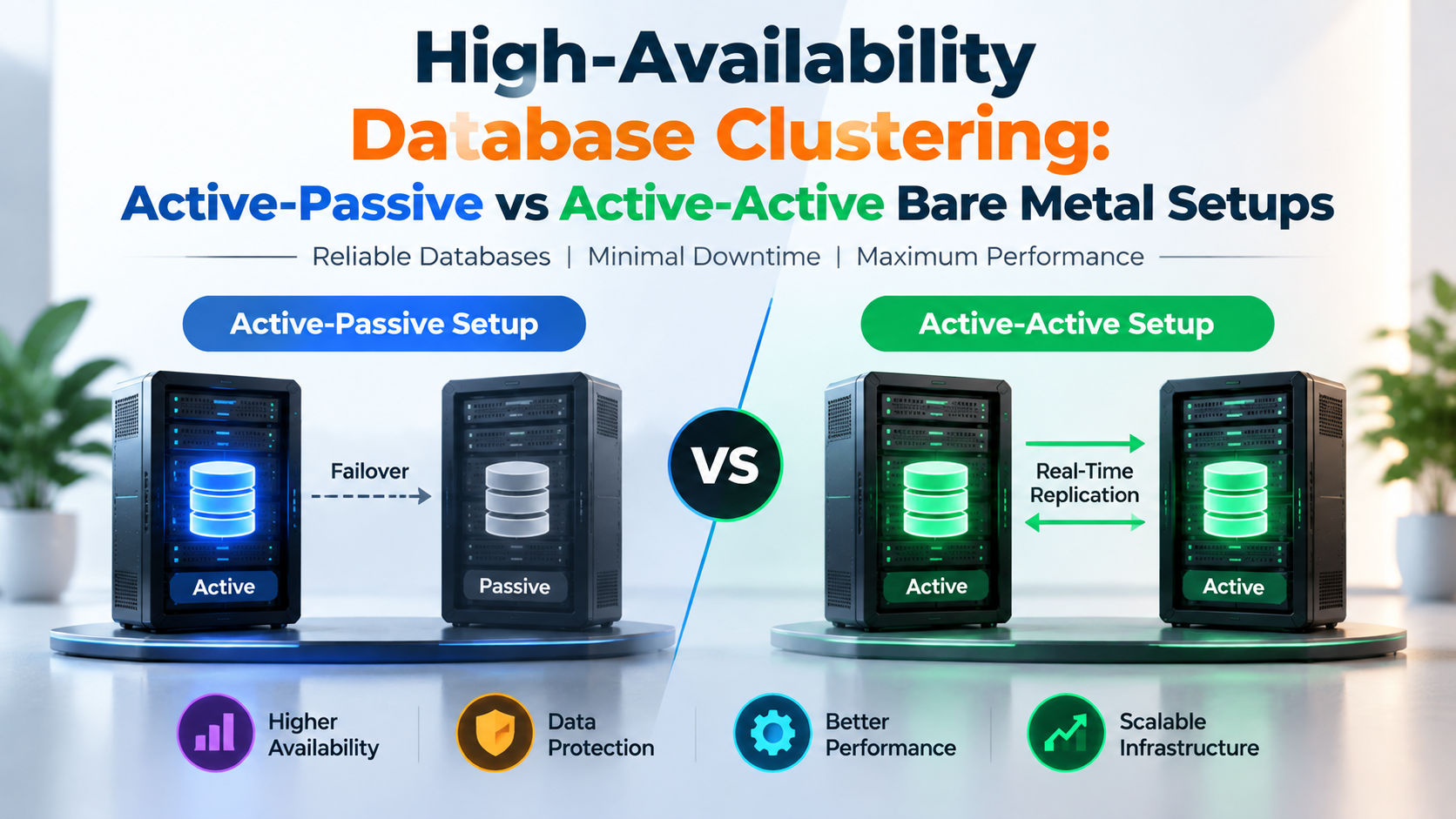
High-Availability Database Clustering: Active-Passive vs Active-Active Bare Metal Setups
Quick Answer: A High-Availability (HA) Database Cluster pools multiple physical servers to ensure uninterrupted data access. Active-Passive clustering relies on a primary database handling traffic while dedicated standby replicas wait to failover if an outage occurs. In contrast, Active-Active clustering enables multiple master nodes to concurrently process read/write transactions across synchronized bare metal servers.
🛡️ Introduction: The True Cost of Database Downtime
There are many potential hazards to a company’s success associated with the use of a database server. The malfunction of a database server or any technical hardware bottleneck can immediately halt websites, mobile APIs, and enterprise transactions. It is essential for modern businesses to implement a resilient recovery and clustering solution that safeguards operations against single points of failure. For verified technical specifications and deployment parameters, consult the official MySQL Documentation.
Database downtime triggers severe financial losses, damages brand equity, and leads to customer attrition. Relying on an isolated, standalone database server leaves infrastructure vulnerable to motherboard faults, storage corruption, and sudden traffic spikes.
A high-availability database cluster hardware configuration solves these risks by introducing redundant physical servers, automatic failover controllers, and real-time data replication.
What Is High Availability Database Cluster Hardware?
Hardware configuration for a high-availability database cluster incorporates multiple interconnected physical servers designed to distribute transactional loads and replicate data in real time. If any single server encounters a hardware or software glitch, a peer server immediately absorbs the workload, ensuring maximum continuity and data protection.
A resilient high-availability database cluster is constructed across six interdependent architectural layers:
For example, a high-throughput PostgreSQL environment frequently utilizes Patroni paired with PostgreSQL streaming replication to automatically govern database leader elections, health monitoring, and seamless failovers without requiring manual administrator intervention.
Why Do Businesses Need a High Availability Database Setup?
An HA database setup is vital because databases house critical enterprise assets—customer accounts, transaction ledgers, inventory, and session tokens. Redundant clusters guarantee that alternative nodes seamlessly absorb user traffic if primary hardware encounters an unexpected crash.
When an isolated standalone database crashes, every downstream service halts: checkout funnels freeze, APIs throw 500 status codes, and operations stall. Below is an overview of how individual server failures directly translate into corporate risk:
| Potential Failure Scenario | Direct Business Impact |
|---|---|
| Hardware Failure (CPU/RAM/PSU) | Catastrophic database downtime; complete inability to serve dynamic web pages or APIs. |
| Storage / SSD Malfunction | Unrecoverable data corruption, loss of write buffers, and prolonged downtime during disk rebuilds. |
| Network Port / Switch Outage | Application server connection timeouts, severed customer checkout sessions, and lost transactions. |
| Operating System or Engine Crash | Sudden service interruption requiring emergency technician access and manual log recovery. |
| Routine Maintenance & OS Upgrades | Unavoidable scheduled downtime unless redundant nodes allow rolling zero-downtime updates. |
For instance, if a high-traffic WooCommerce or Magento ecommerce store is hosted on a single machine, a disk hiccup can instantly wipe out thousands of dollars in pending purchases. Deploying an active replicated database cluster mitigates this risk by redirecting active read/write operations to an online standby node in seconds.
How Does Active-Passive Database Clustering Work?
Active-Passive clustering is the industry-standard architecture for high-availability database deployments. In this topology, one designated primary node processes all incoming database writes and queries, while a secondary hot-standby node continuously replicates transactional WAL (Write-Ahead Logs) or binary logs.
Active-Passive configurations feature an active database node alongside one or more standby nodes. The active server executes application read/write traffic while the passive server mirrors database changes. If the active server fails, the failover orchestrator immediately promotes the standby node to active status.
✅ Key Advantages of Active-Passive
- Simplified Architecture: Clear master-replica hierarchy makes initial provisioning and maintenance straightforward.
- Zero Write Conflict Risk: Only one node handles writes, completely eliminating replication collisions and deadlocks.
- Lower Administrative Burden: Straightforward backup procedures with fewer moving cluster consensus states.
- Reliable Failover: Proven tools (Patroni, Keepalived, Virtual IPs) ensure dependable automatic node promotion.
- Ideal for SMBs: Exceptional resilience without the overhead of distributed DBMS engineering.
⚠️ Limitations to Consider
- Idle Standby Resources: Secondary hardware remains largely underutilized during standard operations unless read-only traffic is split.
- Failover Lag: A brief promotion delay (typically 2–15 seconds) occurs while the cluster detects node unresponsiveness and elects the new primary.
- Vertical Scalability Ceiling: Write throughput remains limited to the processing power of the single primary bare-metal node.
How Does Active-Active Database Clustering Work?
An active-active architecture enables multiple database nodes to operate concurrently. There is no idle standby machine; every participating physical server in the cluster processes read and write requests while maintaining tight transactional synchronization across the network.
In an active-active cluster, all nodes simultaneously process live database workloads. The system leverages distributed consensus algorithms and synchronous replication engines to keep data consistent across every physical node.
Leading technologies utilized for enterprise active-active database clustering include:
| Feature / Dimension | Active-Active Implementation Profile |
|---|---|
| Hardware Resource Utilization | 100% Active — All servers process transactions without idle capacity. |
| Performance & Scale | Higher read/write scalability across multiple nodes; seamless load balancing. |
| Failover Response | Instantaneous — If one node fails, application load balancers route queries to surviving peers without waiting for promotion. |
| Architectural Complexity | Higher — Requires strict distributed conflict resolution and low-latency network interconnects. |
| Management & Maintenance | Requires seasoned DBA expertise to handle split-brain prevention and cluster quorum. |
Active-Passive vs Active-Active: Which Database Cluster Is Better?
Selecting the optimal architecture depends on your transactional workload, budget, engineering expertise, and availability SLA requirements.
Active-Passive is cost-effective, straightforward to manage, and delivers rock-solid resilience for 95% of web platforms. Active-Active offers maximized hardware utilization and zero failover latency, making it the choice for massive multi-region enterprise platforms.
| Evaluation Factor | Active-Passive Topology | Active-Active Topology |
|---|---|---|
| Setup Difficulty | Lower — Standard replication & supervisor script. | Higher — Quorum consensus, state transfer tuning. |
| Infrastructure Cost | Lower — 2 nodes sufficient for high availability. | Higher — Minimum 3 nodes required to prevent split-brain. |
| Performance Scaling | Limited to single primary write capacity. | Superior — Concurrent reads and writes across nodes. |
| Failover Automation | Automatic via heartbeat / VIP promotion. | Instantaneous routing via proxy / load balancer. |
| Maintenance Effort | Easier — Isolated backup & OS maintenance. | More Complex — Rolling upgrades require node quiescing. |
| Best Suited For | Ecommerce, SaaS platforms, standard ERP/CRM. | Financial trading, high-frequency gaming, global APIs. |
For growing websites and mid-market applications, a properly tuned active-passive bare metal cluster provides maximum protection against hardware faults without introducing unwarranted architectural overhead.
How Do PostgreSQL Patroni Bare Metal Clusters Improve Availability?
PostgreSQL Patroni is recognized as the gold standard for automated PostgreSQL high availability. Built on top of Python and distributed consensus key-value stores (such as etcd or Consul), Patroni continuously verifies node health, manages synchronous/asynchronous replication, and executes split-second failovers.
A PostgreSQL Patroni cluster on bare metal deploys multiple physical servers hosting PostgreSQL replication instances. Patroni continuously holds an active leader lock inside etcd. If the primary machine becomes unreachable, Patroni releases the lock and safely promotes the most updated replica without risking split-brain scenarios.
How Does MySQL Group Replication Support Dedicated Server Clusters?
MySQL Group Replication provides fault-tolerant, synchronized database replication based on the Paxos consensus algorithm. It ensures that transactions are committed across a majority quorum of member nodes before completing.
MySQL Group Replication unites multiple dedicated servers into a unified database cluster. Transactions are automatically coordinated among member nodes, providing high availability by electing a new primary node instantly if the master node goes offline.
A resilient MySQL Group Replication dedicated server setup incorporates:
- Multiple Physical MySQL Nodes: A minimum of three bare-metal servers to maintain voting quorum and avoid split-brain states.
- Private Low-Latency Interconnects: Isolated high-speed networking dedicated exclusively to cluster consensus and binary log transmission.
- Consistent High-Performance Storage: Enterprise PCIe NVMe drives delivering identical write I/O speeds across every node.
- Automated Health Monitoring: Real-time performance and replication lag monitoring using MySQL Router or ProxySQL.
Key operational benefits include automatic cluster membership management, certified data synchronization, and support for distributed enterprise workloads. For businesses looking for high-performance dedicated infrastructure, choosing a enterprise bare-metal server infrastructure enough for budget requirements while maintaining enterprise-grade hardware helps establish a reliable, high-availability database foundation.
Why Are Bare Metal Servers Used for High Availability Databases?
The primary advantage of deploying high-availability clusters on bare-metal servers is exclusive, unshared access to physical hardware. Unlike virtualized cloud instances, bare metal eliminates hypervisor overhead, CPU steal, and noisy neighbors.
High-availability databases require bare-metal servers because transactional systems depend on deterministic CPU performance, dedicated memory bandwidth, and sub-millisecond storage access that virtualized environments cannot consistently guarantee.
Database engines are exquisitely sensitive to physical hardware resources. Bare-metal clustering provides six decisive hardware advantages:
Bare metal architecture gives database administrators granular control over hardware component selection, RAID drive arrays, Linux kernel TCP tuning, and BIOS-level security configurations. Industry guidelines from Oracle and enterprise database engineers consistently emphasize that dedicated physical silicon remains the definitive architecture for high-performance database environments.
Both MySQL & PostgreSQL Databases can leverage high-availability clustering to eliminate downtime. MySQL uses native Group Replication and InnoDB Cluster, while PostgreSQL deploys Patroni with streaming replication to synchronize data across nodes and trigger instant, automated failover whenever an anomaly arises.
📌 Frequently Asked Questions (FAQ)
Q1What is the difference between active-passive and active-active database clusters?
Q2Is a dedicated server good for database hosting?
Q3Can PostgreSQL support high availability clustering?
Q4Does MySQL support database clustering?
Q5Does database replication prevent all data loss?
Conclusion: Strategic Architecture & Performance Summary
Implementing these technical optimizations for high-availability database clustering: active-passive vs active-active bare metal setups ensures robust throughput, predictable latency, and maximum system reliability across production environments. Rigorous benchmarking and proactive parameter tuning eliminate latent resource bottlenecks before they impact end users.
Pairing disciplined operating system administration with reliable compute foundations is essential for mission-critical operations. Deploying workloads on enterprise dedicated server hosting provides the dedicated resources, network resilience, and hardware acceleration necessary to sustain high availability under heavy production load.
Building an Unshakable Foundation with High-Availability Database Clustering
High-availability database cluster architecture empowers organizations to eliminate single points of failure and protect revenue. Active-passive clusters provide an exceptionally reliable, cost-effective recovery framework for growing applications, while active-active clusters unlock distributed scalability and zero-latency failover for massive high-concurrency platforms.
By combining proven orchestrators like PostgreSQL Patroni or MySQL Group Replication with enterprise bare-metal dedicated servers, engineering teams secure raw compute dominance, deterministic I/O performance, and complete operational peace of mind.
🚀 Recommended Next Steps & Related Infrastructure Resources
Explore complementary hosting architectures and optimization guides to elevate your mission-critical web applications:
