

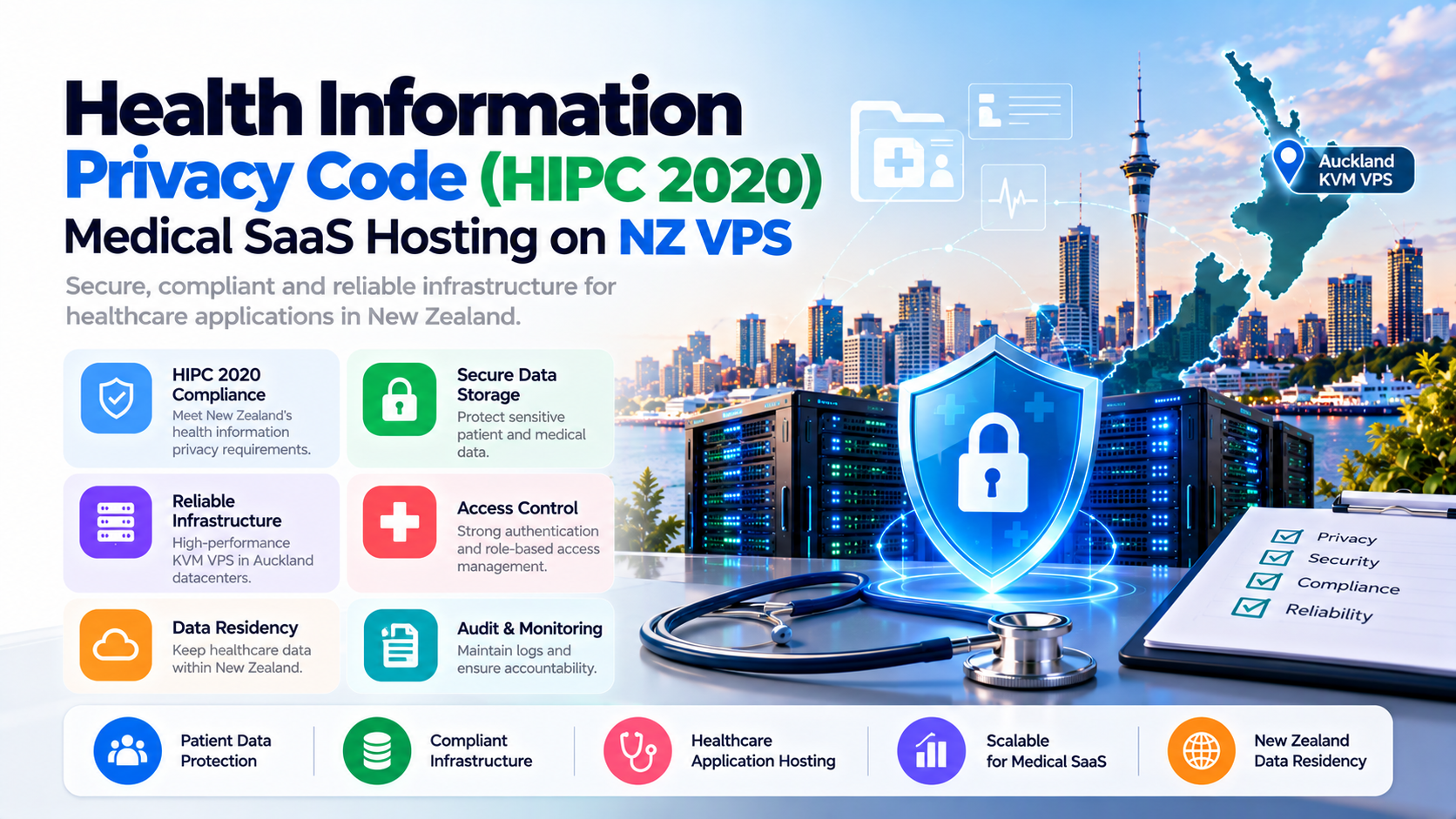
Deploying an enterprise-grade Hipc 2020 Medical Hosting Nz architecture on pure KVM virtualized infrastructure empowers modern organizations with low-latency Auckland connectivity. Furthermore, the Health Information Privacy Code 2020 (HIPC 2020) governs how health agencies in New Zealand collect, store, and share patient information. Cloud servers hosting health records must implement access controls, audit logging, encryption at rest and in transit, and a breach notification process consistent with HIPC obligations. In addition, hosting on a New Zealand VPS simplifies data residency compliance but does not automatically satisfy HIPC — your application’s security architecture, access policies, and breach response procedures must be reviewed independently against the Code.
Developing and hosting digital health technologies, patient portals, practice management systems, or telehealth platforms in New Zealand requires navigating a rigorous compliance landscape. Furthermore, unlike generic corporate information, identifiable health data is classified as highly sensitive under New Zealand law. The Health Information Privacy Code 2020 (HIPC) sets legally enforceable rules that supersede standard privacy principles. In addition, deploying medical workloads on an HIPC compliant healthcare VPS located in Auckland datacenters provides the sovereignty, latency, and security baseline required to satisfy both the Office of the Privacy Commissioner and Te Whatu Ora standards.
Key Takeaways
- HIPC 2020 establishes 12 legally binding Health Information Privacy Rules governing clinical patient data.
- Rule 5 mandates reasonable technical, administrative, and physical safeguards against unauthorized disclosure or loss.
- Te Whatu Ora (Health New Zealand) guidelines strongly discourage transferring identifiable patient data to foreign jurisdictions.
- Hosting healthcare databases locally in Auckland guarantees compliance with domestic legal jurisdiction and NZ Court subpoenas.
- Required technical controls include LUKS volume encryption, TLS 1.3 in transit, role-based access, and immutable audit logs.
Introduction to Health Information Privacy Code 2020: Strategic Architecture for Hipc 2020 Medical Hosting Nz
Issued by the Privacy Commissioner under Section 67 of the Privacy Act 2020, the Health Information Privacy Code 2020 (HIPC) applies specifically to health agencies and third-party IT service providers handling health information. Furthermore, health information encompasses any data concerning an identifiable individual’s physical or mental health, medical history, disability support services, pharmaceutical prescriptions, and National Health Index (NHI) numbers. Furthermore, deploying your hipc 2020 medical hosting nz directly within Auckland guarantees sub-10ms nationwide round-trip routing.
Health Information Privacy Code 2020
Rule 5 Security Safeguards for Health Data
The Privacy Commissioner’s HIPC 2020 legally requires health agencies and SaaS vendors to protect health records by reasonable security safeguards against loss, unauthorized access, use, modification, or disclosure. Furthermore, cloud servers storing National Health Index (NHI) records must implement strict administrative isolation, encryption at rest, and auditable logging. Furthermore, deploying your hipc 2020 medical hosting nz directly within Auckland guarantees sub-10ms nationwide round-trip routing.
The code modifies the standard 13 Information Privacy Principles (IPPs) into 12 tailored Health Information Privacy Rules. The rules impose a higher standard of care because medical records contain permanent, sensitive personal details that cannot be altered if compromised. For medical SaaS founders and healthcare software vendors, compliance is not merely an operational recommendation — non-compliance exposes organizations to formal investigations by the Privacy Commissioner, complaints to the Human Rights Review Tribunal, and severe reputational damage.
Rule 5 Storage & Security Mandates
Among the HIPC rules, Rule 5 is the primary operational mandate governing cloud infrastructure, server storage, and cybersecurity. Furthermore, rule 5 explicitly states that a health agency that holds health information must ensure that: Health software systems must enforce strict alignment with foundational Privacy Act 2020 Information Privacy Principles regarding cross-border transmission.
Health Information Privacy Code 2020
Rule 5 Security Safeguards for Health Data
The Privacy Commissioner’s HIPC 2020 legally requires health agencies and SaaS vendors to protect health records by reasonable security safeguards against loss, unauthorized access, use, modification, or disclosure. Furthermore, cloud servers storing National Health Index (NHI) records must implement strict administrative isolation, encryption at rest, and auditable logging.
- The information is protected, by such security safeguards as it is reasonable in the circumstances to take, against loss, unauthorized access, use, modification, or disclosure; and
- If it is necessary to give information to a third-party processor (such as a cloud hosting provider), everything reasonably within the agency’s power is done to prevent unauthorized use or disclosure.
What constitutes “reasonable security safeguards” evolves with emerging cyber threats. Furthermore, in today’s threat landscape, storing unencrypted patient data on multi-tenant shared hosting or unmanaged offshore instances fails Rule 5 requirements. Deploying on a hardened, dedicated-kernel secure Linux VPS with dedicated CPU cores, encrypted NVMe block storage, and strict firewall segmentation is considered the baseline for modern healthcare software.
Technical Architecture for Medical Records on VPS
Architecting a production medical SaaS environment in New Zealand requires isolating public web interfaces from internal database layers. Furthermore, a resilient architecture typically splits services across isolated virtual networks:
Sovereign Auckland Medical VPS
The legally compliant foundation for GP practice management software, patient portals, and Kiwi telehealth applications.
- Residency: 100% inside New Zealand borders under High Court jurisdiction
- Te Whatu Ora Alignment: Direct low-latency integration with local health APIs
- Access Logging: Forensic-grade syslog retention compliant with HISO standards
- Extraterritorial Risk: Zero exposure to US CLOUD Act foreign search warrants
Offshore Cloud Services
Poses ongoing legal audit burdens and requires explicit contractual protections to meet New Zealand health standards. Furthermore, server infrastructure hosting patient health records must implement certified NZISM Linux security baseline standards across authentication and filesystem controls. Furthermore, deploying your hipc 2020 medical hosting nz directly within Auckland guarantees sub-10ms nationwide round-trip routing.
- Residency: Stored across overseas availability zones (Sydney, Singapore, US)
- Foreign Cloud Acts: Subject to foreign law enforcement discovery requests
- Compliance Documentation: Complex cross-border transfer impact assessments required
- Latency Profile: Elevated RTT for real-time clinical diagnostic telemetry
| Architecture Layer | Technology Component | Security Function |
|---|---|---|
| Edge / Reverse Proxy | NGINX / Envoy on Auckland VPS | TLS 1.3 termination, rate limiting, WAF filtering, DDoS shielding |
| Application Service | Node.js / Python FastAPI / Ruby | Business logic, NHI lookup sanitation, API auth token validation |
| Database Layer | PostgreSQL 16 with pgcrypto | Row-level security, encrypted tablespaces, local socket communication |
| Audit Logging Engine | Vector / Syslog-ng to Remote Write | Write-once immutable access logs, user session tracking |
| Encrypted Backup Vault | BorgBackup / Restic over SSH | Encrypted, deduplicated snapshots replicated to a secondary NZ region |
By ensuring that the database layer does not bind to a public IPv4 address and only accepts connections from the application gateway via an internal virtual bridge (or private subnet), you mitigate direct external penetration risks.
Encryption, RBAC, and Immutable Syslog
Security compliance under HIPC 2020 rests on three technical pillars: ubiquitous cryptography, least-privilege access, and non-repudiable audit logging.
1. Encryption at Rest and in Transit
All block storage holding database files, medical attachments (such as DICOM medical imaging or PDF laboratory reports), and temporary uploads must be encrypted at rest using LUKS2 with AES-XTS-PLAIN64 512-bit cipher suites: Furthermore, deploying your hipc 2020 medical hosting nz directly within Auckland guarantees sub-10ms nationwide round-trip routing.
All ingress and egress network traffic must strictly enforce TLS 1.3, disabling deprecated ciphers, TLS 1.0, and TLS 1.1. Furthermore, hTTP Strict Transport Security (HSTS) with a minimum duration of one year (max-age=31536000; includeSubDomains; preload) must be broadcast on all HTTP endpoints. Healthcare technology providers are governed by the statutory Health Information Privacy Code 2020 rules, which establish strict custodial standards for identifiable medical data.
2. Role-Based Access Control (RBAC)
Administrative access to the underlying VPS must follow strict separation of duties. Furthermore, direct root login over SSH must be permanently disabled. DevOps engineers must authenticate using hardware-backed FIDO2/U2F security keys or ed25519 SSH keys with passphrase protection, gated by multi-factor authentication (MFA).
3. Immutable Audit Logging
Rule 5 demands that every query, view, export, or modification of a patient record generates an audit entry capturing the practitioner ID, timestamp (NZST/NZDT), patient NHI number, IP address, and exact action taken. Furthermore, forward these logs in real-time to an isolated, append-only log server using Syslog-ng with TLS mutual authentication to prevent tampering even in the event of an application compromise. Furthermore, deploying your hipc 2020 medical hosting nz directly within Auckland guarantees sub-10ms nationwide round-trip routing.
Te Whatu Ora Integration Readiness
Healthcare technology platforms in New Zealand frequently interface with Te Whatu Ora (Health New Zealand) regional APIs, the National Health Index (NHI) validation service, and Connected Health networks. Connecting to these centralized national systems requires demonstrating adherence to the HIRA (Health Information Road Map) digital architecture and New Zealand Health Interoperability Standards (such as HL7 FHIR NZ Base profile).
NHI Record Protection
National Health Index data requires strict role-based access control (RBAC) and data classification.
LUKS2 NVMe Encryption
Full-disk encryption ensures data remains unreadable if storage hardware is removed or decomissioned. Furthermore, guarding medical data against ransomware demands automated, read-only immutable ZFS snapshot backups with cryptographic validation.
Immutable Audit Logs
Remote syslog forwarding guarantees administrative actions cannot be scrubbed or altered.
Mandatory Breach Protocol
Statutory duty to notify the Privacy Commissioner and Te Whatu Ora upon serious privacy breaches.
Hosting within an Auckland datacenter directly accelerates Te Whatu Ora integration. Furthermore, national health gateways often enforce IP whitelisting and require domestic network peering. An Auckland VPS communicates with Te Whatu Ora endpoints via NZIX and direct domestic fibre links, achieving sub-10ms latency that guarantees snappy responses during clinical consultations.
Breach Notification and Incident Response Protocol
Under the Privacy Act 2020 and HIPC 2020, if a security incident occurs that results in unauthorized access to, or disclosure of, health information that poses a risk of serious harm to any individual, notification is mandatory.
Implement Full-Disk Encryption with TPM/Key Management
Encrypt NVMe volumes with LUKS2 using AES-256 cipher keys stored securely off-host. Furthermore, healthcare SLAs require continuous uptime, which is best achieved through inter-island disaster recovery replication between northern and southern facilities. Furthermore, deploying your hipc 2020 medical hosting nz directly within Auckland guarantees sub-10ms nationwide round-trip routing.
Enforce Role-Based Access Control (RBAC) & Multi-Factor Auth
Restrict clinical data access strictly to authorized personnel using hardware MFA tokens.
Configure Encrypted Remote Syslog Streaming
Stream auditd and application access logs in real time to an isolated append-only archive.
Execute Annual HISO 10029 Security Vulnerability Audits
Conduct penetration tests and vulnerability scans aligned with Ministry of Health standards.
The health agency must notify both the Privacy Commissioner (via the OPC NotifyUs portal) and affected patients as soon as practicable. Storing medical data on a sovereign New Zealand VPS simplifies digital forensics: server memory dumps, disk snapshots, and network packet captures can be analyzed immediately by local cybersecurity incident response firms (such as CERT NZ or accredited local security specialists) without complex cross-border legal wrangling or conflicting foreign search warrant complications. Furthermore, deploying your hipc 2020 medical hosting nz directly within Auckland guarantees sub-10ms nationwide round-trip routing.
Frequently Asked Questions
What is the Health Information Privacy Code 2020 (HIPC)?
The HIPC 2020 is a specialized code of practice issued under New Zealand’s Privacy Act 2020 that specifically governs how health agencies, medical SaaS providers, and clinicians handle identifiable patient information. Furthermore, it sets out 12 legally enforceable Health Information Privacy Rules that provide strict protections around the collection, storage, security, access, and disclosure of health records in Aotearoa.
Does HIPC 2020 legally prohibit hosting patient data offshore?
While HIPC does not explicitly outlaw overseas hosting with an outright ban, Rule 5 and Privacy Act IPP 12 impose heavy legal requirements on offshore transfers. Furthermore, health agencies must prove the foreign host provides comparable safeguards. Te Whatu Ora guidance strongly advises keeping identifiable clinical data within New Zealand to protect patient privacy and avoid exposure to foreign legal jurisdictions like the US CLOUD Act.
What technical safeguards satisfy HIPC Rule 5 on a VPS?
Satisfying Rule 5 requires full-disk encryption at rest (LUKS2 or encrypted cloud block volumes), TLS 1.3 encryption in transit, strict role-based access control (RBAC), multi-factor authentication for administrators, intrusion prevention systems, automated daily offsite encrypted backups, and immutable audit logs that trace every view or export of an NHI patient record.
What constitutes a “notifiable privacy breach” under HIPC 2020?
A breach is notifiable if it is reasonable to believe that unauthorized access to, or disclosure or loss of, health information has occurred and that it poses a risk of serious harm to any affected individual. Furthermore, serious harm is assessed based on the sensitivity of the medical data, who accessed it, whether encryption was breached, and the potential emotional or financial impact on patients.
Can I use Docker containers for healthcare apps on an Auckland VPS?
Yes, Docker containers are widely used for healthcare SaaS. However, they must be hardened: run containers with non-root users, use read-only root filesystems where possible, scan container images for Common Vulnerabilities and Exposures (CVEs), and manage secrets through environment-independent vaults rather than embedding credentials in image layers.
How does hosting in Auckland benefit telehealth platforms?
Telehealth platforms rely on real-time WebRTC audio and video streaming. Furthermore, hosting your signaling servers, media relays, and clinical databases on an Auckland VPS ensures packet round-trip times under 15ms across New Zealand, eliminating video buffering, audio clipping, and synchronization lag during remote doctor-patient consultations.
Are OnliveServer Auckland VPS instances compatible with HIPC requirements?
Yes. Furthermore, onliveServer provides private KVM virtualization with dedicated compute cores, local NVMe storage, custom OS installation (allowing LUKS encryption), isolated private networking, and physical colocation in Tier III Auckland datacenters with 24/7 biometric security and ISO/IEC 27001-aligned controls.
How does HISO 10029 mandate multi-factor authentication for healthcare clinicians?
HISO 10029 requires mandatory two-factor authentication for any remote access to clinical health records. Furthermore, on a New Zealand VPS, this is enforced via hardware security tokens or time-based one-time password (TOTP) modules integrated into the web gateway and SSH bastion.
Host Secure Medical SaaS on HIPC 2020-Compliant NZ VPS
Safeguard sensitive health records with hardware-level isolation, end-to-end LUKS encryption, and local Auckland data residency. Furthermore, fully align your healthcare SaaS with the Health Information Privacy Code on certified cloud infrastructure.
✓ Sub-10ms NZ Routing
✓ Full Root Access
✓ 24/7 Expert Support
