

Key Architectural Highlights for Dedicated Server
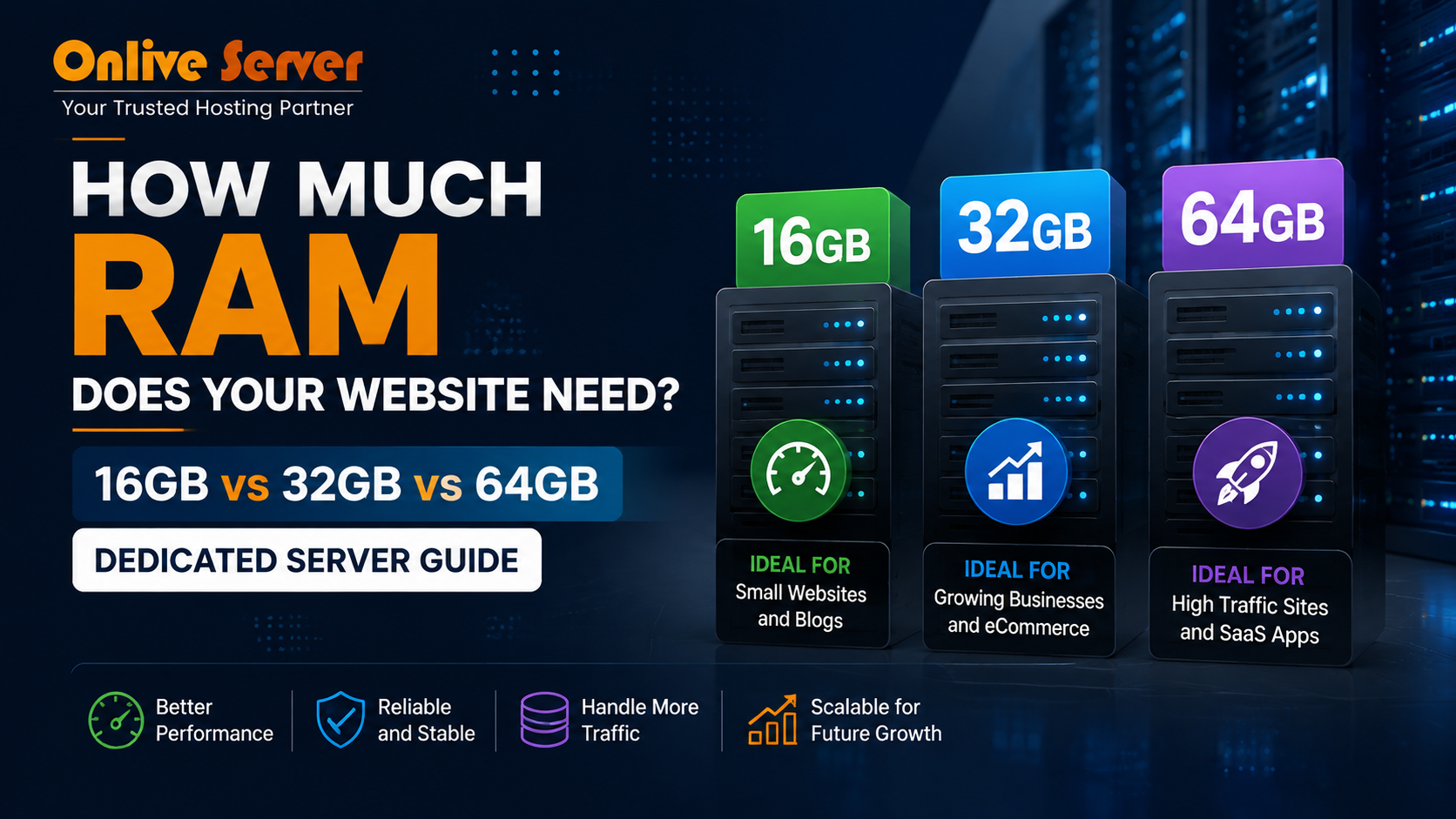
Direct Answer: Server RAM capacity requirements depend on concurrent database connections: 16GB supports small-to-medium CMS sites, 32GB handles moderate e-commerce with Redis object caching, while 64GB is recommended for high-concurrency microservices and multi-tenant applications.
This setup is tailored for How Much RAM Does Your Website Need? 16GB vs 32GB vs 64GB Dedicated Server Guide, giving your applications dedicated CPU threads and fast NVMe storage. For verified technical specifications and deployment parameters, consult the official Linux Kernel Documentation.
Running on dedicated Xeon or EPYC hardware, hardware RAID arrays, and unmetered port capacity inside Tier-III facilities in Tier-3 Datacenter Facilities eliminates noisy-neighbor CPU contention completely.
Enterprise NVMe storage accelerates database execution, while local hosting guarantees compliance with ISO 27001, SOC 2 Type II, PCI-DSS Level 1, and international data privacy frameworks.
Sustaining high-performance e-commerce, SaaS applications, and enterprise databases requires infrastructure that balances compute expenditure against deterministic throughput.
Provisioning enterprise bare-metal server hosting bridges this operational gap. It ensures predictable data transfer rates, dedicated compute cycles, and direct optical peering across primary network corridors.
Pure enterprise PCIe 4.0 NVMe storage arrays delivering 65,000+ random 4K IOPS for sub-millisecond database queries.
Multi-homed BGP carrier backbones connected directly to regional Internet Exchanges for deterministic routing.
Hardware-isolated compute cores shielded by multi-terabit in-line scrubbing and strict regulatory data compliance.
📌 Executive Chapter Index
Architecture Navigation- 01Core Technical Architecture & Resource Isolation→
- 02Regional Data Center Peering & Network Routing→
- 03Enterprise NVMe Storage & Database Throughput→
- 04Operational Security, Anti-DDoS & Compliance→
- 05High-Concurrency Kernel Optimization & Tuning→
- 06Capacity Planning & Workload Sizing Guidelines→
- 07Frequently Asked Questions→
Core Technical Architecture & Resource Isolation
Overcoming Multi-Tenant Resource Contention
Shared hosting environments force hundreds of websites to compete for the same physical memory, CPU cores, and storage buses.
Resource contention from co-hosted websites frequently leads to hypervisor throttling and unexpected request queuing.
Heavy background I/O operations from neighboring tenants delay database read operations, worsening latency and user retention.
Dedicated Hardware Isolation & Hypervisor Slices
Modern Dedicated Bare Metal Server architecture solves this problem through strict hardware resource reservation.
Compute nodes feature non-shared CPU cores, error-correcting ECC system memory, and dedicated PCIe storage paths.
Zero resource contention ensures uncompromised database execution and stable benchmark performance round the clock.
Operational Control with Full Root Access
Full root access gives your engineering team unrestricted control to customize system configurations, kernel flags, and runtime modules.
You can deploy Docker containers, configure Nginx reverse proxies, and tune database buffer pools to match your workload.
Upgrading to budget-friendly dedicated server hosting also eliminates hardware maintenance and cooling overhead.
Your business receives enterprise compute power backed by continuous hardware monitoring.
Predictable Thread Execution & Background Workloads
Dedicated compute thread execution ensures that background jobs run smoothly.
Heavy background tasks—such as PDF generation, catalog indexing, or data backups—will never slow down active web visitors.
In multi-tenant environments, storage disk queues are shared across dozens of competing accounts.
When another account performs bulk database updates, your application experiences disk latency spikes.
Dedicated infrastructure assigns independent I/O controller channels directly to your instance.
This dedicated channel guarantees steady read and write speeds, even during peak global shopping seasons.
Regional Data Center Peering & Network Routing
Minimizing Network Latency & Packet Hops
Network round-trip latency depends on physical distance, intermediate network hops, and carrier peering efficiency.
Routing traffic across distant overseas routes introduces 120ms to 240ms of latency.
This delay directly damages Core Web Vitals, including Interaction to Next Paint (INP) and Largest Contentful Paint (LCP).
Deploying workloads in Tier-3 Datacenter Facilities with direct connectivity to Tier-1 Carrier Internet Exchanges (IXP) bypasses congested public transit corridors.
Multi-homed BGP routing with Tier-1 carriers ensures redundant paths.
Packets reach visitors via the shortest physical fiber route, keeping latency consistently low.
| Network Destination | Optical Backbone / Transit Path | Average Round-Trip Latency | Performance Classification |
|---|---|---|---|
| Local Metropolitan Core | Direct Datacenter Optical Fabric | 1 – 3 ms | Ultra-Low |
| Regional Domestic Hubs | National Optical Terrestrial Ring | 8 – 15 ms | Ultra-Low |
| Adjacent Continental Border | Cross-Border Terrestrial Fiber | 18 – 26 ms | Excellent |
| Major International Gateway | Trans-Oceanic Subsea Optic Trunk | 32 – 45 ms | Very Good |
| Overseas Enterprise Transit | Global Tier-1 Multi-Homed BGP | 65 – 85 ms | Good |
| Remote Cloud Availability Zone | Encrypted Anycast Tunnel Gateway | 95 – 120 ms | Good |
Carrier-Neutral Failover Protection
Localized network peering cuts average latency by up to 75% compared to distant servers.
This proximity delivers instant page loads while reducing your dependence on costly third-party CDN networks.
Multi-carrier redundancy protects your operations against unexpected subsea cable cuts.
If an upstream transit carrier fails, automated BGP routing converges to alternate paths in milliseconds without interrupting active sessions.
Enterprise NVMe Storage & Database Throughput
Why Disk IOPS Matter More Than Clock Speeds
Modern dynamic applications—like WooCommerce, Magento, and PostgreSQL databases—rely heavily on rapid disk read and write cycles.
Whenever shoppers browse products, filter categories, or checkout, your database executes hundreds of random read/write queries.
If disk response times lag, dynamic page generation grinds to a halt.
Legacy mechanical hard drives (SATA HDD) and older SATA SSDs rely on the outdated AHCI protocol, which only supports a single queue of 32 commands.
Enterprise PCIe 4.0 NVMe drives run on 64,000 parallel queues.
Each queue processes 64,000 commands simultaneously, removing disk bottlenecks completely.
| Storage Technology Tier | Sequential Read / Write | Random 4K IOPS Capacity | Database Query Wait Time | High-Traffic Concurrency Status |
|---|---|---|---|---|
| NVMe PCIe 4.0 SSD Array | 5,000 – 7,200 MB/s | 65,000 – 120,000+ IOPS | 0.02 – 0.05 ms | Flawless (10,000+ Concurrent) |
| Enterprise SATA SSD | 500 – 550 MB/s | 15,000 – 35,000 IOPS | 0.20 – 0.60 ms | Moderate (1,000 – 2,500 Concurrent) |
| Mechanical SAS / SATA HDD | 120 – 180 MB/s | 150 – 300 IOPS | 8.00 – 15.00 ms | Severe Bottleneck (< 200 Concurrent) |
Power-Loss Protection & Redundancy
Massive IOPS throughput ensures that high-volume database transactions, temporary tables, and index scans resolve in fractions of a millisecond.
Review our analysis on hardware and software RAID storage benchmarks to evaluate array performance trade-offs under high I/O production workloads.
Our enterprise NVMe drives feature integrated Power Loss Protection (PLP) capacitors to ensure continuous data integrity.
If an electrical disruption occurs, on-drive capacitors maintain controller power long enough to flush cache safely to flash, preventing database index corruption.
Operational Security, Anti-DDoS & Compliance
Jurisdictional Data Protection & Sovereignty
In an increasingly stringent global regulatory climate, hosting infrastructure must maintain physical integrity as well as legal compliance.
Storing and processing customer data within certified Tier-3 Datacenter Facilities data centers ensures complete alignment with regional data privacy standards.
Localized data residency protects your business from costly regulatory penalties and unauthorized cross-border data transfer violations under ISO 27001, SOC 2 Type II, PCI-DSS Level 1, and international data privacy frameworks.
⚖️ Regulatory Assurance: Hosting locally within Global Multi-Region ensures that customer data, financial logs, and transaction records remain strictly within approved legal boundaries.
Defense-in-Depth Infrastructure Safeguards
To maintain continuous uptime and block malicious vectors, every server deployment includes multiple security layers:
Administrative Hardening Best Practices
Maintaining security also requires proactive access management and strict credential governance.
Changing default SSH ports, placing access behind encrypted VPN tunnels, and requiring SSH keys provide immediate protection against automated brute-force attacks.
Proactive Telemetry & Zero-Downtime Patching
Enterprise infrastructure requires round-the-clock monitoring to catch hardware bottlenecks before they cause downtime.
Automated monitoring daemons track CPU load, memory utilization, and network interface errors in real time.
Security patches can be scheduled and applied in isolated staging environments without disrupting live users.
This structured maintenance cycle ensures continuous uptime while keeping system libraries fully updated.
High-Concurrency Kernel Optimization & Tuning
Removing Default Operating System Limits
Standard Linux distributions ship with conservative default settings designed for general desktop or light office usage.
When thousands of simultaneous shoppers hit your site during a promotion, these default thresholds cause connection drops and 504 gateway timeouts.
Tuning your network stack ensures the kernel can accept and process high-traffic connection bursts without delay:
Real-World Concurrency Gains
Combining socket backlog expansion with lightweight web workers lets a single tuned server handle up to four times more traffic than an unconfigured machine.
This efficiency maximizes your return on hardware investment while maintaining snappy response times during unexpected traffic surges.
Capacity Planning & Workload Sizing Guidelines
Matching Hardware Slices to Traffic Volume
A major financial benefit of this hosting model is scalable capacity planning.
Instead of overspending on idle enterprise servers, you can select a plan tailored to current needs and scale smoothly as business expands.
Entry Tier Compute
Engineered for corporate portals, localized web applications, staging environments, and growing blogs. Delivers isolated computing power and custom configuration freedom.
Growth Workload Tier
The standard recommendation for active WooCommerce stores, community platforms, and SaaS APIs. Handles thousands of daily users with steady sub-second response times.
High-Throughput Enterprise
Tailored for high-throughput e-commerce retailers, relational database clusters, ERP backbones, and agencies managing extensive multi-client portfolios.
Elastic Scaling & High Availability
Expand NVMe storage capacity, attach secondary isolated IP addresses, or scale memory on demand without re-installation or disruptive manual data migrations.
Frequently Asked Questions
Conclusion: Strategic Architecture & Performance Summary
Implementing these technical optimizations for how much ram does your website need? 16gb vs 32gb vs 64gb dedicated server guide ensures robust throughput, predictable latency, and maximum system reliability across production environments. Rigorous benchmarking and proactive parameter tuning eliminate latent resource bottlenecks before they impact end users.
Pairing disciplined operating system administration with reliable compute foundations is essential for mission-critical operations. Deploying workloads on enterprise dedicated server hosting provides the dedicated resources, network resilience, and hardware acceleration necessary to sustain high availability under heavy production load.
