

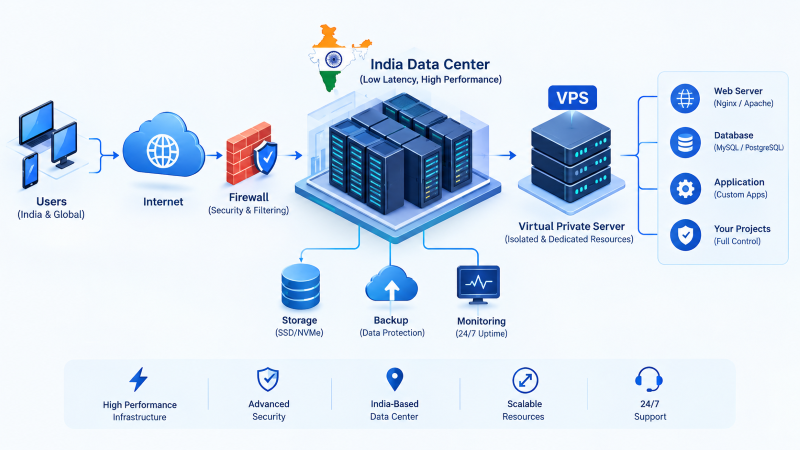
Deploying an India VPS within Tier III/IV datacenters in Mumbai or Noida delivers sub-30ms round-trip latency across the subcontinent via direct NIXI peering. Combining dedicated KVM virtualization, hardware-pinned NVMe Gen4 storage, and optimized Linux kernel network stacks (Google BBR) eliminates I/O bottlenecks and slashes Time To First Byte (TTFB) below 50ms for mission-critical web applications.
Operating high-traffic web applications, transactional e-commerce platforms, and real-time APIs for Indian audiences requires infrastructure tailored to the subcontinent’s distinct networking topography. While legacy offshore hosting in North America or Western Europe introduces unavoidable physical latency exceeding 180ms to 240ms, a locally provisioned virtual private server anchors your workload within milliseconds of end users. Selecting an enterprise-grade best India vps services environment ensures that high-concurrency database queries, dynamic page rendering, and encrypted payment handshakes execute with sub-millisecond determinism.
Achieving peak digital performance involves more than procuring local IP addresses. It requires carrier-neutral interconnects at domestic Internet Exchange Points (IXPs), kernel-isolated hardware virtualization, tuned Linux networking parameters, and resilient storage capable of handling festive traffic surges. This guide details the engineering, sysctl tuning, and architectural blueprints required to maximize throughput and achieve superior Google Core Web Vitals across Indian telecommunications networks.
Direct peering at NIXI Mumbai, Delhi, and Chennai routes domestic packets natively without overseas transit tromboning.
Hardware-assisted virtualization provides 100% dedicated vCPU cycles and ECC RAM, eliminating noisy-neighbor CPU starvation.
Enterprise PCIe 4.0 NVMe arrays in RAID-10 deliver over 1,200,000 IOPS, preventing database read/write bottlenecks.
Implementing Google BBR congestion control and enlarged TCP socket buffers optimizes throughput over mobile 4G/5G networks.
NGINX FastCGI microcaching and Redis object storage serve dynamic HTML within 15ms, maintaining stability during traffic spikes.
In-country data residency guarantees strict adherence to the Digital Personal Data Protection Act 2023 and CERT-In logging directives.
Subcontinental Topography and Domestic NIXI Peering Infrastructure
Network latency is governed by the physical velocity of light through fiber optic cores, approximately 5ms per 1,000 kilometers. When an Indian user in Bengaluru requests data from a server in Frankfurt or Virginia, packets traverse multiple submarine cables (SMW4, IMEWE, AAE-1) and international transit hops, imposing an irreducible latency floor of 140ms to 240ms that degrades Time To First Byte (TTFB).
Hosting within a domestic datacenter in Mumbai or Noida positions workloads adjacent to end users. Crucially, high performance requires direct interconnects at the National Internet Exchange of India (NIXI), alongside Extreme IX and DE-CIX India. Without domestic peering, inter-ISP packets between Jio, Airtel, and Vodafone Idea often route through Singapore or Dubai before returning—a latency-inducing phenomenon known as “traffic tromboning.”
With carrier-neutral BGP routing and Tier-1 carrier uplinks, an enterprise India VPS ensures data flows natively across domestic peering fabrics. The matrix below contrasts round-trip times (RTT) from a Mumbai VPS against offshore alternatives:
| Client Location (India) | Local ISP Network | Mumbai VPS (NIXI) | Singapore Node | Frankfurt (EU) | US East (Virginia) |
|---|---|---|---|---|---|
| Mumbai Metro | Reliance Jio Fiber / 5G | 2 – 6 ms | 48 – 62 ms | 125 – 145 ms | 195 – 225 ms |
| Delhi NCR / Noida | Bharti Airtel Xstream | 16 – 22 ms | 65 – 80 ms | 135 – 155 ms | 205 – 235 ms |
| Bengaluru / South | ACT Fibernet / Tata | 14 – 19 ms | 38 – 52 ms | 140 – 160 ms | 210 – 240 ms |
| Chennai Metro | Jio / BSNL Bharat Fibre | 18 – 24 ms | 35 – 45 ms | 145 – 165 ms | 215 – 245 ms |
| Kolkata / East Hub | Alliance / Airtel | 28 – 35 ms | 55 – 70 ms | 155 – 180 ms | 225 – 260 ms |
| Ahmedabad / West | GTPL / Jio 5G | 8 – 14 ms | 58 – 74 ms | 130 – 150 ms | 200 – 230 ms |
Architectural Matrix and Hardware Virtualization Standards
VPS performance depends directly upon the virtualization hypervisor. Legacy hosting frequently relied on OS-level containerization like OpenVZ or Virtuozzo, where a single host Linux kernel is shared across hundreds of instances. In this architecture, a resource spike by one tenant starves neighboring accounts of CPU cycles, causing CPU steal time (%st in top/htop) and unexpected latency spikes.
Enterprise engineering requires hardware-assisted KVM (Kernel-based Virtual Machine) virtualization. KVM provisions each instance as an isolated virtual machine with dedicated memory mappings and independent kernel space. Developers can customize kernel modules, configure network queuing disciplines, and leverage hardware cryptographic acceleration (AES-NI) without host constraints.
Moreover, enterprise infrastructure utilizes DDR5 Registered ECC memory and high-clock AMD EPYC 9004 or Intel Xeon Scalable Gen 4 processors. ECC memory detects and corrects single-bit errors in real time, preventing silent data corruption during intensive in-memory caching. For organizations scaling microservices, reviewing budget-friendly VPS hosting solutions provides helpful price-performance guidance across diverse workload requirements.
| Architectural Parameter | Legacy Shared / OpenVZ VPS | Enterprise KVM NVMe VPS | Production Impact on Workload |
|---|---|---|---|
| Virtualization Isolation | Shared OS Kernel (No Isolation) | Hardware KVM Isolation | Eliminates CPU steal; guarantees 100% reserved clock cycles. |
| Storage Subsystem | SATA SSD or Mechanical HDD | PCIe 4.0 NVMe in RAID-10 | Over 1,200,000 IOPS; sub-millisecond database query resolution. |
| Memory Integrity | Non-ECC Desktop RAM (Oversold) | DDR5 Registered ECC Memory | Autonomous bit-flip correction prevents segmentation faults. |
| Kernel Tuning Access | Restricted (Host locked) | Full Root SSH & Custom Kernel | Enables Google BBR, nftables, WireGuard, and Docker engines. |
| Network Interconnect | 100 Mbps Shared Uplink | 1 Gbps – 10 Gbps Redundant | Absorbs traffic surges without packet drops or bufferbloat. |
Sub-Millisecond Storage Subsystems and NVMe I/O Determinism
Web application performance is rarely restricted by CPU clock speed alone; disk I/O bottlenecks represent the primary culprit behind sluggish response times. Relational database engines like MySQL and PostgreSQL execute constant random read/write cycles. On legacy SATA SSDs constrained by AHCI protocols (supporting only one command queue of 32 commands), concurrent queries cause storage queue locks.
Enterprise India VPS nodes eliminate storage contention by deploying Non-Volatile Memory Express (NVMe) solid-state drives across PCIe 4.0 buses. NVMe supports 64,000 parallel command queues with 64,000 commands per queue. In hardware RAID-10 arrays, these drives deliver sequential throughput above 6,500 MB/s and random 4K performance exceeding 1,200,000 IOPS. Complex queries, multi-table JOINs, and search index lookups complete in sub-millisecond intervals, keeping disk I/O wait (%iowait) near 0.0%.
Linux Kernel Engineering and Network Stack Tuning Runbook
Default Linux kernel configurations are deliberately conservative, designed for general workloads rather than high-concurrency production servers. When handling thousands of concurrent connections over mobile networks (4G/5G connections prevalent across Indian carriers), default TCP socket buffers quickly exhaust capacity, dropping SYN packets and triggering retransmissions.
A vital optimization is replacing standard Cubic congestion control with Google BBR (Bottleneck Bandwidth and RTT). While traditional algorithms interpret minor mobile wireless packet loss as network congestion (prematurely throttling speed), BBR dynamically measures delivery rates and round-trip times, sustaining maximum throughput without bufferbloat.
To apply enterprise kernel tuning, save the configuration below to /etc/sysctl.d/99-india-vps-network.conf and reload sysctl:
These parameters increase connection backlogs from 128 to 65,535, preventing SYN drops during traffic surges. Setting vm.swappiness = 10 preserves physical RAM for active database processes, postponing disk swap until memory reaches 90% utilization.
Server-Side Caching Architecture for High-Concurrency Applications
Even with low network latency and fast storage, dynamically executing PHP scripts and database queries on every pageview introduces compute overhead. In platforms like WordPress or Magento, uncached requests trigger dozens of queries. Under traffic spikes, this dynamic workload exhausts PHP-FPM workers, generating 504 Gateway Timeouts.
Implementing a multi-layer server-side caching stack effectively eliminates this bottleneck:
- NGINX FastCGI Microcaching: Caches dynamic HTML in memory. Anonymous visitor requests are fulfilled directly by NGINX without invoking PHP or SQL, returning pages in under 15ms.
- Redis Object Caching: Stores database query results and user sessions in RAM via persistent Unix sockets, eliminating repetitive query execution.
- PHP 8.3 OPcache with JIT: Stores precompiled script bytecode in shared memory, eliminating repetitive parsing overhead.
Below is an enterprise NGINX configuration snippet demonstrating FastCGI caching with automatic bypass for user sessions and shopping carts:
Placing the cache directory in /dev/shm leverages shared RAM, removing disk operations for cached assets. A tuned 4-core India VPS can comfortably handle over 8,500 requests per second while maintaining Google Core Web Vitals LCP benchmarks under 0.8 seconds.
Regulatory Compliance and Indian Data Sovereignty Framework
Infrastructure architecture in India is also governed by legal mandates. The Digital Personal Data Protection Act (DPDP Act 2023) establishes strict accountability for “Data Fiduciaries” managing personal information of Indian citizens. Domestic hosting prevents complex cross-border transfer compliance hurdles.
Furthermore, organizations operating digital services in India must satisfy cybersecurity directives established by CERT-In under MeitY:
- Mandatory Log Retention: System, firewall, and access logs must be securely archived within Indian jurisdiction for at least 180 days.
- NTP Time Synchronization: Server clocks must synchronize with official atomic reference servers operated by the National Physical Laboratory (NPL) or NIC.
- Cyber Incident Reporting: Material security incidents—including unauthorized intrusions and DDoS disruptions—must be reported to CERT-In within six hours of discovery.
Hosting critical workloads on an India VPS provides data residency assurance, simplifying compliance with RBI, SEBI, and statutory privacy regulations.
Production Readiness and Security Verification Checklist
Before pointing production DNS records to your India VPS, DevOps engineers should complete this security and operational runbook:
- Cryptographic SSH Hardening: Disable password logins in
/etc/ssh/sshd_config, enforce Ed25519 keys, modify port 22 to an alternate port, and disallow root login. - Stateful Host Firewalling: Deploy
nftablesorufwwith default-drop ingress, permitting only ports 80, 443, and your custom SSH port. - Intrusion Prevention: Configure
Fail2banorCrowdSecto parse authentication logs, automatically banning brute-force attempts. - Automated Security Updates: Enable
unattended-upgradesto install critical Linux security packages automatically. - Encrypted Off-Site Backups: Schedule automated snapshot backups via BorgBackup or Restic to an independent storage node, verifying regular restore testing.
- Monitoring & Alerting: Deploy Prometheus node_exporter or lightweight metrics agents to monitor CPU, memory, NVMe health, and SSL certificate expiration.
📌 Frequently Asked Questions (FAQ)
Q1What latency difference can an Indian audience expect compared to US hosting?
Q2Why is NIXI peering critical for an India VPS environment?
Q3How does KVM virtualization prevent noisy neighbors?
Q4What role does NVMe Gen4 storage play in handling traffic spikes?
Q5How does enabling Google BBR improve mobile website speed?
Accelerate Your Web Applications with Enterprise India VPS
Deploy on high-frequency AMD EPYC and Intel Xeon processors with hardware-isolated KVM virtualization, pure PCIe 4.0 NVMe RAID-10 storage, and direct low-latency NIXI peering in Tier III Mumbai datacenters.
