

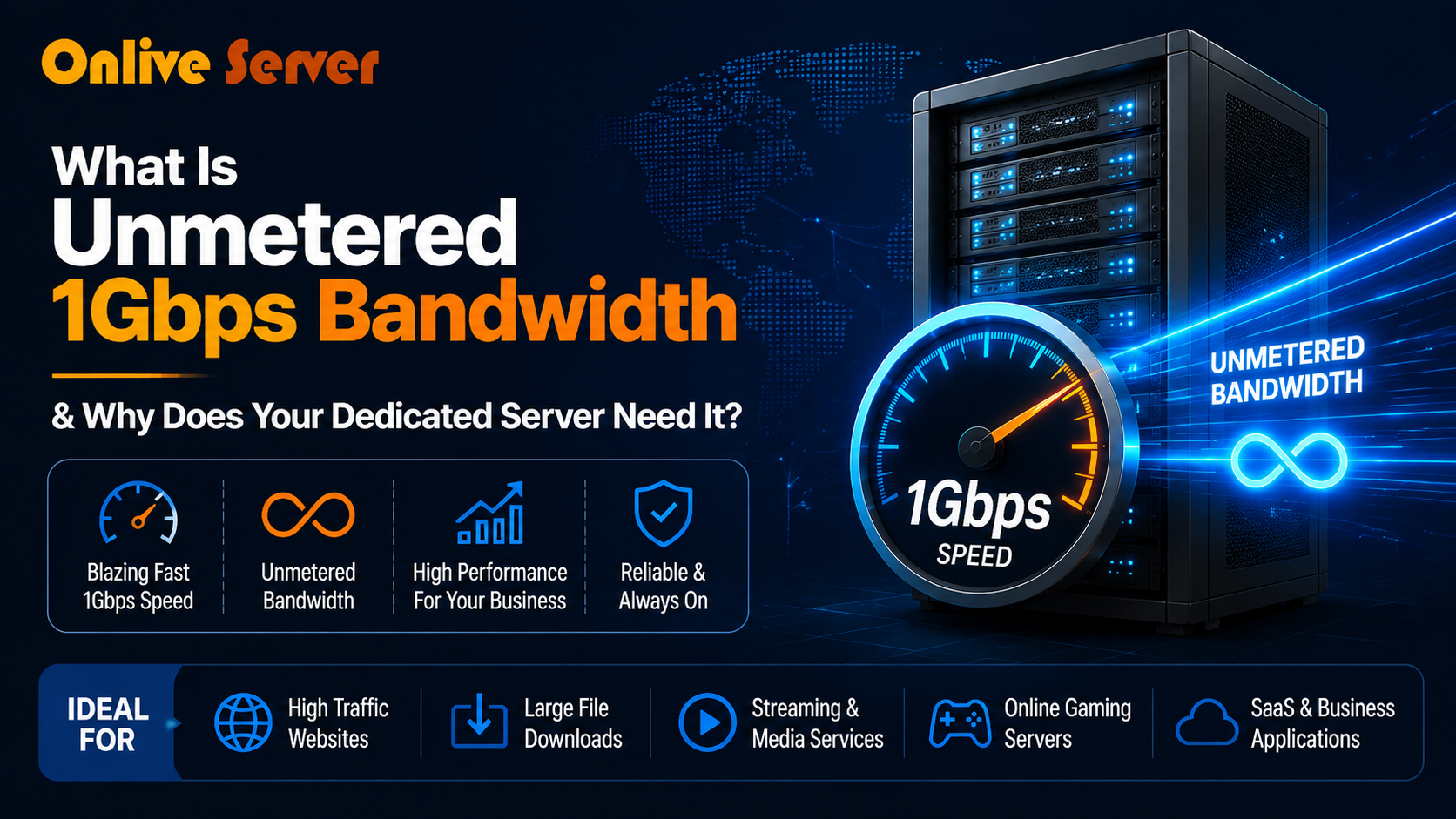
Unmetered 1Gbps bandwidth provides a dedicated 1 Gigabit-per-second network port with zero data transfer caps or overage billing penalties, allowing your server to push up to approximately 330 Terabytes of data per month continuously. This is essential for video streaming platforms, software download mirrors, high-traffic e-commerce sites, and backup repositories where unpredictable traffic spikes would otherwise incur costly cloud egress bandwidth fees.
What Is Unmetered 1Gbps Bandwidth for Inexpensive Dedicated Servers?
Unmetered 1Gbps bandwidth on an inexpensive dedicated server provides a dedicated, non-shared 1 Gigabit-per-second (1,000 Mbps) network port that permits unlimited incoming and outgoing data transmission without monthly volume caps, bandwidth throttling, or expensive overage penalties. Operating at full duplex capacity, a 1Gbps unmetered port can continuously transfer up to ~330 Terabytes of data per month—making it indispensable for high-traffic media streaming, massive database replication, game servers, SaaS platforms, and enterprise file distribution. For verified technical specifications and deployment parameters, consult the official Linux Kernel Documentation.
For data-intensive web platforms, the network port represents either a high-speed transit highway or a catastrophic bottleneck. Many hosting providers attract clients with cheap server hardware, only to enforce restrictive monthly bandwidth quotas or secretly throttle port speeds once a preset traffic ceiling is reached. On inexpensive dedicated servers, securing an authentic unmetered 1Gbps port is the single most effective way to protect against financial surprise and guarantee uninterrupted throughput. In this comprehensive technical guide, we break down how 1Gbps unmetered bandwidth operates, calculate real-world data throughput ceilings, contrast unmetered vs metered billing models, and evaluate upstream BGP network topologies.
📋 Table of Contents
8 SectionsUnderstanding Unmetered 1Gbps Bandwidth: Core Definitions
In networking terminology, bandwidth represents the width of the data pipe, while data transfer represents the actual volume of information traveling through that pipe over a given time period. A 1Gbps (Gigabit per second) port speed means your server’s Network Interface Card (NIC) is connected to a data center switch capable of routing 1,000 megabits of data per second simultaneously in both directions (full duplex).
When a server is provisioned with unmetered bandwidth, it means you can utilize this 1Gbps pipe continuously at 100% capacity without being billed on a per-gigabyte or per-terabyte basis. There are no monthly data ceilings, no automated bandwidth cut-offs, and no throttling down to 10Mbps when traffic peaks.
1Gbps Dedicated Unmetered Port
✓ RecommendedA clean, unshared physical switch port delivering continuous 1,000 Mbps line throughput. Unlimited data ingress and egress with flat-rate monthly billing and zero surprise overage fees.
Metered / Capped Bandwidth
⚠ Financial RiskSeverely restricted quotas (such as 5TB or 10TB per month). Once exceeded, providers either throttle server port speeds to unusable levels or charge punishing per-gigabyte overage fees.
For organizations operating high-throughput web applications, streaming platforms, or large API nodes, deploying inexpensive unmetered dedicated server hosting solutions delivers complete bandwidth certainty without threatening your monthly operational budget.
Unmetered vs Metered Bandwidth Economics
To appreciate why unmetered bandwidth is critical for budget dedicated servers, consider the economic risk of metered models. On major cloud platforms (such as AWS EC2 or Google Cloud), outbound data egress is priced between $0.05 to $0.09 per Gigabyte. If your website transfers 50 Terabytes in a month due to a viral product launch or software download, your cloud egress invoice alone can exceed $4,500.
On an inexpensive dedicated server with unmetered bandwidth, your entire monthly server cost—including bare-metal CPU, NVMe drives, and 100% unlimited data transfer—is bundled into a single predictable flat rate.
To understand how unmetered network pipes prevent billing shocks across enterprise deployments, read our unmetered high-bandwidth dedicated server guide.
Mathematical Throughput Ceilings: How Much Can a 1Gbps Port Move?
To calculate the theoretical maximum monthly volume that a 1Gbps unmetered port can transfer, apply basic network mathematics:
├── Port Speed: 1 Gigabit per second = 1,000 Megabits per second (Mbps)
├── Byte Conversion: 1,000 Mbps ÷ 8 = 125 Megabytes per second (MB/s)
├── Hourly Transfer: 125 MB/s × 3,600 seconds = 450,000 MB = 450 Gigabytes (GB/hour)
├── Daily Transfer: 450 GB × 24 hours = 10,800 GB = 10.8 Terabytes (TB/day)
└── 30-Day Theoretical Ceiling: 10.8 TB × 30 days = ~324 to 330 Terabytes (TB/month)
Even accounting for real-world network packet overhead (TCP/IP framing, MTU sizes, and BGP routing fluctuations), a 1Gbps port reliably provides 250 to 300+ Terabytes of clean usable monthly transfer.
Upstream BGP Peering and Tier-1 Carrier Redundancy
A 1Gbps port is only as fast as the upstream transit providers backing it. Quality data centers maintain redundant multi-homed BGP (Border Gateway Protocol) routing connected directly to Tier-1 global transit providers such as Lumen (CenturyLink), Telia (Arelion), Cogent, NTT, and GTT, as well as direct peering at major internet exchanges (such as DE-CIX, LINX, and AMS-IX).
If an optical fiber cable between cities is severed, automated BGP routing protocols dynamically reroute your server traffic across alternate transit links in milliseconds, preserving zero packet loss.
Workloads That Demand Unmetered 1Gbps Dedicated Servers
Network Port Security and Upstream DDoS Protection
A wide 1Gbps port allows legitimate visitors to access your services swiftly, but it also provides a large intake pipeline if targeted by malicious volumetric Distributed Denial of Service (DDoS) attacks. Enterprise budget dedicated server hosts mitigate this risk by routing traffic through inline hardware filtering scrubbers situated at the edge of the data center network.
Pairing hardware-edge scrubbing with local Linux kernel sysctl hardening protects your server against SYN floods, UDP amplification, and port saturation. Follow our essential dedicated server firewall and security guide to configure optimal iptables rules and block malicious traffic before it impacts server performance.
🎯 Final Verdict: Strategic Deployment Checklist
Securing an unmetered 1Gbps dedicated server delivers high-speed throughput and complete financial protection against exorbitant bandwidth bills. When evaluating your next hosting deployment, confirm these three critical network standards:
By pairing robust bare-metal hardware with unmetered 1Gbps connectivity, your applications gain the bandwidth headroom required to scale seamlessly across global audiences.
Frequently Asked Questions (FAQ)
Conclusion: Strategic Architecture & Performance Summary
Implementing these technical optimizations for what is unmetered 1gbps bandwidth & why does your dedicated server need it? ensures robust throughput, predictable latency, and maximum system reliability across production environments. Rigorous benchmarking and proactive parameter tuning eliminate latent resource bottlenecks before they impact end users.
Pairing disciplined operating system administration with reliable compute foundations is essential for mission-critical operations. Deploying workloads on enterprise dedicated server hosting provides the dedicated resources, network resilience, and hardware acceleration necessary to sustain high availability under heavy production load.