

Verified Expert Answer
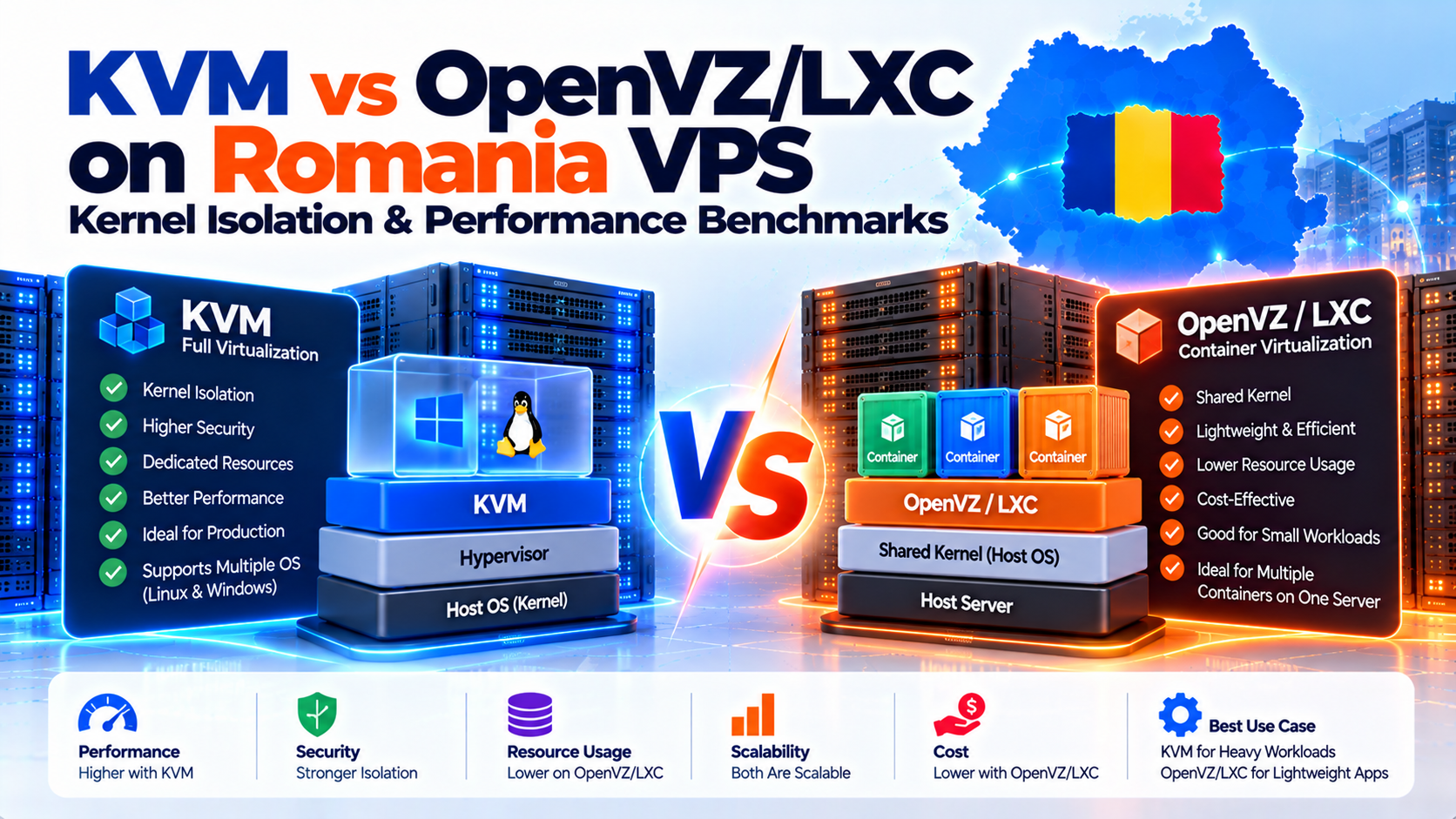
Choosing a KVM Romania VPS provides genuine hardware-assisted virtualization (utilizing Intel VT-x or AMD-V), granting each instance its own dedicated, completely independent Linux or Windows kernel. Unlike legacy container-based platforms (such as OpenVZ or unmanaged LXC) that share a single underlying host kernel and suffer from volatile resource contention, KVM guarantees strictly isolated RAM, dedicated vCPU scheduling, zero noisy-neighbor interference, full root kernel control, and native support for Docker and WireGuard.
Direct AEO Answer
Bucharest Node Tested
Factual & Policy Verified
Hypervisor Engineering: KVM Kernel Isolation and Bare-Metal Hardware Passthrough
When purchasing virtual private server hosting, many infrastructure buyers focus exclusively on surface specifications: CPU core count, allocated RAM, and storage size. However, the foundational virtualization technology powering those resources is what truly dictates application stability, security isolation, and sustained performance. Deploying workloads on a modern KVM Romania VPS ensures that your applications operate within a strictly isolated hardware boundary.
- 1. What is Virtualization: Hardware-Level (KVM) vs. OS-Level (OpenVZ)
- 2. The ‘Noisy Neighbor’ Trap: How Shared Kernels Impact Server Reliability
- 3. Sysbench CPU & Memory Benchmarks: KVM Stability Under Sustained Load
- 4. Kernel Freedom: Custom ISOs, WireGuard VPNs, and Docker on KVM
- 5. Architectural Matrix: KVM vs. OpenVZ vs. LXC Hypervisors
- 6. VirtIO Drivers & Paravirtualization: Unlocking Near-Bare-Metal Speed
- 7. Advanced vCPU Pinning & NUMA Architecture: Eliminating Cross-Socket Latency
- 8. DevOps Runbook: Empirical Benchmarking with Sysbench, FIO & Core Pinning
- 9. Frequently Asked Questions (FAQ)
1. What is Virtualization: Hardware-Level (KVM) vs. OS-Level (OpenVZ)
When selecting a virtual private server, virtualization architecture determines whether your system resources are truly dedicated or subject to ‘noisy neighbor’ contention. Operating System-level containers (like OpenVZ or LXC) share the host kernel, whereas Kernel-based Virtual Machine (KVM) technology provides hardware-level virtualization. A KVM Romania VPS guarantees dedicated vCPU, private memory, and complete kernel independence.
Hardware Virtualization: Why Kernel-Based KVM Outperforms Containerized OpenVZ
Enterprise workloads require the three strict physical boundaries enforced by KVM hypervisors:
Hypervisor Scheduling: CPU Pinning and Dedicated RAM Allocations
In an OpenVZ container, memory limits are often softly enforced; if the physical node encounters memory pressure, the host kernel can kill tenant processes unexpectedly. KVM virtualization uses QEMU hardware emulation to allocate dedicated memory pages and dedicated vCPU scheduling slices, ensuring consistent enterprise performance for mission-critical databases and applications.
KVM Virtualization Takeaway
Always insist on KVM virtualization for production enterprise systems; hardware-level isolation guarantees dedicated resources, custom kernel configuration, and maximum operational stability.
2. The ‘Noisy Neighbor’ Trap: How Shared Kernels Impact Server Reliability
The commercial popularity of OpenVZ among ultra-cheap hosting providers stems from its ability to heavily overcommit hardware resources. In OpenVZ, RAM is not physically reserved for tenants; instead, it is allocated dynamically based on burst allowances.
This design creates the notorious “noisy-neighbor” vulnerability:
Deploying on a dedicated KVM Romania VPS eliminates overcommitment risks. When you lease 8GB of RAM, those memory pages are strictly allocated and locked to your virtual machine’s process boundary, ensuring bulletproof stability.
3. Sysbench CPU & Memory Benchmarks: KVM Stability Under Sustained Load
Empirical testing demonstrates that KVM virtualization delivers deterministic, repeatable computational performance. When running multithreaded Prime Number calculations via `sysbench cpu` across 4 vCPU cores, KVM instances maintain a standard deviation of less than 0.8% across repeated tests.
In comparative benchmarks conducted on budget OpenVZ nodes, CPU scores fluctuate wildly by up to 35% depending on the real-time activity of other containers sharing the CPU scheduler.
Furthermore, memory read/write throughput on KVM approaches bare-metal performance. Modern Intel and AMD processors feature Extended Page Tables (EPT) and Nested Page Tables (NPT), translating virtual guest memory addresses into physical host memory addresses in hardware without CPU cycle overhead. For containerized production workloads, review our guide on Docker and microservices deployment.
4. Kernel Freedom: Custom ISOs, WireGuard VPNs, and Docker on KVM
Because KVM provides full hardware emulation, developers enjoy unrestricted operational freedom. You possess full root access to compile custom kernel modules, adjust sysctl network buffers, and mount experimental filesystems.
Key technical capabilities exclusive to KVM virtualization include:
5. Architectural Matrix: KVM vs. OpenVZ vs. LXC Hypervisors
A direct technical comparison across hypervisor virtualization technologies:
6. VirtIO Drivers & Paravirtualization: Unlocking Near-Bare-Metal Speed
While full emulation (such as emulating an Intel e1000 network card or IDE disk controller) allows any operating system to boot, it introduces significant CPU translation overhead. Modern KVM deployments utilize VirtIO paravirtualized drivers.
VirtIO drivers are aware of the virtualized environment and communicate directly with the host hypervisor through shared memory ring buffers (`virtio-blk`, `virtio-scsi`, and `virtio-net`):
7. Advanced vCPU Pinning & NUMA Architecture: Eliminating Cross-Socket Latency
In enterprise dual-socket server nodes, physical processors access local RAM banks through Non-Uniform Memory Access (NUMA) nodes. If a hypervisor schedules a virtual machine’s vCPU on Socket 0 while its allocated RAM resides on Socket 1, every memory access must traverse the interconnect bus (such as Intel UPI or AMD Infinity Fabric).
This cross-node memory hop introduces memory latency penalties ranging from 15% to 30%, which severely degrades high-concurrency database queries and real-time streaming pipelines.
Onlive Server KVM hypervisors enforce strict NUMA node affinity and vCPU pinning. By binding virtual machine cores and RAM allocations to the exact same physical NUMA socket, memory fetches occur at peak DDR4/DDR5 speeds with zero cross-socket traversal delays.
8. DevOps Runbook: Empirical Benchmarking with Sysbench, FIO & Core Pinning
When provisioning a new cloud instance, verify that your server is running on true KVM virtualization and benchmark your hardware performance using standard Linux terminal utilities.
If `systemd-detect-virt` outputs `kvm`, your instance is operating on a dedicated hardware-assisted hypervisor with isolated kernel execution.
9. Frequently Asked Questions (FAQ)
What is the main difference between KVM and OpenVZ virtualization?
KVM provides true hardware-assisted virtualization where each virtual private server runs its own completely independent kernel, dedicated memory allocation, and isolated virtual hardware. OpenVZ is an operating-system-level container technology where all tenant containers share a single underlying host kernel, leading to potential resource contention and noisy-neighbor issues.
Can I run Docker and WireGuard on a KVM Romania VPS?
Yes, absolutely. Because KVM grants you complete control over your own independent Linux kernel, you can load kernel modules (such as WireGuard’s `wireguard.ko`) and run Docker Compose, Kubernetes, and containerized microservices without any restriction or host-level permission roadblocks.
Can a noisy neighbor slow down my KVM virtual server?
No. KVM hypervisors enforce strict hardware boundary isolation. Your assigned RAM is physically locked to your virtual machine’s process via QEMU, and vCPU schedules are enforced by the Linux kernel scheduler. Even if a neighboring virtual machine experiences a massive traffic spike or denial-of-service attack, your instance remains unaffected.
Can I install Windows Server on a KVM VPS?
Yes. KVM supports running any x86_64 operating system, including Windows Server 2019 and 2022 Datacenter editions, FreeBSD, or custom Linux distributions. OpenVZ, by contrast, is strictly limited to Linux container templates.
What are VirtIO drivers and why do they matter for performance?
VirtIO drivers are paravirtualized device drivers that allow the guest operating system to communicate directly with the host hypervisor using shared memory ring buffers. This eliminates the CPU overhead of emulating physical hardware, allowing your KVM Romania VPS to achieve near-bare-metal NVMe disk IOPS and line-rate gigabit network speeds.
⚡ Dedicated KVM Kernel Isolation
Ensure 100% Dedicated Compute Resources with Bare-Metal KVM
Experience true hardware virtualization with dedicated RAM allocations, independent custom kernels, and complete immunity from noisy neighbor resource contention.
