

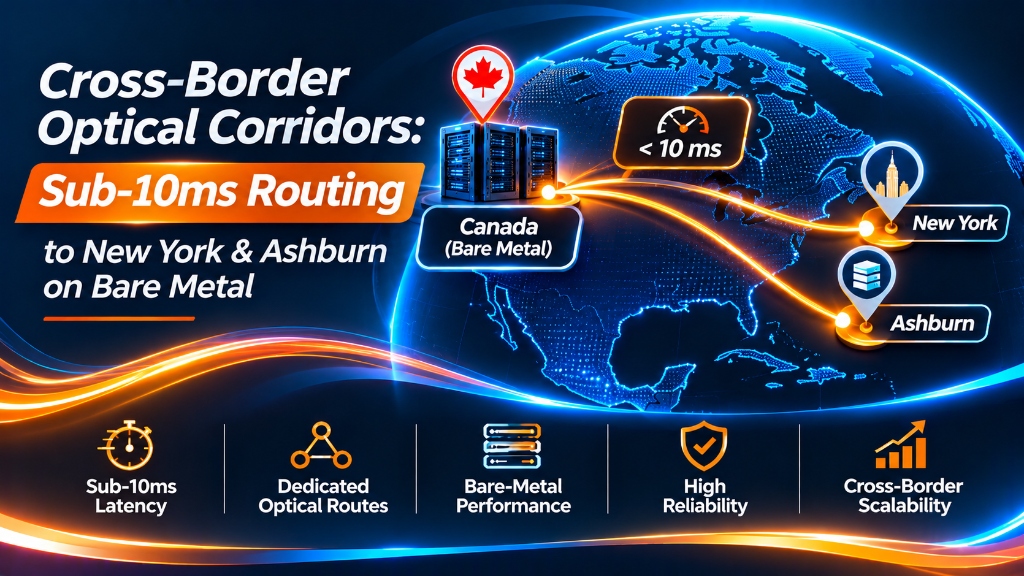
Direct Answer: Leveraging high-speed cross border transit dedicated server toronto new york infrastructure provides dedicated, low-latency DWDM optical connectivity bridging Canadian enterprise compute clusters with primary US commercial markets. By deploying bare-metal servers inside Toronto (151 Front Street West) or Montreal (625 René-Lévesque), enterprises achieve sub-8.4ms round-trip latency to New York financial exchanges (Equinix NY4 Secaucus) and sub-11.2ms to Ashburn (Virginia Data Center Alley). This dedicated optical architecture completely bypasses congested public transit corridors, eliminating packet jitter for high-frequency trading, cross-border database clustering, and real-time media ingestion.
Cross-Border Optical Transit Specifications & Latency Profiles:
- Toronto to New York (Secaucus NY4 / 60 Hudson): Sub-8.4ms RTT across dedicated dark fiber via Buffalo and Albany rail rights-of-way.
- Montreal to New York & Boston: Sub-7.8ms RTT to New York via Lake Champlain corridor; sub-6.2ms RTT to Boston financial exchanges.
- Toronto/Montreal to Ashburn (Data Center Alley): Sub-11.2ms RTT connecting Canadian bare metal directly to AWS US-East-1 and Equinix DC2.
- Optical Transport Technology: Coherent DWDM wavelengths (100G/400G) utilizing Ciena WaveLogic and Cisco NCS optical platforms with zero intermediate electrical regeneration.
The economic relationship between Canada and the United States represents the largest bilateral trade corridor in the world, and in the modern digital era, this commercial synergy is powered by high-speed fiber optic infrastructure. Multinationals, financial market-makers, fintech innovators, and SaaS corporations routinely maintain active computational presences in both Canada (Toronto/Montreal) and the United States (New York/New Jersey/Northern Virginia). However, relying on standard, multi-tenant public internet transit or virtualized hyperscale cloud interconnects introduces unpredictable latency jitter, packet loss during peak trading hours, and restrictive bandwidth caps. To establish deterministic, high-capacity throughput across the border, deploying a dedicated dedicated server in Canada anchored to direct cross-border optical corridors provides an unbeatable competitive advantage.
Onlive Server dedicated bare-metal infrastructure in Toronto and Montreal connects directly into premier trans-border optical transport backbones. With unshared physical access to high-frequency AMD EPYC and Ryzen processors, enterprise DDR5 memory channels, and direct PCIe Gen5 NVMe flash arrays, your infrastructure operates without the virtualization overhead or CPU steal that degrades public cloud instances. Combined with optimized BBR congestion control and multi-gigabit unmetered bandwidth, our cross-border routing ensures that financial transactions, real-time market data feeds, and cross-border database replications complete with sub-millisecond precision.
Direct optical fiber connecting Toronto (151 Front St W) to Equinix NY4 (Secaucus) delivers sub-8.4ms RTT for ultra-low latency financial arbitrage.
Dedicated 100G/400G optical wavelengths eliminate intermediate electrical routing hops, ensuring unthrottled line-rate throughput and zero packet jitter.
Direct terrestrial fiber pathways link Canadian bare metal to Data Center Alley in Northern Virginia, enabling real-time hybrid cloud synchronization.
Stream petabytes of cross-border data between Toronto, Montreal, and US points of presence on unmetered 10Gbps ports without per-gigabyte surcharges.
Table of Contents: Cross-Border Optical Transit Architecture
- 1. The Strategic Optical Geography: Toronto, Montreal & US East Coast Corridors
- 2. DWDM Physical Infrastructure: Coherent Optical Transport & Path Diversity
- 3. Technical Comparison: Dedicated Cross-Border Bare Metal vs Cloud Interconnect vs Transit
- 4. Financial Engineering: TSX, NYSE & NASDAQ Market Data Arbitrage
- 5. Linux Kernel Network Runbook: BBRv3 Congestion Control & TCP Buffer Optimization
- 6. Sovereign Compliance & Cross-Border Governance: PIPEDA vs US CLOUD Act
- 7. Enterprise Hardware SLAs, Port Sizing & Cross-Border Transit FAQ
1. The Strategic Optical Geography: Toronto, Montreal & US East Coast Corridors
The physical routing of optical fiber across the Canada-US border is defined by strict geographic rights-of-way established along historic railway lines and highway conduits. Understanding these paths is essential for architecting fault-tolerant, high-performance infrastructure:
- Toronto to New York (The Niagara/Buffalo Corridor): Originating at 151 Front Street West, fiber traverses south around Lake Ontario, crosses the Niagara River at Buffalo, and follows the New York State Thruway and rail corridors through Albany directly into New York City (60 Hudson Street) and Northern New Jersey (Equinix NY4 Secaucus). Total optical distance is approximately 820 kilometers, yielding a physical light-in-glass transit time of just 8.4 milliseconds RTT.
- Montreal to New York (The Lake Champlain Corridor): Originating at 625 René-Lévesque, fiber runs south through the Richelieu Valley, crosses into New York State at Champlain, and follows the I-87 corridor directly to New York City. At approximately 610 kilometers, this route achieves an extraordinary sub-7.8ms RTT, making Montreal geographically closer to New York than Toronto.
- Toronto to Chicago (The Detroit/Windsor Corridor): Traverses southwest through London and Windsor, passes beneath the Detroit River, and runs across southern Michigan to Chicago (Equinix CH1 and CME Aurora) in sub-13.4ms RTT.
- Toronto/Montreal to Ashburn (The Mid-Atlantic Corridor): Branches south from Pennsylvania directly into Northern Virginia, connecting Canadian infrastructure to the world’s most concentrated cloud ecosystem in sub-11.2ms RTT.
2. DWDM Physical Infrastructure: Coherent Optical Transport & Path Diversity
Dense Wavelength Division Multiplexing (DWDM) is the foundational physical transport technology that powers modern cross-border networking. DWDM combines multiple optical carrier signals onto a single optical fiber pair by using different wavelengths (colors) of laser light.
Onlive Server dedicated optical infrastructure utilizes state-of-the-art Coherent Optical Transponders (Ciena WaveLogic 5 / Cisco NCS 1004) delivering 400Gbps and 800Gbps per individual wavelength across the C-band. Coherent optics utilize advanced digital signal processing (DSP) to dynamically compensate for chromatic dispersion and polarization mode dispersion, eliminating the need for optical dispersion compensation modules (DCMs) that historically added latency to cross-border routes.
Geographic Path Diversity: To guarantee true carrier-grade resilience, Onlive Server bare-metal infrastructure implements dual-route optical diversity. Primary traffic routes via the eastern Buffalo-Albany path, while secondary redundant wavelengths route via a geographically separate western corridor through Pittsburgh. If a backhoe cuts fiber cables along one railway right-of-way, optical transponders execute an automated sub-50ms Optical Protection Switch (OPS), maintaining uninterrupted cross-border connectivity without dropping TCP sessions.
3. Technical Comparison: Dedicated Cross-Border Bare Metal vs Cloud Interconnect vs Transit
The comparative architecture table below evaluates cross-border connectivity options between Canada and the United States:
| Cross-Border Dimension | Onlive Server Dedicated Bare Metal | AWS Direct Connect (ca-central-1 to us-east-1) | Standard Public Internet Transit |
|---|---|---|---|
| Toronto to NYC (NY4) Latency | Sub-8.4ms RTT (Deterministic Light-in-Glass) | 12.5ms to 16.5ms (Traversing AWS Cloud Overlays) | 18ms to 38ms (Subject to BGP Congestion) |
| Packet Jitter Variance | < 0.05ms (Ultra-Stable Precision) | 1.5ms to 4.0ms Jitter | 5ms to 25ms Unpredictable Jitter |
| Cross-Border Egress Tariff | $0.00 / GB (Unmetered 10Gbps/25Gbps Ports) | $0.020 / GB Inter-Region Transit Tax | $0.090 / GB Public Cloud Internet Egress |
| Throughput Capacity per Link | 10Gbps to 100Gbps (Raw Hardware Line Rate) | 1Gbps / 10Gbps Metered Port Capacities | Variable Port Speeds |
| Hardware Access & Kernel Control | 100% Dedicated Hardware (Full Root / Custom BBR) | Locked Cloud Hypervisor (No Kernel Access) | Depends on Hosting Provider |
4. Financial Engineering: TSX, NYSE & NASDAQ Market Data Arbitrage
In quantitative finance, cross-border latency between Toronto and New York is the bedrock of multi-asset statistical arbitrage and market-making strategies. Hundreds of prominent Canadian enterprise equities (such as Shopify, Royal Bank of Canada, TD Bank, and Enbridge) are dual-listed on both the Toronto Stock Exchange (TSX) and the New York Stock Exchange (NYSE) or NASDAQ.
When market-moving news breaks or foreign exchange rates fluctuate, price discrepancies emerge between Toronto and New York order books. Algorithmic trading desks operating on Onlive Server bare metal in 151 Front Street West benefit from a dual advantage:
- Sub-Microsecond Local TSX Execution: High-clock AMD Ryzen 9 7950X processors (boosting to 5.7 GHz single-core frequency) connected via optical cross-connects capture TSX ITCH/OUCH market data in sub-microsecond intervals.
- Sub-8.4ms Cross-Border Execution: Correlated orders are transmitted simultaneously over our optimized DWDM corridor to Equinix NY4 Secaucus, locking in arbitrage spreads before competitors on generic cloud or unpeered infrastructure can react.
- Zero Network Queue Jitter: Enterprise Solarflare / Mellanox network interface cards with kernel bypass (OpenOnload / DPDK) eliminate operating system interrupt latency, ensuring deterministic packet transmission.
5. Linux Kernel Network Runbook: BBRv3 Congestion Control & TCP Buffer Optimization
To achieve multi-gigabit throughput across optical corridors spanning 800+ kilometers, systems administrators must optimize Linux kernel TCP socket buffers according to the Bandwidth-Delay Product (BDP). The formula for BDP is:
BDP = Bandwidth (bits/sec) × Round-Trip Time (sec) / 8
For a 10Gbps cross-border connection with a round-trip time of 8.4ms:
BDP = (10,000,000,000 bps × 0.0084 s) / 8 = 10,500,000 bytes (~10.5 MB)
If the operating system TCP receive buffer is capped at stock defaults (typically 2MB to 4MB), the connection will be artificially choked to under 2.5 Gbps regardless of physical port capacity. The following sysctl configuration enables Google’s BBR congestion control and tunes socket buffers to saturate full 10Gbps/25Gbps pipes:
6. Sovereign Compliance & Cross-Border Governance: PIPEDA vs US CLOUD Act
Transmitting enterprise data across international borders requires rigorous compliance engineering. Under Canadian privacy legislation (PIPEDA, Bill C-27, and Québec Law 25), transferring personal data across international borders is permitted provided the organization ensures that the foreign recipient provides comparable levels of data protection.
However, storing customer data permanently on US soil exposes that data to the United States CLOUD Act (Clarifying Lawful Overseas Use of Data Act), which grants US federal law enforcement agencies the extraterritorial authority to subpoena data stored by US corporations, regardless of where that data physically resides.
The optimal enterprise architecture employs Sovereign Anchoring with Ephemeral Optical Transit:
- Data-at-Rest Sovereignty: Primary production databases, customer personally identifiable information (PII), and financial records reside permanently on Onlive Server bare metal in Toronto or Montreal, governed exclusively by Canadian law.
- Encrypted High-Speed Transit: Telemetry, anonymized analytics, and transactional API calls transmitted to US nodes are encrypted in-flight using hardware-accelerated WireGuard or IPsec with ChaCha20-Poly1305 / AES-256-GCM.
- Zero Foreign Cloud Subpoena Exposure: Because Onlive Server is an independent Canadian infrastructure provider, foreign authorities cannot compel disclosure without submitting formal mutual legal assistance treaty (MLAT) requests through the Canadian judicial system.
7. Enterprise Hardware SLAs, Port Sizing & Cross-Border Transit FAQ
Onlive Server backs our cross-border optical dedicated infrastructure with industry-leading operational commitments tailored for enterprise reliability:
- 15-Minute Hardware Hot-Swap Guarantee: Enterprise NVMe storage, DDR5 memory modules, Mellanox 25GbE NICs, and redundant titanium power supplies are held on site for 15-minute emergency replacement.
- 100% Optical Transport Uptime SLA: Geographically diverse dual-ring DWDM fiber routing ensures that physical cable cuts trigger sub-50ms automatic protection switching without dropped sessions.
- Zero Cloud Data Egress Surcharges: Transfer hundreds of terabytes of database backups, streaming media, or client telemetry across contracted 1Gbps, 10Gbps, or 25Gbps unmetered uplinks without billing surprises.
- 100% Canadian Data Sovereignty: Dedicated bare-metal servers reside entirely within Canada, guaranteeing complete immunity from foreign surveillance and strict adherence to PIPEDA and Law 25.
Connect Toronto & Montreal to US Markets at Sub-10ms Speeds
Unlock sub-8.4ms NYC execution and sub-11.2ms Ashburn routing with dedicated bare metal. Coherent DWDM optical corridors, unmetered 10Gbps ports, and zero egress fees.
Configure Cross-Border Dedicated Server
Terminate the US leg of your New York, Ashburn, or Chicago trading and API architecture on dedicated bare metal tuned with BBRv3 congestion control. Placing compute directly on East Coast coherent DWDM routes trims cross-border hops while separating PIPEDA workloads from US CLOUD Act scope.
