

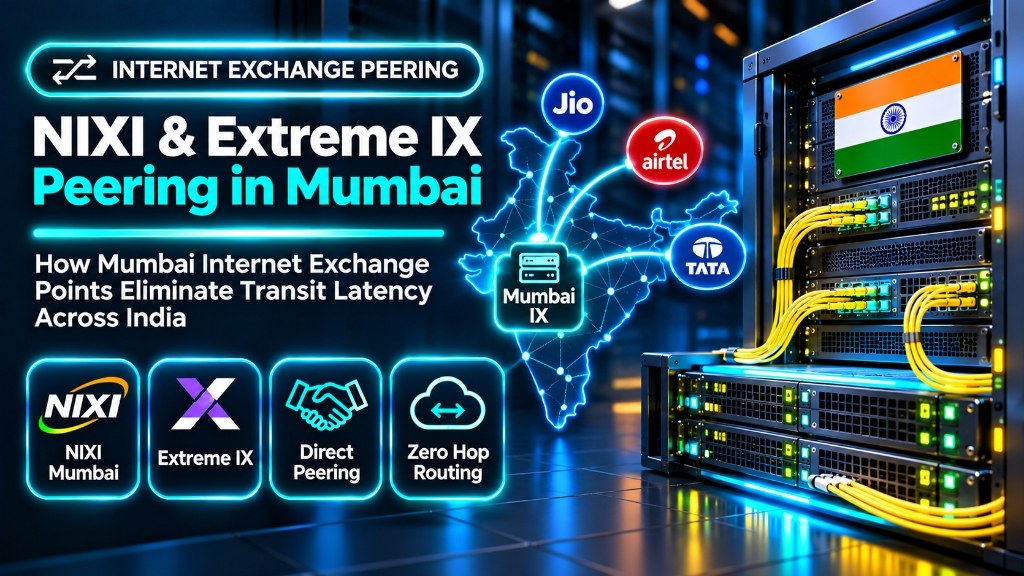
Direct Answer: Enterprise nixi extreme ix peering mumbai integrates dedicated bare-metal servers directly into India’s largest carrier-neutral Internet Exchange Points (IXPs). By exchanging IP traffic over local Layer 2 fabrics connecting Reliance Jio, Bharti Airtel, Vodafone Idea, and major broadband ISPs, it eliminates high-cost upstream transit and slashes domestic latency from 65ms down to sub-3ms.
- Connect to Extreme IX Mumbai (Multi-Lateral Peering): Essential for OTT streaming, online gaming, dynamic mobile apps, and e-commerce platforms distributing gigabits of bandwidth directly to domestic Indian consumer broadband networks.
- Connect to NIXI Mumbai: Recommended for government contractors, educational institutions, banking portals, and public sector applications requiring direct interconnectivity with state and central government networks.
- Deploy Dual-Homed Peering with Tier-1 IP Transit: The enterprise standard: routes domestic Indian eyeball traffic over zero-cost IXP fabrics while utilizing Tier-1 international backbones (Tata, Lumen, Airtel) for global traffic.
- Eliminate International “Tromboning”: Guarantees that Indian users accessing Indian hosted content never route through Singapore or Europe, slashing round-trip time and boosting Core Web Vitals.
In modern network engineering, the path a data packet takes through the global routing matrix determines both performance and cost. In India’s hyper-competitive digital economy—where hundreds of millions of smartphone users stream 4K video, trade on financial markets, and execute UPI payments—network latency directly governs customer satisfaction and application conversion rates. If an enterprise server in Mumbai relies solely on generic IP transit, domestic packets frequently take convoluted routes, traversing intermediate upstream carrier networks or even routing out of the country before reaching domestic consumer internet service providers (ISPs).
Internet Exchange Points (IXPs) solve this systemic inefficiency by providing a shared physical Layer 2 switching fabric where disparate networks, content delivery providers, and internet service providers interconnect directly. Deploying dedicated bare-metal infrastructure configured with an Onlive Server nixi extreme ix peering mumbai architecture establishes direct BGP peering with the National Internet Exchange of India (NIXI) and Extreme IX Mumbai. This engineering approach eliminates intermediate transit hops, slashes domestic latency to under 3 milliseconds, and reduces total bandwidth transit expenditures by up to 75%.
Direct Layer 2 peering bypasses upstream carrier queues, routing packets to Jio, Airtel, and Vi subscribers in single-digit milliseconds.
Keeps 100% of domestic Indian traffic within national borders, eliminating accidental cross-border routing to Singapore or Europe.
Extreme IX Mumbai and NIXI provide high-capacity 10G/40G/100G optical switch ports capable of absorbing massive festive traffic spikes.
Exchanging traffic over settlement-free peering fabrics reduces expensive IP transit volume and eliminates cloud per-gigabyte egress fees.
- 1. The Economics of Indian IP Peering: Transit Bottlenecks vs IXP Efficiency
- 2. National Internet Exchange of India (NIXI): Public Policy & Strategic Interconnects
- 3. Extreme IX Mumbai: Carrier-Neutral Commercial Fabric & Eyeball Density
- 4. Eliminating the “Tromboning” Effect: Direct Local Switching vs Overseas Routing
- 5. BGP Route Server Topologies: Multi-Lateral Peering (MLPA) vs Bilateral Sessions
- 6. Comparative Technical Matrix: Extreme IX vs NIXI vs Upstream IP Transit
- 7. Step-by-Step Production Runbook: BIRD2 BGP Peering with Extreme IX Route Server
- 8. Traffic Engineering & Observability: sFlow, IPFIX & Peering Ratio Telemetry
- 9. Frequently Asked Questions (Technical FAQs)
1. The Economics of Indian IP Peering: Transit Bottlenecks vs IXP Efficiency
To understand the strategic value of internet exchange points, network engineers must differentiate between IP Transit and IP Peering:
- IP Transit (Paid Upstream): An enterprise pays an upstream telecommunications carrier (such as Tata Communications, Bharti Airtel, or Lumen) to carry traffic to any destination on the global internet. Transit carriers bill on a 95th percentile or metered gigabyte basis. In high-volume operations streaming terabytes of media or API calls, IP transit represents a massive recurring expense.
- IP Peering (Direct Exchange): Two networks connect over a shared Layer 2 switch fabric at an IXP to exchange traffic destined for each other’s customers directly. Because this exchange occurs locally and without intermediary transit fees, peering traffic is fundamentally faster, more reliable, and radically cheaper.
- The Indian Data Tsunami: Indian mobile users consume an average of over 20GB of mobile data per month, the highest in the world. Servicing this massive volume through upstream IP transit alone creates bandwidth saturation and unpredictable operational costs. Peering offloads 60% to 80% of total network traffic directly onto local exchange switches.
2. National Internet Exchange of India (NIXI): Public Policy & Strategic Interconnects
Established under the aegis of the Ministry of Electronics and Information Technology (MeitY) and the Department of Telecommunications (DoT), NIXI is India’s pioneer internet exchange:
- National Domestic Routing Mandate: NIXI was created to ensure that internet traffic originating in India and destined for Indian users is routed and switched domestically rather than taking costly, insecure international detour routes.
- Public Sector & Educational Interconnectivity: NIXI Mumbai serves as the primary peering hub for government portals (digital India initiatives, UIDAI Aadhaar, GSTN), public sector banks (SBI, PNB), and educational networks (ERNET and National Knowledge Network – NKN).
- State-Owned Carrier Interconnects: Guarantees direct Layer 2 peering with Bharat Sanchar Nigam Limited (BSNL) and Mahanagar Telephone Nigam Limited (MTNL), which operate extensive rural and semi-urban broadband access networks across India.
3. Extreme IX Mumbai: Carrier-Neutral Commercial Fabric & Eyeball Density
While NIXI provides essential policy-driven routing, Extreme IX Mumbai is the premier carrier-neutral commercial internet exchange in the Indian subcontinent:
- Eyeball Provider Aggregation: Extreme IX Mumbai connects the country’s largest retail consumer broadband networks, including Reliance Jio (over 450 million subscribers), Bharti Airtel (over 380 million subscribers), Vodafone Idea (Vi), ACT Fibernet, Hathway, Den Networks, and hundreds of regional fiber-to-the-home (FTTH) operators.
- High-Throughput Distributed Switching Fabric: Operating across multiple interconnected datacenter facilities in Mumbai (Airoli, Mahape, Chandivali, and BKC), Extreme IX processes multiple terabits of peak traffic daily with sub-millisecond inter-chassis transport.
- Content Delivery & Gaming Synergy: Major global hyper-scalers, cloud gaming platforms, and digital streaming networks peer at Extreme IX, creating a high-density, low-latency ecosystem where dedicated servers interact with consumer networks in single-digit microseconds.
4. Eliminating the “Tromboning” Effect: Direct Local Switching vs Overseas Routing
Without local internet exchange peering, Indian domestic traffic frequently falls victim to the tromboning effect (also known as “hairpinning”):
- How Tromboning Occurs: If an enterprise server in Mumbai uses an upstream transit provider that lacks a domestic peering agreement with a consumer ISP (e.g., ACT Fibernet in Bangalore), the transit provider routes the packet to its nearest international peering point—typically in Singapore, Marseille, or Frankfurt. The packet traverses ocean cables out of India, is handed over to the target carrier, and then travels back across the ocean to India.
- Severe Latency Penalty: A packet that should have traveled 5 kilometers across Mumbai in 1.5ms instead travels 8,000 kilometers across the Indian Ocean to Singapore, adding 60ms to 90ms of unnecessary latency and jitter.
- Data Sovereignty Violation: Routing domestic financial or personal user data through foreign territories exposes packets to foreign surveillance (such as interception under foreign intelligence laws) and violates Indian data residency mandates. Direct IX peering guarantees domestic data remains 100% within sovereign borders.
5. BGP Route Server Topologies: Multi-Lateral Peering (MLPA) vs Bilateral Sessions
When connecting a dedicated bare-metal server to an internet exchange, network engineers can deploy two primary BGP peering topologies to manage prefix exchange and path filtering:
- Multi-Lateral Peering Agreement (MLPA) via Route Servers: Rather than establishing individual BGP peering sessions with hundreds of different member networks, the server establishes a single BGP session with the IXP’s redundant Route Servers (typically running BIRD or OpenBGPD). The Route Server automatically advertises your IP prefixes to all participating members and provides you with prefixes from all connected networks, scaling connectivity instantaneously without requiring individual interconnection agreements.
- Direct Bilateral BGP Peering: For strategic high-volume partners (such as direct peering with Reliance Jio, Bharti Airtel, or Google Cache), engineers establish dedicated, direct bilateral BGP sessions over the IX fabric, allowing customized BGP community tagging, local preference overrides, and granular traffic engineering that bypasses route server path filtering.
- Automated Prefix Validation & IRR Filtering: Route servers enforce strict prefix filtering against IRR databases (such as APNIC/IRINN and RIPE). Only authorized route objects registered to your specific ASN are accepted, preventing prefix leaks and protecting the exchange fabric from misconfigured routing loops.
6. Comparative Technical Matrix: Extreme IX vs NIXI vs Upstream IP Transit
The following engineering comparison highlights the performance, cost, and routing characteristics of different network interconnection models in Mumbai:
| Interconnection Metric | Extreme IX Mumbai (Commercial IXP) | NIXI Mumbai (National Policy IXP) | Standard Tier-1 IP Transit (Upstream) |
|---|---|---|---|
| Domestic Metro Latency | Sub-2ms (Direct Layer 2 Local Switch) | Sub-4ms (Direct Domestic Peering) | 15ms – 45ms (Subject to carrier routing) |
| Consumer Eyeball Density | Exceptional (Jio, Airtel, Vi, ACT, FTTH) | Moderate (BSNL, MTNL, Government, ERNET) | Global Reachability (All ASNs) |
| Data Transfer Cost | Flat Port Fee (Unmetered Settlement-Free) | Nominal Port Fee (Non-Profit Regulatory) | Per-Mbps or Metered Per-GB Invoicing |
| Route Server Automation | Dual BGP Route Servers (MLPA) | Dual BGP Route Servers | Full Global BGP Table (950k+ Routes) |
| Anti-Tromboning Guarantee | 100% Guaranteed Domestic Switching | 100% Guaranteed Domestic Switching | No guarantee; may route via Singapore |
7. Step-by-Step Production Runbook: BIRD2 BGP Peering with Extreme IX Route Server
Follow this exact production runbook to configure the BIRD 2 routing daemon on Ubuntu/Debian bare metal to establish redundant BGP peering sessions with Extreme IX Mumbai Route Servers.
Step 1: Install BIRD2 Internet Routing Daemon:
Step 2: Configure Extreme IX Route Server Sessions in /etc/bird/bird.conf:
Step 3: Validate and Reload BIRD Configuration:
8. Traffic Engineering & Observability: sFlow, IPFIX & Peering Ratio Telemetry
To ensure peering infrastructure operates at maximum financial and technical efficiency, enterprise network architects deploy continuous flow monitoring:
- IPFIX / sFlow Sampling: Sample 1 out of every 1,000 packets at the top-of-rack optical switch, streaming telemetry to an open-source flow analyzer (such as FastNetMon or pmacct).
- Peering Ratio Auditing: Identifies which specific Indian destination ASNs consume the largest volume of outbound traffic. If traffic to a specific regional ISP (e.g., Excitel or Hathway) exceeds 500Mbps, engineers transition from route server multi-lateral peering to a direct bilateral cross-connect to optimize transit quality.
- Automated BGP Community Tagging: Enforces community-based traffic steering to dynamically penalize or prioritize specific transit routes during carrier fiber maintenance windows.
9. Frequently Asked Questions (Technical FAQs)
Below are authoritative answers to common technical inquiries regarding NIXI and Extreme IX peering in Mumbai:
Routing Indian traffic through Singapore or Europe adds unnecessary latency and upstream transit fees. With multi-lateral NIXI and Extreme IX sessions on Mumbai bare metal, local eyeball networks exchange packets directly inside the city. Compare network port allocations and peering options for Indian deployments.
Compare India dedicated server specs