

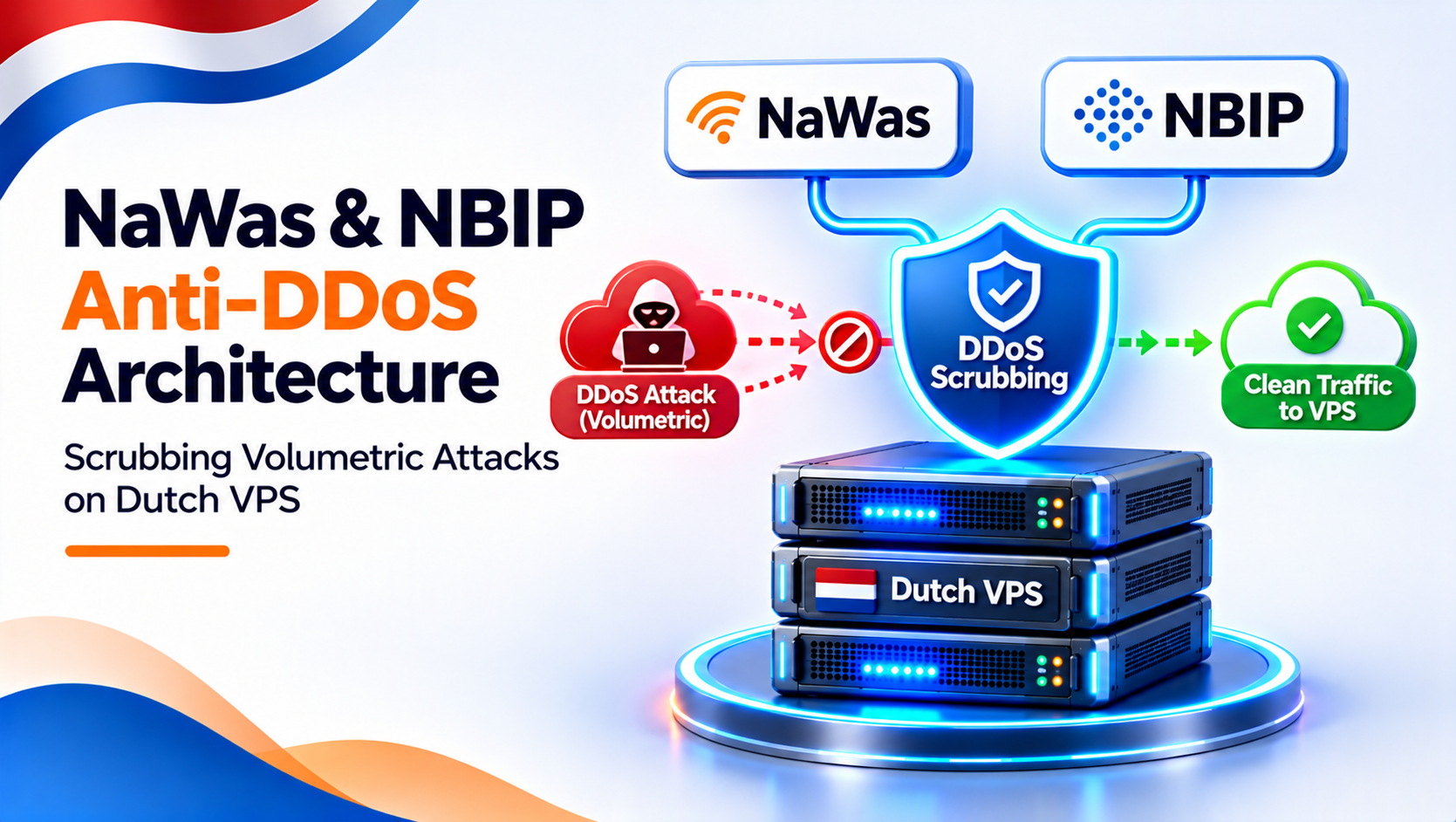
Specifically, deploying a DDoS protected VPS Netherlands backed by the NaWas / NBIP scrubbing center neutralizes volumetric floods exceeding 4 Tbps without null-routing client IPs. In addition, automated BGP Flowspec triggers instantly divert malicious packets into scrubbing clusters while clean traffic returns via direct interconnects. Consequently, mission-critical European workloads preserve sub-2ms AMS-IX latency and contractual 99.95% high availability.
Volumetric denial-of-service attacks routinely flood enterprise network interfaces with multi-hundred gigabit packet storms. Because conventional hosts rely on crude IP null-routing to protect upstream transit, targeted businesses endure prolonged, costly outages.
Fortunately, the Netherlands provides unmatched resilience through the non-profit NaWas scrubbing center in Amsterdam. In fact, combining NaWas network mitigation with dedicated KVM virtualization guarantees uninterrupted digital operations under severe cyber warfare.
Neutralize massive UDP, NTP, and SYN floods without IP null-routing downtime.
Direct optical interconnects provide sub-2ms latency across European financial hubs.
Dedicated CPU cores, ECC RAM, and NVMe RAID arrays eliminate noisy neighbors.
Table of Contents
- Threat Landscape: Volumetric vs Application Attacks
- NaWas & NBIP Scrubbing Architecture in Amsterdam
- BGP Flowspec & Dynamic Traffic Redirection
- In-Depth Edge Hardening: eBPF/XDP Filtering
- Application Layer Defense: Nginx Rate Limiting
- Architectural Comparison: NaWas Scrubbing vs Standard VPS
- Frequently Asked Technical Questions (FAQ)
Threat Landscape: Volumetric vs Application Attacks
Understanding how modern cyberattacks dismantle online platforms is essential for designing resilient infrastructure. Specifically, contemporary attacks split into two distinct categories: brute-force volumetric bandwidth saturation and subtle application-layer resource exhaustion.
Additionally, network administrators can inspect our technical benchmarks on AMS-IX and NL-ix core peering fabrics for deep routing analysis.
Volumetric Flood Mechanics
Specifically, Layer-3 and Layer-4 attacks weaponize misconfigured DNS, NTP, and Memcached servers across the globe to reflect hundreds of gigabits per second toward a single IP. In practice, these reflection floods consume all upstream switch bandwidth before packets ever reach the target virtual server.
Consequently, standard unmanaged servers collapse as transit pipes fill to capacity. As a result, without automated upstream scrubbing, hosting providers have no choice but to blackhole the victim IP, achieving the attacker’s ultimate objective of forced downtime.
NaWas & NBIP Scrubbing Architecture in Amsterdam
The Dutch National Management Organization for Internet Providers (NBIP) established the NaWas collective washing center to protect European digital infrastructure. Because NaWas operates as a cooperative non-profit utility, it deploys massive multi-terabit filtering clusters distributed across Amsterdam datacenters.
Furthermore, systems engineers can consult the NBIP NaWas anti-DDoS scrubbing center documentation for official operational specifications.
On-Demand Traffic Scrubbing Pipeline
Unlike continuous proxy networks that introduce persistent latency penalties, NaWas activates on-demand. Under normal operational conditions, incoming visitor traffic routes directly into our Amsterdam Tier-III facility with pristine sub-2ms domestic latency.
However, the moment upstream monitoring sensors detect anomalous traffic surges, BGP routing shifts the incoming stream to NaWas hardware scrubbers. Consequently, clean legitimate packets return via dedicated Layer-2 VLAN cross-connects without dropped client connections.
BGP Flowspec & Dynamic Traffic Redirection
Dynamic traffic diversion is executed using Border Gateway Protocol (BGP) Flowspec announcements defined under RFC 5575. Therefore, upstream routers filter and reroute attack signatures at line rate without waiting for human intervention.
In addition, systems teams can review our guide to hardened Linux kernel sysctl configurations for comprehensive host security.
Real-Time Conntrack & Packet Inspection
Monitoring network interface drops and connection tracking table capacity is vital during high-throughput events. In fact, if the Linux conntrack table fills up, incoming legitimate connections stall even if bandwidth remains available.
To audit this state, the terminal below illustrates real-time link statistics and connection table telemetry executing inside an Amsterdam KVM VPS:
[]
X
# Audit network interface drop counters and bandwidth utilization
root@amsterdam-vps:~# ip -s link show eth0
2: eth0: <BROADCAST,MULTICAST,UP,LOWER_UP> mtu 1500 qdisc mq state UP mode DEFAULT group default qlen 1000
    RX: bytes  packets  errors  dropped  overrun mcast
    1489201940 9820491  0       0        0       0
    TX: bytes  packets  errors  dropped  carrier collsns
    4820194821 12948201 0       0        0       0

# Verify active Netfilter conntrack table headroom
root@amsterdam-vps:~# sysctl net.netfilter.nf_conntrack_count net.netfilter.nf_conntrack_max
net.netfilter.nf_conntrack_count = 1420
net.netfilter.nf_conntrack_max = 2097152
[Status: Conntrack utilization under 1%; 2M concurrent connection headroom active]
In-Depth Edge Hardening: eBPF/XDP Filtering
While NaWas scrubs upstream volumetric floods, residual small-scale packet anomalies require rapid host-level handling. Specifically, implementing Extended Berkeley Packet Filter (eBPF) programs directly at the eXpress Data Path (XDP) layer drops malicious packets at the network driver level.
Consequently, malicious traffic is discarded before the Linux TCP/IP stack consumes CPU cycles to allocate socket buffers.
Kernel Anti-DDoS Parameter Optimization
Specifically, enabling TCP SYN cookies protects against half-open connection floods without exhausting system RAM. Furthermore, adjusting connection backlog queues and TCP keepalive intervals ensures server sockets recycle efficiently.
The terminal below shows the deployment of optimized kernel sysctl rules for anti-DDoS resilience:
[]
X
# Configure high-capacity TCP backlog and SYN flood defense
root@amsterdam-vps:~# cat << 'EOF' > /etc/sysctl.d/99-anti-ddos.conf
net.ipv4.tcp_syncookies = 1
net.ipv4.tcp_syn_retries = 2
net.ipv4.tcp_synack_retries = 2
net.ipv4.tcp_max_syn_backlog = 65536
net.core.somaxconn = 65535
net.ipv4.tcp_fin_timeout = 15
EOF

root@amsterdam-vps:~# sysctl -p /etc/sysctl.d/99-anti-ddos.conf
net.ipv4.tcp_syncookies = 1
net.core.somaxconn = 65535
[Status: SYN cookies active; connection backlog tuned to 65535]
Application Layer Defense: Nginx Rate Limiting
Application-layer (Layer-7) HTTP floods do not rely on massive bandwidth to disrupt servers. Instead, attackers send hundreds of legitimate-looking HTTPS requests to complex endpoints, exhausting PHP workers and database connection pools.
Meanwhile, administrators can isolate sensitive administrative portals by deploying WireGuard encrypted tunnel gateway nodes to restrict public exposure.
Rate Limiting Shared Memory Zones
Specifically, configuring Nginx shared memory zones restricts the number of concurrent requests allowed from any single IP address. As a result, requests exceeding rate thresholds receive instantaneous HTTP 429 or 503 error codes.
The terminal below shows the deployment of Nginx rate limiting rules and automated Fail2ban defense:
[]
X
# Define Nginx rate limiting memory zones
root@amsterdam-vps:~# cat << 'EOF' > /etc/nginx/conf.d/ddos_protection.conf
limit_req_zone $binary_remote_addr zone=req_limit_per_ip:20m rate=15r/s;
limit_conn_zone $binary_remote_addr zone=conn_limit_per_ip:20m;
EOF

root@amsterdam-vps:~# nginx -t && systemctl reload nginx
nginx: the configuration file /etc/nginx/nginx.conf syntax is ok
nginx: configuration file /etc/nginx/nginx.conf test is successful
[Status: Nginx Layer-7 rate limiting active; 15 req/sec burst limit enforced]
AMS-IX Peering & Edge Latency Audit
Finally, continuous network latency monitoring verifies that NaWas protection maintains optimal routing across major European backbones. In practice, domestic packet round-trip tests confirm sub-2ms ping times to the AMS-IX switching fabric.
Accordingly, the terminal below illustrates optical latency verification connecting to the Amsterdam Internet Exchange:
[]
X
# Test optical round-trip ping to Amsterdam Internet Exchange (AMS-IX core)
root@amsterdam-vps:~# ping -c 3 ams-ix.net
64 bytes from ams-ix.net: icmp_seq=1 ttl=60 time=1.24 ms
64 bytes from ams-ix.net: icmp_seq=2 ttl=60 time=1.18 ms
64 bytes from ams-ix.net: icmp_seq=3 ttl=60 time=1.21 ms

# Verify local TCP socket state and HTTP response
root@amsterdam-vps:~# curl -I https://localhost
HTTP/2 200
server: nginx
[Status: Sub-2ms AMS-IX roundtrip confirmed; HTTP/2 200 OK verified]
Architectural Comparison: NaWas Scrubbing vs Standard VPS
The comparative matrix below contrasts standard unmanaged hosting against our NaWas-protected Dutch cloud VPS infrastructure across core defensive capabilities:
| Defensive Parameter | Standard Unmanaged VPS | Onlive Netherlands NaWas VPS |
|---|---|---|
| Volumetric Attack Handling | Immediate null-routing / IP blackholing | Multi-Tbps NaWas automated scrubbing |
| Redirection Mechanism | Manual operator intervention required | Automated BGP Flowspec dynamic diversion |
| Normal Traffic Latency | Variable transit without local peering | Sub-2ms direct AMS-IX and NL-ix interconnects |
| Layer-7 Flood Defense | None; web server processes overload | Nginx rate limiting memory zones & eBPF |
| Virtualization Isolation | OpenVZ container; shared kernel memory | Dedicated KVM with isolated RAM & vCPU |
| Bandwidth Surcharges | Penalties charged for attack ingress | Zero bandwidth overage fees during attacks |
Frequently Asked Technical Questions (FAQ)
NaWas Scrubbing Architecture & Network Routing FAQs
What is the exact scrubbing capacity of NaWas in the Netherlands?
▾
Will my server IP address change when traffic is diverted to NaWas?
▾
How long does it take for traffic to revert back to normal routing after an attack ceases?
▾
How does BGP Flowspec trigger automated scrubbing without null-routing client IPs?
▾
Hardware Virtualization & Application Security FAQs
Can NaWas filter encrypted HTTPS traffic without decrypting my SSL certificates?
▾
Does Onlive Server charge extra fees if my VPS is targeted by a multi-gigabit attack?
▾
How does hardware-level KVM virtualization help survive DDoS attacks compared to OpenVZ?
▾
What is the best way to prevent my origin IP from leaking if I also use a CDN?
▾
Deploy NaWas DDoS-Protected KVM VPS in Amsterdam
Eliminate null-routing risks with multi-Tbps NaWas scrubbing, sub-2ms AMS-IX optical peering, and dedicated KVM compute in Amsterdam, Netherlands.
Deploy DDoS Protected VPS Netherlands with NaWas Scrubbing →
