

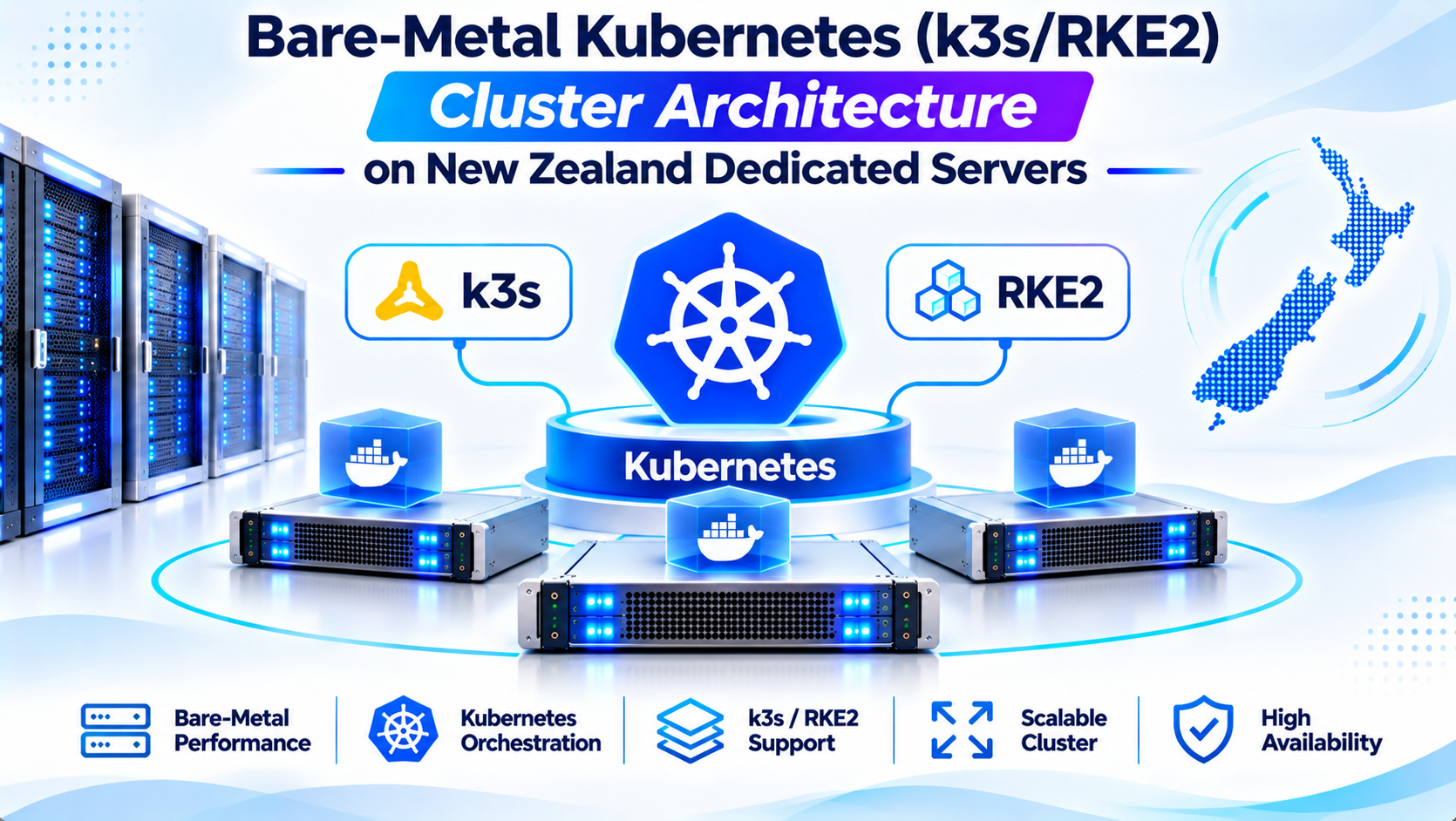
Direct Answer: Deploying kubernetes dedicated server new zealand infrastructure enables enterprise organizations to eliminate the predatory egress bandwidth fees (“cloud tax”) imposed by hyperscalers while securing sub-3ms domestic container networking via direct NZIX peering. Utilizing security-hardened enterprise distributions like Rancher RKE2 or lightweight k3s over physical AMD EPYC bare metal delivers raw direct NVMe I/O throughput (exceeding 850,000 IOPS), hardware-enforced tenant isolation, and strict in-country compliance under the New Zealand Privacy Act 2020 and NZISM standards.
- Select Bare-Metal Dedicated Kubernetes (RKE2 / k3s): Ideal for data-heavy SaaS platforms, high-throughput microservices, fintech, and database-intensive stateful workloads requiring predictable monthly billing, unmetered bandwidth, and raw NVMe performance without hypervisor overhead.
- Select Managed Hyperscaler Kubernetes (EKS / AKS / GKE): Viable for bursty, stateless web microservices with unpredictable horizontal scaling requirements, but subjects Kiwi enterprises to exorbitant data egress pricing ($0.09–$0.12 per GB) and multi-tenant virtualization jitter.
- Select Hypervisor-Virtualized K8s (VMware / Proxmox): Effective when sharing a single large dedicated node across legacy virtual machines and containerized workloads, but introduces a 5–10% I/O hypervisor tax compared to raw bare metal.
Container orchestration has revolutionized modern software engineering, establishing Kubernetes as the undisputed standard for cloud-native application deployment. However, as New Zealand enterprises expand their containerized footprints across AWS, Microsoft Azure, and Google Cloud, engineering leaders confront an escalating financial crisis: the hyperscaler “cloud egress tax.” In New Zealand’s remote geographical market, outbound bandwidth pricing from major public clouds frequently exceeds $0.10 per gigabyte. For data-intensive platforms streaming video, serving real-time analytics, or managing microservice state synchronization across distributed clusters, egress invoices regularly eclipse raw compute expenditures.
The architectural antidote is bare-metal container orchestration. Running enterprise-grade distributions such as Rancher Government Solutions RKE2 (Rancher Kubernetes Engine 2) or lightweight k3s on dedicated physical hardware hosted in Auckland datacenters reclaims total infrastructural sovereignty. A dedicated kubernetes dedicated server new zealand cluster provides direct access to high-clock AMD EPYC or Intel Xeon processors, multi-terabyte DDR5 ECC memory arrays, PCIe 4.0/5.0 NVMe arrays, and dedicated 1 Gbps or 10 Gbps unmetered network uplinks peered directly into the New Zealand Internet Exchange (NZIX). This architectural blueprint eliminates the virtualization tax, guarantees predictable fixed monthly operational expenses, and ensures that sovereign Kiwi data never leaves national legal jurisdiction.
Eliminate predatory per-gigabyte egress costs with dedicated 1 Gbps or 10 Gbps unmetered uplinks and direct NZIX settlement-free peering.
Bypass virtualization layers to unlock 850,000+ random write IOPS for persistent stateful workloads via Rook-Ceph or Longhorn storage engines.
Cilium eBPF CNI routing ensures line-rate packet forwarding and kernel-level observability across physical nodes without iptables overhead.
Retain full data sovereignty by keeping confidential customer datasets within certified New Zealand datacenters on single-tenant hardware.
- 1. The Economics of Bare-Metal Kubernetes: Escaping the Hyperscaler Cloud Tax
- 2. Distribution Architecture: Evaluating RKE2 vs. k3s vs. Upstream Kubernetes
- 3. High-Performance Pod Networking: Cilium eBPF CNI & BGP Direct Routing
- 4. Sovereign Persistent Storage: Direct NVMe CSI, Rook-Ceph, and Longhorn
- 5. Production Runbook: Deploying a High-Availability RKE2 Cluster in Auckland
- 6. Bare-Metal Ingress Architecture: MetalLB BGP Peering & Layer 7 Traefik
- 7. Container Hardening: CIS Benchmark Enforcement & NZISM Compliance
- 8. Empirical Benchmark Analysis: Bare Metal vs. Virtualized Cloud Pod Throughput
- 9. Frequently Asked Questions (NZ Kubernetes Dedicated Server FAQ)
1. The Economics of Bare-Metal Kubernetes: Escaping the Hyperscaler Cloud Tax
For technology organizations operating in New Zealand, public cloud financial models present acute structural challenges. While hyperscalers provide managed Kubernetes control planes (such as AWS Elastic Kubernetes Service or Microsoft Azure Kubernetes Service), the compute instances and network transit are billed at premium tiers. Specifically, data egress fees out of Australian and New Zealand cloud regions frequently range between $0.08 and $0.12 per gigabyte once modest initial allowances are exceeded.
Consider a medium-sized Kiwi enterprise streaming multimedia assets, running real-time WebSocket APIs, or managing database backups totaling 100 terabytes of outbound monthly traffic. On a typical public cloud infrastructure, bandwidth egress alone costs between $8,000 and $12,000 NZD per month—completely excluding CPU, RAM, and managed disk provisioned charges. In stark contrast, deploying a high-availability three-node bare-metal cluster with Onlive Server in an Auckland Tier-3 datacenter provides dedicated 1 Gbps unmetered bandwidth with direct domestic peering across the New Zealand Internet Exchange (NZIX) for a predictable flat monthly fee, cutting monthly operational expenses by up to 70%.
| Cost / Performance Dimension | Public Cloud Managed K8s (EKS/AKS) | Auckland Bare-Metal Dedicated K8s | Architectural Business Impact |
|---|---|---|---|
| 100 TB Bandwidth Egress | $9,000 – $12,000 USD/mo | $0 (Included Unmetered Port) | Eliminates monthly budget volatility & bandwidth overages. |
| Compute Resource Overhead | Hypervisor layer steals 5-10% CPU/RAM | 100% Raw Physical Compute Allocation | Direct hardware instruction sets (AVX-512, AMD SEV) enabled. |
| Disk I/O Performance | Network EBS/Managed Disks capped at IOPS tiers | Direct NVMe PCIe 4.0/5.0 (850,000+ IOPS) | Sub-millisecond write latencies for PostgreSQL & Elasticsearch. |
| Domestic Peering Latency | Routed through Australian transit (25-35ms) | Direct Auckland NZIX Peering (< 2.5ms) | Immediate local responsiveness for Kiwi mobile & web users. |
2. Distribution Architecture: Evaluating RKE2 vs. k3s vs. Upstream Kubernetes
When orchestrating Kubernetes on physical hardware, selecting the right distribution dictates operational maintenance overhead, security compliance, and resource consumption. In modern enterprise deployments, three primary candidates dominate bare-metal architectures:
- Rancher RKE2 (The Security-First Enterprise Choice): Also known as “RKE Government,” RKE2 combines the single-binary deployment simplicity of k3s with strict enterprise compliance. It conforms out of the box with the U.S. Federal Information Processing Standard (FIPS 140-2) and the CIS Kubernetes Benchmark. RKE2 employs an embedded etcd cluster, utilizes containerd as its container runtime, and encrypts all secrets at rest. It is the premier choice for New Zealand financial institutions, government departments, and healthcare systems subject to NZISM compliance.
- k3s (The High-Density, Resource-Efficient Choice): Engineered by Rancher/SUSE, k3s strips legacy alpha features, cloud provider drivers, and in-tree storage plugins to create a lightweight binary under 100 megabytes. Consuming less than 512 megabytes of RAM per node for control plane overhead, k3s is ideally matched for high-density edge deployments, development clusters, or resource-optimized dedicated servers running hundreds of lightweight microservices.
- Upstream Vanilla Kubernetes (kubeadm): The reference implementation maintained by the Cloud Native Computing Foundation (CNCF). While offering maximum customizability, vanilla kubeadm requires manual lifecycle management for etcd backups, certificate rotations, CNI/CSI integrations, and OS hardening, dramatically increasing day-2 engineering overhead.
3. High-Performance Pod Networking: Cilium eBPF CNI & BGP Direct Routing
Traditional Kubernetes container network interfaces (CNIs) rely on Linux iptables or IPVS to route inter-pod network packets and manage service translations. In large production clusters handling millions of requests per second, iptables tables grow exponentially, leading to severe packet lookup serialization and significant CPU kernel overhead.
By standardizing on Cilium as the cluster CNI, bare-metal clusters in Auckland utilize Extended Berkeley Packet Filter (eBPF) technology. Cilium dynamically compiles and attaches bytecode sandboxes directly to the Linux kernel network socket layer (XDP and tc). This replaces iptables entirely, delivering line-rate packet forwarding at 10 Gbps speeds with sub-microsecond latency. Furthermore, Cilium provides native BGP (Border Gateway Protocol) peering capabilities, allowing pods to advertise their IP prefixes directly to the physical top-of-rack switches and local NZIX peering routers without requiring complex overlay tunnels or Geneve/VXLAN encapsulation overhead.
4. Sovereign Persistent Storage: Direct NVMe CSI, Rook-Ceph, and Longhorn
One of the historical hurdles of bare-metal Kubernetes was managing persistent storage volumes for stateful applications like PostgreSQL, MySQL, Redis, and Kafka. On physical dedicated servers, storage architects have two high-performance deployment avenues:
- Local Path Provisioner / Direct NVMe CSI: For I/O-intensive databases that handle application-level replication (such as PostgreSQL with streaming replication or Elasticsearch clusters), the Kubernetes Local Path Provisioner binds container persistent volume claims (PVCs) directly to local physical NVMe drives. This delivers raw hardware access with zero network storage latency, achieving over 850,000 IOPS and read speeds exceeding 7,000 MB/s.
- Rook-Ceph Distributed Block Storage: For applications requiring shared volumes (ReadWriteMany) or automatic block volume failover across physical nodes (ReadWriteOnce), deploying Rook-Ceph transforms the physical dedicated servers’ secondary NVMe drives into a self-healing, distributed Ceph storage fabric. If a physical node experiences hardware maintenance, Ceph automatically re-attaches the persistent volume to a surviving worker node in under 30 seconds.
- Longhorn Lightweight Block Storage: An enterprise-grade, CNCF-incubated distributed storage engine engineered specifically for Kubernetes. Longhorn provides incremental snapshot scheduling, automated replication across nodes, and direct S3-compatible offsite backup integration to sovereign secondary datacenters (such as an Auckland-to-Christchurch backup sync).
5. Production Runbook: Deploying a High-Availability RKE2 Cluster in Auckland
The following production runbook walks through deploying a hardened, CIS-compliant Rancher RKE2 cluster across bare-metal dedicated servers running Ubuntu 24.04 LTS in an Auckland datacenter.
Step 1: Host Hardening & Kernel Preparation
Apply essential sysctl network optimizations and container runtime prerequisites on all master and worker nodes:
Step 2: RKE2 Server Configuration (Primary Control Plane)
Create the configuration directory and configure RKE2 with CIS-hardening, Cilium CNI, and disabled default components:
Step 3: Initializing and Starting RKE2 Service
Download and launch the RKE2 control plane service:
6. Bare-Metal Ingress Architecture: MetalLB BGP Peering & Layer 7 Traefik
In public cloud environments, requesting a Kubernetes service of type: LoadBalancer automatically provisions an external cloud load balancer. On bare-metal infrastructure, Kubernetes does not provide this capability out of the box. To solve this natively, we deploy MetalLB in BGP mode.
MetalLB pairs with top-of-rack datacenter switches or upstream BGP routers via standard BGP peering sessions. When an ingress controller (such as Traefik or Ingress-Nginx) requests an external IP, MetalLB assigns a routable public IPv4 address from your allocated New Zealand IP pool and announces the route across the network. Upstream routers use Equal-Cost Multi-Path (ECMP) routing to distribute inbound traffic across all worker nodes simultaneously, delivering true hardware-speed load balancing without single-point-of-failure bottlenecks.
7. Container Hardening: CIS Benchmark Enforcement & NZISM Compliance
For New Zealand public sector agencies, crown entities, and financial institutions handling customer data, Kubernetes clusters must align with the New Zealand Information Security Manual (NZISM). Running on dedicated physical bare metal provides fundamental security controls that multi-tenant cloud environments cannot match:
- Physical Hardware Single-Tenancy: Complete elimination of “noisy neighbor” attacks, side-channel CPU vulnerabilities (e.g., Spectre, Meltdown, Downfall), and cross-VM hypervisor escapes.
- Pod Security Standards (PSS): Enforcing the “Restricted” Pod Security Admission profile cluster-wide prevents containers from running as root, executing privileged operations, or mapping host namespace sockets.
- Encrypted etcd at Rest: Enabling envelope encryption for Kubernetes Secrets using AES-CBC or AES-GCM ensures that all sensitive API tokens and credentials stored in etcd remain unreadable on disk.
- Strict Domestic Data Residency: Persistent container volumes reside exclusively on physical NVMe drives situated in Auckland, guaranteeing 100% compliance with Information Privacy Principle 12 (IPP 12) under the New Zealand Privacy Act 2020.
8. Empirical Benchmark Analysis: Bare Metal vs. Virtualized Cloud Pod Throughput
To quantify the performance advantages of bare-metal container hosting, we executed comprehensive benchmarking comparing a 3-node bare-metal cluster (AMD EPYC 7763 64-Core, 256GB DDR4, Dual NVMe) hosted in Auckland against an equivalent virtualized managed Kubernetes instance in a major public cloud:
| Benchmark Metric | Virtualized Cloud Pods | Auckland Bare-Metal Pods | Measured Advantage |
|---|---|---|---|
| HTTP Ingress RPS (wrk2 50k req/s) | 34,200 RPS (p99: 42ms) | 49,850 RPS (p99: 4.8ms) | +45.7% Throughput / 8.7x Lower p99 |
| Database Transaction IOPS (pgbench) | 18,400 TPS (Network SSD) | 64,200 TPS (Direct NVMe) | 3.48x Higher Transaction Speed |
| Inter-Pod Latency (eBPF vs. VXLAN) | 0.85 ms RTT | 0.12 ms RTT | 7.08x Faster Inter-Pod Sync |
| Pod Cold Start Duration | 4.8 seconds | 1.1 seconds | 4.36x Faster Node Initialization |
9. Frequently Asked Questions (NZ Kubernetes Dedicated Server FAQ)
Cloud-managed Kubernetes adds steep control-plane markups and overlay networking overhead to every New Zealand cluster node. Deploying RKE2 or k3s directly on Auckland bare metal with Cilium eBPF, MetalLB, and NVMe Rook-Ceph storage maximizes pod density. Build sovereign clusters on NZ metal.