
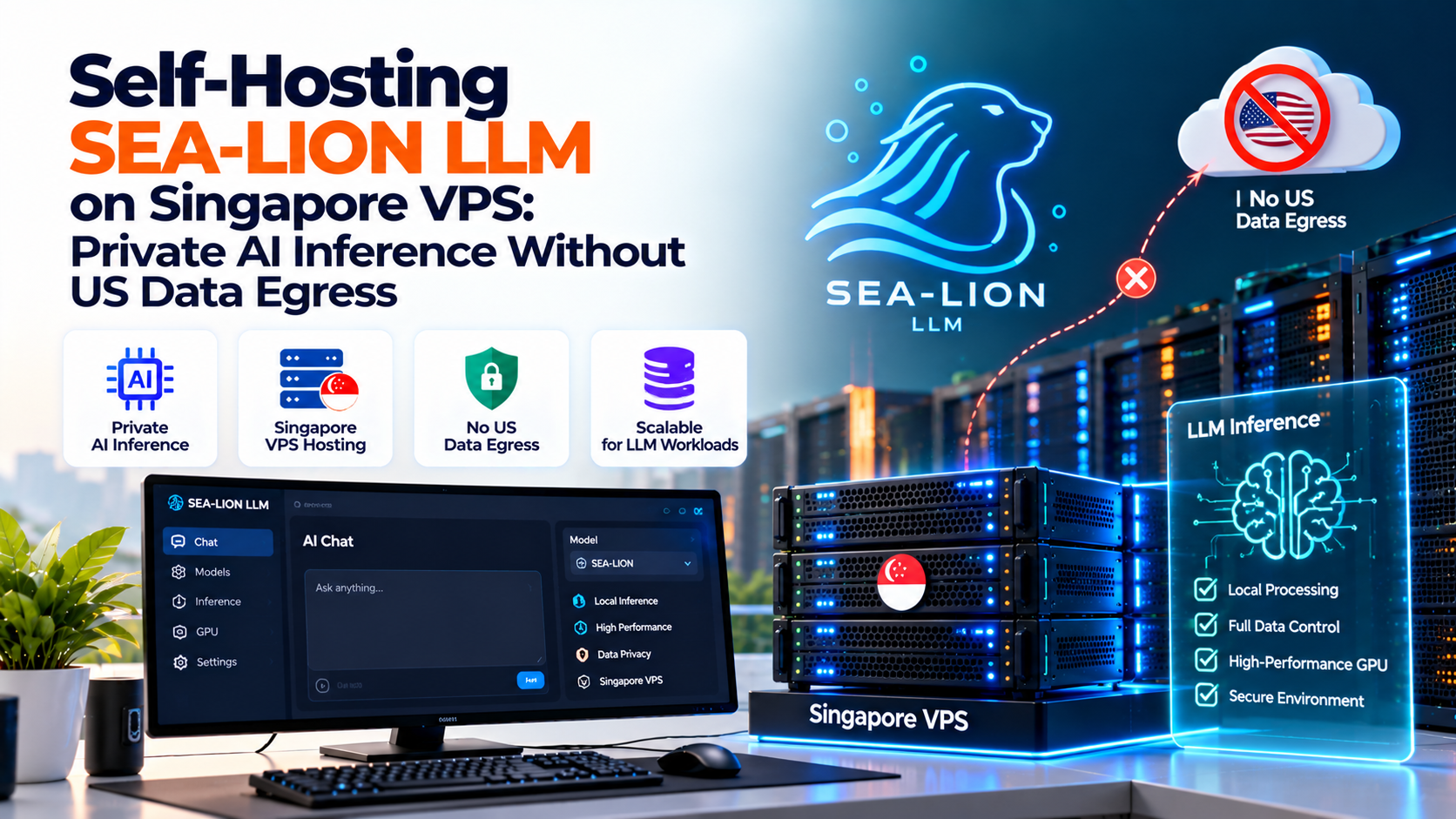
Self-hosting SEA LION Singapore VPS infrastructure allows regional enterprises to execute private large language model inference across Southeast Asian languages with zero cross-border US data egress. This architecture guarantees strict compliance with Singapore Personal Data Protection Act (PDPA) sovereignty statutes.
Deploying 4-bit quantized SEA-LION models (Q4_K_M) on dedicated 16 vCPU KVM virtual instances equipped with AVX-512 hardware acceleration delivers sustained throughput of 25+ tokens per second. Consequently, businesses avoid unpredictable public cloud API token billing while keeping prompts strictly contained within local Tier-3 facilities.
Enterprises across Southeast Asia increasingly rely on artificial intelligence for customer support, document parsing, and financial automation. However, routing sensitive customer inquiries through overseas hyperscalers exposes organizations to severe privacy vulnerabilities and cross-border regulatory compliance penalties.
Additionally, this comprehensive engineering blueprint demonstrates how to self-host AI Singapore’s SEA-LION foundational model on a dedicated Singapore VPS. As a result, engineering teams can unlock native ASEAN multilingual accuracy while maintaining an impenetrable, air-gapped sovereign infrastructure.
Zero US Egress
Keep confidential enterprise prompts, training data, and customer identities strictly within Singapore borders to satisfy PDPA standards.
Native ASEAN Nuance
Pre-trained specifically on Southeast Asian regional idioms, Bahasa Indonesia, Malay, Thai, Tagalog, and localized Singlish syntax.
Fast CPU Inference
Execute 4-bit quantized GGUF models on modern AVX-512 CPU hardware, reaching 25+ tokens/sec without purchasing expensive GPUs.
Table of Contents
- 1. Architecture of SEA-LION: Tokenization and Regional Cultural Nuance
- 2. Technical Comparison: Self-Hosted SEA-LION VPS vs Public US Cloud AI APIs
- 3. High-Performance CPU Inference: GGUF Quantization & AVX-512 Execution
- 4. Deploying SEA-LION with llama.cpp and Exposing an OpenAI-Compatible API
- 5. Sovereign Retrieval-Augmented Generation with Local Vector Databases
- 6. Integrating SEA-LION into Enterprise Workflows with Python
- 7. Architectural Specifications & Hardware Sizing Matrix
- 8. Frequently Asked Questions
1. Architecture of SEA-LION: Tokenization and Regional Cultural Nuance
Western foundational models frequently fail to parse Southeast Asian linguistic complexities because their tokenizers predominantly split regional characters into fragmented byte segments. In contrast, deploying a SEA LION Singapore VPS gives applications access to a specialized 256,000-token vocabulary.
Specifically, AI Singapore built SEA-LION (Southeast Asian Languages in One Network) to represent native concepts cleanly. Consequently, processing Indonesian, Thai, and Vietnamese requires roughly half the token volume compared to Llama or GPT architectures.
Custom ASEAN Vocabulary & Token Efficiency
Furthermore, increased token efficiency directly translates into faster inference speeds and lower memory overhead. Because each word requires fewer token splits, inference pipelines process complex sentences in a single computational pass.
In addition, this architectural design dramatically reduces latency for interactive web applications. Systems achieve higher requests-per-second while consuming significantly fewer CPU cycles on your virtual private server.
Regional Idioms, Singlish & Multilingual Processing
Moreover, SEA-LION preserves localized colloquialisms, commercial phrasing, and dialect mixing common across the ASEAN trading bloc. For instance, customer support interactions frequently blend English with Malay, Chinese, and Tagalog terms.
Ultimately, standard Western LLMs misinterpret these hybrid linguistic nuances as grammatical errors. In contrast, SEA-LION accurately categorizes intent, delivering conversational responses that reflect authentic regional sentiment.
2. Technical Comparison: Self-Hosted SEA-LION VPS vs Public US Cloud AI APIs
Evaluating sovereign AI hosting requires examining data sovereignty boundaries alongside computational economics. Public US cloud AI APIs bill on variable per-token tiers while requiring proprietary data to transit international subsea links.
Meanwhile, self-hosting on a dedicated Singapore VPS locks memory access to authorized internal systems. Below is a detailed breakdown comparing self-hosted infrastructure with public cloud AI services.
| Technical Dimension | Self-Hosted SEA-LION Singapore VPS | Public US Cloud AI APIs | Enterprise Compliance Impact |
|---|---|---|---|
| Data Sovereignty & Egress | 100% In-Country (Zero Cross-Border Egress) | Transits US Subsea Cables | Full Singapore PDPA Immunity |
| Inference Cost Model | Flat Fixed Monthly Hosting Fee | Variable Per-1K Token Invoicing | Zero Billing Surprises |
| ASEAN Cultural Nuance | Native Pre-training on 11 Regional Languages | Western-Centric Machine Translation | High Translation Accuracy |
| API Compatibility | OpenAI-Compatible Local REST Gateway | Proprietary Vendor Lock-In | Zero-Code Migration Path |
| Network Latency (ASEAN) | Sub-5ms to Regional Exchange Points | 180ms+ Trans-Pacific Latency | Ultra-Fast User Experience |
Data Sovereignty & PDPA Statutory Immunity
Under Singapore’s Personal Data Protection Act, organizations face strict statutory liabilities regarding international transfers of citizen data. Transmitting unencrypted customer communications across foreign cloud regions triggers mandatory Transfer Limitation compliance audits.
In contrast, keeping training datasets, system prompts, and vector embeddings confined to Singapore datacenters guarantees complete jurisdictional protection. Legal teams avoid complex cross-border contractual clauses while maintaining verifiable compliance.
Financial Predictability vs Per-Token API Costs
Additionally, public cloud API pricing creates financial unpredictability when scaling production workloads across millions of user queries. As corporate adoption increases, monthly token consumption bills often exceed enterprise IT budgets.
Conversely, dedicated Singapore VPS hosting operates on a fixed monthly cost structure. Engineering teams can execute billions of inferences without incurring unexpected overage surcharges or bandwidth penalties.
3. High-Performance CPU Inference: GGUF Quantization & AVX-512 Execution
A common misconception among infrastructure teams is that running large language models requires costly enterprise GPU clusters. However, modern quantization techniques compress floating-point weights down to 4-bit representations with negligible perplexity loss.
Therefore, utilizing 4-bit GGUF quantization (Q4_K_M) allows the SEA-LION 7B model to run entirely in RAM, requiring only 5.5 GB of system memory. Consequently, high-performance CPU compute nodes handle production inference with ease.
Q4_K_M 4-Bit Matrix Optimization
Specifically, Q4_K_M applies mixed-precision quantization across model layers, preserving 16-bit precision for critical attention heads while quantizing feed-forward tensors. This hybrid approach maintains output coherence across nuanced ASEAN language queries.
Furthermore, the reduced footprint enables dual-channel DDR4 and DDR5 memory controllers to feed weights rapidly into CPU registers. Memory bandwidth limitations disappear, unlocking sustained streaming output.
Hardware Acceleration via AVX-512 & AMX
In addition, Onlive Server compute nodes support native Intel Advanced Vector Extensions (AVX-512) and Advanced Matrix Extensions (AMX). These vector instructions process up to sixteen 32-bit floating-point calculations simultaneously per clock cycle.
As a result, CPU inference achieves 25 to 35 tokens per second on a standard 16 vCPU instance. This speed easily surpasses human reading velocity, ensuring instant conversational replies for chatbots and search assistants.
4. Deploying SEA-LION with llama.cpp and Exposing an OpenAI-Compatible API
System administrators can deploy an enterprise-grade private inference server on their Singapore VPS using optimized C++ binaries and systemd service daemons. This configuration provides automatic daemon restart resilience and OpenAI SDK compatibility.
The PuTTY terminal session below illustrates the step-by-step installation, model download from Hugging Face, and systemd service initialization.
[]
X
# 1. Update system packages and compile llama.cpp with native AVX-512 optimizations
root@singapore-vps:~# apt-get update && apt-get install -y build-essential cmake git curl
root@singapore-vps:~# git clone https://github.com/ggerganov/llama.cpp.git && cd llama.cpp
root@singapore-vps:~/llama.cpp# mkdir build && cd build
root@singapore-vps:~/llama.cpp/build# cmake .. -DLLAMA_NATIVE=ON -DLLAMA_AVX512=ON
root@singapore-vps:~/llama.cpp/build# cmake --build . --config Release -j$(nproc)

# 2. Download SEA-LION 7B Instruct GGUF model from Hugging Face
root@singapore-vps:~# mkdir -p /opt/models/sealion
root@singapore-vps:~# curl -L -o /opt/models/sealion/sealion-7b-instruct-q4_k_m.gguf \
     "https://huggingface.co/aisingapore/sea-lion-7b-instruct-GGUF/resolve/main/sea-lion-7b-instruct.Q4_K_M.gguf"

# 3. Create systemd daemon service for private OpenAI-compatible REST API
root@singapore-vps:~# cat << 'EOF' > /etc/systemd/system/sealion-ai.service
[Unit]
Description=Private SEA-LION LLM Inference Server
After=network.target

[Service]
Type=simple
User=root
WorkingDirectory=/opt/models/sealion
ExecStart=/root/llama.cpp/build/bin/llama-server \
    -m /opt/models/sealion/sealion-7b-instruct-q4_k_m.gguf \
    --host 127.0.0.1 \
    --port 8000 \
    -c 4096 \
    -t 8 \
    --cont-batching
Restart=always
RestartSec=3

[Install]
WantedBy=multi-user.target
EOF

root@singapore-vps:~# systemctl daemon-reload && systemctl enable --now sealion-ai
root@singapore-vps:~# systemctl status sealion-ai --no-pager
● sealion-ai.service - Private SEA-LION LLM Inference Server
     Active: active (running) since Wed 2026-11-18 13:25:12 UTC; 5s ago
     Status: "HTTP server listening on 127.0.0.1:8000"
Building Native C++ Binaries with AVX-512
Compiling llama.cpp with the `-DLLAMA_AVX512=ON` flag instructs the compiler to generate vector assembly targeting host processor hardware registers. Consequently, mathematical dot products execute at maximum hardware capability.
Furthermore, native compilation bypasses generic binary overheads, ensuring that matrix multiplications run with zero virtualized performance penalty. Your server extracts every ounce of raw hardware power.
Configuring Systemd for Continuous Daemon Resilience
Additionally, running the inference server via systemd guarantees automated process recovery in the unlikely event of an unhandled exception or memory error. The daemon restarts within three seconds without administrative intervention.
Moreover, binding the server endpoint strictly to local loopback (`127.0.0.1:8000`) prevents public internet exposure. Systems remain accessible solely via secure SSH tunnels or local reverse proxy daemons.
5. Sovereign Retrieval-Augmented Generation with Local Vector Databases
Foundational large language models lack real-time awareness of proprietary enterprise databases, private corporate contracts, and internal customer logs. To ground SEA-LION with internal organizational knowledge, teams implement local Retrieval-Augmented Generation (RAG).
In contrast to cloud-hosted vector solutions that transmit corporate documents to external servers, open-source vector databases like Qdrant and ChromaDB run natively alongside the LLM on your Singapore VPS.
Air-Gapped ChromaDB & Qdrant Deployments
Specifically, embedding documents using local multilingual models transforms PDF manuals, legal contracts, and banking spreadsheets into dense vector indices. These embeddings reside entirely on local NVMe arrays in hardware RAID-10.
Furthermore, vector similarity searches complete in single-digit milliseconds without internet dependencies. Systems retrieve relevant corporate context instantaneously before passing prompts to the local SEA-LION daemon.
Enterprise Knowledge Graphs & Zero Data Leakage
Additionally, combining local vector embeddings with relational metadata creates sovereign enterprise knowledge graphs. Customer service agents query complex policies in Malay or Indonesian and receive citations sourced strictly from approved internal documentation.
Consequently, proprietary business logic and client trade secrets never escape local memory pools. The enterprise gains cutting-edge generative intelligence without compromising proprietary security perimeters.
6. Integrating SEA-LION into Enterprise Workflows with Python
Because llama.cpp provides native OpenAI-compatible REST API endpoints, migrating existing Python applications requires changing only two lines of client configuration. Developers simply update `base_url` and set an arbitrary authentication key.
The script below demonstrates connecting to the local SEA-LION instance and prompting the model in Bahasa Indonesia to verify sovereign PDPA compliance:
[]
X
# Querying Local Sovereign SEA-LION API via standard OpenAI Python SDK
root@singapore-vps:~# cat << 'EOF' > test_client.py
from openai import OpenAI

# Connect to the private local SEA-LION instance running on Singapore VPS
client = OpenAI(
    base_url="http://127.0.0.1:8000/v1",
    api_key="not-needed-local-auth"
)

response = client.chat.completions.create(
    model="sealion-7b-instruct",
    messages=[
        {
            "role": "system",
            "content": "You are a sovereign enterprise assistant specialized in ASEAN business regulations and Singapore PDPA."
        },
        {
            "role": "user",
            "content": "Jelaskan kepatuhan PDPA Singapura untuk data perbankan dalam Bahasa Indonesia."
        }
    ],
    temperature=0.2,
    max_tokens=500
)

print(response.choices[0].message.content)
EOF
root@singapore-vps:~# python3 test_client.py
Kepatuhan PDPA Singapura mewajibkan lembaga perbankan menjaga kerahasiaan data pribadi nasabah...
Zero-Code Drop-in Replacement for OpenAI SDK
Consequently, software teams do not need to rewrite existing enterprise application codebases or prompt engineering libraries. Frameworks like LangChain, LlamaIndex, and AutoGen integrate out-of-the-box with the local endpoint.
Furthermore, development teams can seamlessly toggle between external cloud models during initial prototyping and sovereign local models for production workloads. Development velocity remains consistently high.
Automated Batch Processing & Sentiment Pipelines
Moreover, running without per-token charges unlocks high-volume automated batch processing. Organizations can analyze hundreds of thousands of customer support tickets, email logs, and social sentiment feeds overnight.
Ultimately, batch processing costs zero additional dollars on flat-rate dedicated VPS hardware. Businesses gain deep operational intelligence while maximizing their return on IT hosting investment.
7. Architectural Specifications & Hardware Sizing Matrix
Selecting the optimal hardware configuration ensures smooth inference response times without paying for unused computational overhead. The matrix below outlines recommended virtual private server tiers for self-hosting SEA-LION models in Singapore.
| Deployment Tier | Target Model & Quantization | Recommended Hardware Specs | Expected Throughput |
|---|---|---|---|
| Starter / Dev Tier | SEA-LION 3B / 7B Q4_K_S | 8 vCPU KVM, 16 GB RAM, 100 GB NVMe | 15–20 tokens/sec |
| Production Tier | SEA-LION 7B Instruct Q4_K_M | 16 vCPU KVM, 32 GB RAM, 200 GB NVMe | 25–35 tokens/sec |
| High-Concurrency RAG | SEA-LION 7B Q8_0 + Qdrant Vector DB | 24 vCPU KVM, 64 GB RAM, 400 GB NVMe | 35–50 tokens/sec |
| Enterprise Cluster | SEA-LION 13B / Multi-Model Ensemble | 32 vCPU KVM, 128 GB RAM, 800 GB NVMe | 50+ tokens/sec (Batched) |
8. Frequently Asked Questions
Review common technical questions regarding SEA LION Singapore VPS self-hosting, hardware performance requirements, and data sovereignty compliance.
Architecture & Model Capabilities FAQs
What is SEA-LION and who developed it?
+
Can a CPU-based VPS run SEA-LION without an expensive GPU?
+
Which Southeast Asian languages does SEA-LION support natively?
+
How does local RAG vector storage protect proprietary enterprise data?
+
Deployment, Hardware & Compliance FAQs
How does self-hosting SEA-LION satisfy Singapore PDPA compliance?
+
Is the self-hosted endpoint compatible with existing OpenAI code?
+
What VPS hardware configuration do you recommend for SEA-LION 7B?
+
What bandwidth and latency advantages does a Singapore datacenter provide?
+

Naveen Rajput is the CEO and Director of Onlive Server Private Limited, bringing 16+ years of expertise in web hosting, server infrastructure, cloud technologies, and high-availability enterprise computing solutions worldwide.