

Direct Technical Answer
Sizing Singapore VPS Infrastructure for SGX Low-Latency Execution
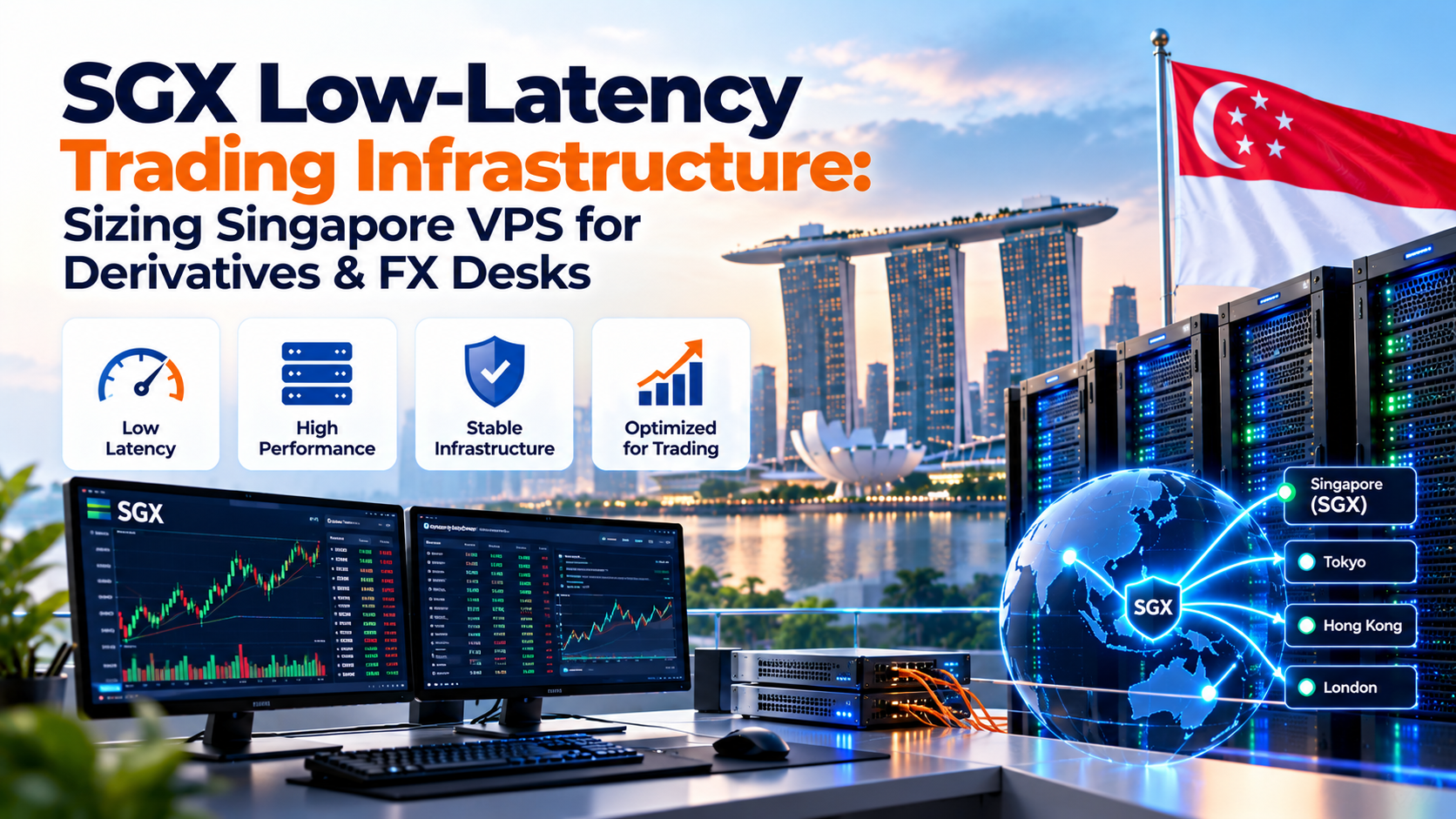
When architecting an SGX Trading Singapore VPS solution, executing high-frequency algorithmic strategies requires specialized proximity hosting. Specifically, co-locating near the Singapore Exchange matching engine at Pasir Ris or Equinix SG1 achieves round-trip latencies below 600 microseconds. Furthermore, configuring dedicated KVM vCPU pinning, disabling kernel C-states, and allocating 1GB HugePages eliminates execution jitter. Consequently, trading desks capture critical market spreads without the prohibitive expenses of direct physical co-location.
📌 Table of Contents
- The Topography of SGX Financial Connectivity: Pasir Ris, Equinix SG1 & Dark Fiber Rings
- Performance Matrix: Proximity VPS vs Generic Cloud vs Direct SGX Co-Lo
- Hardware Sizing: Hypervisor Tuning for Jitter-Free Execution
- Precision Time Protocol Clock Synchronization for SGX Regulatory Timestamping
- Kernel Bypass Networking Mechanics: Accelerating FIX and ITCH Order Processing
- Configuring Linux Kernel Parameters and Real-Time Scheduling for Trading
- Frequently Asked Questions (FAQ)
Financial Market Context: Architectural Framework & Execution Dynamics
Specifically, the Singapore Exchange (SGX) serves as Asia’s primary risk management capital. Furthermore, it operates as the central venue for institutional foreign exchange derivatives. It handles major benchmark equity index futures like the FTSE China A50 and Nikkei 225. Consequently, execution speeds directly govern algorithmic profitability. In high-frequency trading and statistical arbitrage, microseconds dictate trade fill quality. As a result, execution delays determine whether an order crosses the spread or suffers costly fill slippage.
Furthermore, tier-one institutional banks often lease direct co-location rack suites inside Pasir Ris. However, direct co-location requires substantial monthly capital. Monthly fees frequently exceed SGD 20,000 for cross-connects and cabinet space. Consequently, boutique quantitative funds need a more agile approach. A proximity-hosted SGX Trading Singapore VPS delivers an optimal balance. It provides sub-millisecond execution at a tiny fraction of physical colocation expenses.
In addition, deploying automated engines on high-performance Singapore VPS hosting infrastructure ensures dedicated compute power. High-speed Singapore dedicated server uplinks prevent network saturation during economic announcements.
SGX Trading Singapore VPS: The Topography of SGX Financial Connectivity: Pasir Ris, Equinix SG1, and Dark Fiber Rings
In addition, understanding trading latency requires analyzing the physical fiber topology in Singapore. The primary matching engine for SGX Titan resides inside the SGX Data Centre at Pasir Ris. Concurrently, secondary liquidity hubs operate at Equinix SG1 on Ayer Rajah Crescent. Major institutional foreign exchange aggregators such as EBS and Currenex also peer at SG1.
Consequently, trading desks must minimize geographic distance across the island. The physical fiber distance between Ayer Rajah and Pasir Ris measures roughly 32 kilometers. In optical fiber, light travels at approximately 200,000 kilometers per second. Therefore, each kilometer introduces 5 microseconds of propagation latency. Subsequently, the baseline one-way time of flight across Singapore spans roughly 160 microseconds.
Moreover, enterprise proximity networks utilize diverse dark fiber metro rings. Specifically, these rings bypass public Internet peering exchanges. As a result, network round-trips stay consistently under 500 to 750 microseconds. Deploying an algorithmic engine on a low-latency Singapore VPS guarantees predictable network transit times.
Performance Matrix: SGX Trading Singapore VPS vs Generic Cloud vs Direct SGX Co-Lo
Therefore, evaluating hosting architectures against algorithmic trading performance metrics reveals striking distinctions:
| Technical Metric | SGX Proximity VPS | Direct SGX Co-Location | Generic Public Cloud |
|---|---|---|---|
| SGX Tick Latency | 450 – 750 microseconds | 5 – 25 microseconds | 3,500 – 12,000 microseconds |
| Jitter Variance | ± 45 microseconds | ± 2 microseconds | ± 2,400 microseconds |
| Monthly Operating Cost | Around SGD 85 – SGD 450 | From SGD 15,000 – SGD 35,000 | Estimated SGD 220 – SGD 800 |
| CPU Resource Contention | Zero (Dedicated Pinning) | Zero (Bare Metal) | Severe (Noisy Neighbors) |
| Provisioning Lead Time | Instant (Under 10 Minutes) | 6 – 12 Weeks | Instant |
Hardware Sizing: SGX Trading Singapore VPS Hypervisor Tuning for Jitter-Free Execution
Notably, in automated trading, average latency is far less important than tail latency. For instance, a strategy executing in 400 microseconds can still fail if volatility introduces 15-millisecond spikes. As a result, these sudden spikes create execution slippage during market breakouts. In contrast, eliminating tail latency requires systematic hardware tuning.
High-Performance KVM Hypervisor Tuning & Core Isolation
Additionally, modern KVM hypervisors must enforce dedicated CPU core pinning. Specifically, standard Linux schedulers migrate execution threads across multiple CPU cores dynamically. This migration invalidates L1 and L2 processor caches. In our specialized low-latency environments, vCPU cores pin directly to physical cores. Using the isolcpus boot directive completely prevents hypervisor context switching.
For example, quantitative engineers must disable processor C-states entirely. When a core goes idle between ticks, waking it up takes 20 to 50 microseconds. Consequently, disabling sleep states keeps CPU cores running at peak clock rates. To illustrate, allocating 1GB HugePages reduces memory translation lookaside buffer (TLB) misses. This optimization accelerates market depth parsing significantly.
Furthermore, quantitative teams can deploy specialized Forex VPS instances alongside enterprise Asia VPS hosting gateways to synchronize international order flow.
Precision Time Protocol Clock Synchronization for SGX Regulatory Timestamping
In particular, high-frequency execution requires precise clock synchronization for regulatory compliance. Both the Monetary Authority of Singapore (MAS) and SGX enforce strict order audit trails. Algorithms must log every market quote and execution report with sub-microsecond timestamps.
As a result, legacy Network Time Protocol (NTP) daemons are inadequate. Standard NTP introduces milliseconds of jitter over wide-area networks. In contrast, Precision Time Protocol (PTP, IEEE 1588v2) leverages hardware network timestamping. Our Singapore datacenter nodes synchronize against atomic grandmaster clocks. This ensures system clocks remain synchronized within 100 nanoseconds of exchange time.
Kernel Bypass Networking Mechanics: Accelerating FIX and ITCH Order Processing
Moreover, in standard operating systems, incoming network packets generate hardware interrupts. Subsequently, the kernel copies the packet from network interface card (NIC) memory to socket buffers. As a result, these memory context switches consume 8 to 20 microseconds.
In fact, our financial trading infrastructure architecture supports modern kernel bypass frameworks. Using Solarflare Onload or DPDK, algorithms map network packets directly into user space memory. Therefore, when an ITCH quote arrives, the trading algorithm reads the packet immediately. This drops tick-to-trade processing latency down to under 1.2 microseconds. Algorithmic desks can configure robust Linux VPS kernels or Windows VPS platforms to fit their proprietary stacks.
Configuring Linux Kernel Parameters and Real-Time Scheduling for Trading
Similarly, quantitative engineers can consult the Linux Foundation Real-Time Documentation for low-latency kernel tuning. In addition, engineers can apply optimized network sysctl parameters and real-time FIFO scheduling directly:
Importantly, executing the trading process with chrt -f 99 assigns the highest real-time priority. Furthermore, this ensures the kernel preempts non-critical tasks when market ticks arrive on your Singapore trading instance.
Frequently Asked Questions: SGX Trading Singapore VPS
Execution Latency, Network Routing & Architecture
Hardware Storage, Operating Systems & Deployment
Deploy SGX Proximity Low-Latency Trading VPS
Specifically, gain sub-millisecond execution to the SGX matching engine with dedicated high-frequency CPU cores, unmetered dark fiber routing, and instant automated provisioning.