

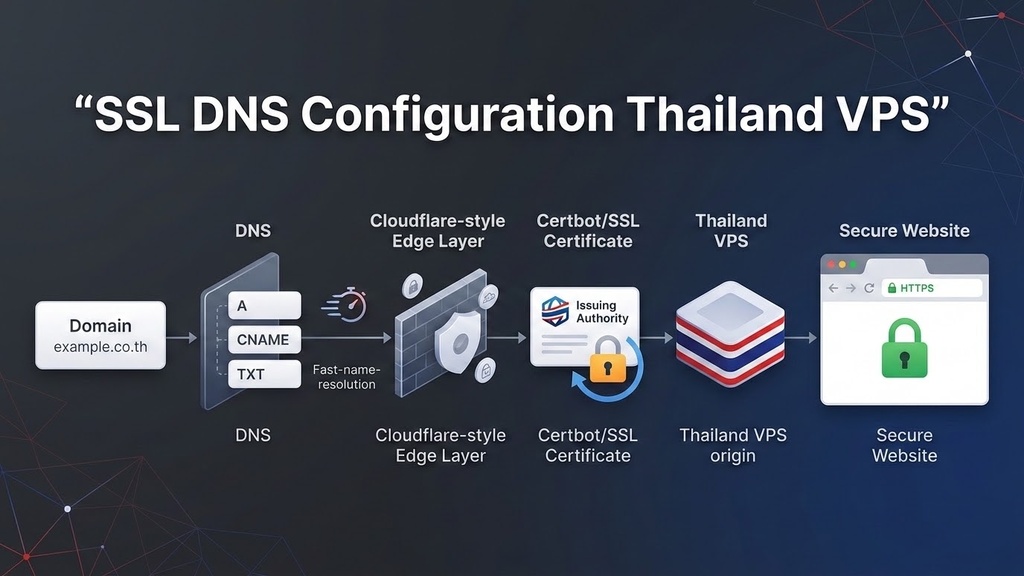
SSL Setup VPS Thailand architecture: Deploying automated SSL/TLS certificates on a Bangkok VPS requires installing Certbot with NGINX integration. Next, map your DNS A records to your dedicated Thai IPv4 address. Run certbot --nginx -d yourdomain.co.th to obtain free 90-day certificates. Furthermore, enable TLS 1.3, OCSP Stapling, and HTTP/2 to guarantee sub-10ms handshake speeds across Thai carriers including AIS, TrueMove H, and NT.
Securing production web applications hosted in Southeast Asia requires modern TLS cryptography, low-latency DNS resolution, and automated certificate management. In particular, e-commerce stores, fintech portals, and corporate workloads hosted in Thailand must comply with strict Personal Data Protection Act (PDPA) regulations. Choosing enterprise Thailand VPS hosting inside Bangkok data centers ensures physical proximity to local telecom backbones.
Furthermore, slow DNS resolution or expired cryptographic certificates directly damage conversion rates and search rankings. Unoptimized handshakes introduce perceptible lag on mobile connections. This comprehensive SSL Setup VPS Thailand technical guide explores automated Certbot deployment, modern TLS 1.3 configuration in NGINX, and Anycast DNS optimization.
TLS 1.3 Cryptography
Single round-trip handshakes with forward secrecy and AES-GCM ciphers for mobile users in Bangkok.
Certbot Automation
Automated Let’s Encrypt renewals via systemd timers with zero manual administrative overhead.
BKNIX DNS Peering
Direct domestic DNS resolution across AIS, TrueMove H, and NT for sub-5ms query performance.
Table of Contents: Thailand VPS SSL/TLS & DNS Architecture
- 1. Modern Cryptography: Why TLS 1.3 is Essential for Your SSL Setup VPS Thailand
- 2. Understanding Domain Resolution: How DNS Propagates Across Thai ISPs
- 3. Step-by-Step DNS Mapping: Configuring A, AAAA, CNAME & MX Records
- 4. Automated Certificates: Complete Certbot & SSL Setup VPS Thailand Runbook
- 5. Accelerating Handshakes: Enabling OCSP Stapling and Session Resumption
- 6. Automated Pipeline: Hardening Renewals on Your SSL Setup VPS Thailand
- 7. Cloudflare Integration: Anycast DNS Layer for Sub-Millisecond Resolution
- 8. Frequently Asked Questions
Modern Cryptography: Why TLS 1.3 is Essential for Your SSL Setup VPS Thailand
Legacy cryptographic protocols like SSL 3.0, TLS 1.0, and TLS 1.1 contain documented structural vulnerabilities. Modern web security mandates deploying TLS 1.2 or TLS 1.3 exclusively. In particular, running an optimized SSL Setup VPS Thailand configuration protects customer credentials while satisfying national PDPA audit benchmarks.
Specifically, TLS 1.3 eliminates obsolete cipher suites and reduces the cryptographic handshake from two round-trips down to a single round-trip (1-RTT). Furthermore, returning visitors benefit from zero round-trip resumption (0-RTT). For mobile users connected via 4G and 5G networks across Bangkok, Chiang Mai, and Phuket, this protocol reduces page negotiation latency significantly.
Understanding Domain Resolution: How DNS Propagates Across Thai ISPs
Before issuing SSL certificates, domain names must resolve accurately to your server IP address. Domain Name System (DNS) translation converts human-friendly URLs into numerical machine addresses. In Thailand, major Internet Service Providers (ISPs) like AIS, TrueMove H, 3BB, and National Telecom operate their own recursive caching resolvers.
Consequently, updating your domain DNS records triggers a propagation window. The Time to Live (TTL) value governs how long intermediary ISP resolvers cache previous responses before requesting fresh authorative data. Keeping TTL values set to 300 seconds during migrations guarantees rapid propagation across Thai carrier networks.
Step-by-Step DNS Mapping: Configuring A, AAAA, CNAME & MX Records
To establish seamless connectivity between domain registrars and your Bangkok VPS, configure standard DNS resource records. The reference table below outlines standard record definitions:
| Record Type | Host / Name | Target Value | TTL Setting | Operational Purpose |
|---|---|---|---|---|
| A Record | @ (root) | 103.13.228.x | 300 sec (5 min) | Maps apex domain to your dedicated Bangkok IPv4 address. |
| AAAA Record | @ (root) | 2404:c800::x | 300 sec (5 min) | Maps domain to your dedicated IPv6 allocation for modern 5G. |
| CNAME | www | yourdomain.co.th | 300 sec (5 min) | Aliases the www subdomain to the apex domain record. |
| TXT Record | @ (root) | v=spf1 ip4:103.13.228.x ~all | 3600 sec (1 hr) | Authorizes your Bangkok VPS IP to send authenticated email (SPF). |
Verify propagation using command-line diagnostic utilities before running certificate enrollment commands. Specifically, run dig yourdomain.co.th +short to confirm that authorative resolvers reflect your target Bangkok IP.
Automated Certificates: Complete Certbot & SSL Setup VPS Thailand Runbook
Let’s Encrypt provides automated, trusted X.509 certificates at zero licensing expense. The Electronic Frontier Foundation (EFF) maintains Certbot, an automated client that executes ACME challenge validations and configures NGINX virtual hosts automatically.
root@bangkok-vps:~# Certbot Installation Runbook
BASH / CLI
# 1. Update package lists and install Certbot via Snapd
sudo apt update && sudo apt install -y snapd
sudo snap install core && sudo snap refresh core
sudo snap install --classic certbot
sudo ln -s /snap/bin/certbot /usr/bin/certbot

# 2. Issue certificates and automatically configure NGINX
sudo certbot --nginx -d yourdomain.co.th -d www.yourdomain.co.th

# 3. Test automated renewal dry-run
sudo certbot renew --dry-run
Executing this deployment provisions strong RSA 2048-bit or ECDSA certificates. Furthermore, Certbot automatically inserts hardened SSL configuration directives and redirects unencrypted HTTP traffic to HTTPS.
Accelerating Handshakes: Enabling OCSP Stapling and Session Resumption
In standard TLS handshakes, client web browsers verify certificate validity by querying an external Online Certificate Status Protocol (OCSP) responder. This remote query adds round-trip delay to international servers.
Fortunately, enabling OCSP Stapling in your NGINX configuration allows your Bangkok VPS to fetch and cache signed OCSP responses locally. In addition, configuring shared SSL session caches allows returning visitors to bypass computational overhead. Review the hardened NGINX configuration snippet below:
root@bangkok-vps:~# /etc/nginx/conf.d/ssl.conf
NGINX CONFIG
# Enforce Modern TLS Protocols Exclusively
ssl_protocols TLSv1.2 TLSv1.3;
ssl_prefer_server_ciphers off;
ssl_ciphers "ECDHE-ECDSA-AES128-GCM-SHA256:ECDHE-RSA-AES128-GCM-SHA256:ECDHE-ECDSA-AES256-GCM-SHA384:ECDHE-RSA-AES256-GCM-SHA384";

# Enable Fast OCSP Stapling
ssl_stapling on;
ssl_stapling_verify on;
resolver 1.1.1.1 8.8.8.8 valid=300s;
resolver_timeout 5s;

# Configure High-Speed Session Resumption
ssl_session_timeout 1d;
ssl_session_cache shared:SSL:10m;
ssl_session_tickets off;

# Enforce HTTP Strict Transport Security (HSTS)
add_header Strict-Transport-Security "max-age=63072000; includeSubDomains; preload" always;
Implementing these directives optimizes security audits. Consequently, your website achieves an A+ score on Qualys SSL Labs while maintaining maximum speed across Southeast Asian network routes.
Automated Pipeline: Hardening Renewals on Your SSL Setup VPS Thailand
Let’s Encrypt certificates remain valid for 90 days. Certbot installs an automated systemd timer that checks renewal validity twice daily. If a certificate approaches 30 days before expiration, Certbot requests an updated certificate automatically.
Moreover, administrators can create an automated deployment hook to reload NGINX gracefully once fresh certificates arrive. By placing a shell script in /etc/letsencrypt/renewal-hooks/deploy/, your web server applies renewals seamlessly without human intervention.
Cloudflare Integration: Anycast DNS Layer for Sub-Millisecond Resolution
While hosting authoritative nameservers on your VPS is possible, deploying a distributed Anycast DNS network delivers superior latency and DDoS resilience. Cloudflare operates Anycast nodes inside Bangkok, connected directly to the Thailand Internet Exchange (BKNIX).
Specifically, when Thai consumers resolve your domain name, queries route to the closest domestic node in under 2 milliseconds. In addition, Cloudflare automated DNS proxying shields your origin server IP address from Layer 7 application attacks. Combining this Anycast routing with your Bangkok VPS creates an enterprise-grade hosting platform.
Frequently Asked Questions
Core Technical Specifications & Cryptography
Deployment, Security & Automation Inquiries
Bangkok Tier-3 Infrastructure
BKNIX Peering • 24/7 Support
Deploy Automated SSL & Fast DNS on High-Speed Thailand VPS
Protect customer transactions, ensure full PDPA compliance, and accelerate web performance across Bangkok. In addition, deploy on high-performance KVM hardware with automated snapshots, dedicated IPv4 addresses, and 24/7 technical support.
Sub-5ms BKNIX Peering
Automated TLS 1.3 Encryption
100% NVMe Storage Arrays
