

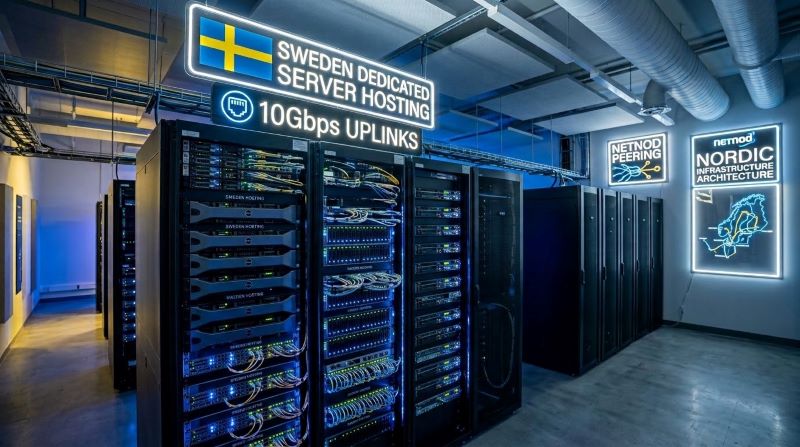
Quick Answer: Sweden Dedicated Server Hosting
Sweden dedicated server hosting (deployed in Tier-3 Stockholm facilities) delivers 100% physically isolated AMD EPYC and Intel Xeon Scalable silicon backed by direct peering at Netnod IXP (Stockholm), unmetered 1Gbps to 10Gbps uplinks, and subsea Baltic fiber routes. Operating on 100% renewable hydroelectric power (PUE < 1.15) under strict Swedish privacy and GDPR mandates, Stockholm bare metal guarantees sub-10ms round-trip latency across the Nordics and sub-25ms reach throughout Northern and Western Europe without hypervisor overhead.
Engineering high-throughput, latency-critical digital platforms across Northern Europe, the Baltic rim, and Scandinavia requires infrastructure anchored at the epicenter of Nordic telecommunications: Stockholm, Sweden. As global digital workloads migrate toward edge computational proximity, data sovereignty compliance, and sustainable carbon-neutral operations, virtualized multi-tenant cloud solutions increasingly buckle under compounding bandwidth egress costs, IOPS throttling, and hypervisor scheduling latency.
Sweden has established itself as the preeminent datacenter jurisdiction in Europe. With the world’s most interconnected internet exchange points (Netnod, STHIX), redundant subsea terrestrial backbones connecting directly to Germany, Finland, Norway, and the United Kingdom, and an electrical grid powered by near-zero-carbon hydroelectric generation, Stockholm provides an unbeatable engineering foundation for enterprise bare-metal hosting.
This architectural technical guide explores the regional telecommunications topography of Swedish bare-metal infrastructure. We examine BGP multihoming fabrics, benchmark direct-attached PCIe Gen4 NVMe storage subsystems, provide production-tested Linux kernel network tuning runbooks for 10Gbps line-rate throughput, and detail the compliance standards that make Sweden a preferred jurisdiction for mission-critical enterprise workloads.
1. Stockholm Telecommunications Topography: Netnod, STHIX & Baltic Carrier Fabrics
The principal architectural justification for provisioning dedicated servers in Sweden is the density of Stockholm’s carrier-neutral interconnection fabric. Stockholm serves as the primary routing nexus uniting the Nordic nations (Sweden, Norway, Denmark, Finland) with the Baltic states (Estonia, Latvia, Lithuania) and Central Europe.
Netnod IXP & STHIX Peering Architecture
At the core of Swedish transit lies Netnod, one of the oldest and most trusted Internet Exchange Points (IXPs) in the world, alongside STHIX (Stockholm Internet Exchange). Connecting directly to Netnod enables bare-metal hosts to exchange traffic with hundreds of regional ISPs, content delivery networks (CDNs), and global cloud backbones via local Layer-2 peering fabrics without traversing expensive transit hops.
By bypassing multi-hop transit routes, direct Netnod peering achieves deterministic packet routing:
- Intra-Stockholm Round-Trip Time (RTT): < 1.5ms over local dark fiber rings.
- Nordic Cross-Border Routing: Stockholm to Oslo (4.8ms), Stockholm to Helsinki via subsea Gulf of Bothnia fiber (6.2ms), and Stockholm to Copenhagen (8.4ms).
- Baltic Reach: Direct subsea cables to Tallinn, Estonia achieve round-trip latencies under 5.5ms, making Stockholm the primary compute anchor for Baltic financial and technology workloads.
Tier-1 Carrier Transit & BGP Multihoming Resilience
Enterprise infrastructure in Sweden is anchored by Telia Carrier (now Arelion), which originated in Sweden and operates the world’s highest-ranked global optical IP transit backbone (AS1299). Onlive Server bare-metal deployments integrate multi-homed BGP routing fabrics pairing Arelion transit with Lumen, Cogent, and regional transit providers. If a physical terrestrial backhaul link or subsea fiber sheath experiences an outage, BGP edge routers dynamically recalculate Autonomous System (AS) paths within milliseconds, maintaining unbroken TCP sessions.
2. Enterprise Silicon & Hardware Matrix: Dedicated Architecture vs. Cloud VPS
Workloads requiring Swedish dedicated hosting—such as high-frequency trading platforms, gaming servers, database clusters, and media streaming nodes—cannot tolerate the resource preemption inherent in virtualized multi-tenant environments.
3. Linux Kernel Engineering: 10Gbps Network Stack & BBR Congestion Runbook
Provisioning a 10Gbps unmetered network drop in Stockholm requires low-level kernel tuning to achieve line-rate throughput without packet drops. Standard Linux default distributions (Ubuntu LTS, AlmaLinux, Debian) configure TCP network buffers optimized for 1Gbps desktop-class connections. Under massive concurrent streaming traffic or database replication streams, default buffer allocations cause buffer bloat, TCP window stalls, and dropped packets.
Production Kernel Sysctl Configuration for High-Speed BBR Transit
Run the following production runbook on your Swedish bare-metal server to enable Google BBR (Bottleneck Bandwidth and RTT) congestion control, expand socket memory pools, and tune network interface card (NIC) ring buffers.
4. Sub-Millisecond Storage Subsystems: PCIe Gen4 NVMe RAID & ZFS Determinism
In high-traffic platforms hosted in Sweden, transactional throughput is fundamentally bound by disk I/O latency. Legacy SAS or SATA mechanical drives max out at 75–100 IOPS per spindle, creating massive D-state kernel wait states during database checkpoint writes.
Our Swedish dedicated servers deploy direct-attached PCIe Gen4 enterprise NVMe solid-state storage communicating natively over the Non-Volatile Memory Express protocol. Unlike cloud network-attached storage (EBS) which routes block I/O through a shared datacenter switch fabric, PCIe NVMe connects directly to CPU lanes:
- Sequential Read/Write Speeds: Exceeding 7,000 MB/s per drive.
- Random 4K Read Throughput: Over 800,000 IOPS under queue depths (QD=32).
- Access Latency: Sustained sub-30 microsecond response times, completely eliminating database query execution stalls.
Software RAID-10 (mdadm) and ZFS Storage Pools
For high-availability storage resilience, mirrored NVMe configurations via Linux mdadm (RAID-1/RAID-10) or OpenZFS storage pools deliver zero-downtime drive failure recovery. OpenZFS provides copy-on-write transactional integrity, native end-to-end checksumming against silent data corruption, and real-time LZ4 compression, significantly reducing physical disk writes and extending solid-state drive endurance.
5. Nordic & Baltic Latency Topography: Real-World Network Routing Metrics
Deploying bare-metal servers in Stockholm provides balanced low-latency routing across Northern, Western, and Eastern Europe. The table below illustrates typical round-trip times (RTT) from our Stockholm datacenter facility:
6. European Regulatory Sovereignty, GDPR Compliance & Green Energy Sustainability
Beyond raw computational speed, hosting infrastructure decisions are strictly governed by legal data privacy mandates and corporate sustainability frameworks. Sweden stands out globally as a model jurisdiction in both arenas.
Swedish Data Protection Legislation & GDPR Alignment
Under Swedish jurisdiction and the EU General Data Protection Regulation (GDPR), Sweden enforces rigorous data confidentiality protections through the Swedish Authority for Privacy Protection (Integritetsskyddsmyndigheten – IMY). Unlike hosting facilities subject to the US CLOUD Act—which empowers foreign law enforcement to subpoena enterprise data regardless of physical storage location—Swedish bare-metal infrastructure provides legal sovereignty. Single-tenant physical servers guarantee that your sensitive customer databases, encryption keys, and intellectual property remain isolated from multi-tenant hypervisor inspection and third-party access.
100% Green Renewable Datacenter Infrastructure
Stockholm datacenters are powered almost entirely by carbon-free energy sources, predominantly municipal hydroelectric generation and inland wind power. Benefiting from naturally cold Scandinavian ambient temperatures, facilities utilize advanced free-air cooling and heat-recovery systems that feed datacenter exhaust heat back into Stockholm’s district heating network. With an annualized Power Usage Effectiveness (PUE) below 1.15, hosting in Sweden satisfies strict Corporate Social Responsibility (CSR) and ESG (Environmental, Social, and Governance) sustainability requirements.
7. High-Throughput Workload Sizing: Nordic Streaming & High-Concurrency Architecture
To assist system architects in selecting the optimal configuration, consider this production workload sizing model for a high-concurrency streaming ingest and real-time database API serving Northern Europe:
8. Systematic 6-Step Buyer’s Checklist for Swedish Dedicated Servers
Before deploying production services in Stockholm, verify that your dedicated server provider complies with these infrastructure standards:
Frequently Asked Architectural Questions (FAQ)
Why choose a dedicated server in Sweden over Frankfurt, London, or Amsterdam?
Stockholm delivers superior network proximity for Scandinavia and the Baltic nations (sub-10ms RTT) while maintaining low sub-20ms latency to Central Europe. Additionally, Sweden offers the highest concentration of 100% green renewable hydroelectric energy (PUE < 1.15) and robust privacy laws under Swedish GDPR enforcement.
What internet exchanges are connected to your Swedish dedicated servers?
Our Stockholm infrastructure features direct peering connectivity to Netnod, Scandinavia’s premier Internet Exchange Point, and STHIX (Stockholm Internet Exchange). This is complemented by multi-carrier BGP transit via Arelion (Telia Carrier AS1299), Lumen, and Cogent.
What bandwidth capacities are available on Sweden dedicated servers?
Standard configurations are provisioned with 1Gbps dedicated uplinks, with optional upgrades to 10Gbps full-duplex unmetered ports. All connections are backed by multi-homed BGP routing fabrics with zero data egress surcharges.
How does bare metal in Sweden eliminate hypervisor CPU steal time?
Unlike public cloud instances or shared virtual private servers, a dedicated server grants you 100% physical ownership of CPU cores, memory registers, and PCIe buses. There is no host hypervisor layer, locking CPU steal time (%st) at 0.0% and ensuring deterministic execution for time-critical applications.
What operating systems and control panels are supported?
Our servers support all major enterprise 64-bit operating systems, including Linux dedicated servers (Ubuntu LTS, Debian, AlmaLinux, Rocky Linux), Windows dedicated server hosting with Microsoft SPLA licenses, and bare-metal hypervisors such as Proxmox VE and VMware ESXi.
Is remote out-of-band IPMI / KVM access included?
Yes. Every dedicated server includes dedicated IPMI 2.0 / iDRAC out-of-band management over an isolated administrative network. This provides continuous HTML5 virtual console access, BIOS controls, virtual ISO media mounting, and remote power cycling at zero additional cost.
What is the hardware replacement SLA in Stockholm?
We contractually guarantee a 2-to-4 hour hardware replacement SLA. In the event of a physical disk, memory module, or power supply fault, on-site datacenter technicians replace defective components directly from inventory.
Are Sweden dedicated servers compliant with EU GDPR regulations?
Yes. Deploying in Swedish datacenters ensures full adherence to European Union GDPR standards. Data stored on single-tenant bare-metal hardware remains strictly under Swedish sovereignty, free from multi-tenant access risks or third-party cloud data extraction.
- Unrivaled Nordic & Baltic Interconnectivity: Direct Layer-2 peering at Netnod IXP and STHIX in Stockholm provides sub-10ms latency across Scandinavia and the Baltic nations.
- 100% Deterministic Compute & 0% Steal Time: Bare-metal AMD EPYC and Intel Xeon silicon guarantees total resource isolation with zero hypervisor contention or egress billing surprises.
- Direct-Attached PCIe Gen4 NVMe Storage: Sub-30 microsecond access latencies and 800k+ IOPS eliminate database transaction wait states under sustained production loads.
- GDPR Sovereignty & 100% Green Hydro Energy: Deploying in Stockholm ensures full compliance with European data privacy mandates while maintaining an eco-conscious PUE < 1.15 footprint.
