

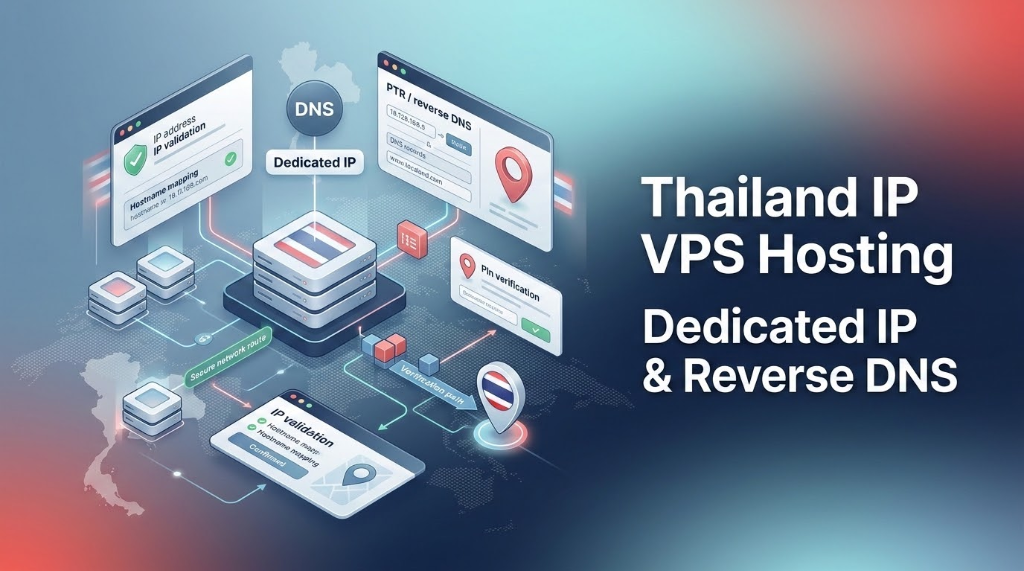
Why Is a Dedicated Thailand IP Address Essential for Local Workloads?
When planning an enterprise deployment for Thailand IP VPS, a dedicated Thailand IP address is essential because local payment gateways (PromptPay, 2C2P), Thai commercial banks, and government e-filing systems restrict or flag foreign IP addresses. Hosting on a dedicated Bangkok IPv4 ensures pristine IP reputation, prevents allowlisting caused by shared proxy neighbors, and improves local geo-targeted search rankings.
Specifically, in today’s interconnected digital landscape, an IP address is far more than an abstract network identifier; it serves as your application’s digital passport, physical location signature, and cryptographic reputation anchor. International digital agencies, fintech platforms, expat entrepreneurs, and corporate system administrators frequently struggle with recycled IP addresses that are falsely geolocated to Singapore, flagged by fraud detection filters, or allowlisted on global email security registries. Deploying an enterprise Thailand IP VPS hosting environment in Bangkok guarantees genuine APNIC geolocation, dedicated IPv4 reputation isolation, and pristine transactional deliverability.
✔ Key Network Engineering Takeaways
- Furthermore, APNIC Registry Accuracy: Genuine Thai IP subnets are allocated under APNIC with Autonomous System Numbers (ASNs) peered directly at the Bangkok Neutral Internet Exchange (BKNIX).
- Consequently, Fixing GeoIP Misclassification: Learn how to diagnose and resolve common MaxMind and IP2Location database lags that mistakenly categorize new Thai IP blocks as Singapore.
- In addition, Reverse DNS (PTR) Automation: Correct Forward-Confirmed Reverse DNS (FCrDNS) mapping is mandatory for passing Google Gmail and Microsoft Outlook enterprise spam filters.
- In particular, Reputation Safeguards: Dedicated IP allocation protects your corporate traffic from the collateral damage caused by malicious shared-host neighbors.
- Therefore, Local Service Unlocking: A native Bangkok IP address bypasses geographic IP restrictions on Thai financial institutions, government portals, and local content platforms.
Table of Contents
- Moreover, Why IP Geolocation Matters for Thailand Server Workloads
- In fact, The Architecture of APNIC IP Allocation in Bangkok
- Dedicated vs. Shared IP: Security and Deliverability Implications
- Similarly, How to Verify Your Server’s Physical Geolocation Using CLI Tools
- Meanwhile, Resolving the ‘Singapore Misclassification’ Problem in GeoIP Databases
- Additionally, Setting Up Reverse DNS (PTR) for Seamless Email Deliverability
- As a result, Safeguarding Your Thai IP: Spamhaus Checks and Anti-allowlisting Best Practices
- Specifically, Frequently Asked Questions (FAQ)
1
Furthermore, in modern cloud engineering, geographic IP assignment governs far more than just network routing hops. Major content delivery networks (Cloudflare, Akamai), financial fraud prevention systems (Stripe Radar, 2C2P Security Engine), and search engine indexing spiders rely on the IP address’s registered geolocation to establish trust, compliance, and user localization.
Consequently, operating with a verified Thailand IP address stationed in Bangkok is critical across multiple operational use cases:
1. Domestic Financial and Banking Gateways
In addition, thai commercial banking APIs (Kasikornbank, Siam Commercial Bank, Bangkok Bank) enforce strict geographic filtering. Connecting to PromptPay QR payment switches, automated settlement systems, or local corporate banking portals from foreign IP addresses often triggers automated security lockouts, fraud investigations, or mandatory SMS OTP challenges that break automated backend cron jobs.
2. Localized Search Engine Optimization (SEO)
While search engines like Google evaluate numerous signals (such as ccTLD .co.th and hreflang tags), physical server IP geolocation remains a foundational signal for local search intent. A website served from a clean Bangkok IP address directly signals geographical relevance to Google.co.th algorithms, enhancing visibility for Thai-language search queries.
3. Unlocking Regional Media and Content Platforms
Digital marketing agencies and media streaming platforms often need to manage, test, and preview content specifically targeted at Thai consumers (such as TrueID, AIS Play, Line TV, and localized social ad previews). Accessing these services requires an authentic, residential- or datacenter-grade Thai IP to bypass regional geo-blocking.
2
In particular, all IP address allocations across the Asia-Pacific region are governed by the Asia-Pacific Network Information Centre (APNIC), one of the world’s five Regional Internet Registries (RIRs). Understanding how IP blocks are routed into Bangkok datacenter telehouses is crucial for verifying that your provider owns legitimate, carrier-grade network transit.
Therefore, an enterprise hosting provider in Thailand obtains an autonomous IP assignment from APNIC, which includes:
- Moreover, Autonomous System Number (ASN): A globally unique identifier that allows the provider’s routers to announce routing prefixes via Border Gateway Protocol (BGP) to international and domestic carriers.
- In fact, Direct IPv4 and IPv6 Prefixes: Dedicated CIDR blocks (such as /24 IPv4 networks containing 256 addresses) assigned directly to the provider’s organization in Thailand.
- Similarly, whois Registry Database Records: Authoritative public database entries detailing the network name, country code (
country: TH), physical address in Bangkok, and technical contact point (abuse email, NOC phone number).
Meanwhile, onliveServer’s cloud network operates with dedicated BGP routing directly inside Bangkok’s premier telecom exchanges (CAT Bangrak and True IDC). When traffic reaches your server, packets travel directly into our local border routers and BKNIX optical fabric without traversing circuitous foreign hops.
3
Additionally, the distinction between a dedicated IP address and a shared IP address is one of the most critical structural security boundaries in web hosting: Operating dedicated Thai IP addresses requires strict adherence to PDPA and Computer Crime Act compliance standards, ensuring lawful packet inspection, user log retention, and data sovereignty compliance. Engineers verifying whois geolocation, ASN route propagation, and subnet integrity should consult the APNIC IP resource management guidelines.
| Operational Dimension | Dedicated Thailand IP (VPS) | Shared IP Address (Shared Hosting) |
|---|---|---|
| Tenant Isolation | 100% Private (Your workload only) | Shared with 200+ unknown domains |
| Email Deliverability | Pristine reputation / Custom PTR | Frequent RBL allowlisting by spammers |
| SSL/TLS Configuration | Full IP-level SSL / Custom SNI | SNI dependent / Provider controlled |
| API Allowlisting | Fully supported (Static IP allowlisting) | Impossible (IP may change or be shared) |
| DDoS Target Exposure | Protected by private mitigation profile | Vulnerable to attacks on adjacent sites |
As a result, when you share an IP address with hundreds of unknown websites on budget shared hosting, you inherit the collective behavior of your neighbors. If an adjacent user sends unauthenticated marketing spam, compromises a WordPress plugin, or hosts phishing material, global security filters block the entire IP address. On an OnliveServer Thailand KVM VPS, your dedicated static IPv4 address belongs exclusively to your instance, isolating your reputation entirely.
4
Specifically, rather than relying on marketing claims, an infrastructure engineer should verify their server’s network location using standard command-line diagnostic tools. You can interrogate authoritative whois registries, inspect BGP routing paths, and query geolocation databases directly from any Linux terminal:
The traceroute diagnostic above confirms that the packet terminates cleanly within the local Bangkok telecommunications ecosystem (CAT Bangrak / BKNIX) with sub-15ms round-trip latency, proving that the server is physically hosted in Thailand rather than proxied overseas.
5
Furthermore, a frequent technical challenge encountered by organizations acquiring newly assigned IP blocks in Thailand is the GeoIP Database Lag. Commercial geolocation providers (MaxMind GeoIP2, IP2Location, DB-IP) crawl RIR registries periodically, but often cache regional records for months. For enterprises requiring large pools of clean static IP subnets with full BGP routing, explore dedicated server hosting in Thailand with custom ASN announcements.
Because Singapore is APNIC’s headquarters and the administrative center for many Southeast Asian subnets, newly reallocated IP ranges assigned to Bangkok datacenters are occasionally misclassified as Singapore in outdated GeoIP database caches. This can cause local Thai streaming services or banking portals to erroneously reject the IP address.
Consequently, if your newly provisioned Thai IP experiences this misclassification, execute this remediation procedure:
The GeoIP Database Correction Runbook
- In addition, Submit a MaxMind GeoIP Correction Request: Visit
support.maxmind.com/geoip-data-correction/and submit your IP address with proof of Bangkok datacenter assignment (whois URL and postal code 10500 Bangkok). MaxMind updates its weekly database releases. - In particular, Submit an IP2Location Geolocation Update: Visit
ip2location.com/contactand submit the IP correction form specifying Thailand, Bangkok province. - Therefore, Verify Google Search Country Association: In Google Search Console, submit your domain with targeting configured for Thailand to ensure Google crawlers associate the new IP block with Thai domestic searches.
Moreover, onliveServer pre-audits all IPv4 subnets deployed across our Bangkok virtualization clusters, ensuring that upstream GeoIP providers recognize your IP as 100% Thailand-based before your server is handed over.
6
While standard DNS translates a domain name into an IP address (Forward DNS), Reverse DNS (rDNS) performs the inverse: it resolves an IP address back to its authoritative Fully Qualified Domain Name (FQDN) via a special PTR (Pointer) record located in the in-addr.arpa DNS zone.
Modern enterprise mail servers (Google Workspace, Microsoft 365, Yahoo Mail) mandate Forward-Confirmed Reverse DNS (FCrDNS). When your Bangkok VPS attempts to deliver an email, the recipient mail transfer agent (MTA) extracts your connecting IP, queries its PTR record, and then queries the resulting domain’s forward A record. If the IP and domain do not match bidirectionally, the email is flagged as unauthenticated spam and dropped immediately.
Because the forward A record and the reverse PTR record match identically, receiving mail servers verify authenticity, guaranteeing high inbox placement rates. OnliveServer provides an integrated, self-service rDNS management dashboard in our client portal, enabling instant PTR updates without waiting on manual support tickets.
7
Once you possess a pristine Thailand dedicated IP, maintaining its reputation requires proactive sysadmin hygiene. The following security practices ensure your IP remains clean and trustworthy:
IP Reputation Protection Runbook
- Implement Strict SPF, DKIM, and DMARC: Publish comprehensive DNS records (
v=spf1 ip4:YOUR_IP -all) and configure 2048-bit DKIM cryptographic signatures for all outbound mail. - Close Open Relays: Configure your Postfix or Exim mail daemon to strictly reject unauthenticated mail relaying, preventing spammers from hijacking your SMTP server.
- Deploy Fail2ban Intrusion Prevention: Ban IP addresses that repeatedly fail SSH or web authentication attempts, neutralizing brute-force dictionary attacks.
- Monitor RBL Allowlists Regularly: Automate weekly health checks against major Real-time Blackhole Lists (Spamhaus ZEN, Barracuda BRBL, SpamCop) using automated monitoring scripts.
By pairing genuine APNIC-registered Thai IP allocations with disciplined security hygiene, your digital operations in Bangkok enjoy uninterrupted network trust, maximum email deliverability, and seamless domestic user engagement.
8
Core Technical Specifications
Secure Your Dedicated Thailand IP Address in Bangkok
Protect your email deliverability, configure reverse DNS (PTR), and boost local Thai search engine rankings with pristine static IPv4 subnets routed directly through Bangkok data centers.
