

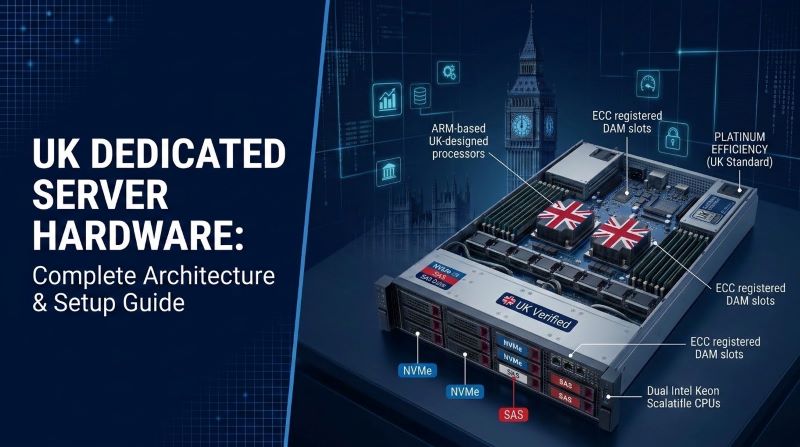
What Are the Key Architectural Requirements for UK Dedicated Server Hardware?
Direct Technical Answer: Selecting enterprise-grade UK dedicated server hardware requires physical silicon isolation powered by Intel Xeon Scalable or AMD EPYC processors, multi-channel ECC registered DDR4/DDR5 memory to prevent silent bit corruption, and direct-attached PCIe Gen4/Gen5 NVMe SSD drive arrays managed via hardware RAID with non-volatile flash-backed cache. Housing this physical infrastructure in a London Tier III datacenter facility with carrier-neutral multi-homing to the London Internet Exchange (LINX) guarantees sub-5ms domestic latency, unshared 10Gbps uplinks, and out-of-band IPMI/iDRAC management for complete root-level control.
In modern high-performance computing, virtualization has established itself as the default deployment mechanism for standard web workloads. However, when enterprise applications scale toward high-concurrency relational databases, algorithmic transaction processing, large-scale Redis caching tiers, or multi-tenant virtualization clusters, the multi-tenant virtualization tax becomes a severe operational bottleneck. Hypervisor scheduling latency, shared memory bus contention, and unpredictable storage I/O jitter introduce micro-delays that undermine system predictability.
Deploying single-tenant UK dedicated server hardware restores complete deterministic performance by granting your operating system unmediated, direct access to the physical silicon. Every CPU clock cycle, memory channel, PCIe lane, and network packet buffer operates under your exclusive control. This comprehensive engineering guide examines the core physical layers of enterprise dedicated bare-metal infrastructure, analyzes processor and storage topologies, explores London Internet Exchange (LINX) network interconnects, and provides production-verified Linux configuration runbooks.
📌 Executive Chapter Index
8 Core Sections
1. Processor Silicon Architecture: Intel Xeon Scalable vs. AMD EPYC Microarchitectures
The foundation of physical server performance begins at the central processing unit. Unlike virtualized slices where physical cores are multiplexed across multiple operating systems, bare-metal deployment allocates 100% of the instruction pipeline to your workloads. When sizing bare-metal compute, the two dominant microarchitectures—Intel Xeon Scalable and AMD EPYC—deliver distinct advantages depending on whether your applications demand raw single-thread clock velocity or massive parallel multithreading.
Single-Thread Clock Velocity vs. High-Core Density Multithreading
Workloads such as game server daemons (e.g., Minecraft, CS:GO/CS2), high-frequency financial trading, and legacy monolithic relational databases (un-sharded MySQL or Microsoft SQL Server) scale primarily with single-thread frequency. For these operations, high base clock speeds (3.8 GHz to 4.5+ GHz turbo) on Intel Xeon or high-frequency AMD processors prevent execution pipeline bottlenecks.
Conversely, modern distributed microservices, containerization hypervisors, and data analytics pipelines benefit dramatically from high core counts. AMD EPYC (Zen 3/Zen 4) processors leverage a chiplet-based Core Complex Die (CCD) design, providing up to 64 or 128 physical cores (128 to 256 threads) within a single socket. This multi-die architecture enables unprecedented parallel processing capability without requiring dual-socket mainboards.
NUMA Memory Node Topologies & L3 Cache Latency
Modern multi-core enterprise processors utilize Non-Uniform Memory Access (NUMA). On multi-socket Xeon servers or multi-CCD AMD EPYC architectures, physical RAM is segmented into local memory nodes tied to specific CPU cores. When a thread running on Core A accesses memory mapped to Node B, the memory request must traverse the inter-socket interconnect (Intel Ultra Path Interconnect / UPI or AMD Infinity Fabric). This cross-node traversal introduces an access latency penalty of 30% to 60%.
Engineering your operating system to enforce NUMA node pin affinity (using numactl) ensures that CPU instructions, L3 cache lines, and memory buffers execute within the exact same physical silicon domain, eliminating inter-socket interconnect thrashing.
2. Enterprise Storage Topologies: PCIe Gen4/Gen5 NVMe vs. SATA SSDs & Hardware RAID
Storage subsystems are the most common source of application latency. A server with 64 CPU cores will remain largely idle if worker threads spend cycles blocked in an uninterruptible I/O wait (wa) state. In single-tenant UK dedicated server hardware, drive topologies must balance pure read/write throughput, random 4K IOPS, and data fault tolerance.
| Storage Architecture | Interface Protocol | Sequential R/W (MB/s) | Random 4K IOPS | Typical Read Latency | Primary Workload Fit |
|---|---|---|---|---|---|
| Enterprise SATA SSD | AHCI / SATA 3.0 (6 Gbps) | 550 / 520 | 95,000 / 85,000 | 100–150 μs | Static web assets, OS boot, general backups |
| PCIe Gen3 Enterprise NVMe | NVMe 1.3 / PCIe x4 | 3,500 / 3,000 | 500,000 / 250,000 | 30–50 μs | Mid-tier relational databases, active caching |
| PCIe Gen4 Enterprise NVMe | NVMe 1.4 / PCIe x4 | 7,000 / 6,500 | 1,000,000 / 500,000 | 15–25 μs | High-concurrency PostgreSQL, Redis, KVM hosts |
| PCIe Gen5 Enterprise NVMe | NVMe 2.0 / PCIe x4 | 14,000 / 12,000 | 2,500,000 / 1,200,000 | 8–12 μs | Real-time financial ingestion, ML model inference |
Hardware RAID Controllers with CacheVault vs. Software mdadm / ZFS
For mission-critical production data, single-drive configurations are unacceptable. Dedicated servers utilize either dedicated hardware RAID controllers (such as Broadcom MegaRAID / LSI SAS3108/3816) or kernel-level software RAID (Linux mdadm or OpenZFS):
- Hardware RAID with BBU / CacheVault: Hardware controllers feature on-board DDR4 cache memory protected by a Flash-Backed Write Cache (FBWC) or Battery Backup Unit (BBU). This allows the controller to acknowledge database writes instantaneously in
WriteBackmode without risk of data loss during a power outage. - Software RAID (mdadm): Operates within the Linux kernel, distributing parity across CPU cores. For direct-attached NVMe drives, modern Linux kernels handle millions of IOPS with negligible CPU overhead, avoiding the PCIe bottleneck of older SAS RAID controllers.
- ZFS ZPools (RAID10 / Z2): Delivers built-in checksum verification, copy-on-write integrity, and automated bit rot detection, making it the premier choice for virtualization storage pools and sensitive document archives.
3. Memory Architecture: Multi-Channel ECC Registered DDR4/DDR5 Protection
System memory represents the volatile workspace for your operating system kernel and active data sets. In consumer-grade computing, non-ECC memory can experience cosmic ray-induced single-event upsets (SEUs)—commonly known as “bit flips”—where a binary 0 spontaneously switches to a 1. In enterprise servers, a bit flip can silently corrupt database indexes, cause unexpected kernel panics, or inject data errors into financial transactions.
Single-Bit Error Correction & Multi-Bit Detection (SECDED)
Enterprise UK dedicated server hardware exclusively utilizes Error-Correcting Code (ECC) registered memory (RDIMMs). ECC architecture includes additional memory chips on each module that calculate and store parity bits for every 64 bits of data. Using Hamming codes:
- Single-Bit Errors (Correctable): Automatically detected and corrected on the fly by the memory controller with zero downtime or software interruption.
- Multi-Bit Errors (Uncorrectable): Detected by the hardware, triggering an orderly Machine Check Exception (MCE) to prevent corrupted data from being written to persistent disk storage.
Memory Channel Saturation & Bandwidth Optimization
Memory throughput is governed by the number of active memory channels supported by the processor. Modern Intel Xeon Scalable CPUs feature 8-channel DDR4 or DDR5 controllers, while AMD EPYC Genoa/Bergamo processors support up to 12 memory channels per socket. To achieve peak memory bandwidth (up to 460+ GB/s), servers must be populated with identical DIMMs across all available channels. Installing a single DIMM or uneven channel distribution restricts the CPU to single- or dual-channel mode, reducing database query processing speeds by up to 50%.
4. Network Uplinks & London Peering: LINX BGP Multi-Homing & 10Gbps Fabrics
Raw computing power is useless without an enterprise network fabric capable of delivering low-latency transit to your end users. London represents Europe’s primary network interconnection capital, housing major internet exchange points including the London Internet Exchange (LINX) and LONAP.
| Destination Region | Transit Route / Exchange | Average Round-Trip Latency (RTT) | Packet Jitter Variance |
|---|---|---|---|
| Greater London / Docklands | Direct LINX Peering / Local Dark Fiber | 1.2 – 2.8 ms | < 0.2 ms |
| Manchester & Birmingham | Domestic UK Fiber Backbone | 5.5 – 8.2 ms | < 0.5 ms |
| Edinburgh & Glasgow (Scotland) | Trans-UK Direct Route | 11.0 – 14.5 ms | < 0.8 ms |
| Dublin, Ireland | Irish Sea Subsea Fiber Cable | 8.5 – 12.0 ms | < 0.6 ms |
| Paris, France | Channel Tunnel Subsea Interconnect | 6.8 – 9.5 ms | < 0.4 ms |
| Frankfurt, Germany | DE-CIX Cross-Border Transit | 11.5 – 15.0 ms | < 0.7 ms |
| New York, USA (East Coast) | Transatlantic Subsea Cable (TAT-14 / Apollo) | 64.0 – 72.0 ms | < 1.5 ms |
High-capacity dedicated servers feature redundant 1Gbps or 10Gbps Network Interface Cards (NICs) configured with LACP (Link Aggregation Control Protocol / 802.3ad). This bond interface balances incoming traffic across dual physical switches while providing automatic failover if a switch port or cable fails. For organizations that require entry-level development or testing nodes before scaling up to bare metal, reviewing budget-friendly VPS hosting solutions provides a cost-effective staging path on the same London network backbone. Additionally, IT consultancies and digital agencies scaling client workloads can establish a UK dedicated server business partnership to secure custom bare-metal rack reservations with Tier-1 multi-homed transit.
5. Out-of-Band Remote Management: Dedicated IPMI, iDRAC, and KVM-over-IP
When managing a physical server housed hundreds of miles away in a London datacenter, conventional SSH access is insufficient. If a kernel panic occurs, firewall rules accidentally drop port 22, or network interfaces fail to negotiate an IP address, software-level remote access drops completely. This is where out-of-band management becomes indispensable.
Hardware-Level Remote Console, Virtual Media & BIOS Orchestration
Enterprise server mainboards integrate a Baseboard Management Controller (BMC)—a dedicated micro-computer with its own processor, RAM, and independent network interface. Popular implementations include IPMI 2.0 / Redfish on Supermicro, Dell iDRAC (Integrated Dell Remote Access Controller), and HP iLO (Integrated Lights-Out). Through this out-of-band interface, administrators can:
- Power Cycle & Hard Reset: Issue hardware reboot signals directly to the power supply unit (ATX power header) even when the main OS is completely frozen.
- KVM-over-IP Video Redirection: View the server’s physical VGA/DisplayPort video output and control mouse/keyboard inputs across a browser console from initial BIOS POST through bootloader loading.
- Virtual Media Mounting: Attach local ISO images (Ubuntu Server, Rocky Linux, Proxmox VE) remotely over the network to perform clean bare-metal operating system installations.
- Hardware Telemetry Auditing: Monitor fan RPMs, power draw (Watts), CPU die temperatures, and power supply redundancy status in real time.
Securing the Baseboard Management Controller (BMC)
Security Warning: BMC interfaces have historically contained vulnerabilities (such as IPMI cipher 0 exploits or unpatched firmware bugs). In enterprise datacenters, the IPMI interface must never be assigned a public IP address. It must reside strictly within an isolated management VLAN, accessible solely through an encrypted WireGuard/OpenVPN jump host or dedicated point-to-point IPsec tunnel.
6. Production Linux Hardware Diagnostics & Kernel Hardening Runbook
Upon provisioning single-tenant UK dedicated server hardware, system administrators must verify hardware authenticity, benchmark storage health, and tune Linux kernel networking parameters. The following copy-ready terminal runbooks provide verified diagnostic and optimization sequences, separated individually into distinct execution steps with dedicated spacing.
Step 1: Inspect Physical CPU Sockets, Core Counts & NUMA Node Topology
Execute this command to verify that all physical processor sockets, hardware threads per core, and NUMA memory nodes are recognized by the Linux kernel:
sudo lscpu | grep -E "Model name|Socket\(s\)|Core\(s\) per socket|Thread\(s\) per core|NUMA"Step 2: Audit Physical Memory DIMMs, Bus Speed & ECC Architecture via DMI
Query the motherboard DMI table to inspect each physical memory slot, verifying that registered Multi-Bit ECC protection and expected clock frequencies are operational:
sudo dmidecode -t memory | grep -E "Size:|Type:|Speed:|Error Correction Type:|Configured Memory Speed:"Step 3: Query NVMe Drive SMART Health, Temperature & Media Wear Percentages
Audit all active NVMe storage namespaces, checking real-time operating temperature, wear indicators, and physical media errors before provisioning:
sudo nvme list
sudo nvme smart-log /dev/nvme0n1 | grep -E "temperature|percentage_used|critical_warning|media_errors"
Step 4: Check Hardware RAID Controller & Battery Backup Unit (BBU) Status
Verify hardware controller health, virtual drive redundancy, and ensure the CacheVault flash backup unit is fully charged for safe WriteBack caching:
sudo storcli /c0 show | grep -E "Model|Status|BBU|Virtual Drives"Step 5: Real-Time Memory Error Detection and Correction (EDAC)
Install user-space error detection modules to verify that correctable (CE) and uncorrectable (UE) memory hardware errors remain at zero:
sudo apt update && sudo apt install -y edac-utils rasdaemon
sudo edac-util -v
Step 6: Query System Journal for Kernel Machine Check Exceptions (MCE)
Search the Linux system journal for any hardware-level machine check errors or thermal throttling events recorded by the CPU:
sudo journalctl -k --grep="Machine check events|EDAC" --no-pagerStep 7: Configure 10Gbps TCP Buffer & BBR Congestion Control Optimization
Tune kernel network memory limits and enable Google BBR congestion control to sustain unmetered 10Gbps throughput across transatlantic fiber routes:
cat << 'EOF' | sudo tee /etc/sysctl.d/99-dedicated-network.conf
net.core.rmem_max = 67108864
net.core.wmem_max = 67108864
net.core.rmem_default = 33554432
net.core.wmem_default = 33554432
net.core.netdev_max_backlog = 100000
net.ipv4.tcp_rmem = 4096 87380 33554432
net.ipv4.tcp_wmem = 4096 65536 33554432
net.core.default_qdisc = fq
net.ipv4.tcp_congestion_control = bbr
net.netfilter.nf_conntrack_max = 2097152
EOF
sudo sysctl --system
7. Enterprise Workload Capacity Planning & Hardware Sizing Matrix
Properly mapping application profiles to physical silicon prevents expensive over-provisioning or catastrophic performance degradation under peak load. The following reference matrix outlines production-tested hardware sizing archetypes for dedicated environments.
| Workload Profile | Target Processor | ECC Memory Dimension | Storage Topology | Network Bandwidth |
|---|---|---|---|---|
| Enterprise PostgreSQL / MySQL Cluster | Dual Intel Xeon Silver 4314 (32 Cores) or AMD EPYC 7543 | 128 GB – 256 GB ECC DDR4 (8-Channel) | 4× 1.92TB Enterprise NVMe Gen4 (Hardware RAID 10 + BBU) | Dual 10Gbps LACP Bonded Uplink |
| Virtualization Hypervisor (Proxmox / KVM) | AMD EPYC 9354 (32 Cores / 64 Threads) or Dual Xeon Gold | 256 GB – 512 GB ECC DDR5 | 6× 3.84TB NVMe Gen4 in ZFS RAIDZ2 + Dedicated ZIL SSD | 10Gbps Multi-VLAN Trunked Link |
| Low-Jitter Game Hosting & Voice Servers | Intel Xeon E-2388G or AMD Ryzen 9 7950X (High Frequency) | 64 GB – 128 GB ECC DDR4/DDR5 | 2× 960GB NVMe Gen4 (RAID 1 Mirror) | 1Gbps / 10Gbps with Edge DDoS Filtering |
| High-Throughput Elasticsearch & Log Ingestion | Dual AMD EPYC 7763 (128 Cores / 256 Threads) | 512 GB – 1 TB ECC Registered DDR4 | 8× 7.68TB Enterprise U.2 NVMe in Software RAID 0/10 | Dual 10Gbps Unmetered Dedicated Fabric |
8. Hardware Deployment Checklist & Pre-Flight Production Readiness Audit
Prior to directing live production traffic or migrating transactional customer databases to a newly provisioned dedicated server, run through the following operational verification audit:
- [ ] Hardware Burn-In & Stress Testing: Execute
stress-ngormprimeacross all CPU cores for a minimum of 4 hours to verify thermal dissipation and heat-sink seating under 100% load. - [ ] Memory Verification (Memtester): Run
memtesteracross at least 90% of available physical memory to confirm zero correctable or uncorrectable bit errors prior to production use. - [ ] NVMe Drive Endurance & SMART Audit: Verify drive power-on hours, media wear indicators, and write error logs via
nvme smart-logto ensure factory-fresh storage modules. - [ ] Dual Power Supply Redundancy Verification: Check the IPMI sensor interface to ensure both redundant Power Supply Units (PSUs) are actively drawing current from independent datacenter A+B power feeds.
- [ ] Out-of-Band IPMI Network Isolation: Verify that the Baseboard Management Controller is strictly restricted to an internal management VLAN with zero public internet exposure.
- [ ] Kernel Security Hardening: Configure SSH key-only authentication, disable root password logins, implement a stateful
nftablesfirewall, and configure automated security patching.
Frequently Asked Questions
1What are the primary performance advantages of dedicated server hardware over virtual cloud instances?
2Why is ECC registered memory essential for enterprise production servers?
3How does a London datacenter location improve latency for UK and European users?
4What is the difference between hardware RAID and software RAID for NVMe SSDs?
5What is IPMI / iDRAC and why is out-of-band management necessary?
6How does hosting on dedicated hardware in the UK ensure compliance with the UK GDPR?
7Can I configure my own virtualization hypervisor on an OnliveServer dedicated machine?
Executive Strategic Takeaways: UK Dedicated Hardware & Sizing
Eliminate hypervisor CPU steal time entirely. Dedicated bare-metal processors grant your operating system unmediated, deterministic instruction pipeline execution.
Deploy enterprise NVMe arrays with hardware RAID or ZFS mirrors to achieve sub-25μs read latencies and up to 1,000,000 random 4K IOPS for intense database queries.
Protect critical in-memory states against cosmic bit flips with SECDED ECC registered memory, maintaining data integrity across transactional database engines.
Anchor workloads in Tier III London facilities with carrier-neutral multi-homing to LINX, delivering unmetered 10Gbps bandwidth and complete UK GDPR sovereignty.
