

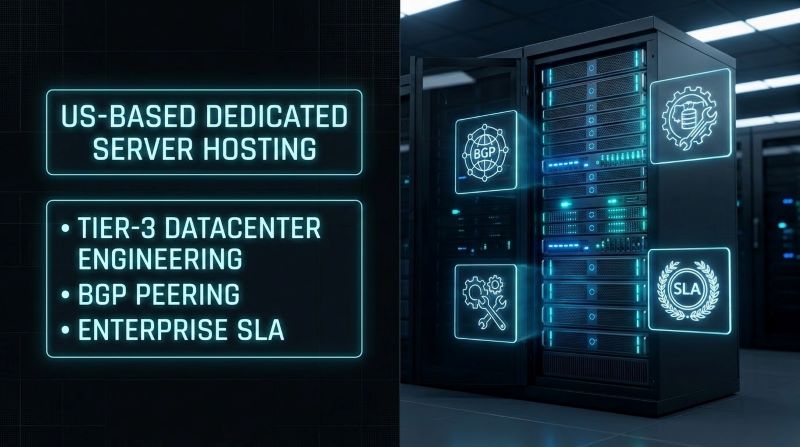
US-based dedicated server hosting provides 100% single-tenant physical bare-metal hardware provisioned inside certified Tier-3 carrier-neutral datacenters across the United States. By combining multi-homed BGP routing across Tier-1 backbones (Lumen, Arelion, Cogent) with direct-attached PCIe Gen4/Gen5 NVMe RAID arrays, unmetered 1Gbps to 10Gbps uplinks, and isolated IPMI/KVM out-of-band management, it delivers deterministic sub-30ms nationwide latency, zero multi-tenant resource contention, and a binding 99.99% uptime and 2-hour hardware replacement SLA for enterprise workloads.
Deploying mission-critical applications across North American markets requires an underlying infrastructure engineered for deterministic compute execution, sustained storage throughput, and uncompromised network routing. While multi-tenant public cloud platforms offer rapid virtual instance spinning, high-concurrency production systems—such as high-frequency transactional platforms, large-scale relational databases, streaming services, and multi-node private cloud clusters—frequently degrade under cloud virtualization. Multi-tenant hypervisor contention (the “noisy-neighbor” effect), unpredictable I/O throttling on virtualized network-attached block storage, and punitive egress bandwidth billing create severe operational and financial instability.
Transitioning to enterprise US-based dedicated server hosting re-establishes direct hardware sovereignty. By leasing dedicated, unshared physical servers deployed within carrier-neutral facilities, engineering teams unlock raw bare-metal execution, granular kernel optimization, and predictable operating expenses. This engineering blueprint presents infrastructure architects, sysadmins, and technology leaders with a technical analysis of US bare-metal hosting—covering Tier-3 facility topology, transcontinental BGP routing, PCIe NVMe storage queue dynamics, Linux kernel tuning scripts, and enforceable enterprise Service Level Agreements (SLAs).
1. Regional Telecommunications Topography: Optimizing Latency Across US Geographies
The United States spans almost 3,000 miles across four contiguous time zones. In high-throughput and interactive workloads, physical distance dictates baseline packet propagation times. Speed-of-light propagation through terrestrial fiber optic cable introduces approximately 1 millisecond of round-trip latency for every 100 miles traversed, before factoring in routing serialization delays, switch hops, and peering handoffs. Selecting the appropriate geographical datacenter region is the single most critical decision in controlling network latency.
+-------------------------------------------------------------------------------+
|                       US CONTINENTAL ROUTING TOPOGRAPHY                       |
+-------------------------------------------------------------------------------+
|                                                                               |
|   WEST COAST HUBS                 CENTRAL HUBS               EAST COAST HUBS  |
|   [Silicon Valley / LA]       [Dallas / Chicago]           [Ashburn / NYC]    |
|            |                          |                          |            |
|            +--- 25-30ms RTT ----------+---------- 20-25ms RTT ---+            |
|            |                                                     |            |
|            +------------------- 55-68ms Direct RTT --------------+            |
|            |                                                     |            |
|     Transpacific Routes                                   Transatlantic Routes|
|     (Japan, Aus, APAC)                                    (UK, Frankfurt, EU) |
|     75ms - 130ms RTT                                      65ms - 85ms RTT     |
|                                                                               |
+-------------------------------------------------------------------------------+
Continental Transit Hubs: East Coast, Central, and West Coast Positioning
Deploying a dedicated server in the USA requires aligning server placement with customer demographic concentrations and external API dependencies:
- East Coast (Northern Virginia / Ashburn, New York, New Jersey): Ashburn represents the densest interconnection point in the world, routing an estimated 70% of global internet traffic. Infrastructure located in the Ashburn/New York corridor provides sub-5ms latency to major financial centers and technology hubs across the US East Coast. Furthermore, it delivers optimal transatlantic latency (65ms to 80ms RTT to London, Amsterdam, and Frankfurt), making it the premier location for international organizations serving both North American and European audiences.
- Central US (Dallas, Texas / Chicago, Illinois): Central facilities function as the premier balance point for nationwide US deployments. A single dedicated cluster hosted in Dallas or Chicago typically delivers symmetric 20ms to 32ms RTT to both East and West coasts. This eliminates the necessity of deploying complex multi-region active-active database clustering for organizations that require balanced national latency under a unified infrastructure footprint.
- West Coast (Silicon Valley, Los Angeles, Seattle): West Coast nodes optimize access for Pacific time zone users and serve as primary gateways for transpacific subsea fiber cables connecting to Tokyo, Singapore, Sydney, and the broader Asia-Pacific region.
Multi-Carrier BGP Multi-Homing & Autonomous System Routing
A single upstream internet service provider (ISP) represents an unacceptable single point of failure (SPOF) for enterprise infrastructure. Carrier-neutral US datacenters mitigate this risk by implementing Border Gateway Protocol (BGP4) routing across multiple Tier-1 transit backbones—including Lumen (formerly CenturyLink), Arelion (formerly Telia Carrier), Cogent Communications, NTT Communications, and Zayo.
When an upstream fiber backhaul suffers an accidental cut or BGP route leak, multi-homed edge routers detect packet loss and route degradation within milliseconds. Traffic is dynamically shifted to alternate Tier-1 transit providers via shortest AS-Path evaluation. This automated self-healing network topology ensures continuous session persistence for mission-critical web applications and VPN endpoints.
2. Tier-3 Datacenter Engineering: Power, Cooling & Concurrently Maintainable Infrastructure
The hardware housed within a dedicated server can only perform reliably if the hosting facility delivers uncompromised power, thermal regulation, and structural protection. In enterprise hosting, datacenters are categorized according to the Uptime Institute’s Tier Classification System. Tier-3 facilities provide concurrently maintainable site infrastructure, ensuring that any physical capacity component (power transformers, UPS modules, chillers) can be removed from service for maintenance or replacement without disrupting operational compute nodes.
2N Power Distribution, Dual UPS Topologies & On-Site Generation
Enterprise servers require continuous, clean alternating current (AC). A true Tier-3 facility isolates equipment from utility grid transients through a multi-stage electrical architecture:
- Dual Utility Substations: High-voltage electricity is delivered through diverse utility paths originating from independent municipal substations.
- Uninterruptible Power Supply (UPS) Arrays in 2N Configuration: Utility AC power is continuously converted to direct current (DC) to charge industrial battery banks, then inverted back to ultra-stable AC power. The facility maintains two completely separate UPS power distribution paths (A-side and B-side). Enterprise dedicated servers equipped with redundant power supply units (PSUs) connect to both independent feeds.
- On-Site Diesel Generation Autonomy: In the event of total municipal grid collapse, automatic transfer switches (ATS) trigger on-site diesel generators within 10 to 15 seconds. Facilities maintain minimum on-site fuel reserves guaranteeing 48 to 72 hours of continuous full-load runtime, supported by priority fuel replenishment contracts with regional suppliers.
Precision Climate Control & Physical Data Sovereignty
Modern high-density bare-metal processors—such as 64-core AMD EPYC and 32-core Intel Xeon chips—generate massive localized thermal loads. Tier-3 datacenter engineering utilizes hot-aisle/cold-aisle containment systems paired with N+2 Computer Room Air Conditioning (CRAC) or Computer Room Air Handler (CRAH) chillers.
By sealing cold aisles and forcing chilled air (maintained strictly between 18°C and 22°C with 40–55% relative humidity) directly through server chassis into isolated hot exhaust plenums, the facility prevents thermal throttling across processor cores and PCIe expansion bays. Physical security standards enforce multi-layered defense: perimeter anti-ram barriers, 24/7/365 armed security personnel, biometrically authenticated mantrap sally ports, and comprehensive CCTV monitoring of every server rack corridor to satisfy SOC 2 Type II, ISO 27001, and PCI-DSS physical audit standards.
3. Architectural Matrix: Bare Metal Dedicated Hardware vs. Multi-Tenant Cloud
Before committing to an infrastructure path, enterprise engineering teams must evaluate physical bare metal against virtualized cloud instances across core architectural dimensions:
| Architectural Metric | Multi-Tenant Public Cloud Instances | Onlive Server US Bare-Metal Dedicated | Technical Operational Impact |
|---|---|---|---|
| Hypervisor Overhead | 8% to 15% compute & scheduling drag | 0% (Direct Bare Metal Execution) | Full instruction-set availability; AVX-512 extensions run without virtualization penalty. |
| CPU Core Isolation | Shared virtual vCPU threads; susceptible to noisy neighbors | 100% Dedicated Physical Cores | Deterministic processing speed; zero thread preemption by neighboring workloads. |
| Memory Bus Access | Virtualized RAM mapping; shared L3 cache contention | Dedicated Multi-Channel ECC DDR4/DDR5 | Unconstrained memory bandwidth; hardware ECC prevents silent bit-flip data corruption. |
| Storage Architecture | Network-attached virtual block storage (EBS/Ceph) | Direct-Attached PCIe Gen4/Gen5 NVMe | Latency drops from 2–15ms (cloud) to sub-30 microseconds; 800k+ sustained IOPS. |
| Network Interface | Virtualized elastic interfaces; shared hypervisor pipe | Dedicated 1Gbps / 10Gbps LACP Uplinks | Line-rate packet processing; zero packet drops during concurrent burst events. |
| Bandwidth Billing Model | Punitive egress fees ($0.05 to $0.09 per GB transferred) | Flat-Rate Unmetered or High-Allocation Ports | Predictable monthly operational expenditure; no fiscal shock during traffic spikes. |
| Management Sovereignty | Restricted cloud provider console/API | Out-of-Band IPMI 2.0 / iDRAC / KVM-over-IP | BIOS/UEFI control; custom kernel compilation; custom OS ISO installations. |
| Hardware SLA | Virtual instance reboot SLA only | 2-Hour On-Site Hardware Replacement | Physical technician replaces failed drives, RAM, or power supplies directly on-site. |
4. Hardware Sizing Framework: Processors, Memory Channels & NVMe Storage Fabrics
Procuring a dedicated server hosting environment requires matching physical silicon and bus specifications directly to software concurrency models.
Compute Architecture: AMD EPYC High-Density Cores vs. Intel Xeon Clock Speed
Selecting the optimal processor platform depends on whether the target application scales horizontally across threads or requires raw single-core execution speed:
- AMD EPYC (Zen 4 / Zen 5 Architecture): Engineered for multi-tenant virtualization (Proxmox VE, VMware ESXi), high-concurrency microservices, and massive parallel containerization. Offering up to 64 or 128 physical cores (128 to 256 threads) per socket and 12-channel DDR5 memory controllers, AMD EPYC provides industry-leading compute density per rack unit.
- Intel Xeon Scalable (Sapphire Rapids / Emerald Rapids): Ideal for relational database engines (PostgreSQL, Microsoft SQL Server), financial computation, and legacy software stacks licensed per-core. Intel Xeon processors feature higher sustained base and all-core turbo frequencies, alongside integrated acceleration engines such as Intel Advanced Matrix Extensions (AMX) and QuickAssist Technology (QAT).
Storage Subsystems: Direct-Attached PCIe Gen4/Gen5 NVMe vs. Virtualized Block Storage
Storage bottlenecks represent the primary cause of high average server load and application timeouts. When relational databases execute transactions, every COMMIT statement forces a synchronous flush (fsync) to persistent storage.
- SATA Solid-State Disks (AHCI Protocol): Limited to a single command queue capable of handling only 32 commands simultaneously. Under concurrent multi-user write bursts, queue saturation causes
iowaitspikes exceeding 20%, stalling upstream application worker processes. - Enterprise PCIe NVMe (Non-Volatile Memory Express): Communicates directly with the processor across the PCIe bus, bypassing legacy controller bottlenecks. NVMe supports up to 64,000 parallel command queues, each processing up to 64,000 commands concurrently. Configured in a redundant hardware RAID-10 array, enterprise NVMe storage sustains over 800,000 random 4K read IOPS and sub-30 microsecond access latencies, eliminating transactional locking.
5. Enterprise Linux Kernel Optimization: High-Throughput Network & Storage Runbook
Default Linux kernel settings are intentionally conservative to maintain compatibility with low-spec office desktops and virtual machines. On enterprise bare-metal hardware with high-density cores and 10Gbps uplinks, default networking and storage buffer limits throttle packet delivery and cause socket exhaustion under load.
Execute the following hardened production runbook to audit hardware topology, configure 802.3ad network bonding, and tune the network stack within your enterprise Linux environment (e.g., Ubuntu LTS or AlmaLinux) according to official Linux Kernel Documentation.
Activating BBR prevents TCP connections across transcontinental or transoceanic routes from collapsing in throughput when minor network packet loss occurs, maintaining near-line-rate data delivery even over long-distance client sessions.
6. Network Bandwidth Models: Unmetered 1Gbps/10Gbps Uplinks & DDoS Scrubbing
Bandwidth procurement is often fraught with hidden restrictions, fair use policies, and throttling thresholds. In high-traffic environments, understanding network port sizing dictates both operational stability and financial predictability.
- Metered vs. Unmetered Bandwidth: Metered plans bill customers based on total terabytes transferred each month or levy per-gigabyte egress penalties ($0.05 to $0.09 per GB on public cloud). For media streaming, game hosting, and SaaS data processing, bandwidth bills fluctuate wildly. An unmetered US-based dedicated server provides a dedicated physical port (1Gbps or 10Gbps) capable of continuous, 24/7 saturation without data metering or overage surcharges.
- Dedicated Port vs. Shared Burstable Port: A 10Gbps port shared among multiple rack neighbors can drop to fractional speeds during concurrent peak operating windows. Enterprise dedicated hosting guarantees dedicated switch port reservation, ensuring you receive the full line-rate throughput provisioned in your agreement.
- Hardware-Level Anti-DDoS Scrubbing: Volumetric Distributed Denial of Service (DDoS) attacks targeting US infrastructure frequently exceed 100Gbps. Onlive Server integrates automated multi-layer DDoS mitigation. Incoming traffic is analyzed at edge scrubbing centers where malicious SYN floods, UDP amplification, and Layer 7 HTTP flood vectors are dropped before clean packets reach your server interface.
7. Workload Reference Architectures: Mission-Critical Deployment Blueprints
Rather than evaluating hypothetical scenarios, technical leaders benefit most from transparent, production-proven architectural reference patterns:
Blueprint A: High-Concurrency Relational Database Cluster (PostgreSQL / MySQL)
- Compute Tier: Dual Intel Xeon Gold processors (high single-thread frequency) or AMD EPYC 9354 (32 Cores, 3.25GHz base clock).
- Memory Tier: 256GB to 512GB ECC DDR5 RAM. Memory is sized to ensure that active database tables and indexes reside 100% within RAM (InnoDB Buffer Pool or PostgreSQL
shared_buffers). - Storage Subsystem: 4x 3.84TB Enterprise NVMe SSDs in hardware RAID-10 with write-back caching.
- Operational Advantage: Write-Ahead Log (WAL) commits execute with sub-50 microsecond latency; complex JOIN queries execute across multi-channel DDR5 memory without swapping, sustaining thousands of concurrent write transactions.
Blueprint B: Private Cloud Virtualization Node (Proxmox VE / KVM)
- Compute Tier: AMD EPYC 9654 (96 Cores, 192 Threads).
- Memory Tier: 768GB to 1.5TB ECC DDR5 Registered RAM across 12 memory channels.
- Network Interface: Dual 10Gbps SFP+ ports in 802.3ad LACP bonding.
- Storage Subsystem: 8x 7.68TB Enterprise U.3 NVMe drives managed in an OpenZFS mirrored storage pool (
raidz2or striping mirrors). - Operational Advantage: Hosts 80 to 120 isolated, high-performance virtual private servers or container workloads with hardware-enforced CPU core pinning, automated ZFS snapshots, and isolated VLAN customer tenant segmentation. Organizations scaling regional hosting nodes can leverage this blueprint alongside dedicated VPS hosting infrastructure to maintain hybrid fleet flexibility.
8. Enterprise Service Level Agreements: Hardware Replacement & Financial Uptime Guarantees
A Service Level Agreement is only as valuable as its financial backing and enforceability. Enterprise hosting contracts must explicitly define the difference between network uptime, electrical facility uptime, and physical hardware replacement:
| SLA Category | Guarantee Commitment | Enforceable Penalty Structure |
|---|---|---|
| Electrical Power Distribution | 100% Continuous Dual-Feed 2N Power | Pro-rated credit for every 15 minutes of disruption beyond SLA. |
| Core Network Uptime (BGP) | 99.99% Monthly Multi-Carrier Path Availability | Tiered billing credits scaled to outage duration. |
| Failed Hardware Replacement | 2-Hour Maximum Physical Component Swap | Credit applied if diagnostic-to-replacement window exceeds 120 minutes. |
The 2-Hour Hardware Replacement Guarantee
In commodity hosting, a failed SAS drive, RAM DIMM, or redundant power supply often requires hours or days for remote technicians to order parts and schedule replacement windows. Enterprise Onlive Server US hosting enforces a strict 2-hour hardware replacement SLA. All Tier-3 datacenter locations maintain comprehensive inventories of pre-tested, on-site spare components—including complete motherboards, memory modules, hot-swap power supplies, and NVMe drives. In the event of a component failure detected via out-of-band monitoring or diagnostic ticketing, certified on-site technicians complete physical replacement and restore system boot within 120 minutes of failure verification.
9. Production Readiness & Hardening Checklist
Before shifting production customer traffic to your newly provisioned US dedicated server, verify operational readiness across this technical checklist:
- Out-of-Band Management Isolation: Confirm IPMI 2.0 / iDRAC / KVM-over-IP interface is bound strictly to an isolated private administrative VLAN; disable public IP access; enforce SSH key or certificate authentication.
- Cryptographic SSH Hardening: Disable password authentication in
/etc/ssh/sshd_config; enforce ED25519 public key pairs; configure non-standard listening port; enforce idle session disconnect (ClientAliveInterval 300). - Kernel Parameter Activation: Verify
/etc/sysctl.d/99-enterprise-network.confis loaded; confirmtcp_congestion_control = bbr; verify socket buffer scaling. - Hardware RAID & Storage Health: Audit hardware RAID battery backup unit (BBU) charge status; confirm write-back caching is active; verify smartmontools alerting daemon (
smartd) is active. - LACP Uplink Redundancy: Physically verify dual-switch uplink bonding by testing single-interface failover; ensure packet drops remain zero during interface flapping.
- Stateful Firewall Enforcement: Implement default-drop ingress policies using NFTables or UFW; restrict administrative ports to trusted bastion IP ranges.
- Automated Offsite Backup Synchronization: Deploy encrypted snapshot replication (using BorgBackup, Restic, or encrypted S3 endpoints) targeting a geographically isolated secondary facility.
10. Frequently Asked Architectural Questions
Four architectural pillars governing enterprise bare-metal performance across US datacenter infrastructure:
100% dedicated physical CPU sockets and DDR5 channels eliminate hypervisor scheduling latency and noisy-neighbor compute contention.
Central hubs (Dallas, Chicago) deliver balanced sub-30ms nationwide transit; East Coast hubs minimize transatlantic latency to Europe.
Over 800,000 random 4K read IOPS with sub-30µs access latencies eliminate database transactional locking and I/O wait spikes.
Binding 2-hour on-site hardware replacement SLA backed by local spare parts inventory and 2N concurrently maintainable power feeds.
Instant automated provisioning in Tier-3 US datacenters with 100% dedicated physical compute, direct-attached PCIe NVMe storage arrays, and enterprise 2-hour hardware replacement SLAs.
