

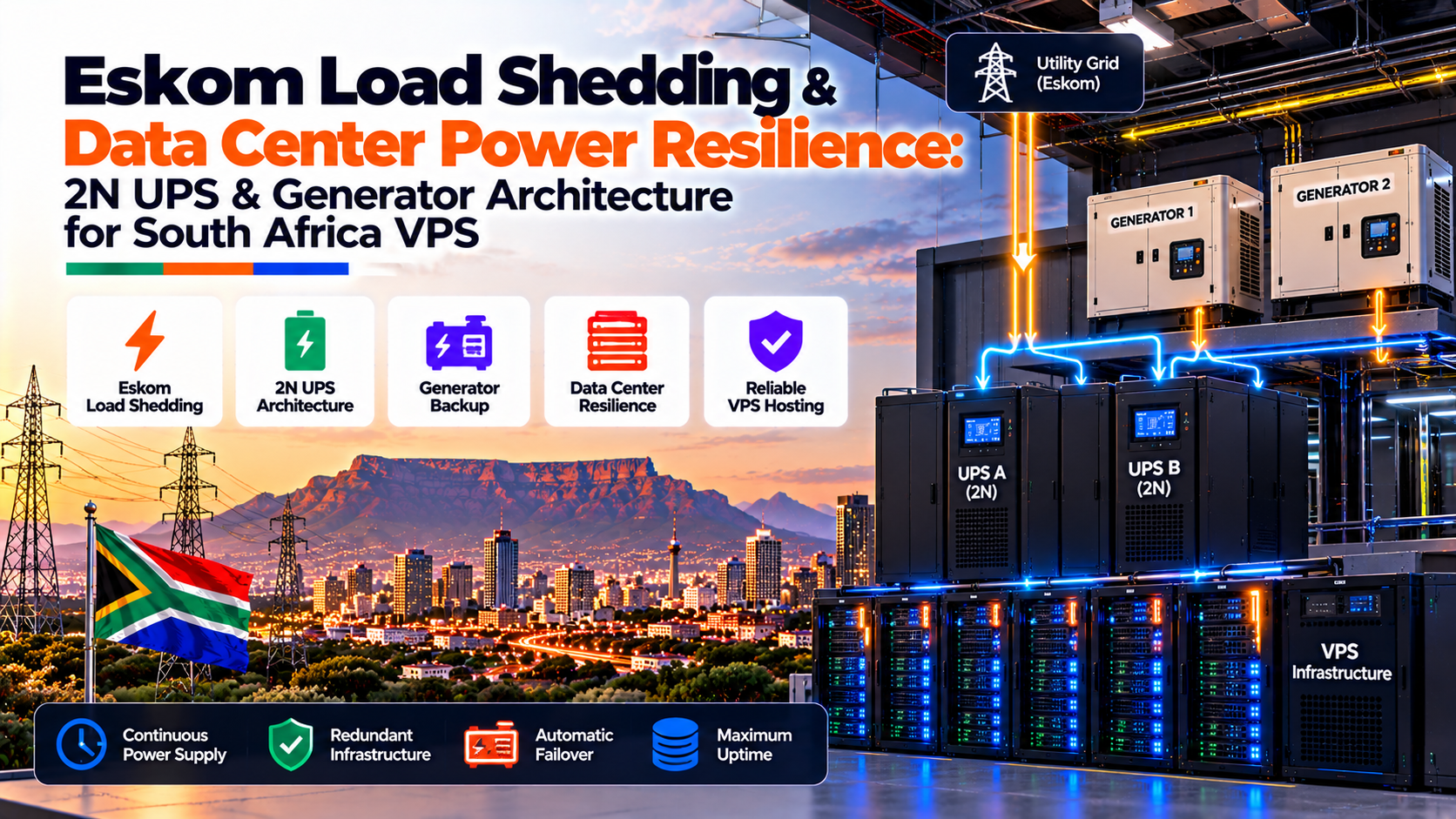
For South African enterprises, fintech transaction switches, and digital commerce platforms, electrical reliability is the single most important component of infrastructure stability.
Specifically, unpredictable municipal power cuts, load reduction, and cable theft across Johannesburg, Durban, and Cape Town threaten corporate continuity daily. When power drops suddenly, unconditioned battery backups degrade rapidly, leaving servers vulnerable to hard crashes and permanent data loss.
Furthermore, migrating your digital workloads to enterprise south africa vps hosting inside certified colocation campuses completely isolates your operations from municipal power failures.
In addition, understanding how enterprise colocation centers engineer electrical redundancy enables IT executives to audit hosting providers with technical precision. This comprehensive engineering guide deconstructs 2N power topologies, dynamic rotary UPS systems, and fuel polishing runbooks.
⚙️ Architectural Execution Framework
Verified Infrastructure Standards
Key Technical Architecture & Engineering Takeaways
Evaluating enterprise hosting infrastructure requires verifiable telemetry across compute isolation, hypervisor performance, and domestic carrier interconnects:
The Eskom Crisis: The Need for VPS Loadshedding Power Backup South Africa
Specifically, operating on-premise servers in South Africa requires confronting the harsh reality of an aging, constrained national power utility.
First, when Eskom declares Stage 6 load shedding, commercial areas experience up to 12 hours of rotational blackouts within a 24-hour cycle. Commercial office generators are designed for intermittent emergency backup, not continuous base-load operation.
Similarly,
In practice, running small commercial diesel generators for extended daily periods leads to mechanical overheating, fuel pump failures, and dirty electrical current. Severe voltage spikes during utility grid restoration regularly blow power supplies and damage server motherboards.
Accordingly,
Standard office generators produce significant total harmonic distortion (THD) and fluctuating frequencies (52 Hz to 48 Hz). Sensitive enterprise storage arrays and high-density compute nodes interpret this as dirty power, triggering automated emergency shutdowns that freeze database writes mid-transaction.
Furthermore, localized transformer explosions and subterranean cable theft frequently prevent municipal power restoration even after an scheduled load shedding block concludes. As a result, commercial tenants face days of unanticipated outage while city electrical technicians replace damaged sub-station switchgear.
Consequently, on-premise infrastructure cannot guarantee the continuous availability modern enterprise workloads require.
Rotary DRUPS vs Battery Banks: The Kinetic Energy Advantage
Notably,
Traditional data centers rely on massive banks of lead-acid (VRLA) or lithium-ion batteries to bridge the gap between grid loss and generator startup.
Surviving national grid instability requires auditing contractual uptime guarantees to verify that power interruptions are covered under formal service agreements.
However, in South Africa, repeated daily power cycling causes chemical batteries to degrade rapidly. When subjected to multiple discharge cycles each day, chemical battery capacity drops significantly within 12 to 18 months, creating severe risk during extended outages.
In contrast, premier colocation facilities like Teraco Isando utilize Diesel Rotary Uninterruptible Power Supply (DRUPS) systems. These units store energy mechanically using heavy spinning kinetic flywheels running in a vacuum chamber.
Furthermore, in a DRUPS system, an electro-magnetic clutch couples the spinning kinetic flywheel to the diesel generator engine block. When utility power drops, the kinetic momentum immediately cranks the diesel engine, allowing full combustion and power generation within milliseconds.
Therefore, kinetic flywheel DRUPS technology provides an unyielding, maintenance-free foundation for uninterrupted server power.
2N Generator Redundancy and VPS Loadshedding Power Backup South Africa
As a result,
In enterprise data center design, power redundancy is categorized by mathematical multiples. Budget hosting centers often claim “N+1” redundancy, meaning they maintain one spare generator for the entire facility.
Web caching layers prevent memory exhaustion and cache thrashing by following the official Redis key eviction and memory management documentation.
Specifically, N+1 redundancy fails if two generators encounter simultaneous mechanical faults during prolonged load shedding. In contrast, true enterprise hosting requires a 2N power architecture.
Moreover,
In a 2N configuration, the data center operates two completely independent, mirror-image power systems (System A and System B). Each system features its own medium-voltage switchgear, rotary flywheels, transformers, and industrial generator banks.
In addition, System A and System B are routed through physically separated subterranean trenches and risers. Consequently, even a physical cable breach or localized fire along one distribution path leaves the secondary path fully energized.
Specifically, 2N power ensures concurrent maintainability. Facility engineers can completely shut down and dismantle System A for major maintenance while System B seamlessly carries 100% of the data center’s electrical load. Not a single virtual server experiences voltage drop or downtime during the procedure.
Furthermore, choosing a host backed by 2N power redundancy guarantees complete peace of mind throughout extended national power blackouts.
Bulk Diesel Storage: Sustaining VPS Loadshedding Power Backup South Africa
Furthermore, even the most advanced industrial generator fleet is useless without reliable, clean diesel fuel. In South Africa, fuel supply logistics determine whether a data center survives multi-day blackouts.
Enterprise hosting environments prevent electrical transfer drops by adhering to Tier III facility electrical specifications with dual utility transformer feeds.
First, premier facilities maintain on-site bulk diesel storage tanks holding between 100,000 and 300,000 liters of 50ppm low-sulfur diesel. In addition, this reserves sufficient fuel to run the entire colocation campus at maximum load for 72 to 96 continuous hours without refuel deliveries.
Second, in practice, diesel fuel stored for months in bulk underground tanks suffers from condensation moisture and microbial contamination (“diesel bug”). Specifically, if unconditioned fuel enters high-pressure generator injectors, fuel filters clog instantly and engines seize under load.
In addition,
To eliminate contamination risks, facility management deploys automated multi-stage fuel polishing systems:
Consequently, stored fuel remains in pristine condition, ensuring engines start flawlessly the microsecond utility power cuts out.
Hardware Power Telemetry Runbook: Monitoring Dual PDU Feeds
Specifically,
Inside enterprise server racks, virtual server hypervisor hosts connect to two independent Power Distribution Units (PDUs): Feed A and Feed B.
Specifically, server administrators can inspect physical power supply health and ambient rack temperatures directly from the Linux command line using IPMI telemetry tools:
# Query status of redundant server power supplies
ipmitool sdr type "Power Supply"

# Monitor real-time wattage consumption and input voltage
ipmitool sensor reading "PS1 Input Watts" "PS2 Input Watts"

# Verify ambient chassis temperature to detect thermal throttling
ipmitool sensor reading "Ambient Temp" "Exhaust Temp"
First, redundant hot-swappable power supplies share the electrical load equally. Second, if one circuit experiences a maintenance shutdown, the surviving power supply assumes 100% load within 0 milliseconds without triggering a server reboot.
In addition, configure an automated Bash alert script to parse IPMI sensor logs and transmit Slack alerts whenever utility input voltage fluctuates:
#!/bin/bash
# Check dual power supply input status
PS1_STATUS=$(ipmitool sdr get "PS1 Status" | awk -F': ' '/Status/{print $2}')
PS2_STATUS=$(ipmitool sdr get "PS2 Status" | awk -F': ' '/Status/{print $2}')

if [ "$PS1_STATUS" != "OK" ] || [ "$PS2_STATUS" != "OK" ]; then
    MESSAGE="CRITICAL: Power Supply redundancy compromised on $(hostname)! PS1: $PS1_STATUS, PS2: $PS2_STATUS"
    curl -s -X POST -H 'Content-type: application/json' \
      --data "{\"text\":\"$MESSAGE\"}" https://hooks.slack.com/services/YOUR/WEBHOOK/URL
fi
Specifically, running this monitor on a 2-minute cron schedule immediately alerts engineering teams if an individual rack circuit breaker trips or an upstream PDU undergoes maintenance.
In addition, continuous IPMI telemetry ensures that thermal throttling never degrades high-performance NVMe virtual servers.
Comparison Matrix for VPS Loadshedding Power Backup South Africa
Therefore,
When assessing the power resilience of different hosting environments in South Africa, compare the engineering criteria below:
Safeguard your digital operations from Eskom Stage 8 load shedding with 2N generator-backed data center hosting in Johannesburg featuring 72-hour diesel reserves.
Frequently Asked Questions
Core Technical Specifications
How do South African data centers survive Stage 8 load shedding?
Why are rotary DRUPS flywheels better than chemical batteries in South Africa?
What happens to my VPS during the switch from Eskom to data center generators?
Why is automated diesel fuel polishing necessary for data center generators?
Deployment & Operational Inquiries
Can a hosting provider legally blame Eskom load shedding for server downtime?
How often are emergency generator banks tested under full electrical load?
Does municipal power surging after load shedding damage virtual private servers?
Protect Server Availability from National Electrical Grid Fluctuations
Consequently, host in enterprise Teraco facilities equipped with multi-day diesel reserves and automatic generator switchover controls.
Furthermore,
Deploy Power-Resilient South Africa Cloud Virtual Servers →