

What Is the Difference Between VPS and VDS in the Turkish Hosting Market?
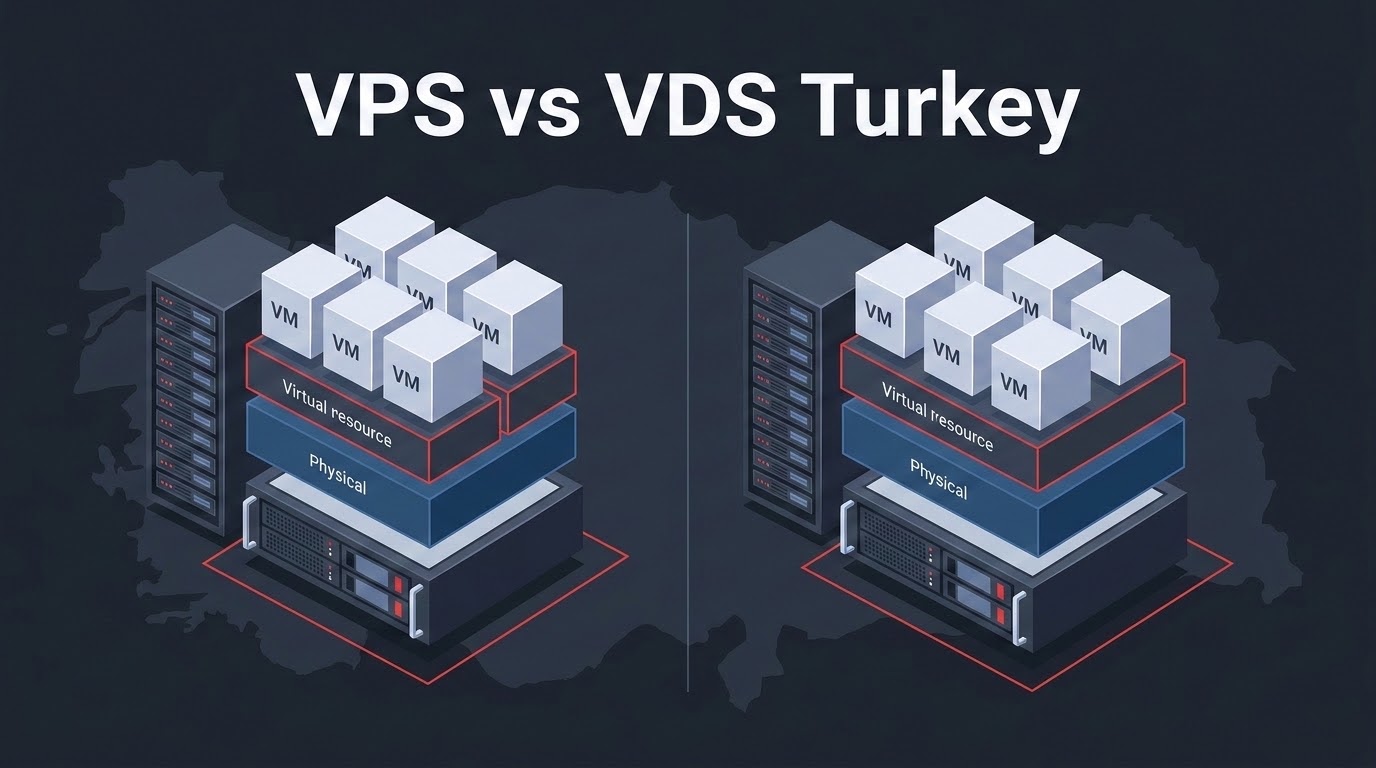
In Türkiye, “VPS” traditionally describes shared-core virtual instances with overcommitted CPU threads, whereas “VDS” (Virtual Dedicated Server) denotes 100% dedicated hardware slices with locked physical RAM and dedicated vCPU core affinity. While international hosting providers often treat the terms synonymously, Turkish hosting providers distinguish VDS by guaranteeing zero resource contention and unmetered NVMe disk channels. A properly configured enterprise KVM VPS functions identically to a premium VDS, providing bare-metal performance consistency at lower infrastructure overhead.
If you browse Turkish web development communities such as R10.net, IT forums, or local cloud catalogs, you will immediately notice a distinct pricing and packaging structure that separates server plans into two categories: “VPS Satın Al” and “VDS Kiralama”. For international developers and system administrators unfamiliar with regional industry conventions, this terminology frequently causes confusion. Both technologies deliver a root-access virtual machine with a dedicated IP address, yet they represent drastically different underlying hypervisor commitments. Choosing dedicated resource Turkey VPS and VDS hosting stationed in Istanbul ensures your mission-critical applications receive guaranteed physical hardware slices without noisy-neighbor resource throttling during peak Turkish business hours.
✔ Key Architectural Takeaways
- The Turkish Market Definition: In Türkiye, “VPS” generally implies shared hypervisor threads where CPU cores are pooled, whereas “VDS” guarantees dedicated, 1:1 mapped physical cores that cannot be overcommitted.
- Hypervisor Architecture: VDS relies on Kernel-based Virtual Machine (KVM) or VMware ESXi with hardware-assisted virtualization (Intel VT-x/AMD-V), while budget VPS plans historically leveraged OS-level containerization (OpenVZ or LXC).
- Memory Allocation Integrity: VDS allocates static, locked RAM blocks from host ECC memory. VPS instances often rely on dynamic memory ballooning, exposing databases to unexpected out-of-memory (OOM) termination.
- Storage and Disk I/O: VDS environments typically guarantee dedicated IOPS queues on local enterprise NVMe arrays, preventing adjacent tenants from monopolizing read/write bandwidth during heavy database updates.
- Regulatory Compliance: VDS hardware isolation satisfies Turkish Law No. 6698 (KVKK) data privacy standards by physically separating memory address registers between individual client tenants.
Table of Contents
- The Historical Origin of VDS in the Turkish Web Hosting Market
- Architectural Breakdown: Hypervisor Isolation vs. Shared Kernels
- CPU Scheduling: Core Pinning vs. Dynamic Oversubscription Ratios
- RAM Locking and NVMe I/O Queuing: Preventing Storage Thrashing
- Decision Framework: When to Deploy VPS vs. VDS for Turkish Workloads
- Technical Verification: How to Audit Your Server Isolation on Linux
- Frequently Asked Questions (FAQ)
The Historical Origin of VDS in the Turkish Web Hosting Market
To understand why the acronym VDS (Virtual Dedicated Server) holds such widespread prominence across Türkiye, one must examine the evolution of the Turkish webmaster community. During the late 2000s and early 2010s, Turkish digital publishers, vBulletin forum administrators, and emerging e-commerce portals were hosted predominantly on shared cPanel accounts or rudimentary virtual private servers. At that time, most entry-level VPS hosting was powered by OpenVZ, Virtuozzo, or early containerization technologies.
Because OpenVZ shared a single monolithic Linux kernel across all host tenants, hosting providers routinely oversubscribed physical host servers by 300% to 500%. When a single tenant suffered a traffic surge or launched a poorly optimized SQL query, the host kernel throttled CPU cycles across every neighboring container. The phrase “VPS aldım ama sitem kasıyor” (I bought a VPS but my site is lagging) became an omnipresent complaint across webmaster forums such as R10.net and DonanımHaber.
To distinguish premium, unthrottled virtual servers from overcommitted container hosting, Turkish hosting providers coined and aggressively marketed the term VDS (Virtual Dedicated Server). In the regional lexicon, “VDS” represented a solemn technical contract: the virtual server was provisioned with dedicated hardware virtualization (primarily VMware ESXi, Citrix XenServer, and later modern KVM), where RAM and CPU cores were strictly reserved for that specific customer.
While global cloud giants (such as AWS, Google Cloud, and DigitalOcean) refer to all virtual compute instances generically as “instances”, “virtual machines”, or “VPS”, the Turkish domestic market maintains this sharp, functional distinction between shared-resource VPS and dedicated-resource VDS to this day.
Architectural Breakdown: Hypervisor Isolation vs. Shared Kernels
At a systems architecture level, the difference between a traditional budget VPS and a true VDS lies in the virtualization boundary enforced by the hypervisor layer:
1. Traditional VPS (Container / Shared Hypervisor):
In a container-based VPS, tenants share the parent operating system’s kernel. There is no independent virtual BIOS, no private virtual hardware abstraction layer, and no capability to install custom kernel modules (such as WireGuard, custom iptables NAT tables, or alternative file systems like ZFS). The host kernel uses Linux Control Groups (cgroups) and namespaces to partition resources. However, if the host kernel experiences memory pressure, it can invoke the Out-of-Memory (OOM) killer or dynamically swap memory pages to disk, degrading performance for all tenants.
2. VDS (Hardware-Assisted Full Virtualization):
A VDS operates on top of a Type-1 or bare-metal Type-2 hypervisor using Kernel-based Virtual Machine (KVM) or VMware ESXi. The hypervisor leverages hardware virtualization extensions built into enterprise processors—namely Intel VT-x (with Extended Page Tables) or AMD-V (with Rapid Virtualization Indexing). Each VDS runs its own completely independent guest kernel, virtual BIOS, and virtual hardware bus. The guest operating system can be any standard Linux distribution (Ubuntu, Debian, AlmaLinux, Rocky Linux) or Microsoft Windows Server, completely isolated from neighboring instances.
| Technical Attribute | Traditional Turkish VPS | Turkish VDS (Virtual Dedicated) | Production Impact |
|---|---|---|---|
| Virtualization Technology | OpenVZ, LXC, or shared KVM | KVM / VMware ESXi (Hardware) | Complete architectural isolation |
| CPU Allocation Model | Time-shared / Fair-share pooling | 1:1 Dedicated vCPU Pinning | Zero CPU steal (%st = 0.0) |
| RAM Allocation Integrity | Dynamic ballooning / Shared pool | 100% Dedicated Physical ECC RAM | No OOM database terminations |
| Kernel Independence | Shared host Linux kernel | Independent guest OS kernel | Full root & kernel module control |
| Windows OS Support | Not supported (Linux only) | Fully supported (Native ISO boot) | Enables Turkish ERP & Netsis |
| Storage Performance | Shared I/O queues | VirtIO dedicated NVMe queues | High transactional IOPS |
CPU Scheduling: Core Pinning vs. Dynamic Oversubscription Ratios
The defining technical distinction between VPS and VDS revolves around how the Linux hypervisor scheduler handles virtual CPU (vCPU) threads. In standard cloud hosting environments, hypervisors employ aggressive oversubscription ratios (often 4:1 to 8:1). If a host server possesses 32 physical CPU cores with hyperthreading (yielding 64 logical threads), an oversubscribing host might provision 250 to 500 virtual CPU cores across dozens of budget VPS instances.
# Verify physical CPU topology and hardware virtualization support
lscpu | grep -E 'Model name|Virtualization|Hypervisor vendor|CPU(s):'

# Check whether dedicated CPU cores are pinned without vCPU overcommitment
cat /sys/devices/system/cpu/isolated
Under this shared model, when multiple tenants run demanding workloads simultaneously, the Linux scheduler must context-switch rapidly between competing virtual machine processes. In your server telemetry, this context-switching manifests as CPU Steal Time (%st) in tools like top or htop. When CPU steal exceeds 5% to 10%, database queries execute noticeably slower, PHP-FPM workers stall, and website response times spike unpredictable. Enforcing guaranteed CPU time and preventing hypervisor-level memory ballooning adheres to architecture models outlined in the Linux Kernel Virtualization subsystem documentation.
In contrast, a genuine VDS architecture utilizes CPU core pinning or strict 1:1 scheduling. In KVM hypervisors, administrators use QEMU configuration directives to bind virtual CPU threads directly to dedicated host CPU cores via processor affinity flags (e.g., vcpupin):
“`xml
“`
With CPU pinning, cores 4 through 7 on the physical Intel Xeon or AMD EPYC processor are exclusively assigned to your virtual machine. No other customer’s traffic, cron jobs, or DDoS attacks can preempt your execution cycles. Your CPU steal remains at an unshakeable 0.0%, ensuring that complex calculations, e-commerce checkouts, and transactional database updates complete with deterministic, microsecond latency.
RAM Locking and NVMe I/O Queuing: Preventing Storage Thrashing
Beyond CPU allocation, random access memory and storage throughput represent the two most frequent failure points in high-concurrency hosting environments.
In a budget VPS configuration, providers frequently utilize memory overcommitment and memory ballooning drivers (virtio_balloon). If the parent host approaches physical RAM saturation, the hypervisor commands the balloon driver inside individual virtual servers to inflate, artificially claiming memory back from the guest OS and transferring it to other tenants. If your MySQL or PostgreSQL database buffer pool happens to occupy that memory, the Linux kernel is forced to dump memory to swap space on disk. This results in severe swap thrashing, bringing application response times to an immediate crawl.
A true VDS provides locked physical RAM. When you order an 8 GB or 16 GB VDS in an Istanbul data center, the hypervisor allocates the full memory block at boot using POSIX mlock() or dedicated KVM huge pages. That memory is physically mapped to host ECC DDR4 or DDR5 RAM and cannot be reclaimed, swapped, or shared under any circumstances.
Similarly, storage throughput on a VDS is safeguarded by dedicated VirtIO paravirtualized block drivers. Instead of emulating legacy IDE or SATA controllers, VirtIO establishes direct circular ring buffers in shared host memory, interfacing directly with enterprise PCIe Gen4 NVMe arrays. This guarantees sustained 4K random read/write speeds exceeding 50,000 IOPS, ensuring that high-throughput Turkish WooCommerce or OpenCart platforms can handle thousands of concurrent product lookups during flash sales without disk I/O bottlenecks.
Decision Framework: When to Deploy VPS vs. VDS for Turkish Workloads
To choose the correct server tier for your budget and application architecture, consider the following deployment scenarios:
Application Sizing and Deployment Guide:
Opt for a Budget VPS When:
- You are running staging, test, or development environments where occasional micro-delays do not impact revenue.
- You host lightweight static sites, personal blogs, or low-traffic corporate brochures receiving under 10,000 visits per month.
- You are deploying secondary DNS nameservers, background log collectors, or simple cron runners with minimal CPU requirements.
- Cost minimization is the primary constraint and occasional CPU steal does not disrupt business operations.
Mandate a VDS (Virtual Dedicated Server) When:
- Production E-Commerce: You operate high-volume WooCommerce, OpenCart, PrestaShop, or Magento stores where checkout speed directly dictates sales conversion.
- Relational Databases: You host standalone MySQL, MariaDB, or PostgreSQL databases requiring dedicated InnoDB buffer pools and zero swap thrashing.
- High-Concurrency APIs: You serve real-time REST or GraphQL APIs for mobile applications with thousands of active Turkish users.
- Enterprise Windows Applications: You run Turkish ERP and accounting suites (such as Logo Go 3, Mikro, or Netsis) that mandate Windows Server and dedicated computing cores.
- KVKK Regulatory Compliance: You handle personal customer data, payment credentials, or medical records subject to Law No. 6698 privacy isolation audits.
Technical Verification: How to Audit Your Server Isolation on Linux
Once you provision a virtual server from any Turkish or international provider, you should independently verify whether your instance enjoys true hardware virtualization and zero CPU steal. Connect to your instance via SSH with root credentials and execute the following commands:
“`bash
# 1. Inspect underlying virtualization hypervisor
$ sudo systemd-detect-virt
kvm
# 2. Check for CPU hardware virtualization flags (Intel VT-x / AMD-V)
$ grep -E –color ‘vmx|svm’ /proc/cpuinfo
flags : fpu vme de pse tsc msr pae mce cx8 apic sep mtrr pge mca cmov pat pse36 clflush mmx fxsr sse sse2 ss syscall nx pdpe1gb rdtscp lm constant_tsc arch_perfmon rep_good nopl xtopology cpuid tsc_known_freq pni pclmulqdq vmx …
# 3. Monitor CPU Steal Time under load
$ vmstat 1 5
procs ———–memory———- —swap– —–io—- -system– ——cpu—–
r b swpd free buff cache si so bi bo in cs us sy id wa st
1 0 0 5849200 120400 1824000 0 0 4 28 120 240 4 1 95 0 0
0 0 0 5849180 120400 1824000 0 0 0 0 85 180 2 1 97 0 0
“`
In the output of vmstat, the final column—labeled st (CPU Steal)—is the definitive truth metric. If st reports 0 under heavy processing, your server is operating with dedicated hardware core isolation. If st climbs above 5 or 10, your host provider is oversubscribing physical cores, and your application is suffering from noisy-neighbor contention.
At OnliveServer, all Istanbul cloud instances are provisioned on pure enterprise KVM architecture with dedicated vCPU mapping and locked ECC DDR4/DDR5 RAM, ensuring your workloads enjoy the uncompromised reliability of a genuine VDS at competitive cloud pricing.
Frequently Asked Questions (FAQ)
Why do Turkish hosting companies offer both VPS and VDS plans?
In the Turkish web hosting market, VPS traditionally designates lower-cost servers with shared or overcommitted CPU cores, whereas VDS designates virtual servers with 100% dedicated hardware resources (CPU cores and RAM) guaranteed by KVM or VMware hypervisors.
What is CPU steal time and why is it zero on a true VDS?
CPU steal time occurs when a virtual machine wants to execute instructions but the physical host CPU is busy servicing other competing virtual servers. On a true VDS with dedicated core pinning, physical CPU threads are assigned 1:1, eliminating context switching and keeping steal time at 0%. To accurately project vCPU and RAM requirements for scaling production workloads, explore our detailed Turkey VPS hardware sizing calculations.
Can I run Windows Server on a Turkish VPS, or do I need a VDS?
Container-based VPS plans (OpenVZ/LXC) cannot run Windows because they share a Linux host kernel. Running Windows Server requires full hardware virtualization (KVM or VMware), which is standard on VDS plans. This is necessary for Turkish accounting software like Logo, Mikro, and Netsis.
How does RAM allocation differ between VPS and VDS?
On a budget VPS, RAM is often managed through dynamic ballooning, where the host can temporarily reclaim memory during spikes. On a VDS, RAM is statically locked into physical host ECC memory at boot time, preventing unexpected out-of-memory crashes for databases.
Is a VDS the same as a dedicated bare-metal server?
A VDS provides a dedicated virtual partition of a bare-metal server with guaranteed CPU cores, RAM, and storage queues. While a full dedicated server gives you 100% of the physical chassis, a VDS provides identical architectural isolation and performance consistency at a fraction of the cost.
Which option is better for high-traffic Turkish e-commerce websites?
A VDS is strongly recommended for e-commerce stores (WooCommerce, OpenCart, PrestaShop). Dedicated CPU cores and locked RAM prevent checkout slowdowns and database timeouts during marketing campaigns or peak shopping hours.
How does VDS hosting help with Turkish KVKK compliance?
Türkiye’s Personal Data Protection Law No. 6698 (KVKK) requires stringent technical data isolation. Hardware-level memory and storage separation on a VDS ensures that tenant data is isolated by hardware memory boundaries, fulfilling regulatory audit requirements.
How can I test if my current Turkish server is a VPS or a VDS?
Run systemd-detect-virt to verify hardware virtualization (KVM/VMware), and monitor vmstat 1 10 under load. If the st (CPU steal) column stays strictly at 0.0, your instance is operating with dedicated core isolation typical of a VDS.
Experience True Dedicated Core Performance in Türkiye
Stop suffering from noisy-neighbor CPU steal and dynamic memory ballooning. Deploy on 100% KVM hardware-isolated virtual dedicated instances in Istanbul with pure enterprise NVMe storage and sub-10ms domestic latency.
