

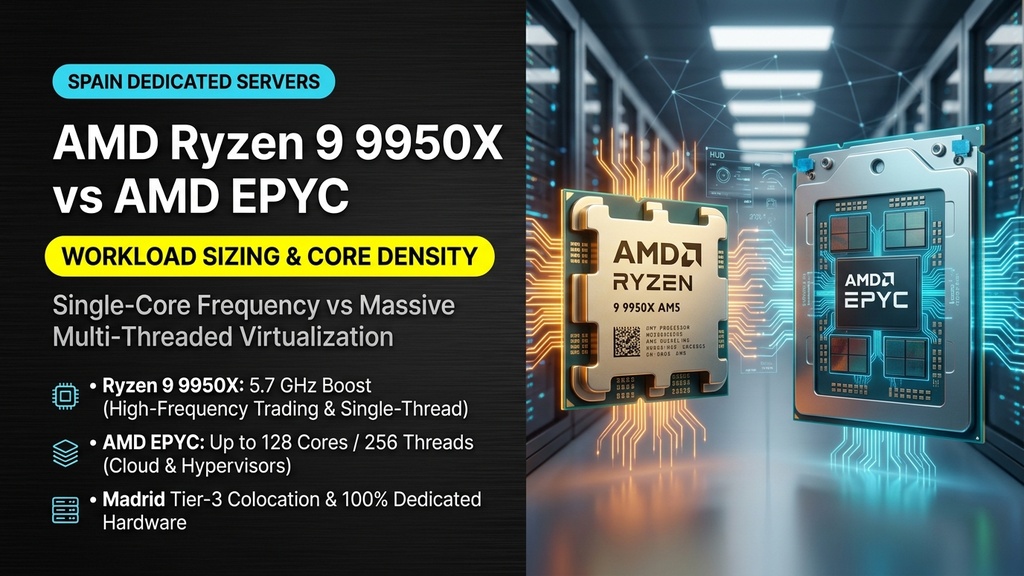
Choose AMD Ryzen (such as the 16-core Ryzen 9 9950X) on a Spain dedicated server when per-thread clock speed drives latency—such as PHP checkouts, game loops, or builds. Choose AMD EPYC (7502P, 7662, 7702, or 9354) when workloads demand 8–12 channel Registered ECC memory, 256–768 GB RAM ceilings, or dense VM isolation.
Identify whether your bottleneck is single-thread execution or memory bandwidth and concurrency. If your working set fits under 128 GB RAM and requests serialize on one thread (PHP-FPM, single-shard Redis, game loops), pick Ryzen 9700X or 9950X. Once RAM exceeds 128 GB or active workers cross 32+, move directly to EPYC 7662, 7502P, or 9354.
Choosing an AMD Ryzen vs EPYC Spain dedicated server is a direct trade between per-core boost velocity and platform-wide memory and I/O scale. Putting dense Proxmox VMs on desktop-class AM5 silicon starves memory channels early, while running single-threaded PHP checkouts on a 2.3 GHz dual-socket EPYC leaves budget idle. Neither processor family wins every workload. This guide compares clock density, ECC memory channels, NUMA topology, verified Madrid AMD server plans, and thermal behavior.
AMD Ryzen 9950X (Zen 5, 4.3 GHz base / up to 5.7 GHz boost) maximizes per-thread IPC for serialized request loops and compilation tasks.
EPYC SP3 (8-channel DDR4 RDIMM) and SP5 (12-channel DDR5 RDIMM) scale to 512–768 GB RAM and 128 PCIe lanes per socket, versus dual-channel AM5 on Ryzen.
Verified Madrid AMD tiers span $93/mo (DSX22, 4C EPYC 3151), $384/mo (DSX20, 16C Ryzen 9950X, 128 GB), up to $1,151/mo (DSX21, 32C EPYC 9354, 768 GB).
Clock Speed vs Core Density: Why Benchmark Scores Mislead
Teams often compare server CPUs by picking whichever chip posts the highest aggregate Geekbench or PassMark score per euro. In production Linux systems, that shortcut fails because synthetic multi-core benchmarks assume 100% parallelizable work with zero lock contention or memory-bus saturation.
Amdahl's Law in Production Stacks
Most real applications contain serial critical paths—a PHP worker rendering a WooCommerce checkout, a game server advancing physics ticks on one thread, single-threaded Redis, or a SQL query planner. Under Amdahl's Law, scaling from 16 to 64 cores produces zero speedup on that serial fraction.
- AMD Ryzen 9000 Series (Zen 5, AM5): Ryzen 9 9950X pairs 16 cores (32 threads) with a 4.3 GHz base clock and up to 5.7 GHz boost; Ryzen 7 9700X offers 8 cores at 3.8 GHz base. When response time waits on one sequential thread, Zen 5's IPC and boost clocks finish requests significantly faster than older 2.3–3.3 GHz server silicon.
- AMD EPYC 7002 (Rome, Zen 2) & 9004 (Genoa, Zen 4): EPYC trades peak single-core boost for parallel throughput, large shared L3 caches, and continuous 24/7 datacenter power envelopes. EPYC 7662 (64C/128T) and Dual EPYC 7702 (128C/256T) sustain dozens of isolated VMs, analytics queries, or parallel transcodes simultaneously without queuing.
Generations Matter Inside EPYC
Verified Madrid servers span four distinct EPYC generations:
- EPYC 3151 (Embedded Zen 1, 4C/8T, 2.7 GHz): Lightweight embedded silicon for firewalls, VPN gateways, or backup witnesses.
- EPYC 7451 (Naples, Zen 1, 24C/socket): First-gen multi-die design with higher inter-die latency; best for NUMA-pinned parallel batch work.
- EPYC 7502P / 7662 / 7702 (Rome, Zen 2, 32C–64C/socket): Unified central I/O die (cIOD), 8-channel DDR4 RDIMM, and PCIe 4.0—strong core and RAM value.
- EPYC 9354 (Genoa, Zen 4, 32C/64T, 3.25 GHz base): Modern SP5 silicon with high per-core IPC, AVX-512, 12-channel DDR5, and PCIe 5.0.
If you are still deciding whether to move off virtualized cloud instances onto physical silicon, read our diagnostic guide on bare metal vs cloud VPS hosting in Spain (scheduled cluster guide).
Memory Channels, ECC Support & NUMA Effects
The deepest architectural divide between Ryzen and EPYC lies outside the CPU core: memory channel width, Registered ECC reliability, PCIe lane count, and NUMA topology.
Dual-Channel DDR5 vs. 8- and 12-Channel Server Memory
AMD Ryzen AM5 (9700X, 9950X) provides 2 memory channels (dual-channel DDR5), a practical 128–192 GB unbuffered DIMM (UDIMM) ceiling, and 28 total (24 usable) PCIe 5.0 lanes.
By contrast:
- AMD EPYC 7002 (Rome — 7502P, 7662, 7702): Delivers 8 channels per socket (16 channels on dual-socket
DSX12) of Registered ECC DDR4 (RDIMM/LRDIMM) and 128 PCIe 4.0 lanes per socket. - AMD EPYC 9004 (Genoa — 9354): Scales to 12 channels per socket of Registered ECC DDR5 and 128 PCIe 5.0 lanes, supporting
768 GBRAM (DSX21) with massive aggregate bandwidth for ClickHouse, dense PostgreSQL buffer pools, and 40+ KVM guests.
The Truth About ECC on Ryzen Bare Metal
Ryzen AM5 silicon supports unbuffered ECC (ECC UDIMM), but active ECC on a rented host is never automatic—it requires motherboard BIOS support, genuinely populated ECC UDIMMs (not non-ECC consumer sticks), and active Linux EDAC reporting. Ryzen also lacks EPYC RDIMM RAS features like chipkill-grade resilience and enterprise BMC memory telemetry. For regulated financial ledgers or primary transactional databases, verify ECC explicitly or standardize on EPYC.
Verifying Topology, ECC, and NUMA After Delivery
Run these read-only Linux commands after provisioning to confirm core count, NUMA distance, and active ECC. (Standard documented Linux util-linux, numactl, and dmidecode syntax; not executed on live customer hardware in this draft.)
Managing NUMA on Dual-Socket EPYC
Single-socket Ryzen (DSX19, DSX20) and NPS1 single-socket EPYC deliver uniform memory latency. On dual-socket DSX12 (2x EPYC 7702) or DSX23 (2x EPYC 7451), cross-socket memory fetches traverse Infinity Fabric links—so enable NUMA awareness (numa: 1 in KVM/Proxmox, or numactl --cpunodebind=0 --membind=0) for latency-sensitive databases.
Workload Matching: Game/PHP/Trading vs Databases/VMs
Where AMD Ryzen (9700X / 9950X) Wins
- Dynamic E-Commerce (WooCommerce, PrestaShop, Magento): Uncached checkout, cart, and webhook PHP-FPM workers execute serially; Zen 5 boost clocks lower TTFB directly during campaign bursts. For stack-level PHP-FPM and Redis sizing, see our WooCommerce and PrestaShop hosting guide (scheduled cluster guide).
- Multiplayer Game Servers: Tick-rate loops (Minecraft, Rust, CS2) bind simulation updates to 1–2 primary threads where Ryzen holds steady frame times.
- CI/CD & Build Runners: Rust, C++, and TypeScript builds feature serial dependency/linking stages that finish noticeably faster on Zen 5.
- Compact Low-Latency Feeds (
< 128 GBstate): Single-node market-data or routing engines favor Ryzen's high uniform clock—once ECC and thermal headroom are verified.
Where AMD EPYC (7502P / 7662 / 7702 / 9354) Wins
- Multi-Tenant Virtualization (Proxmox VE / KVM): Running 30–100 isolated VMs demands 256–768 GB Registered ECC RAM, high core counts, and abundant PCIe lanes.
- Large Working-Set Databases (PostgreSQL, MySQL, Elasticsearch): Keeping 256–768 GB of hot indexes resident in multi-channel EPYC RAM beats any single-core clock bump once data outgrows 128 GB.
- High-Concurrency Kubernetes & Microservices: Parallel Go, Java, and Node.js worker pools scale smoothly across 32–128 physical cores.
- Media Transcoding & Columnar Analytics: FFmpeg and ClickHouse saturate every core and all 8–12 memory channels simultaneously.
Mapping Verified Madrid AMD Configurations to Workloads
This decision matrix uses verified live configurations from Onlive Server's Madrid catalog (spain_server_plan_verification.csv; confirm current stock at checkout). Verified specs on DSX20 (128 GB RAM, 2x 2 TB NVMe) and DSX14 (512 GB RAM, 2x 3.84 TB NVMe) heavily influence price-to-workload math.
Ryzen vs. EPYC Decision Matrix (Verified Madrid Catalog Plans)
| Verified Madrid Plan | Processor & Architecture | Verified RAM & Storage | Port | Monthly (Triennial) | Optimal Workload Fit | Key Caveat |
|---|---|---|---|---|---|---|
DSX22 (920) |
EPYC 3151 (4C, 2.7 GHz, Zen 1) | 32 GB, 1 TB NVMe |
10 Gbps |
$93 ($74.40) |
VPN gateway, reverse proxy, PBS witness, static edge | Single NVMe (no local RAID); 4C ceiling. |
DSX19 (917) |
Ryzen 7 9700X (8C, 3.8 GHz, Zen 5) | 64 GB, 1 TB NVMe |
1 Gbps |
$169 ($135.20) |
Game servers, CI runner, stateless high-clock web tier | Single NVMe—keep authoritative state off-host. |
DSX5 (740) |
Ryzen 7 5800X (8C, Zen 3) | 128 GB, 2x 1 TB NVMe |
1 Gbps |
$295 ($236.00) |
Redundant PHP storefront or mid-sized web+DB host | Older Zen 3 DDR4; compare against DSX20. |
DSX20 (918) |
Ryzen 9 9950X (16C, 4.3 GHz, Zen 5) | 128 GB, 2x 2 TB NVMe |
1 Gbps |
$384 ($307.20) |
High-traffic WooCommerce/PrestaShop, game hubs, rapid builds | Dual-channel 128 GB ceiling; verify ECC UDIMMs. |
DSX14 (885) |
EPYC 7662 (64C, 3.3 GHz, Zen 2) | 512 GB, 2x 3.84 TB NVMe |
2 Gbps |
$305 ($244.00) |
Dense Proxmox/K8s clusters, large PostgreSQL/Elasticsearch | Exceptional RAM-per-dollar; lower IPC than Zen 4/5. |
DSX23 (921) |
2x EPYC 7451 (48C, 2.3 GHz, Zen 1) | 256 GB, 1 TB NVMe |
10 Gbps |
$307 ($245.60) |
High-egress parallel workers, CDN origin/caching | Dual-socket Naples NUMA + single NVMe. |
DSX7 / DSX8 |
EPYC 7502P (32C, Zen 2) | 256 / 512 GB, 2x1.92 / 2x4 TB NVMe |
1 Gbps |
$531 / $707 |
Single-socket enterprise DB avoiding dual-socket NUMA | Compare value directly against DSX14 (2 Gbps). |
DSX12 (883) |
2x EPYC 7702 (128C, Zen 2) | 512 GB, 2x 960 GB NVMe |
2 Gbps |
$805 ($644.00) |
Heavy transcoding, parallel builds, dense VDI/containers | Pin latency-sensitive apps per NUMA node; 960 GB mirror. |
DSX21 (919) |
EPYC 9354 (32C, 3.25 GHz, Zen 4) | 768 GB, 2x 3.84 TB NVMe |
10 Gbps |
$1,151 ($920.80) |
Mission-critical in-memory DBs, 10 Gbps Ceph/analytics | Highest tier cost; justified when modern IPC + 768 GB matter. |
Comparing Madrid AMD dedicated server configurations, note DSX14 ($305/mo) vs. DSX20 ($384/mo): similar budgets serving opposite bottlenecks—4x cores and 4x RAM on DSX14 versus dominant single-thread Zen 5 speed on DSX20.
Upgrade Path & Thermal Considerations
Sustained All-Core Frequency Under Rack Airflow
Ryzen 9 9950X (170W TDP) hits 5.7 GHz on 1–2 cores within strict Package Power Tracking (PPT) limits. Inside compact 1U datacenter chassis during continuous 24/7 loads, sustained all-core clocks settle lower—and may throttle further if BIOS power caps or rack airflow are tight. EPYC chips are engineered from the outset for predictable 1U/2U front-to-back cooling and enterprise BMC fan telemetry.
Inspect sustained frequencies and package temperatures safely before launch using standard read-only lm-sensors and turbostat commands:
If Bzy_MHz drops well below base clock while PkgTmp nears TjMax during staging tests, open a hardware ticket to check chassis airflow or BIOS power limits before going live.
Licensing Traps, Scaling Limits & Pre-Order Checks
- Per-Core Software Licensing: Commercial software licensed per physical core (SQL Server, Windows Server Datacenter, enterprise security agents) turns 64–128 core EPYC boxes into steep licensing bills—making a fast 16-core Ryzen 9950X or 32-core EPYC 9354 far more economical.
- Vertical RAM Ceilings: AM5 Ryzen tops out near
128–192 GBRAM with fewer PCIe lanes for extra NVMe or 10 Gbps NICs. If your database grows rapidly, start on EPYC or split tiers horizontally (Ryzen frontend + EPYC database). - Mandatory Pre-Order Verification: Confirm in writing with Onlive Server support: (a) active ECC UDIMM installation on Ryzen (
DSX19/DSX20), (b) IPMI/BMC availability on AM5 motherboards, (c) private L2 VLAN support for pairing Ryzen web + EPYC DB nodes, and (d) exact transfer terms on1–10 Gbpsports.
Frequently Asked Questions
Match Verified AMD Silicon to Your Madrid Workload
Whether your stack needs Zen 5 single-thread velocity (Ryzen 9 9950X, 128 GB RAM, 2x 2 TB NVMe at $384/mo) or multi-channel server density (EPYC 7662 with 512 GB RAM at $305/mo up to EPYC 9354 with 768 GB RAM at $1,151/mo), explore verified hardware tiers on Onlive Server's Spain Dedicated Server catalog. Contact support before ordering to confirm ECC DIMM configuration on Ryzen nodes, out-of-band IPMI access, and private inter-node networking.
