

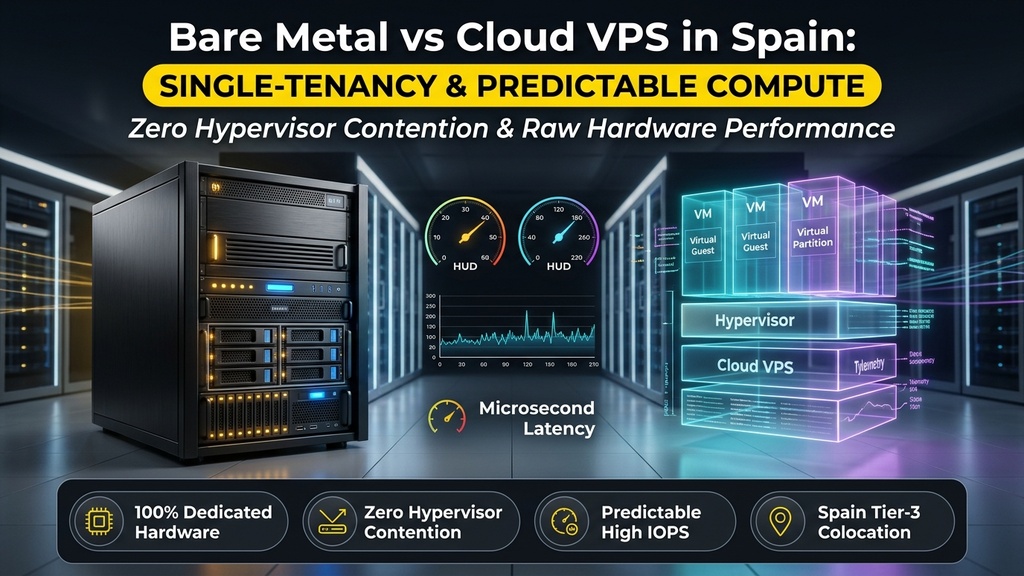
The core difference between bare metal and a cloud VPS in Spain is physical resource ownership versus hypervisor time-slicing. Bare metal dedicates CPU sockets, memory controllers, and local storage buses to one tenant, eliminating noisy-neighbor CPU steal and storage throttling—at the cost of manual OS lifecycle management and fixed monthly hardware commitment.
Stay on a Spanish or European cloud VPS if your workload is bursty, relies on rapid API-driven autoscaling, or lacks Linux operations staff. Plan a move to Madrid bare metal once production telemetry shows sustained %steal above 3–5% during peak hours, erratic iostat disk wait spikes, or steady-state compute bills exceeding $100–$300/month.
Deciding between bare metal vs cloud VPS in Spain fails when teams migrate too early or too late. Moving bursty microservices onto physical servers adds avoidable maintenance overhead, while leaving stateful databases on oversubscribed hypervisors turns Spanish peak hours into erratic p99 latency. The right inflection point is measurable directly from Linux scheduler and storage telemetry. This guide covers noisy-neighbor diagnostics, hardware isolation tradeoffs, and staged migration triggers for Madrid workloads.
Run mpstat -P ALL 1 30 and iostat -xz 1 30 during peak traffic; elevated %steal or erratic await confirms shared-host pressure rather than bad application code.
Dedicated hardware removes cross-tenant CPU scheduling and storage queues, but legal compliance under Spain's LOPDGDD still requires encryption, DPAs, and access governance.
Verified Madrid bare-metal tiers start at $93/mo (DSX22, 4C EPYC 3151, 32 GB RAM, 1 TB NVMe) and scale to $305/mo (DSX14, 64C EPYC 7662, 512 GB RAM).
Diagnosing VPS Noisy-Neighbor Bottlenecks
Before blaming application code or buying larger virtual instances, verify whether your cloud VPS actually receives the CPU cycles and disk responsiveness you pay for. On multi-tenant KVM or Xen hosts, oversubscription rarely triggers a hard crash; instead, it surfaces as intermittent tail-latency spikes between 10:00 and 20:00 CET when neighboring tenants run backups, analytics, or traffic bursts on the same physical motherboard.
Measuring CPU Steal (%steal) Without Guesswork
In Linux, %steal (%st) tracks the percentage of time a virtual CPU (vCPU) had runnable threads waiting while the hypervisor scheduled another tenant onto the physical core. On bare metal, %steal is structurally zero because no hypervisor sits below the host kernel.
Capture continuous 30-second telemetry during peak Spanish business hours using standard sysstat utilities. (Note: These read-only commands follow documented Linux sysstat and procps syntax; they were not executed against live customer servers in this draft.)
Interpreting Contention Thresholds
Read these metrics together before concluding you have a noisy-neighbor problem:
- Sustained
%stealabove 2–5%: Confirms your vCPUs wait routinely on host scheduling. Even 4% average steal over 30 seconds can conceal 100–250 ms scheduling pauses that stall database locks and real-time APIs. - High context switches (
cs) and rising run queue (r) with moderate%usr: Frequently signals vCPU preemption or last-level L3 cache thrashing as neighboring VMs evict your working set—contention that%stealalone understates. - Elevated
awaiton modestr/s+w/sIOPS iniostat -xz: Points to shared networked storage congestion or exhausted cloud IOPS burst credits. - Burstable CPU Credit Depletion: On burstable cloud tiers, throttling occurs even on quiet hosts once baseline credits empty; check provider credit metrics first.
If %steal remains near 0.0% and await stays flat while %usr hits 100%, fix query plans or scale application workers before buying bare metal.
Physical Silicon Isolation vs Hypervisor Scheduling
Moving from a cloud VPS to single-tenant hardware removes the virtualization boundary across CPU execution, cache residency, memory controllers, and PCIe I/O.
Hypervisor Scheduling vs. Direct Core Ownership
Even when a VPS offers "dedicated vCPUs" (1:1 thread pinning), guest kernels still pay VM-exit (VMEXIT) overhead for privileged instructions, virtualized interrupts, and paravirtualized rings (virtio-net, virtio-blk). On single-tenant bare metal:
- Zero Hypervisor Preemption: Your Linux scheduler dispatches threads directly to physical cores without external host scheduling pauses.
- Private Cache Residency: Hot Redis keys, PHP-FPM workers, and database B-tree pages remain warm in L1/L2/L3 caches rather than being evicted by neighboring tenants.
- Explicit NUMA Control: On dual-socket or chiplet servers (such as AMD EPYC), you pin memory-intensive processes to local NUMA nodes via
numactlorsystemd. For silicon selection between high-clock desktop-class chips and multi-channel server CPUs, see our AMD Ryzen 9 9950X vs AMD EPYC processor comparison (scheduled cluster guide).
Security Isolation and Spanish Regulatory Reality
Teams in Spanish fintech, healthcare, and e-commerce often evaluate bare metal for compliance. Separate genuine hardware isolation from overstated legal claims:
- What Single-Tenancy Solves: Removing unrelated tenants from the CPU package eliminates cross-tenant exposure to speculative-execution side-channel flaws (Spectre variants, MDS, L1TF) and removes hypervisor escape surfaces.
- What Single-Tenancy Does NOT Automatically Solve: Hosting hardware in Madrid does not by itself guarantee compliance with Spain's Ley Orgánica 3/2018 (LOPDGDD, Official State Gazette
BOE-A-2018-16673) or EU GDPR oversight by the Agencia Española de Protección de Datos (AEPD), nor does physical location automatically confer immunity from extraterritorial frameworks like the US CLOUD Act if your organization or sub-processors fall under US jurisdiction. Compliance still requires Data Processing Agreements (DPAs), encryption at rest/in transit, RBAC, audit trails, and 72-hour breach workflows.
Storage Queue Depth & Predictable IOPS
For database-driven Spanish applications, erratic storage latency—not raw CPU speed—usually forces the move off cloud VPS first.
Why Virtualized Block Storage Degrades Under Concurrency
Cloud VPS volumes normally attach over a networked storage fabric (Ceph RBD or distributed SAN) via virtio-blk/virtio-scsi, creating three bottlenecks:
- Network Replication Hops: Every synchronous PostgreSQL WAL or MySQL InnoDB
fsync()commit traverses a storage network and awaits multi-node acknowledgment before unlocking the database thread. - Baseline IOPS & Burst Credit Caps: Standard cloud SSD volumes cap baseline throughput (often around 3,000 IOPS unless you pay extra for provisioned IOPS) and drain burst buckets rapidly during nightly backups or catalog re-indexing.
- Shared Controller Queues: Even local-NVMe VPS slices partition physical flash across tenants, exposing your write queue to another customer's sequential write storm.
Direct PCIe NVMe on Bare Metal (And Redundancy Responsibility)
Local bare-metal NVMe connects directly to CPU PCIe lanes with deep multi-queue parallelism and no storage network hop. However, local storage removes the cloud provider's invisible distributed redundancy: entry single-drive Madrid tiers like DSX22 (1 TB NVMe) and DSX1 (1 TB SATA) have zero local disk fault tolerance. Production stateful workloads belong on dual-drive tiers (DSX5, DSX15, DSX14) configured with RAID 1 or ZFS mirroring. For NVMe queue depth, DWPD endurance, and Power Loss Protection (PLP) details, read our PCIe NVMe vs SATA storage performance guide (scheduled cluster guide).
Cost & Operational Tradeoffs: When VPS Still Wins
Bare metal maximizes compute-per-euro under steady utilization, yet cloud VPS remains the better tool in five common scenarios:
- Spiky or Highly Seasonal Traffic: Workloads idling most of the month before spiking 10–15x during short flash campaigns benefit from hourly autoscaling rather than 24/7 fixed hardware.
- No Dedicated Linux Ops Coverage: On unmanaged bare metal, your team handles kernel security updates,
nftablesfirewalls, RAID/ZFS monitoring, drive swap coordination, and off-server backup validation. - Ephemeral CI/CD & Short-Lived Staging: Provisioning and destroying 20 test environments in 90 seconds via Terraform is effortless on cloud APIs unless you first build your own Proxmox virtualization layer.
- One-Click Block Snapshots: Cloud block storage provides API-level volume clones independent of guest filesystems; bare metal requires ZFS/LVM snapshot scripting.
- Small Steady Footprints (
< $50/mo): Lightweight 2 vCPU / 4 GB microservices rarely justify$93–$169/mounless isolation mandates single-tenancy.
Illustrative Economics (CLEARLY_HYPOTHETICAL Crossover Example)
Transparency Note (CLEARLY_HYPOTHETICAL): Cloud rates vary by provider and reserved commitment; always verify live quotes and include internal sysadmin hours in your TCO calculation.
Consider a hypothetical 24/7 Spanish SaaS stack needing 8 dedicated cores, 64 GB RAM, a 40 GB PostgreSQL database, and 8 TB/month outbound transfer:
- Hypothetical Public Cloud / VPS Tier: Dedicated compute, provisioned high-IOPS block volumes, snapshots, and 8 TB of metered European cloud egress (commonly billed near
$0.08–$0.09/GBafter small free tiers) can push monthly spend into the$450–$900+band. - Verified Madrid Bare-Metal Reference: In Onlive Server's verified Spain catalog (confirm live stock and transfer policy at checkout),
DSX19(Ryzen 9700X 8C, 64 GB RAM, 1 TB NVMe, 1 Gbps) lists at$169/mo($135.20triennial), dual-NVMeDSX15(Xeon Silver 4116 24C, 96 GB RAM,2x 1 TB NVMe, 2 Gbps) at$259/mo($207.20triennial), andDSX14(EPYC 7662 64C, 512 GB RAM,2x 3.84 TB NVMe, 2 Gbps) at$305/mo($244.00triennial).
Once steady utilization, RAM needs, or monthly egress climb, fixed bare-metal pricing quickly leaves headroom even for a second failover server and off-site backup storage.
Staged Migration Triggers for Madrid Workloads
Tie hardware moves to observable telemetry rather than guesswork, and migrate stateful bottlenecks first.
Workload Migration Trigger Matrix
| Workload Profile | Keep on Cloud VPS When… | Trigger Madrid Bare Metal When… | Verified Madrid Tier Reference |
|---|---|---|---|
| PostgreSQL / MySQL Primary DB | Working set < 8 GB, flat iostat await |
Erratic await spikes, RAM costs surge, or sync WAL stalls on networked storage |
DSX5 (2x1 TB NVMe, 128 GB, $295/mo) or DSX14 (2x3.84 TB NVMe, 512 GB, $305/mo) |
| WooCommerce / PrestaShop | Low checkout concurrency; CDN serves >90% hits | Checkout p95 slows under %steal or DB lock pressure during campaigns |
DSX19 (Ryzen 9700X, $169/mo, add off-host backup) or DSX20 (Ryzen 9950X, 2x2 TB NVMe, $384/mo) |
| Multi-Tenant SaaS / VMs | < 4 small VMs; frequent API spin-ups |
Combined VPS spend crosses $250–$350/mo with steady 24/7 utilization |
DSX15 (24C, 96 GB, 2x1 TB NVMe, $259/mo) or DSX14 (64C, 512 GB, $305/mo) |
| High-Egress API / Media | Outbound < 1–2 TB/mo within bundled quota |
Metered cloud egress bills overtake compute every month | DSX22 (10 Gbps, $93/mo) or DSX23 (10 Gbps, 256 GB, $307/mo) (verify transfer policy) |
| Staging & Microservices | Intermittent load; zero-ops priority | Rarely standalone; consolidate onto an existing Proxmox/K8s bare-metal node | Remain on Cloud VPS |
Pre-Order Provider Verification Checklist
Before ordering a high-performance Spain dedicated server in Madrid, confirm five items in writing with support:
- Port Transfer Policy: Verify whether
1 Gbps,2 Gbps, or10 Gbpsports include unmetered transfer, monthly TB caps, or 95th-percentile billing. - Out-of-Band Console (IPMI / KVM-over-IP): Confirm permanent remote console availability for firewall or kernel recovery.
- Local Redundancy & Controller Mode: Select dual-drive tiers (
2x NVMe/2x HDD) for stateful apps and confirm raw HBA/JBOD pass-through vs. hardware RAID. - Hardware Swap SLA: Clarify target replacement windows for failed drives, RAM, or PSUs in Madrid.
- Private L2 VLANs & IPv4 Routing: Confirm private inter-node VLAN pricing and routed IPv4 subnet delivery before building multi-server tiers.
Safe Staged Cutover Sequence
Operational Cutover Warning: Never decommission your source VPS the same day you flip DNS to bare metal. Keep the VPS warm and reachable for at least 72 hours of peak Spanish traffic so firewall mistakes or connection-pool regressions can roll back cleanly.
- Harden SSH,
nftables, and automated off-host backups on the new Madrid host first. - Stream PostgreSQL/MySQL replication asynchronously from the VPS so the target catches up live.
- Lower DNS TTLs to
60–300seconds 48 hours ahead of cutover. - Enter a brief read-only window, confirm zero replication lag, promote the Madrid database, switch DNS/proxy upstreams, and watch error logs and p95 latency continuously.
Frequently Asked Questions
Compare Verified Madrid Bare-Metal Specifications
If your production telemetry points to CPU steal, storage throttling, or escalating cloud egress bills, review current AMD EPYC, AMD Ryzen, and Intel Xeon configurations on Onlive Server's Spain Dedicated Server catalog (from $93/mo entry servers to 512–768 GB RAM dual-NVMe hosts). Before placing an order, ask support to confirm bandwidth transfer terms, IPMI console access, and dual-drive RAID or JBOD options for your workload.