

Verified Answer
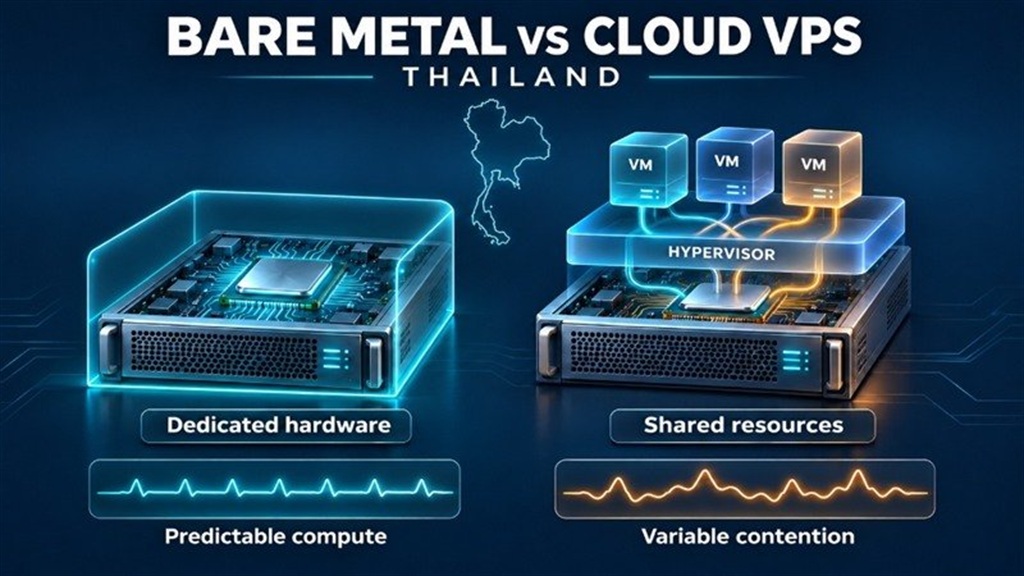
Dedicated bare metal in Thailand eliminates hypervisor resource contention and noisy-neighbor CPU steal (0.00% %steal), delivering sustained PCIe Gen4 NVMe throughput and dedicated 1 Gbps switch ports. Choose bare metal for high-concurrency databases and mission-critical applications; choose cloud VPS when rapid vertical elasticity and lower entry costs outweigh raw hardware predictability.
Engineering teams frequently reach an operational crossroad where vertical scaling on virtual private servers yields diminishing returns and unpredictable latency spikes. When concurrent application requests trigger severe CPU steal or storage wait times on shared hypervisors, migrating to dedicated bare-metal infrastructure in a Bangkok datacenter becomes an architectural necessity rather than a luxury. This guide analyzes the measurable performance differences between multi-tenant cloud VPS instances and isolated bare-metal servers, providing concrete diagnostic runbooks to evaluate hypervisor contention before making an infrastructure transition.
Reality: Cloud VPS shares physical CPU cores via KVM/Xen scheduler; bare metal grants 100% dedicated hardware threads with zero %steal.
Takeaway: Eliminates micro-stutter and unpredictable tail latency (p99) during traffic surges.
Reality: Virtualized disks route through hypervisor virtio/QEMU layers; bare metal communicates directly over PCIe Gen4 NVMe / SATA buses.
Takeaway: Eliminates storage queue congestion caused by noisy neighbor writes on shared SAN/NAS pools.
Reality: Cloud VPS uplinks share host NIC interfaces; Bangkok bare metal provides dedicated 100 Mbps or 1 Gbps physical switch ports.
Takeaway: Delivers sustained, unthrottled throughput for domestic Thai traffic without sudden cross-tenant throttling.
Measuring Multi-Tenant VPS Contention Before Migrating
Before investing engineering hours into a hardware migration, you must verify whether application slowdowns stem from internal code inefficiencies or external hypervisor resource starvation. In a virtualized cloud environment, multiple virtual machines (VMs) share the host machine’s physical CPUs, memory channels, storage backplanes, and network interface controllers (NICs). When neighboring tenants initiate heavy computational jobs or large disk writes, your virtual machine experiences forced execution delays.
The primary operating system metric indicating hypervisor-level CPU starvation is CPU Steal Time (documented in the Linux top manual page on CPU steal time metrics, %steal or %st). CPU steal occurs when the Linux kernel inside your guest VM is ready to execute instructions on a virtual CPU (vCPU), but the underlying physical hypervisor scheduler (such as KVM or Xen) allocates those physical CPU clock cycles to another guest container or virtual machine.
To measure this phenomenon across production nodes, execute the following non-destructive diagnostic sequence:
When reviewing the output of mpstat, any sustained %steal value exceeding 3.0% to 5.0% signifies severe multi-tenant contention. In database environments (PostgreSQL, MySQL) or synchronous runtimes (PHP-FPM, Node.js), a 5% steal time often triples 99th-percentile (p99) API latency.
Furthermore, inspect /proc/pressure/cpu. The some avg10 metric reports the percentage of time tasks were stalled waiting for CPU over the last 10 seconds. On isolated bare metal, CPU steal is physically impossible because the kernel directly executes on physical registers. On dedicated hardware, %steal remains permanently at 0.00%, restoring predictable execution curves.
Single-Tenant Hardware Isolation Across Bangkok Entry Tiers
Moving from a multi-tenant virtual slice to single-tenant hardware fundamentally alters execution predictability. On bare metal, the operating system kernel possesses exclusive control over hardware interrupts (IRQs), CPU cache hierarchies (L1, L2, and unified L3), physical memory controllers, and peripheral buses.
In a virtual machine, hardware cache lines are repeatedly flushed when the hypervisor context-switches between competing tenants. A cache-miss penalty forces the CPU to retrieve data from high-latency system RAM rather than on-die SRAM. On dedicated bare metal, database indexes and active process memory remain resident in processor caches without cross-tenant thrashing.
To evaluate practical hardware options, examine how verified bare-metal tiers deployed in Bangkok datacenters compare:
| Plan Identifier | Processor Architecture | Cores / Threads | Physical Memory | Primary Storage | Network Port | Monthly Entry Cost |
|---|---|---|---|---|---|---|
| DSX16 | AMD Ryzen 9 7900 | 12 Cores / 24 Threads (up to 5.4 GHz) | 16 GB DDR5 | 240 GB SSD | 1 Gbps Dedicated | $99 / mo |
| DSX10 | Intel Core i5 12600 | 6 Cores / 12 Threads (up to 4.8 GHz) | 16 GB DDR4 | 500 GB NVMe | 1 Gbps Dedicated | $119 / mo |
| DSX1 | Intel Xeon X3430 | 4 Cores / 4 Threads (2.40 GHz) | 8 GB DDR3 | 500 GB SATA | 100 Mbps Dedicated | $116 / mo |
The Thailand Dedicated – DSX16 plan provides an ideal example of raw single-tenant performance economics. Powered by an AMD Ryzen 9 7900 processor with 12 physical Zen 4 cores and 64 MB of L3 cache, this tier delivers sustained single-thread clock frequencies exceeding 5.0 GHz alongside 24 uninterrupted execution threads for $99 per month.
In contrast, provisioning an equivalent 12-vCPU / 16 GB RAM compute instance on public cloud infrastructure typically costs between $140 and $220 per month before factoring in storage IOPS allowances and bandwidth transfer fees. Moreover, those cloud vCPUs represent fractional time slices on an oversubscribed server rather than dedicated execution units.
For workloads requiring high single-thread clock speeds paired with ultra-low-latency NVMe block storage, reviewing AMD Ryzen and Intel Xeon Bangkok server configurations clarifies how specific microarchitectures handle complex multi-threaded concurrency versus compute-bound transactional tasks.
Storage, Port Speed & Memory Economics Compared to Cloud VPS
Storage bottlenecks represent the second most common failure mode on multi-tenant cloud platforms. Cloud providers frequently host virtual machine disks on shared Storage Area Networks (SAN). Because hundreds of customer disks traverse shared storage fabrics, providers enforce baseline IOPS throttles (often 3 IOPS per gigabyte) and charge steep surcharges for “provisioned IOPS.” A virtual machine with a 200 GB volume may be throttled to 600 baseline IOPS, causing severe disk queue delays (%iowait) during database operations.
On bare-metal architecture, your server interacts directly with dedicated physical drives. Modern configurations such as the Thailand Dedicated – DSX10 route storage traffic over PCIe Gen4 lanes using the Non-Volatile Memory Express (NVMe) protocol. Instead of the single hardware queue found in legacy SATA or virtualized SCSI drivers, NVMe supports up to 64,000 parallel queues, each handling up to 64,000 commands simultaneously.
For an in-depth breakdown of drive bus topologies, queue depth mechanics, and IOPS scaling, see our dedicated analysis on NVMe SSD storage architecture in Bangkok.
Network economics follow an identical trajectory. Public cloud platforms bill outbound bandwidth aggressively, often charging $0.08 to $0.12 per gigabyte. A service pushing 30 TB of monthly egress can accrue over $2,400 in network fees alone. In contrast, modern Bangkok bare-metal tiers (DSX10–DSX25) include dedicated 1 Gbps unmetered network ports in carrier-neutral facilities, eliminating variable egress invoices. Note that entry budget tiers (DSX1–DSX9) operate on dedicated 100 Mbps ports, providing steady throughput for lower-bandwidth services.
When a Thai Cloud VPS Still Outperforms Bare Metal on Agility & Cost
While bare-metal hardware eliminates hypervisor contention, dedicated infrastructure is not universally superior for every operational scenario. Architectural maturity requires recognizing when a virtual private server delivers superior business agility.
A cloud VPS remains optimal under specific conditions:
- Transient Workloads: Jobs requiring infrastructure briefly—such as CI/CD test runners or staging builds—benefit from hourly cloud billing. Provisioning a bare-metal server on a monthly commitment creates unnecessary financial overhead for workloads active only a few hours weekly.
- Horizontal Elasticity: Systems with brief, severe traffic spikes require automated horizontal scaling. Cloud hypervisors spin up and tear down virtual machine images via API calls within seconds. Bare metal requires pre-provisioned physical nodes standing by in rack cabinets.
- Minimal Resource Utilization: Early-stage projects and internal corporate micro-services consuming under 2 vCPUs and 4 GB of RAM are served cost-effectively by entry virtual instances. Committing $99 to $119 per month for a 12-core bare-metal server is over-engineering when an unmanaged 2 GB RAM slice satisfies demand.
- Instant Multi-Region Redundancy: Deploying secondary hot-standby instances across international zones is straightforward on global cloud fabrics. Note that AWS currently has its Bangkok cloud region (
ap-southeast-7) in development; active regional availability zones sit in Singapore (ap-southeast-1), Jakarta (ap-southeast-3), and Malaysia (ap-southeast-5). Running services in Singapore introduces roughly 25 to 35 milliseconds of cross-border fiber latency to Bangkok, whereas local Bangkok hosting delivers sub-10 millisecond domestic response.
Furthermore, compliance under the Thailand Personal Data Protection Act (PDPA B.E. 2562) governs where personal data is processed. Supervised by the Personal Data Protection Committee (PDPC), the PDPA mandates technical and organizational safeguards. Non-compliance risks civil punitive damages up to double actual damages, administrative fines up to THB 5,000,000, and criminal penalties up to one year imprisonment.
While hosting locally in Bangkok simplifies cross-border compliance under Sections 28 and 29, physical location alone does not ensure compliance. Systems engineers must implement disk encryption, access logging, and privilege separation. For detailed technical controls, consult our guide to the Thailand PDPA dedicated server compliance framework.
Staged Cutover Triggers & Pre-Order Verification Checklist
When your operational telemetry indicates that cloud VPS constraints are degrading user experience, follow an orderly decision framework to plan your bare-metal migration.
The following trigger matrix outlines the specific threshold metrics that justify migrating from a cloud VPS to dedicated Bangkok bare-metal hardware:
| Performance Metric | Warning Threshold (Plan Migration) | Critical Threshold (Immediate Cutover) | Bare Metal Resolution |
|---|---|---|---|
CPU Steal (%steal) |
> 3.0% sustained for > 15 mins | > 7.0% sustained during peak hours | Dedicated physical CPU cores (DSX16 Ryzen 9 7900 or DSX10 Core i5). |
Linux I/O Wait (%iowait) |
> 10.0% during database writes | > 25.0% causing HTTP connection drops | Direct PCIe NVMe storage bypassing hypervisor virtio abstraction. |
Disk Queue Latency (await) |
> 15 ms on transactional volumes | > 40 ms with blocked thread pools | Sub-millisecond dedicated local flash read/write operations. |
| Monthly Bandwidth Egress | Egress invoices exceed $300 / mo | Egress invoices exceed server base cost | Unmetered 1 Gbps physical switch port on DSX10–DSX25 series. |
| Regulatory Audit Scope | High-risk Thai PII processed | Section 28/29 cross-border transfers | Sovereign Bangkok datacenter physical hardware residency. |
Safe Pre-Migration Storage Rollback & Configuration Guardrails
[!CAUTION] Data Redundancy Warning: Catalog plans DSX1 through DSX3 and DSX10 through DSX21 ship standard with a single physical drive (for example, DSX10 includes 1x 500 GB NVMe; DSX16 includes 1x 240 GB SSD). If your production application requires hardware RAID 1 or software OpenZFS mirroring to withstand drive failure, you must explicitly request a secondary matched drive during order configuration. Running production databases on a single physical drive without active disk mirroring exposes your organization to unrecoverable data loss during hardware faults.
Before issuing order requests or initiating cutover procedures, complete this technical pre-order audit:
- [ ] Physical Drive Redundancy Verified: Have you ordered two identical physical drives for plans shipping with a single disk (DSX10–DSX21) to configure Linux software RAID (
mdadm) or OpenZFS mirror pools? - [ ] Network Port Speed Matched to Throughput Requirements: Did you verify whether your selected plan includes a 100 Mbps port (DSX1–DSX9) or a 1 Gbps unmetered port (DSX10–DSX25)?
- [ ] Out-of-Band Management Activated: Is dedicated IPMI / KVM-over-IP access enabled to guarantee remote console and virtual media rescue capabilities during kernel updates?
- [ ] Domestic Peering & Transit Path Audited: Has your network team verified traceroutes to major Thai consumer ISPs (AIS, True-Dtac, National Telecom) via local Bangkok internet exchanges (such as BKNIX, AS1025)?
- [ ] Rollback Strategy Documented: Is your existing cloud VPS configured to maintain asynchronous database replication from the new bare-metal server during the initial 72-hour cutover window?
By verifying these technical specifications prior to provisioning, engineering teams ensure that migrating to bare metal Thailand dedicated servers delivers deterministic low latency, eliminates hypervisor contention, and secures predictable operating expenditures.
Frequently Asked Questions
Ready to Eliminate Hypervisor Contention?
Shared virtualization introduces unpredictable CPU steal and noisy-neighbor storage degradation. Moving to dedicated bare metal in Bangkok ensures dedicated physical cores, isolated memory buses, and guaranteed hardware throughput for mission-critical services.

Naveen Rajput
Founder, CEO & Technical Director, Onlive Server
Naveen Rajput oversees enterprise infrastructure architecture, bare-metal server provisioning, and international peering networks across Onlive Server Tier III datacenters in Bangkok and worldwide.