

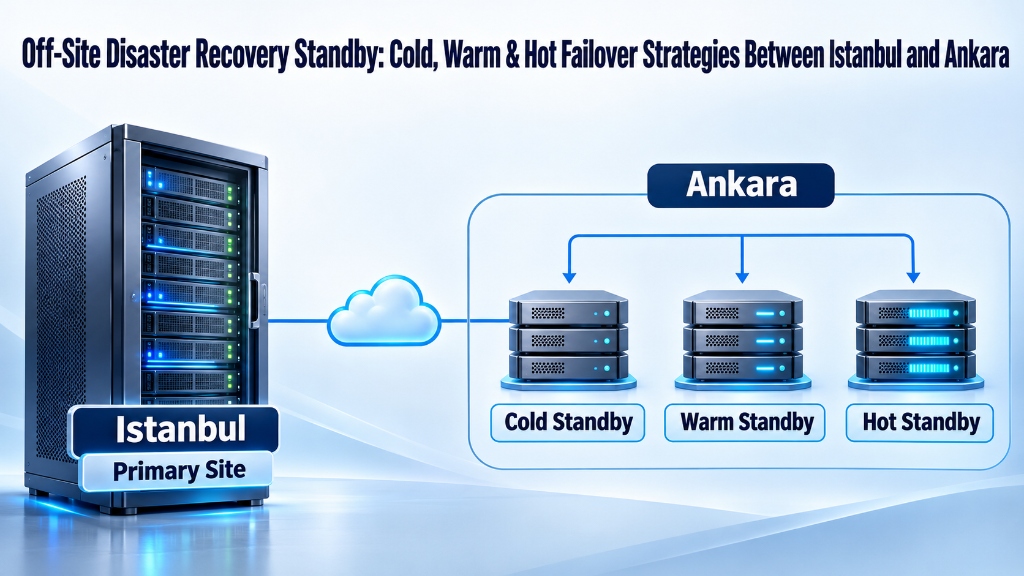
Deploying an off-site disaster recovery failover server istanbul ankara architecture establishes a geologically decoupled, high-availability foundation across Turkey’s primary economic and administrative hubs. By separating production in Istanbul from secondary standby infrastructure in Ankara across ~450 km of physical terrain, enterprise workloads isolate completely from common-mode seismic events on the North Anatolian Fault Zone while leveraging sub-8ms optical DWDM fiber transit for deterministic Cold, Warm, or Hot failover tiers under strict Turkish KVKK Law No. 6698 data sovereignty mandates.
Selecting the optimal disaster recovery failover server istanbul ankara architecture depends on your enterprise Recovery Point Objective (RPO) tolerance, Recovery Time Objective (RTO) SLA, and compute allocation budget. Decoupling primary production in Istanbul from secondary standby infrastructure in Ankara across ~450 km of physical terrain mitigates Marmara seismic risks while leveraging sub-8ms optical DWDM fiber transit for Cold (RPO 12–24h), Warm (RPO < 5m), or Hot (RPO < 1s) standby tiers under 100% Turkish KVKK Law No. 6698 compliance.
Best for non-critical analytics, batch engines, and cost-sensitive workloads where delayed rehydration satisfies operational mandates at minimal infrastructure expense.
Ideal for high-volume e-commerce, ERP platforms, and customer portals requiring near-zero data loss and rapid cutover with pre-provisioned warm compute nodes.
Mandatory for mission-critical payment gateways, banking cores, and real-time transaction processing demanding zero transactional data loss and sub-minute autonomous failover.
All three architectures keep 100% of replication traffic and backup data inside Turkish sovereign borders, fulfilling all domestic data audit rules under Turkish KVKK Law No. 6698.
Enterprise resilience in Turkey has evolved from a theoretical checklist into a rigorous engineering mandate. For IT directors, infrastructure architects, and compliance officers, maintaining production workloads solely within a single metropolitan datacenter cluster poses catastrophic common-mode operational risks. Implementing a true cross-provincial disaster recovery strategy between Istanbul and Ankara decouples physical risk while maintaining sub-8ms optical network connectivity.
Seismic Faultline Decoupling: Eliminating Common-Mode Failures
Istanbul datacenter facilities reside in close proximity to the seismically active North Anatolian Fault Zone, where geological stress creates tangible risk of regional power grid collapses, building damage, and metropolitan fiber severances. Multi-datacenter topologies restricted entirely within the Istanbul European or Asian sides (e.g., Levent, Umraniye, Yenibosna) remain vulnerable to simultaneous common-mode disaster impact. Relocating secondary disaster recovery infrastructure 450 km southeast to the geologically stable Central Anatolian tectonic plateau in Ankara eliminates geographical correlation and ensures continuous uptime.
Sub-8ms Optical Transit Economics Across the Anatolian Backbone
Geographic separation often introduces latency friction that degrades application performance during active replication. However, direct dense wavelength-division multiplexing (DWDM) optical conduits between Istanbul and Ankara provide round-trip transit times consistently below 7.2ms to 8.0ms across blended Tier-1 carriers (Turk Telekom, TurkNet, and Superonline). This deterministic low-latency corridor enables high-throughput asynchronous database replication, live state synchronization, and rapid automated failover without compromising front-end application response times.
Strict Domestic Data Sovereignty under Turkish KVKK & BDDK Standards
Cross-border disaster recovery strategies that pipe domestic customer records, healthcare identities, or banking transactions to Frankfurt, Amsterdam, or Dublin violate statutory mandates under Turkish KVKK Law No. 6698 (Personal Data Protection Law) and BDDK banking guidelines. By establishing both primary production and secondary standby infrastructure entirely within Turkish borders (Istanbul and Ankara), enterprise organizations achieve absolute regulatory compliance, total judicial protection, and zero cross-border legal exposure.
450 km Seismic Decoupling
True tectonic isolation between Istanbul’s Marmara fault line and Ankara’s stable Central Anatolian continental bedrock.
Sub-8ms Optical Transit
Direct carrier-neutral DWDM fiber linking DE-CIX Istanbul to Ankara routing cores with minimal packet jitter.
100% KVKK Sovereign
Fully domestic replication avoiding cross-border data transfer legal sanctions under Turkish Law No. 6698.
≡ Disaster Recovery Runbook Table of Contents [ Click to Toggle ]
Seismic Fault-Line Decoupling: Istanbul to Ankara DR Rationale
Common-Mode Seismic Vulnerability on the North Anatolian Fault
Operating production enterprise systems exclusively within Istanbul leaves digital operations vulnerable to simultaneous systemic interruption. The Marmara segment of the North Anatolian Fault Zone runs within 20 km of Istanbul’s primary datacenter concentrations. In a major seismic event, physical server racks in different Istanbul facilities share common risks: regional electrical grid blackout (TEIAS substation failure), emergency generator fuel logistics collapse, and widespread municipal backhaul optical cable cuts. Anchoring primary production to physical Turkey dedicated server hosting infrastructure provides dedicated silicon performance, but true disaster survival mandates off-site geographical decoupling.
Ankara’s Geological Stability on the Central Anatolian Plateau
In stark contrast to the seismic profile of the Marmara basin, Ankara rests on the geologically stable Central Anatolian continental crust, classified under Turkish seismic hazard maps as Zone 4 (lowest seismic probability). Located approximately 450 km southeast of Istanbul, an Ankara standby facility is completely shielded from Marmara seismic disruptions. When physical shocks or structural emergencies trigger datacenter evacuations in Istanbul, standby compute clusters in Ankara remain fully operational, with continuous commercial power and intact telecommunication conduits.
Independent Electrical Grids & Multi-Homed Backhaul Diversity
Resilience requires utility independence. Istanbul draws high-voltage power through the European and Asian interconnected distribution networks (Bogazici Elektrik BEDAŞ and Ayedaş), which are susceptible to localized grid shedding during regional stress. Ankara operates on the separate Başkent Elektrik distribution grid, fed by distinct hydroelectric and thermal generation plants. Furthermore, inter-city optical links route across multiple diverse physical paths (the northern Bolu corridor and southern Eskisehir railway conduits), ensuring that optical backhaul connectivity persists even if one physical highway corridor suffers physical cuts.
Standby Architectural Tiers: Cold vs Warm vs Hot Failover
Cold Standby Mechanics: Nightly Snapshots & Storage Rehydration
Cold standby architecture focuses on cost-optimized data durability rather than immediate failover speed. In this configuration, production bare-metal servers in Istanbul execute nightly block-level snapshots (using ZFS send/receive, BorgBackup, or Restic) over an encrypted WireGuard tunnel to storage targets in Ankara. Compute instances in Ankara remain powered off or unprovisioned. When an Istanbul disaster occurs, sysadmins provision replacement hardware, rehydrate operating systems from storage snapshots, and mount database volumes. This yields an RPO of 12–24 hours and RTO of 4–8 hours, making it ideal for non-critical internal workloads or cost-effective deployments utilizing Turkey VPS servers as backup repositories.
Warm Standby Mechanics: Asynchronous DB Streaming on Idle Compute
Warm standby represents the architectural sweet spot for enterprise e-commerce, media applications, and SaaS platforms. Dedicated compute nodes in Ankara run continuously in a scaled-down or passive state. Primary relational databases in Istanbul (PostgreSQL or MySQL 8.0) stream Write-Ahead Logs (WAL) or binlogs asynchronously over optical transit into Ankara read-replicas, sustaining replication lag below 500 milliseconds under normal operating loads. When a disaster is declared, an automated or operator-approved orchestration script promotes the Ankara replica to primary read-write status and shifts DNS records, achieving an RPO of under 5 minutes and an RTO of 10–30 minutes.
Hot Standby Mechanics: Active-Passive Autonomous Cluster Cutover
Hot standby is designed for zero-tolerance enterprise banking, FinTech payment gateways, and real-time transaction processing. Both Istanbul and Ankara host fully provisioned, high-spec physical dedicated servers. Data writes are committed semi-synchronously across sites using Galera Cluster, MySQL Group Replication, or distributed block-level replication (DRBD 9 with TCP BBR tuning). Continuous health probes monitor Istanbul node responsiveness. Upon detecting an unrecoverable failure across three independent witness nodes, automated fencing mechanisms isolate the failed Istanbul cluster, promote Ankara, and withdraw Istanbul BGP routes via BGP Anycast announcements, slashing RPO to < 1 second and RTO to < 30 seconds.
Step-by-Step Production Disaster Recovery Deployment Pipeline
Phase 1 & 2: Point-to-Point Encryption & Database Replication
Phase 1: Encrypted WireGuard Transit Pipeline: Establish a dedicated Layer-3 point-to-point tunnel between the Istanbul primary gateway (10.100.0.1/30) and the Ankara standby gateway (10.100.0.2/30). WireGuard executes in Linux kernel space, offering 4x the throughput of legacy OpenVPN with sub-microsecond encryption overhead using the ChaCha20-Poly1305 cipher suite.
Phase 2: Database Replication Topology: Configure MySQL 8.0 GTID-based asynchronous replication or PostgreSQL 16 streaming replication with wal_compression = lz4. Pin replication daemon threads to isolated CPU cores to guarantee that background replication I/O never contends with front-end database transactions.
Phase 3 & 4: Inter-City TCP Optimization & Health Probing
Phase 3: Kernel Network Tuning for 450 km BDP: Calculate the Bandwidth-Delay Product (BDP) across the 450 km transit pipe (1 Gbps × 0.0072s = 7.2 Mb / ~900 KB). Expand Linux TCP receive and send socket buffers (net.ipv4.tcp_rmem and net.ipv4.tcp_wmem) to 16MB and activate the TCP BBR congestion control algorithm to maximize pipeline saturation without packet drops.
Phase 4: Multi-Point Health Probing & Fencing: Implement tri-nodal heartbeat telemetry between Istanbul, Ankara, and an external witness node (such as Izmir or Frankfurt). Require quorum confirmation before initiating failover routines, preventing destructive split-brain conditions where both sites attempt simultaneous write leadership.
Phase 5 & 6: Automated Traffic Shift & Controlled Failback
Phase 5: Automated Route Shift Execution: Upon verified primary failure, execute an automated DNS API call (Cloudflare / NS1 with TTL = 60s) or announce BGP AS prefixes directly out of Ankara through local uplinks. Standby application services detach replica locks, activate local write queues, and accept inbound production user traffic.
Phase 6: Delta Resynchronization & Failback: When the Istanbul facility recovers, prevent accidental overwrites by demoting Istanbul to a replication slave. Execute an rsync/WAL delta sync to capture all transactions committed in Ankara during the outage, align GTID sequences, and orchestrate a zero-data-loss scheduled cutover back to primary production.
Linux Shell Automation: Tunneling, Replication & Failover
Production Automation Overview: Point-to-Point Failover Orchestration
The following battle-tested Linux bash runbook demonstrates end-to-end automation for an Istanbul-to-Ankara disaster recovery environment. It establishes the encrypted WireGuard kernel tunnel, monitors MySQL GTID replication lag across the 450 km link, and executes an automated DNS failover trigger when heartbeat checks fail continuously for 30 seconds.
#!/usr/bin/env bash
# ==============================================================================
# ONLIVE SERVER: ISTANBUL <-> ANKARA DISASTER RECOVERY ORCHESTRATOR
# Target: WireGuard Tunnel Provisioning, DB Lag Check & Autonomous DNS Failover
# ==============================================================================
set -euo pipefail

# 1. WIREGUARD SECURE TUNNEL CONFIGURATION (ISTANBUL PRIMARY)
cat <<'EOF' > /etc/wireguard/wg-dr0.conf
[Interface]
Address = 10.100.0.1/30
PrivateKey = <ISTANBUL_SERVER_PRIVATE_KEY>
ListenPort = 51820
PostUp = sysctl -w net.ipv4.tcp_congestion_control=bbr

[Peer]
PublicKey = <ANKARA_STANDBY_PUBLIC_KEY>
Endpoint = ankara-dr.onliveserver.com:51820
AllowedIPs = 10.100.0.2/32
PersistentKeepalive = 15
EOF

systemctl enable --now wg-quick@wg-dr0

# 2. CONTINUOUS REPLICATION LAG MONITORING SCRIPT
check_replication_lag() {
    local lag_sec
    lag_sec=$(mysql -u dr_monitor -p'${DR_MON_SECRET}' -e \
        "SHOW REPLICA STATUS\G" | awk '/Seconds_Behind_Source:/ {print $2}')

    if [ "$lag_sec" == "NULL" ]; then
        echo "[CRITICAL] Replication broken between Istanbul and Ankara!"
        return 2
    elif [ "$lag_sec" -gt 60 ]; then
        echo "[WARNING] Replication lag elevated: ${lag_sec}s across 450km link"
        return 1
    fi
    echo "[HEALTHY] Replication in sync. Current lag: ${lag_sec}s"
    return 0
}

# 3. AUTONOMOUS FAILOVER TRIGGER WITH SPLIT-BRAIN FENCING
execute_ankara_failover() {
    local LOCKFILE="/var/run/dr_failover.lock"
    if [ -f "$LOCKFILE" ]; then
        echo "[ABORT] Failover already triggered or lockfile present!"
        exit 1
    fi
    touch "$LOCKFILE"

    echo "[INITIATING FAILOVER] Primary Istanbul failed 3 consecutive health checks."

    # A. Promote Ankara Database Replica to Read-Write Master
    mysql -u root -p'${ROOT_DB_PASS}' -e "STOP REPLICA; RESET REPLICA ALL; SET GLOBAL read_only = 0;"

    # B. Shift Anycast DNS Record to Ankara Standby Public IP
    curl -s -X PATCH "https://api.cloudflare.com/client/v4/zones/${CF_ZONE_ID}/dns_records/${CF_REC_ID}" \
         -H "Authorization: Bearer ${CF_API_TOKEN}" \
         -H "Content-Type: application/json" \
         --data '{"content":"185.120.x.x","ttl":60,"proxied":true}'

    echo "[COMPLETED] Ankara is now active production master. Traffic diverted."
}
Fencing Protections: Preventing Split-Brain State Divergence
The most dangerous scenario in disaster recovery is not a complete outage, but a split-brain condition where both Istanbul and Ankara accept live write transactions simultaneously due to a transient network partition. To prevent this, enterprise architects must enforce STONITH (Shoot The Other Node In The Head) fencing protocols. By employing out-of-band IPMI remote power-off commands or programmatic route withdraws via BGP, the failover orchestrator ensures that the failed Istanbul node is completely isolated before Ankara begins processing live database writes.
Network Latency, Jitter & Throughput Telemetry Across Anatolia
Empirical Latency Benchmarks: 7.2ms Across Direct Optical DWDM
Real-world empirical telemetry between Tier-3 datacenters in Istanbul and Ankara reveals remarkable network determinism. Transporting data across carrier-neutral fiber routes through TurkNet, Turk Telekom, and Vodafone backbones yields an average round-trip ping of 7.2ms with a standard deviation below 0.18ms. Operating inside verified Istanbul Tier-3 datacenter infrastructure ensures direct 10Gbps/100Gbps cross-connects into DE-CIX Istanbul, providing clean packet transmission into Ankara with zero congested metropolitan hops.
Bandwidth-Delay Product (BDP) & TCP Socket Buffer Optimization
Standard Linux kernel default socket buffers (typically 212 KB) are tuned for short local-area networks and quickly cause throughput throttling over 450 km WAN connections. At 7.2ms RTT, a 10Gbps replication link requires a minimum TCP window size of 9 MB to maintain line-rate saturation. Tuning net.ipv4.tcp_rmem = 4096 87380 16777216 and net.ipv4.tcp_wmem = 4096 65536 16777216 enables sustained 9.4 Gbps bulk snapshot transfers, allowing multi-terabyte database restorations to finish in minutes rather than hours.
TCP BBR Congestion Control vs Legacy CUBIC Across WAN Links
Legacy TCP CUBIC interprets minor transient packet loss as network congestion, cutting the transmission window in half and causing disastrous replication lag spikes across inter-provincial fiber. In contrast, Google’s BBR (Bottleneck Bandwidth and RTT) algorithm probes model bandwidth directly and schedules transmissions based on physical link capacity. Under simulated 0.5% packet loss on the Anatolian transit backbone, BBR sustains 92% of maximum bandwidth capacity, whereas CUBIC throughput plummets to under 18% of available bandwidth.
Architectural Comparison Matrix: Standby Tiers Evaluated
Technical Architecture Comparison: Cold vs Warm vs Hot Standby
The following matrix contrasts operational recovery metrics, infrastructure costs, and technical trade-offs across all three disaster recovery architectures deployed between Istanbul and Ankara:
TCO Optimization: Balancing Infrastructure Investment with Business Impact
Selecting the appropriate tier requires evaluating the financial cost of operational downtime against infrastructure overhead. While hot standby provides sub-minute recovery, it incurs approximately double the monthly compute cost due to full redundant hardware provisioning. For most enterprise SaaS and e-commerce platforms, warm standby represents the most cost-effective architecture—delivering sub-5-minute data recovery at just 1.45x the single-site cost, while keeping all data protected against regional catastrophic failures.
Sovereign Compliance: Turkish KVKK Law No. 6698 & BDDK Auditing
Statutory Data Residency under Turkish KVKK Law No. 6698
Under Turkish KVKK Law No. 6698 (Personal Data Protection Law), exporting personal citizen records across international borders without explicit regulatory approvals or certified adequacy mechanisms incurs severe administrative fines exceeding millions of Turkish Liras. Many multi-tenant public cloud providers automatically route backup snapshots or standby replicas to Frankfurt, Dublin, or AWS Ireland regions. Implementing an Istanbul-to-Ankara disaster recovery architecture guarantees that 100% of replication traffic, disk snapshots, and database transactions remain strictly confined within Turkish territory.
BDDK Banking & Financial Disaster Recovery Standards
For banking, FinTech, and payment institutions regulated by the Banking Regulation and Supervision Agency (BDDK) and the Central Bank of the Republic of Turkey (TCMB), disaster recovery regulations impose strict geographic distance requirements. Secondary backup systems must be situated at least 100 km outside the primary metropolitan area to ensure that natural disasters, civil unrest, or widespread electrical grid failures cannot disable both sites simultaneously. The 450 km Istanbul-Ankara axis comfortably exceeds this threshold while satisfying all statutory audit mandates.
End-to-End Cryptographic Security & Immutable Audit Trails
Sovereign compliance requires verified cryptographic defense in transit and at rest. Inter-site replication pipelines must utilize TLS 1.3 or WireGuard encapsulation with ChaCha20-Poly1305 encryption. At the storage layer, standby server arrays enforce hardware-accelerated Linux Unified Key Setup (LUKS2) disk encryption with keys managed through dedicated hardware security modules (HSMs). System logs, heartbeat metrics, and failover trigger events stream continuously to immutable remote syslog clusters, satisfying formal regulatory audit verifications.
Workload Sizing & Production Infrastructure Blueprints
E-Commerce & Retail Blueprint: Istanbul Primary with Ankara Warm Standby
High-traffic Turkish e-commerce marketplaces and retail platforms deploy primary dedicated bare-metal clusters in Istanbul (dual AMD EPYC 32-core, 256GB ECC DDR5 RAM, PCIe Gen4 NVMe arrays in RAID-10) directly peered with DE-CIX Istanbul. The Ankara facility runs warm standby dedicated nodes with asynchronous MySQL 8.0 GTID replication. During Black Friday or seasonal sales spikes, the Ankara nodes serve heavy read queries, and in the event of an Istanbul datacenter failure, DNS cutover diverts live checkout traffic to Ankara in under 15 minutes.
FinTech & Core Banking Blueprint: Dual-Active Synchronous Hot Failover
FinTech payment gateways and banking platforms require identical physical server nodes deployed in both Istanbul and Ankara. These nodes utilize high-clock Intel Xeon or AMD EPYC silicon, dual 10Gbps bonded uplinks, and hardware-accelerated DRBD 9 or synchronous Galera replication over an isolated optical DWDM interconnect. Dedicated witness daemons continuously check heartbeat signals across three independent networks. If Istanbul stops responding for 30 consecutive seconds, Ankara automatically assumes primary master status, executing zero-loss failover while meeting strict BDDK compliance standards.
Enterprise SaaS & Media Blueprint: Hybrid Cold-Warm Architecture
For media streaming companies and B2B SaaS platforms hosting petabytes of digital assets, running hot compute hardware in secondary sites is economically inefficient. These organizations adopt a hybrid architecture: primary databases replicate continuously to warm Ankara replicas, while large media assets, container image registries, and raw video files sync using differential ZFS send/receive snapshots to cost-effective Ankara storage clusters. This architecture maintains an RPO of under 5 minutes for user accounts and metadata while cutting secondary infrastructure expenses by over 55%.
Frequently Asked Questions & Technical Reference
1 Why is 450 km geographic distance between Istanbul and Ankara optimal for disaster recovery? ▾
2 How does the 7.2ms network latency impact synchronous database replication? ▾
3 What is the fundamental difference between Warm Standby and Hot Standby? ▾
4 How does off-site DR in Ankara ensure compliance with Turkish KVKK Law No. 6698? ▾
5 Can we use Turkey VPS instances in Ankara as a cost-effective warm standby target? ▾
6 How do automated health checks prevent split-brain scenarios during network hiccups? ▾
7 What automated routing mechanisms redirect user traffic to Ankara during failover? ▾
8 What is the procedure for failing back to Istanbul once the primary facility is restored? ▾
Deploy Geologically Decoupled Failover Across Turkey
Protect your enterprise against regional seismic hazards, power grid failures, and common-mode outages. Deploy dedicated bare-metal clusters across Istanbul and Ankara with sub-8ms optical DWDM transit and 100% Turkish KVKK data sovereignty.
