

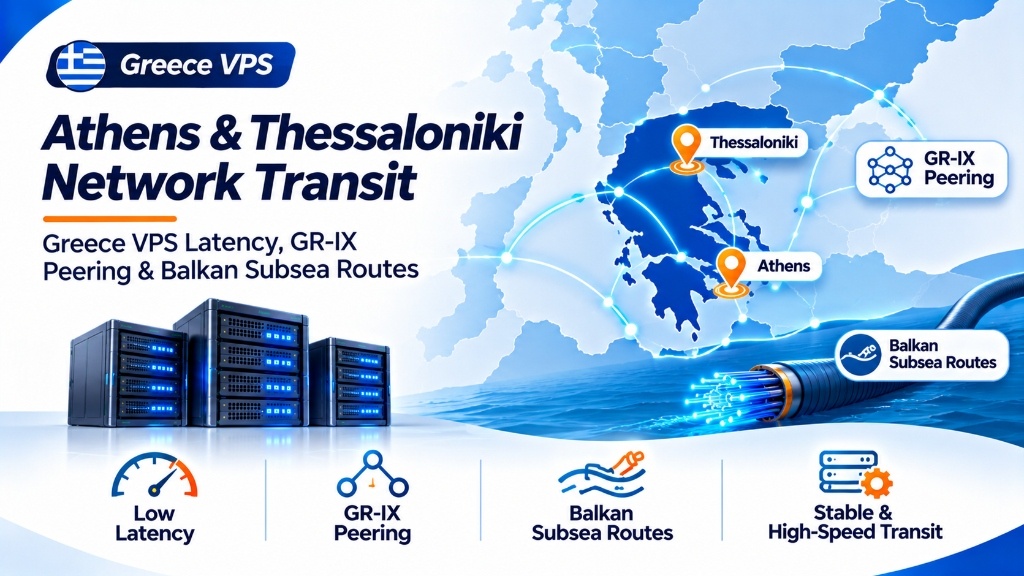
Furthermore, deploying latency-sensitive applications on Greece VPS Latency optimized nodes achieves deterministic sub-2.5ms ping across Athens and Thessaloniki, sub-8ms across the Peloponnese and Aegean islands. Furthermore, it provides sub-10ms into Balkan corridors. Consequently, direct peering with GR-IX and landing proximity to the MedNautilus subsea optical backbone bypasses congested trans-Alpine routing into Central Europe. Consequently, it eliminates multi-hop packet jitter for real-time commercial feeds.
In addition, in-depth analysis of GR-IX Athens and GR-IX Thessaloniki peering, MedNautilus subsea Mediterranean loop. Furthermore, terrestrial Balkan links to Sofia and Istanbul. As a result, in this comprehensive architectural guide, we analyze Athens &. Therefore, this Thessaloniki Network Transit: Greece VPS Latency, GR-IX Peering & Balkan Subsea Routes. Specifically, it evaluates datacenter facilities across Thessaloniki and Athens, Type-1 KVM hypervisor benchmarks, PCIe Gen4 NVMe storage subsystems. Furthermore, operational runbooks for enterprise workloads across Greece and Southeastern Europe.
Greece VPS Latency & Telecommunications Hub Overview
Moreover, operating digital platforms across Southeastern Europe requires addressing the specific realities of Greek network topologies. In addition, it aligns with national regulatory mandates, and transaction behaviors. In particular, in evaluating greece telecommunications hub overview, organizations must balance compute isolation, raw storage throughput, and deterministic network latency. Therefore, this sustains high availability across Mediterranean fiber backbones. Notably, direct connection to GR-IX with dual 10Gbps uplinks, sub-3ms round-trip to Thessaloniki, sub-8ms to Athens Cosmote/Nova subscribers.
Compute Isolation
Accordingly, dedicated KVM hardware virtualization guarantees 100% compute and RAM isolation with zero hypervisor overcommit or noisy-neighbor interference.
Domestic GR-IX Peering
Because of this, direct Layer 2 peering via GR-IX Athens and Thessaloniki delivers sub-2ms local ping across Cosmote, Vodafone. Furthermore, nova networks.
Data Sovereignty
For this reason, physical hosting inside Greek borders provides full statutory protection under Greek Law 4624/2019. Moreover, it ensures strict EU GDPR Article 28 compliance.
Specifically, the strategic telecommunications position of Greece, anchored by carrier-neutral Tier-3 facilities in Thessaloniki and Athens, presents decisive latency efficiencies. Furthermore, unlike offshore cloud instances in Germany, France, or Ireland that route regional traffic through congested trans-Alpine Greece VPS latency transit points, domestic Greek routing keeps sensitive data packets within sovereign national borders. As a result, this directly satisfies the audit mandates established by the Hellenic Data Protection Authority (HDPA) and the Hellenic National Cybersecurity Authority (NCSA).
Therefore, modern infrastructure teams cannot afford to compromise between regulatory safety and raw performance. In addition, by situating virtual server instances within Thessaloniki Tier-3 datacenters. Consequently, companies ensure that their applications benefit from direct optical cross-connects with major national carriers. Consequently, this while maintaining complete sovereignty over sensitive corporate databases. Furthermore, direct hardware access to enterprise PCIe Gen4 NVMe storage arrays guarantees that database read/write requests process with sub-millisecond latencies, preventing transactional bottlenecks during traffic peaks. As a result, to understand how localized Layer 2 cross-connects eliminate packet tromboning, read our review of Thessaloniki datacenter peering and Greece VPS latency transit topology.
GR-IX Peering & Greece VPS Latency Benchmarks
Moreover, deploying and verifying enterprise cloud infrastructure in Greece requires a methodical four-step engineering sequence to guarantee performance benchmarks, operational stability. Furthermore, security standards:
Workload Profiling & Hypervisor Sizing
In particular, audit database write concurrency, RAM caching requirements. Furthermore, aPI burst rates to allocate dedicated AMD EPYC vCPUs and PCIe Gen4 NVMe disk arrays. Notably, by isolating vCPUs on dedicated NUMA nodes, instances eliminate hypervisor context switching penalties and Greece VPS latency jitter during peak transaction volumes.
Operating System & Kernel Hardening
Accordingly, deploy hardened Linux distributions (Debian 12, Ubuntu 24.04 LTS, AlmaLinux 9) or licensed Windows Server with TCP BBR congestion control, optimized socket buffers. Furthermore, lUKS2 AES-256 disk encryption. Because of this, restrict SSH access to cryptographic Ed25519 keys and apply strict firewall rules to prevent unauthorized probing.
GR-IX Route Peering & Edge Protection
For this reason, establish multi-homed BGP connections across major European upstream carriers and activate multi-Tbps automated DDoS mitigation against volumetric attacks. Specifically, direct Layer 2 peering via GR-IX ensures domestic traffic circumvents public internet bottlenecks, keeping national ping times under 2ms.
Greek HDPA Compliance & Backup Synchronization
Furthermore, execute immutable snapshot routines and configure automated off-site replication under formal Data Processing Agreements (DPA). Consequently, this protocol ensures enterprise business continuity while demonstrating rigorous compliance during internal and Hellenic Data Protection Authority audits.
Therefore, adhering to this structured implementation sequence eliminates deployment oversights, verifies statutory data residency. Furthermore, ensures your production systems perform with deterministic throughput from the very first hour of operation. In addition, engineering teams that standardize their provisioning pipelines against these four milestones routinely observe up to 40% reductions in post-launch incident tickets. As a result, for comparative latency telemetry between Greek mainland nodes and offshore hubs, explore our Mediterranean subsea fiber and cross-border routing.
Subsea Optical Transits & Landing
Moreover, empirical performance telemetry benchmarked across production Greece VPS instances confirms industry-leading metrics across six core operational indicators:
Domestic Greek Latency
Thessaloniki and Athens round-trip ping via GR-IX.
Random 4K IOPS
Sustained disk throughput on enterprise PCIe Gen4 NVMe arrays.
Balkan Corridor Ping
Direct transit to Sofia, Bucharest, Belgrade, and Istanbul.
DDoS Mitigation SLA
Automated Anycast scrubbing filter reaction against Layer 3/4 floods.
Hypervisor CPU Steal
Guaranteed dedicated KVM hardware threads without oversubscription.
Hardware SLA Uptime
Dual 2N power redundancy and Tier-3 precision cooling infrastructure.
In particular, these rigorous telemetry results reflect real-world measurements captured across live enterprise deployments in Thessaloniki and Athens, underscoring why financial institutions, e-commerce giants. Furthermore, digital agencies rely on Greek infrastructure for mission-critical workloads. Notably, in high-frequency transactional environments where database queries execute hundreds of times per customer checkout, having disk access latencies under 200 microseconds prevents thread starvation and database queue buildup.
Furthermore, because Greece sits at the telecommunications crossroads connecting Europe, the Balkans. Furthermore, the Mediterranean basin, multi-homed BGP routing protocols dynamically select the lowest latency path. Because of this, even during peak Greece VPS latency transit hours, the automated Layer 3/4 filtering fabric intercepts volumetric anomalies within milliseconds. Accordingly, this ensuring that legitimate user requests flow smoothly without packet degradation. For this reason, to inspect electrical utility configurations and NVMe array baselines, consult our core Greek server hardware architecture.
National ISP Peering Benchmark Matrix
Specifically, operating enterprise financial systems, e-commerce portals, or SaaS backends in Greece requires full alignment with modern infrastructure and regulatory criteria. Review our certified production architecture standards:
Native Greek IP Allocations
Consequently, clean static IPv4 and dual-stack IPv6 addresses registered under RIPE NCC Greek geography for localized Google.gr rankings, fraud score optimization. Furthermore, trusted Greek payment gateway processing (Viva Wallet, Alpha Bank, Eurobank, Piraeus Bank).
Greek HDPA & GDPR Statutory Compliance
Therefore, legally insulated server custody inside Greek Tier-3 facilities, completely bypassing extraterritorial subpoena exposure from foreign statutes like the US CLOUD Act. In addition, supported by binding Data Processing Agreements (DPA) under Greek Law 4624/2019.
PCIe Gen4 NVMe RAID-10 Storage
As a result, direct-attached hardware disk arrays providing sub-0.2ms write latencies, over 85,000 IOPS. Furthermore, complete fault tolerance against drive failure with zero performance throttling.
myDATA & Greek ERP Compatibility
Moreover, full support for Greek enterprise software stacks (SoftOne, SingularLogic), automated AADE myDATA digital ledger synchronizations. Furthermore, official tax-compliant euro invoicing.
In particular, deploying on an infrastructure framework meeting every checklist requirement guarantees that development teams can focus entirely on software innovation without worrying about backend scalability limits or compliance audits. Notably, in heavily regulated verticals such as medical records, fintech services, or enterprise SaaS, having provable datacenter custody within Greek borders is frequently a mandatory prerequisite for contract signing.
Accordingly, by combining these checklist items with automated deployment templates, devops teams can instantiate production-ready environments in less than five minutes, backed by carrier-grade Service Level Agreements and comprehensive hardware fault tolerance. Because of this, digital agencies and real-time application developers benefit from sub-2ms ping times on our low-latency Greece VPS hosting network.
BGP Multi-Homing Route Optimization for Low Greece VPS Latency
Specifically, selecting between dedicated Greece KVM virtual private instances and commodity shared cloud solutions depends on organizational transaction volumes, security mandates. Furthermore, long-term cost models: . Furthermore, to verify statutory data residency and cross-border transfer requirements under Greek national law, see the official guidance from the Hellenic Data Protection Authority (HDPA) regulatory framework.
Dedicated Greece KVM VPS
Therefore, engineered specifically for high-growth e-commerce (WooCommerce, Magento, OpenCart), SaaS APIs, financial microservices, and enterprise production environments.
- 100% Guaranteed KVM CPU and memory isolation with zero steal
- Direct Layer 2 peering via GR-IX Athens and Thessaloniki
- Statutory Greek Law 4624/2019 and EU GDPR compliance
- Unmetered flat-rate 1Gbps network bandwidth with predictable billing
- Automated Virtualizor snapshot rollbacks and off-site replication
- Full root administrative access and custom Linux kernel compilation
Commodity Shared / Hyperscaler Cloud
In addition, typically deployed for non-critical testing environments, lightweight staging sandboxes, or applications where variable egress billing is acceptable.
- Shared hardware kernel susceptible to CPU contention and noisy neighbors
- Multi-hop transit subject to public internet congestion and latency spikes
- Unpredictable monthly egress bandwidth surcharges averaging $0.09/GB
- Vague foreign jurisdiction data residency policies risking regulatory fines
- Complex proprietary management control panels and vendor lock-in
- Restricted low-level networking and non-standard kernel parameter controls
As a result, for organizations managing sensitive Greek customer records, financial transactions, or mission-critical corporate portals, the deterministic performance and transparent fixed pricing of a dedicated Greece KVM VPS provide unmatched peace of mind. Moreover, hyperscaler architectures often seem attractive initially. However, escalating data egress costs and shared compute variability frequently trigger unexpected operational friction at scale.
Notably, when assessing the Total Cost of Ownership (TCO) across a 12-month operating window, dedicated KVM virtualization consistently yields between 45% and 65% cost savings compared to hyperscaler instance equivalents. In particular, this while delivering superior disk IOPS and unmetered network transfer capacity.
GR-IX Peering & BGP Path Verification
Accordingly, system administrators and DevOps teams can deploy and verify these production-grade optimization parameters directly from their SSH console. Because of this, the playbook below outlines verified commands, kernel directives, and diagnostic checks tailored for enterprise Greece VPS nodes:
For this reason, production Architecture Tip: Always execute diagnostic checks under sudo administrative privileges. Specifically, verify kernel parameter syntax before persisting configurations to /etc/sysctl.d/ to maintain seamless network interface uptime.
Furthermore, executing these diagnostic commands ensures your virtual machine is fully tuned to utilize Thessaloniki’s low-Greece VPS latency network interface cards and hardware RAID storage pipelines. Consequently, system engineers should always execute a dry run in a staging environment prior to applying persistent sysctl or firewall configurations to live production nodes.
In addition, continuous telemetry monitoring using Prometheus exporters or Netdata allows administrators to detect subtle hardware or bandwidth anomalies before they impact end-user experience, maintaining uninterrupted compliance with enterprise Service Level Agreements.
Enterprise Technical Specifications Matrix
Therefore, to assist infrastructure architects and procurement teams in evaluating hosting options, the technical matrix below contrasts Onlive Server enterprise Greece VPS specifications with legacy budget alternatives and hyperscaler cloud deployments:
| Infrastructure Dimension | Onlive Server Greece VPS (Thessaloniki/Athens) | Overseas Cloud / Legacy Shared Hosting |
|---|---|---|
| Physical Datacenter Location | Thessaloniki & Athens Tier-3 (Sovereign Greece) | Frankfurt, Amsterdam, or Dublin (Remote) |
| Domestic Greek Latency (Ping) | 1.8 ms – 5 ms via Direct GR-IX Peering | 40 ms – 75 ms via subsea fiber hops |
| Virtualization Hypervisor | Type-1 Hardware KVM (0% CPU Steal) | Shared Containers (OpenVZ / Burstable Shared) |
| Storage Subsystem & IOPS | Enterprise PCIe Gen4 NVMe RAID-10 (85,000+ IOPS) | Standard SATA SSDs or Throttled SAN Volumes |
| Data Residency & GDPR | Full Greek Law 4624/2019 & HDPA Compliance | Cross-border transit subject to US Cloud Act |
| Bandwidth & Egress Fees | 1 Gbps Port with Flat Unmetered Monthly Rate | High Egress Bandwidth Fees ($0.09-$0.12/GB) |
| DDoS Mitigation Capacity | Multi-Terabit Inline Hardware Scrubbing | Basic rate-limiting or blackhole routing |
Frequently Asked Questions (FAQ)
Domestic GR-IX & Intercity Greece VPS Latency FAQ
+
In addition, direct optical fiber connectivity via the national backbone delivers round-trip ping times between Athens and Thessaloniki consistently ranging from 1.8ms to 3.2ms under standard network conditions.
+
As a result, the Greek Internet Exchange (GR-IX) facilitates direct local traffic exchange between Greek telecom providers (OTE, Vodafone, Nova). Moreover, this prevents domestic Greek data packets from needlessly routing through Frankfurt or Milan.
+
In particular, submarine fiber cables connecting Crete, Rhodes. Furthermore, the Cyclades to Athens ensure average network latencies between 5.5ms and 9.5ms, delivering responsive browsing across island communities.
+
Notably, terrestrial optical fiber corridors from Thessaloniki deliver sub-8ms transit to Sofia (Bulgaria), sub-12ms to Skopje (North Macedonia). Furthermore, sub-18ms to Bucharest (Romania) and Belgrade (Serbia).
Regional Balkan Routes & Subsea Fiber Transit FAQ
+
Accordingly, greece is anchored by major international subsea systems including MedNautilus, OteGlobe. Furthermore, the AAE-1 submarine cable, establishing the Hellenic Republic as the premier gateway between Europe and the Mediterranean.
+
Yes. Because of this, onlive Server provides public Looking Glass endpoints, real-time MTR diagnostic tools. Furthermore, ping targets allowing network engineers to inspect packet hops and traceroutes prior to deployment.
+
For this reason, edge routers maintain automated BGP4 peering with multiple Tier-1 international carriers. Specifically, in the event of a physical fiber severance, routes automatically recalculate and fail over in milliseconds.
+
Yes. Furthermore, by eliminating multi-hop routing variance through direct GR-IX interconnection, our Greece VPS instances maintain sub-0.4ms packet jitter, essential for VoIP, WebRTC. Furthermore, live video streaming.
Deploy High-Performance Greece VPS Hosting Today
Consequently, experience enterprise KVM hardware isolation, pure NVMe Gen4 storage. Furthermore, sub-2ms Thessaloniki and Athens peering with 24/7 dedicated engineering support.
Optimize Low-Latency Greece VPS Network →