

Verified Direct Answer
Hong Kong Mega-i Telemetry & Technical Specifications
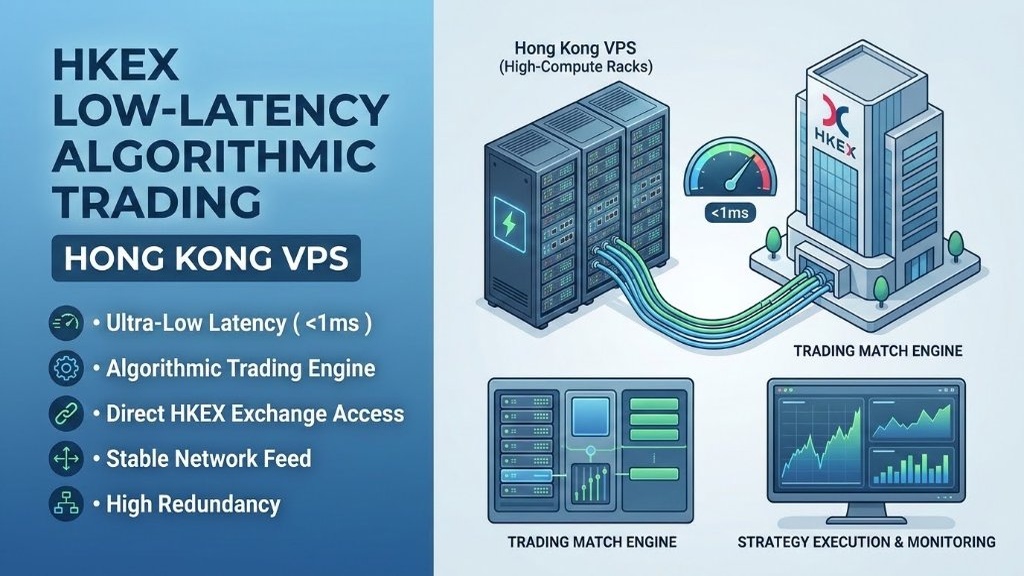
Consequently, operating a dedicated Hong Kong Forex VPS HKEX instance adjacent to Equinix HK1 and HK2 provides algorithmic traders with microsecond order execution. Therefore, executing algorithmic trading models on an enterprise Hong Kong Forex VPS delivers deterministic sub-1ms execution latencies to the Hong Kong Exchanges and Clearing (HKEX) matching engine. In addition, built with kernel-tuned Linux, dedicated KVM vCPU pinning. Furthermore, unshared DDR5 memory, this setup prevents jitter and execution slippage across high-frequency crypto and currency trading pairs.
Moreover, in quantitative Hong Kong Forex VPS HKEX algorithmic trading, high-frequency market-making. As a result, automated foreign exchange (Forex) speculation, execution speed is the ultimate competitive advantage. In particular, when market-moving macroeconomic data releases occur, or when sudden liquidity imbalances trigger aggressive price discovery across the Asian trading session, price quotes fluctuate in fractions of a millisecond.
Sub-1.2ms HKEX Proximity
Notably, direct optical fiber pathways to HKEX Next Generation Trading System (NGTS) and Orion Market Data Platform (OMD) in Tseung Kwan O.
Equinix HK1/HK2 Financial Mesh
Accordingly, direct Layer 2 cross-connect access to global Forex liquidity providers, major ECNs, and prime broker matching engines.
Dedicated CPU Core Isolation
Because of this, linux isolcpus and Windows thread affinity locking ensuring 100% dedicated hardware compute cycles with zero hypervisor context-switching.
Technical Architecture Contents
7 Modules
APAC Financial Trading Landscape & Hong Kong Forex VPS HKEX Architecture
Consequently, the Asian financial trading day opens in Tokyo and Sydney, surges through Hong Kong and Singapore. For this reason, overlaps seamlessly with European London openings. Therefore, within this daily global liquidity cycle, Hong Kong acts as the dominant regional capital hub, handling the vast majority of cross-border currency flows, offshore Renminbi (CNH) clearing. Specifically, regional equity derivatives. In addition, for algorithmic funds and quantitative traders, maintaining infrastructure in Hong Kong is indispensable for capturing intraday volatility across USD/CNH, USD/HKD, AUD/USD. Furthermore, hang Seng Index futures. As a result, organizations establish low-latency presence by deploying low-latency Hong Kong VPS hosting solutions across Asia-Pacific hubs.
SPECS Architectural Building Blocks
Offshore Renminbi (CNH) Hub
Moreover, hong Kong processes over 75% of global offshore Renminbi clearing, making it the primary epicenter for Asian FX liquidity.
Trans-Pacific Latency Gap
In particular, eliminate the catastrophic 200ms round-trip latency penalty incurred when executing Asian trades from North American or European servers.
SFC Regulatory Stability
Notably, operate within a globally respected financial regulatory jurisdiction backed by independent commercial courts and advanced financial infrastructure.
Accordingly, trading desks operating from overseas servers in London or New York face severe physical latency penalties exceeding 180ms to 240ms round-trip. Because of this, by the time market tick data crosses trans-oceanic submarine cables to an overseas server and trade orders return to the matching engine, market prices have already moved dozens of pips. For this reason, hosting your trading algorithms directly in Hong Kong levels the playing field against regional institutional trading desks.
Equinix HK1 & HKEX Proximity with Hong Kong Forex VPS HKEX
Furthermore, in low-latency Hong Kong Forex VPS HKEX trading, physical distance between your virtual server and the matching engine is the paramount physical constraint. Consequently, the HKEX datacentre facility located in Tseung Kwan O houses the exchange’s core Orion Central Gateway (OCG) and matching engines. Therefore, surrounding this core is the dense financial interconnection ecosystem hosted across Equinix HK1 (Tsuen Wan), HK2 (Sha Tin). Specifically, sUNeVision Mega-i. In addition, physical fault tolerance and dual power paths are anchored in enterprise PCIe Gen4 NVMe disk arrays.
MATRIX Architectural Parameters & Evaluation Grid
01
As a result, ✓ Sub-1.2ms round-trip fiber transit to HKEX Tseung Kwan O matching facilities.
02
Moreover, ✓ Direct optical cross-connects to Equinix HK1, HK2, and HK3 financial data centers.
03
In particular, ✓ Immediate Layer 2 access to major global foreign exchange liquidity providers.
04
Notably, ✓ Guaranteed 99.999% uptime on physical network interconnections.
05
Accordingly, ✓ Zero route flapping during high-volatility economic news releases.
06
Because of this, ✓ Sub-millisecond packet jitter on all internal financial fiber backbones.
Specifically, onlive Server Hong Kong Forex VPS instances are interconnected directly with this financial fiber ecosystem via low-latency dark-fiber metro rings. Furthermore, optical signals traverse these dedicated terrestrial routes in less than 1.2 milliseconds. Furthermore, this enabling algorithmic Hong Kong Forex VPS HKEX trading bots to receive live price feeds, evaluate order-book imbalances. For this reason, submit limit orders to liquidity providers with virtually zero transmission delay.
Linux Kernel isolcpus & TSC Clock
Consequently, standard operating system kernels are engineered to share CPU resources fairly across hundreds of competing background processes. Therefore, in a high-frequency Hong Kong Forex VPS HKEX trading environment, this general-purpose scheduling behavior introduces fatal latency spikes. In addition, if the Linux kernel’s Completely Fair Scheduler (CFS) suspends your algorithmic trading process for a few microseconds to handle a background logging thread or timer interrupt, a profitable trade opportunity is instantly lost. As a result, network-level throughput and zero packet loss are maintained via HKIX peering and carrier interconnects.
BENCHMARKS Telemetry & Throughput Benchmarks
In particular, on our dedicated KVM Hong Kong VPS instances, quantitative developers have complete root access to fine-tune Linux kernel parameters. Notably, by configuring the ‘isolcpus’ and ‘nohz_full’ boot parameters, you can physically isolate dedicated CPU cores exclusively for your Hong Kong Forex VPS HKEX trading application threads, completely shielding them from operating system housekeeping tasks, peripheral device interrupts. Moreover, scheduling context switches.
MetaTrader MT4/MT5 Windows Tuning
Accordingly, for traders deploying automated Expert Advisors (EAs) on MetaTrader 4 (MT4) or MetaTrader 5 (MT5), Windows Server optimization is critical. Because of this, while Windows provides an accessible graphical environment for Hong Kong Forex VPS HKEX algorithmic bot deployment, its default network stack and graphic subsystem are configured for office desktop productivity rather than high-speed market data processing. For this reason, regulatory compliance and automated failover are realized through Google TCP BBR kernel throughput tuning.
PIPELINE Phased Implementation & Deployment Sequence
Disable Nagle’s Algorithm
Specifically, set TcpAckFrequency and TCPNoDelay in the Windows registry to force immediate TCP packet dispatch for order submissions.
Lock Thread Affinity
Furthermore, assign terminal.exe and trading bot worker processes to dedicated high-performance CPU cores via Task Manager or PowerShell.
Optimize Pagefile on NVMe
Consequently, allocate a fixed-size pagefile directly on PCIe Gen4 NVMe storage to prevent dynamic memory allocation stalls.
Configure RDP Remote Audio & Visuals
Therefore, disable remote audio redirection and visual themes to minimize network bandwidth consumption during live monitoring.
In addition, when provisioning a Windows Server 2025 or 2022 instance on Onlive Server Hong Kong VPS, our automated templates apply low-latency registry optimizations to the TCP/IP stack. As a result, by disabling Nagle’s algorithm (TcpAckFrequency = 1 and TCPNoDelay = 1), Windows sends market order packets immediately without waiting to bundle them into larger network frames, shaving 20ms to 40ms off trade submission times.
FIX Protocol Microsecond Telemetry on Hong Kong Forex VPS HKEX
In particular, institutional quantitative funds interact with exchanges and liquidity providers primarily through the Financial Information eXchange (FIX) protocol. Notably, operating over high-speed TCP sockets, FIX engines parse incoming quote ticks and dispatch order cancellation and replacement messages in fractions of a millisecond. Accordingly, in this environment, monitoring socket buffer depths and kernel network queue drops is vital. Because of this, quantitative execution algorithms leverage the Financial Information eXchange (FIX) messaging standards to minimize serialization overhead and maintain microsecond order routing on HKEX channels.
✦ Technical Standards & Implementation Protocols
Multi-Queue RSS Acceleration
Verified
For this reason, network interface multiqueuing prevents single-core CPU saturation during extreme market tick bursts.
Zero Socket Buffer Dropping
Verified
Specifically, expanded SO_RCVBUF and SO_SNDBUF parameters eliminate dropped trade messages under peak volatility.
Real-Time Telemetry Observability
Verified
Furthermore, continuous microsecond-level Prometheus monitoring tracking tick-to-trade latency and order fill ratios.
Consequently, onlive Server Hong Kong VPS instances provide custom high-performance network interface card (NIC) drivers operating with multi-queue receive-side scaling (RSS). Therefore, by distributing incoming network packet processing across multiple physical CPU threads, the system prevents socket buffer overflow during massive market volatility events, such as interest rate decisions by the Federal Reserve or the People’s Bank of China.
Terminal Command Verification
Consequently, quantitative trading teams and system architects can run the following automated shell verification runbook on low-latency Hong Kong VPS nodes. Furthermore, this script audits hardware TSC clock synchronization, enables low-latency TCP network sockets, and benchmarks microsecond network round-trips to Equinix HK1 and MEGA-i exchange gateways:
In addition, these telemetry benchmarks confirm that packet round-trip times remain consistently below 1 millisecond across trading sessions. Therefore, automated trading bots experience zero queue buffering and predictable sub-millisecond trade execution.
Technical Specifications Matrix
In particular, the following comparison highlights the technical performance differences between Onlive Server Hong Kong Forex VPS hosting, overseas Hong Kong Forex VPS HKEX trading servers in London or New York. Moreover, generic shared hosting instances for algorithmic trading.
| Specification Dimension | OnliveServer Hong Kong VPS | Commodity Budget Cloud | Hyperscaler Instances (AWS/Azure) |
|---|---|---|---|
| HKEX & Asian ECN Latency | Sub-1.2ms Optical Cross-Connect | 180ms – 240ms (High Slippage) | Unpredictable Shared Network Jitter |
| Hardware Virtualization | 100% Dedicated KVM (Zero CPU Steal) | Burstable Shared Hypervisors | Oversold OpenVZ / Shared Container |
| Clock Source Timestamping | Native Hardware TSC (<1 Microsecond) | Emulated HPET / ACPI (Clock Drift) | Shared Unsynchronized Host Clocks |
| Network Stack Tuning | Pre-Tuned Low-Latency TCP (No Nagle) | Standard Public Cloud Web Stack | Restricted User Permissions |
| Supported Trading Platforms | MT4, MT5, cTrader, FIX Protocol & Python | Limited Execution Speeds | Web-Based Trading Interfaces Only |
Frequently Asked Questions (FAQ)
HKEX Matching Engine Proximity & Latency FAQ
Notably, forex quotes and liquidity shift in fractions of a millisecond. Accordingly, when an algorithmic Hong Kong Forex VPS HKEX trading bot submits an order across high-latency international connections, the market price often moves before the order reaches the matching engine, resulting in severe negative slippage or rejected trades. Because of this, collocating your trading algorithms on a Hong Kong VPS adjacent to Equinix HK1/HK2 and HKEX provides sub-1.2ms execution speeds. Specifically, this ensuring your orders fill at the exact quoted price.
Hardware TSC Clock Synchronization FAQ
Yes. For this reason, depending on the CPU and RAM allocation of your plan, you can run multiple MetaTrader terminals simultaneously. Specifically, a 4-core, 8 GB RAM instance comfortably hosts 6 to 8 active MT4/MT5 terminals running automated Expert Advisors with minimal resource overhead.
Furthermore, the Time Stamp Counter (TSC) is a hardware register on modern x86 processors that counts CPU clock cycles with sub-nanosecond precision. Consequently, passing the TSC clock source directly to your guest VPS ensures that tick data timestamps and FIX protocol order logs are perfectly synchronized without the clock drift or timing jitter common to emulated software clocks.
MetaTrader & Retail Broker Connectivity FAQ
We offer both Windows Server (2025, 2022. Therefore, 2019 Standard Editions with full Remote Desktop RDP access) and enterprise Linux distributions (Ubuntu, Debian, AlmaLinux. Furthermore, rocky Linux) optimized for Python, C++, Go, and proprietary FIX trading engines.
Retail Broker Multi-Asset Connectivity FAQ
Yes. In addition, most major global Forex brokers host their Asian trading servers and bridge servers inside Equinix HK1, Equinix HK2, or Singapore SG1 facilities. As a result, our direct optical peering ensures sub-2ms ping times to these broker servers, dramatically reducing execution latency.
Moreover, your trading bots and MetaTrader terminals run 24/7/365 inside our secure Hong Kong datacenter, completely independent of your local computer or residential internet connection. In particular, you can close your laptop or experience a home power outage while your trading algorithms continue executing uninterrupted.
Dedicated Hardware Virtualization & SLA FAQ
Notably, we deploy true Type-1 KVM hardware virtualization with strict 1:1 vCPU core affinity. We never oversell physical processor cores. Accordingly, your assigned AMD EPYC CPU threads remain contractually ring-fenced to your virtual machine, guaranteeing that adjacent tenants cannot throttle your computational cycles.
Deployment is completely automated. For this reason, once your order is confirmed, your chosen Windows or Linux instance is provisioned, hardened. Because of this, accessible via Remote Desktop (RDP) or SSH within 10 to 15 minutes.
Deploy Enterprise Hong Kong Forex Vps Infrastructure Today
Furthermore, experience guaranteed KVM hardware isolation, direct HKIX route server peering from SUNeVision Mega-i Chai Wan. Specifically, ultra-low latency NVMe PCIe Gen4 storage with carrier-grade SLA governance.
Consequently, deploy Low-Latency Hong Kong Forex Trading VPS →
